
Many Muslims ask whether Islamic relationship rules in Islam allow dating. The answer depends on what is meant by “dating.” Traditional Islamic teachings encourage relationships that are based on modesty, respect, and the intention of marriage. Casual dating, romantic relationships outside marriage, and physical intimacy before marriage are generally not permitted in Islam. Instead, Islam promotes a structured and respectful process for getting to know a potential spouse while maintaining Islamic relationship rules in Islam.
What Does Islam Actually Say About Dating?

Islam doesn’t pretend love doesn’t exist. It acknowledges attraction, connection, and the deep human need for a partner.
The Quran describes marriage beautifully in Surah Ar-Rum (30:21): “And among His signs is that He created for you spouses from among yourselves so that you may find tranquility in them. And He placed between you affection and mercy.” That’s not the language of a faith that fears love.
But Islam also sets boundaries. The goal of any romantic pursuit in Islam is marriage not exploration, not experience-gathering, not “seeing where things go.” If the intention isn’t serious, the interaction doesn’t have a legitimate foundation in Islamic teaching.
The keyword here islamic-relationship-rules-in-islam is intention. You can feel attracted to someone. That’s human. What matters is what you do with that attraction and whether it’s guided by values or impulse.
The Difference Between Haram Dating and Halal Courtship in Islamic relationship rules in Islam
This distinction matters more than most people realize.
| Haram Dating | Halal Courtship | |
| Goal | Casual or undefined | Marriage-focused |
| Physical contact | Often expected | Not before marriage |
| Supervision | Private, unsupervised | Chaperoned or family-aware |
| Transparency | Hidden from family | Open and accountable |
| Emotional depth | Built on physical chemistry | Built on values, faith, and compatibility |
Haram dating is not just about physical intimacy. It’s about the structure or lack of it. Secret meetings, undefined intentions, private late-night conversations these are the patterns that make a relationship fall outside Islamic guidelines, regardless of whether anything physical happens.
Halal courtship, on the other hand, has a clear direction. Both people know why they’re talking. There’s accountability. Families are aware. The process is honest.
Is Dating Forbidden in Islam?
Here’s the honest answer: casual dating as Western culture defines it is not permitted in Islam. But that doesn’t mean Muslims can’t get to know someone before marriage.
The word “dating” covers a huge range of behavior. If dating means swiping right, meeting for drinks, spending the night, and seeing how things develop over months of undefined relationship territory that doesn’t align with Islamic principles.
But if dating means two people getting to know each other with clarity, respect, and a shared understanding that marriage is the goal? Islam doesn’t forbid that conversation. It actually encourages finding a compatible partner before committing.
What Makes a Relationship Haram vs. Halal?
Here’s a simple checklist. A relationship starts to move into haram territory when:
- There’s no stated intention of marriage from either party
- Meetings happen in private without any family awareness
- Physical boundaries are crossed touching, intimacy, or anything beyond modest interaction
- Conversations drift into inappropriate territory sexual topics, emotionally intense exchanges that feel more like a relationship than a courtship
- It’s a secret from parents, family, or the community
A halal relationship flips every one of these. Intent is clear. Meetings are accountable. Boundaries are respected. Families are involved.
Islamic Rulings vs. Cultural Norms What American Muslims Actually Experience
Here’s something that doesn’t get talked about enough.
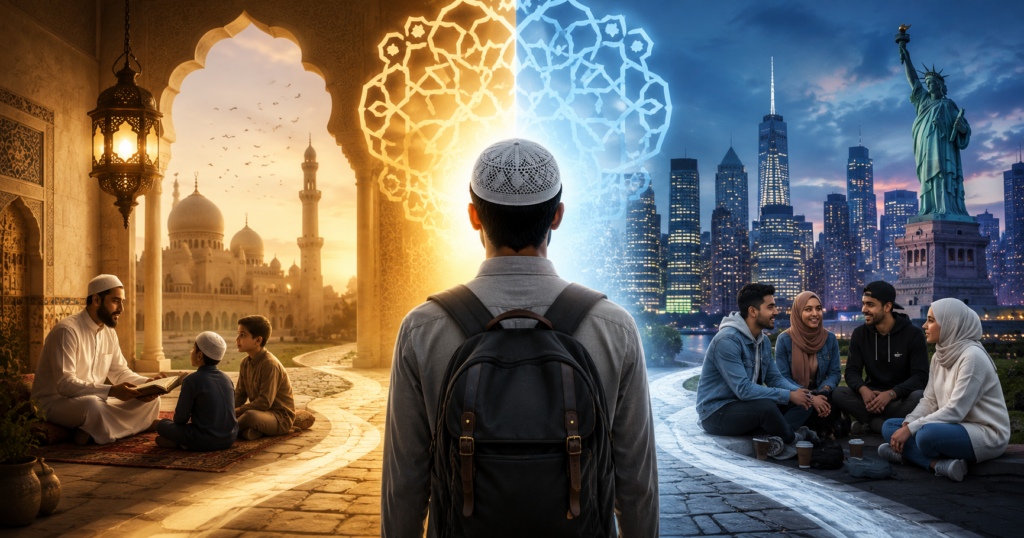
Islamic teaching and cultural norms are not the same thing. Not even close. And for Muslims growing up in America, this distinction can cause a lot of confusion.
A Muslim family from South Asia might have extremely strict views on any interaction between unmarried men and women stricter, in some cases, than Islamic teaching actually requires. A Muslim family from West Africa might approach courtship differently. A convert to Islam with no Muslim family at all faces a completely different set of challenges.
The religious standard stays consistent. The cultural expression of it varies wildly.
Some things that feel “haram” in certain communities are actually cultural preferences, not Islamic rulings. And some things that feel normalized within a Muslim community might not actually be in line with Islamic teaching either.
A few realities American Muslims regularly navigate:
- Family pressure vs. personal agency Islam gives both men and women a say in who they marry. Forced marriages are not Islamically valid.
- Cultural secrecy Some families discourage any discussion of marriage until a formal proposal, leaving young people with no guidance and no safe outlet for questions.
- Western dating pressure Schools, workplaces, and social media all normalize dating in ways that make halal courtship feel countercultural or even embarrassing.
Understanding the difference between “my family says this” and “Islam says this” is one of the most important things you can do as a Muslim navigating relationships in America.
What Are the Rules for Halal Dating?
Let’s make this practical. If you want to pursue a relationship the right way, here’s what that looks like in real terms:
- Start with clear intention. Both people should understand that the goal is marriage. This isn’t a trial run.
- Keep meetings public or supervised. Avoid being alone with someone in a private setting. Meet in public places a coffee shop, a family home, a community event.
- Involve your families early. This doesn’t mean a formal proposal on day one. It means your parents or a trusted family member knows you’re getting to know someone.
- Set communication boundaries. Long, late-night private conversations can build emotional attachment before you really know someone. Keep communication purposeful and measured.
- Avoid physical intimacy. This is non-negotiable in Islamic teaching. No physical contact before marriage.
- Take it seriously, but don’t rush. Islam doesn’t ask you to decide in a week. Take the time you need to evaluate compatibility just don’t drag it out indefinitely without a clear direction.
Can Muslims Date Online or Through Apps?
The short answer: yes, with conditions.
Halal-focused Muslim dating apps have become a real and accepted part of how many Muslims in America find a spouse. The technology isn’t the issue the way you use it is.
Using an app can be completely aligned with Islamic values if:
- Your profile is honest about who you are and what you’re looking for
- Your intention is marriage, not curiosity or casual connection
- Conversations stay appropriate no flirtatious, inappropriate, or secretive exchanges
- Your family is aware that you’re using a platform to find a spouse
- You move toward family involvement once you find someone worth pursuing seriously
Platforms designed for Muslim marriage seekers where users are explicitly looking for a spouse are generally considered acceptable. Mainstream dating apps that normalize casual relationships are a different story. The platform shapes the behavior, and the behavior is what matters.
Emotional Boundaries in Digital Communication What Nobody Talks About
This is a gap that almost no one addresses, and it’s one of the most important issues facing young Muslims today.
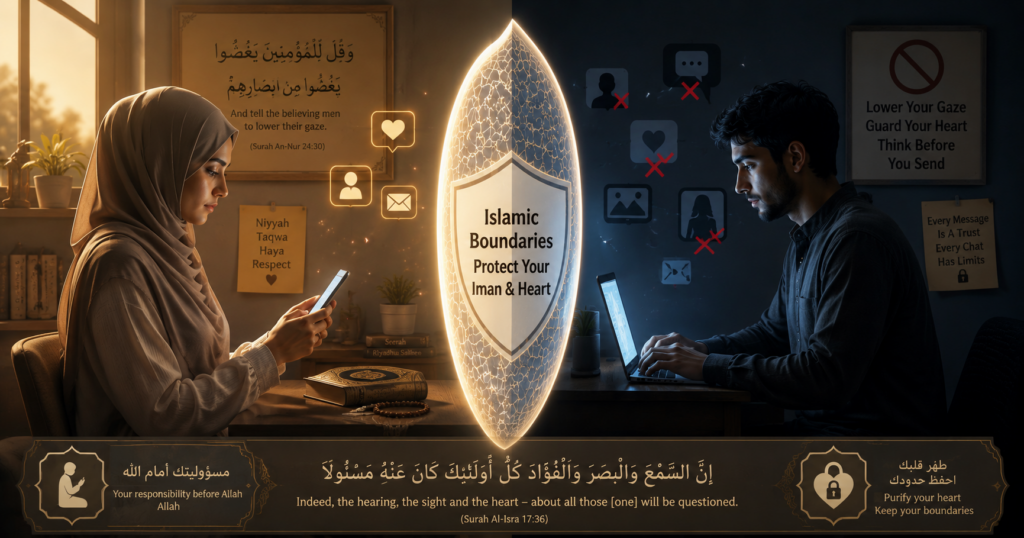
You don’t need to meet someone in person to cross a boundary. Emotional intimacy can develop fast through texting, voice notes, and late-night DMs. And emotional entanglement before you’ve established a real, accountable relationship is just as risky as physical contact maybe more so, because it’s invisible.
Here’s what healthy digital communication looks like in a halal courtship context:
- Keep conversations purposeful. Talk about values, goals, family, and faith not just daily banter that builds attachment without direction.
- Avoid late-night messaging. The hour matters. Conversations at 2 a.m. have a different emotional texture than a thoughtful exchange in the afternoon.
- Don’t share everything too fast. Deep emotional vulnerability before a real commitment is established can create false intimacy.
- Check your patterns. If you’re reaching for your phone to talk to this person before you’ve prayed, that’s a signal worth paying attention to.
- Ask yourself if your family knew about this conversation, would you be comfortable? That question cuts through a lot of confusion quickly.
Emotional boundaries aren’t about being cold or robotic. They’re about protecting your heart until someone has actually earned access to it.
How Do Muslims Find a Spouse the Right Way?
Finding a spouse as a Muslim in America is completely possible. It just requires intentionality.
Here’s a practical path that works for many Muslims:
- Make it a sincere personal intention. Before anything else, get clear within yourself. What are you looking for? What are your non-negotiables in terms of faith, values, and character?
- Tell your family you’re ready. This conversation can feel awkward, but it opens doors. Families often know people you don’t. And their involvement protects you.
- Get connected to your mosque community. Many mosques have matrimonial events, or can connect you with trusted community members who facilitate introductions.
- Consider a reputable Muslim matchmaking service. Professional matchmakers who work within Islamic values are a legitimate and increasingly popular option.
- Use a halal-aligned app if apps feel right for you. Just go in with clear boundaries and clear intentions.
- Be patient, but be active. Waiting passively for someone to appear isn’t a strategy. Making sincere effort while trusting the process is.
How to Evaluate Halal Matchmaking Options in the United States
Not every Muslim matchmaking service is worth your time or trust. Here’s what to look for:
- Marriage is the stated goal. Not networking, not “meeting people.” Marriage.
- Family involvement is encouraged. A good service will support, not sidestep, family participation.
- There are privacy protections in place. Your personal information should be handled carefully.
- The service has a real reputation. Look for community endorsement, verified reviews, or an established presence in the Muslim community.
- There’s a genuine filtering process. You shouldn’t be matched with someone whose intentions or values are completely incompatible with yours.
First-Hand Perspective What Muslim Americans Say About Navigating Love and Faith
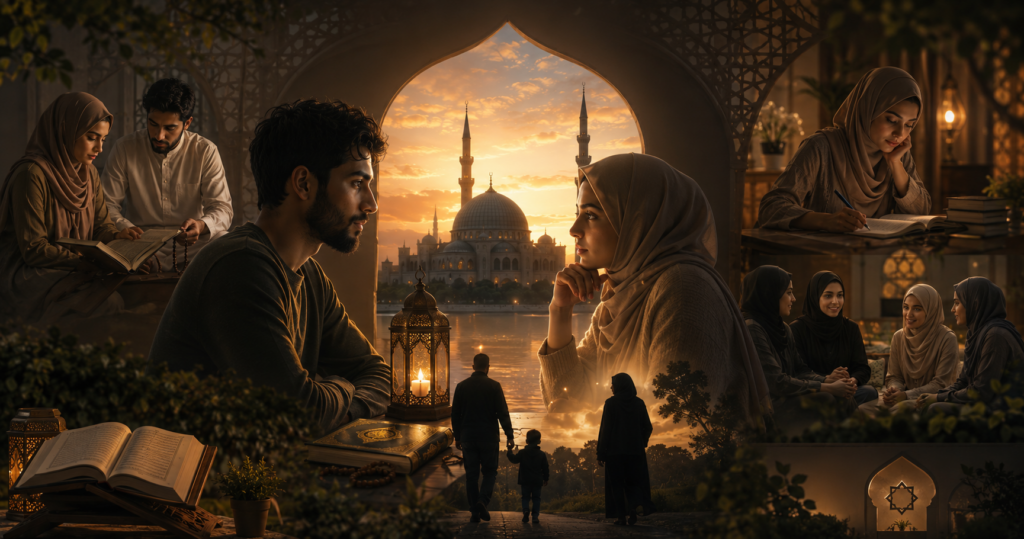
The theory of halal courtship is one thing. Living it in America is another.
Consider Layla, a 26-year-old Muslim woman raised in Chicago. She tried two mainstream dating apps before switching to a Muslim-specific platform. “The difference wasn’t just the religion box,” she says. “It was the conversation. On the other apps, no one wanted to talk about anything serious. On the Muslim app, the first message I got asked about my values. That felt right.”
Then there’s Omar, a 29-year-old convert from Georgia who had no Muslim family to involve in the process. He relied on his local mosque community and a trusted imam who helped facilitate introductions. “I didn’t have the traditional family structure, so I built one. The imam became my advisor. It felt like Islam had thought of people like me.”
These stories aren’t outliers. Across the U.S., Muslim Americans are finding creative, faith-honoring ways to meet a spouse through mosques, apps, matchmakers, community events, and trusted friends. The path looks different for everyone. But the principles hold.
Can a Muslim Date a Non-Muslim?
This is one of the most searched questions on this topic, and it deserves a clear, honest answer.
Islamic teaching distinguishes between Muslim men and Muslim women on this question:
- Muslim men are generally permitted by classical Islamic scholars to marry women from the People of the Book meaning Christians and Jewish women though many scholars strongly advise against it in practice, given the complexities of raising children and maintaining a faith-centered home.
- Muslim women are not permitted to marry non-Muslim men under traditional Islamic rulings. The reasoning relates to the role of leadership in the household and the preservation of faith within the family.
These are scholarly positions held across major Islamic traditions. Different scholars and communities may discuss nuances, but this is the broadly accepted framework.
The practical reality is that many Muslims in America face this question when they develop feelings for a non-Muslim colleague, classmate, or friend. Those feelings are understandable. But feelings and Islamic guidance don’t always point in the same direction — and part of faith is navigating that honestly.
Conclusion
Islam encourages Muslims to seek meaningful and committed relationships that lead to marriage. While casual dating is generally discouraged, getting to know a potential spouse in a respectful and halal manner is acceptable. The goal is to build a strong foundation based on faith, trust, and mutual respect while following Islamic principles.
FAQs
Can Muslims date before marriage?
Muslims cannot date casually in the Western sense before marriage. However, they can engage in intentional, marriage-focused courtship with clear boundaries, family involvement, and mutual respect. The goal must be marriage, not casual exploration.
What is halal dating and how does it work?
Halal dating more accurately called halal courtship is a structured process where two Muslims get to know each other with the intention of marriage. It involves public or supervised meetings, open family involvement, modest communication, and no physical intimacy before the wedding.
Is it a sin for a Muslim to have a boyfriend or girlfriend?
Maintaining a boyfriend-girlfriend relationship as defined in Western culture with emotional exclusivity, private meetings, and physical contact is not permitted in Islam. Islam encourages purposeful courtship toward marriage rather than undefined romantic relationships.
Can Muslim men date non-Muslim women?
Classical Islamic scholarship permits Muslim men to marry Christian or Jewish women, though many scholars advise against it given the challenges it creates for family faith and raising children. Dating non-Muslim women casually, without marriage as the goal, would not be considered acceptable.
What is the difference between halal courtship and Western-style dating?
Western-style dating is often casual, physically inclusive, and emotionally undefined. Halal courtship is marriage-focused, physically boundaried, transparent with families, and guided by shared values rather than chemistry alone.
How do Muslim parents feel about their children dating in America?
This varies enormously by family background, culture, and generation. Some Muslim parents are actively involved in their children’s search for a spouse. Others are more hands-off. What Islam asks for is family awareness and involvement — not control, but not secrecy either.