
Yes, Muslims can eat fish. In Islam, fish and many other seafood items are generally considered halal, meaning they are permissible to eat. If you are wondering, Can Muslims Eat Fish, the answer is yes. Unlike land animals, fish do not require a specific method of slaughter to be lawful for consumption. Fish is widely consumed by Muslims around the world as part of a halal diet.
What Does the Quran Say About Eating Fish?
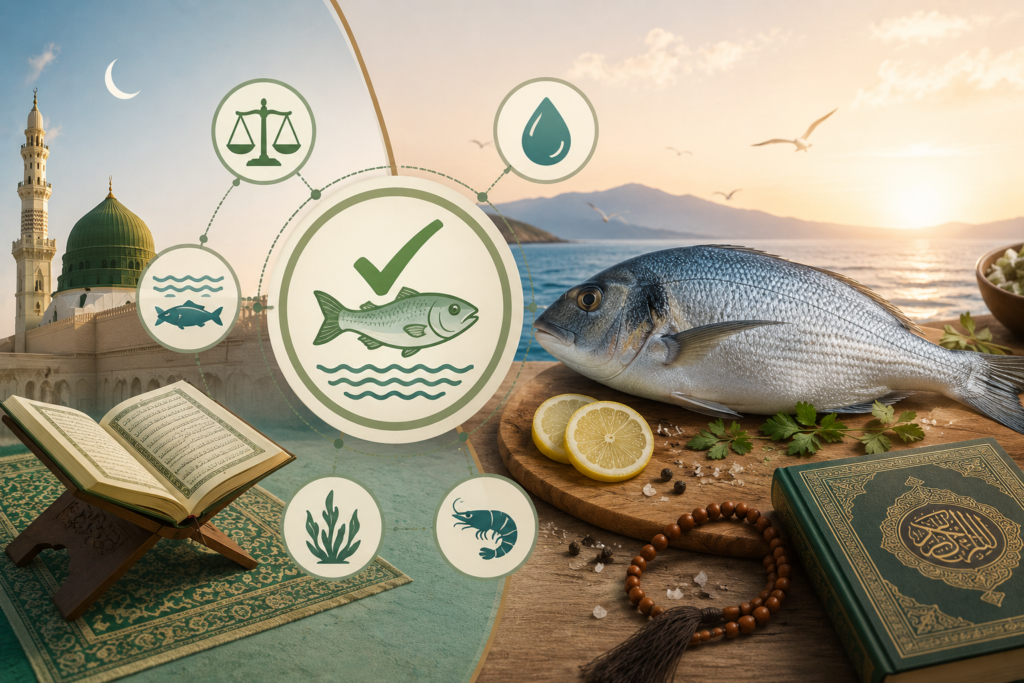
The permission to eat fish doesn’t come from tradition alone. It comes directly from the Quran.
In Surah Al-Ma’ida, verse 96, Allah says: “Lawful to you is the pursuit of water-game and its use for food for the benefit of yourselves and those who travel.“ Scholars across all major schools of thought cite this verse as the foundational basis for the permissibility of seafood.
The Prophet Muhammad (peace be upon him) made it even clearer. In an authentic hadith recorded by Imam Ahmad and Ibn Maajah, he said: “Two kinds of dead animals have been made lawful for us: fish and locusts.” This is significant. For land animals, dying without proper slaughter makes them impermissible. Fish are the exception they’re lawful even without a ritual killing.
This isn’t a loophole. It’s a deliberate distinction rooted in the nature of fish themselves, which we’ll explain next.
Why Don’t Muslims Need to Slaughter Fish?
This is one of the most overlooked questions in Islamic dietary law — and one that almost no mainstream source explains properly.
Here’s the logic, drawn from the scholarship of Ibn Al-Qayyim, one of the most respected Islamic scholars in history:
The reason land animals must be slaughtered according to Islamic rites is to remove the blood and bodily fluids that remain in the animal after death. These retained fluids are considered impure. Proper slaughter drains them. Without it, the meat is considered impure and therefore forbidden.
Fish are biologically different. They don’t have flowing blood in the same way mammals do. When a fish dies, there are no harmful fluids that remain inside to cause impurity. So the reason that makes slaughter necessary for cows, sheep, and chickens simply doesn’t exist for fish.
As Ibn Al-Qayyim explained: “That which does not have flowing blood does not become impure by death like flies, bees, and fish.”
This is why a Muslim can buy fresh fish from any grocery store halal-certified or not without any concern about how it was killed.
Understanding why a rule exists is a beautiful part of learning Islam. If you’re exploring the faith and want to understand its foundations more deeply, The Revert’s Learning Library is a great place to start.
What Fish Is Halal? A Full Species Breakdown
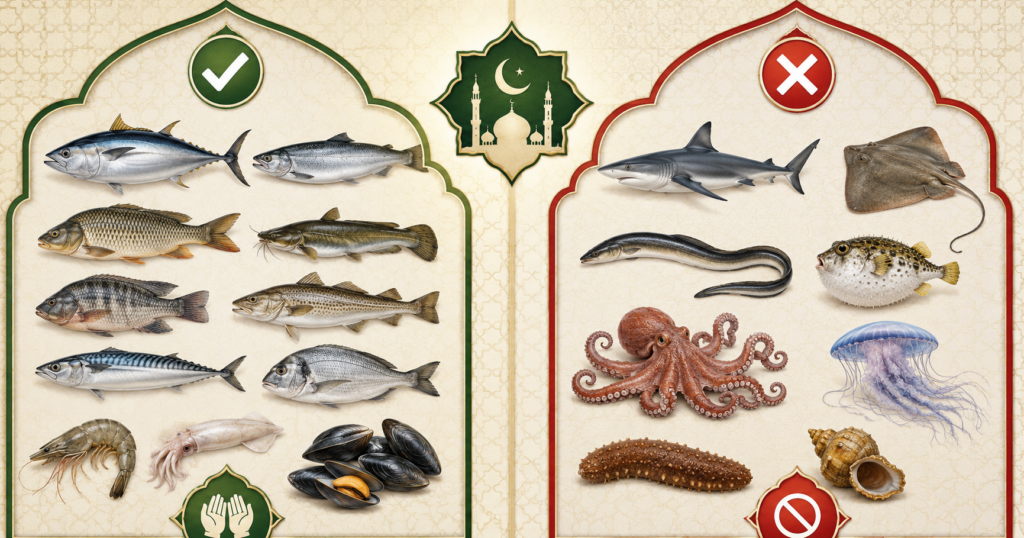
This is where most guides fail you. They tell you “fish is halal” and stop there. But what you actually want to know is: is THIS fish halal? Let’s break it down species by species.
Universally Halal Fish (All Schools Agree)
These fish are considered halal by every major school of Islamic thought. If you follow any madhab Hanafi, Shafi’i, Maliki, Hanbali, or Ja’fari these are always on the table:
- Salmon one of the most popular and widely available halal fish in the US
- Tuna fresh, canned, or seared; universally halal
- Cod a staple in American seafood; fully permissible
- Tilapia widely farmed and sold in the US; halal across all schools
- Trout rainbow or brown, always halal
- Mackerel halal without question
- Herring fully permissible
- Bass (sea bass, striped bass) halal
- Flounder and sole halal
- Sardines halal, including canned varieties without haram additives
These are scaled fish, and scales are the key criterion for the most conservative schools of thought.
Fish That Are Debated by Islamic Scholars
These species sit in a grey zone. Whether they’re halal for you depends on your school of thought:
- Catfish scaleless; halal under Shafi’i, Maliki, and Hanbali; not permitted under strict Hanafi rulings
- Eel scaleless; similar ruling to catfish; debated
- Shark scaleless; debated; most Hanafi scholars say avoid; Shafi’i and Maliki permit it
- Swordfish scales fall off easily; debated among Hanafi scholars; permitted by most others
- Monkfish scaleless; ruled similarly to catfish by most scholars
The simple rule: if the fish has scales, it’s halal for everyone. If it doesn’t, check your school of thought.
Halal Fish Rules by Islamic School of Thought
One of the most useful things you’ll find anywhere on this topic. Here’s how the five major schools rule on fish and seafood:
| School of Thought | Fish With Scales | Scaleless Fish | Shrimp | Crab / Lobster |
| Hanafi | Halal | Not permitted | Debated (makruh to haram) | Haram |
| Shafi’i | Halal | Halal | Halal | Halal |
| Maliki | Halal | Halal | Halal | Halal |
| Hanbali | Halal | Halal | Halal | Halal |
| Ja’fari (Shia) | Halal | Not permitted | Halal | Haram |
A few things stand out here. Three out of five schools permit all seafood without restriction. The Hanafi school which a large portion of South Asian and Turkish Muslims in America follow is the strictest, limiting permissible seafood to fish with visible scales. The Ja’fari school (followed by most Shia Muslims) takes a similar but slightly different position, permitting shrimp but not crab or lobster.
If you’re not sure which school your family follows, a good rule of thumb: if you have South Asian or Turkish heritage, you likely follow Hanafi rulings. If you have Arab, West African, or Southeast Asian heritage, you likely follow one of the more permissive schools.
For a broader understanding of what Muslims eat and how halal dietary rules apply beyond fish, read What Do Muslims Eat? Halal Food and Dietary Guide on The Revert.
Does Fish Need a Halal Label or Certification?
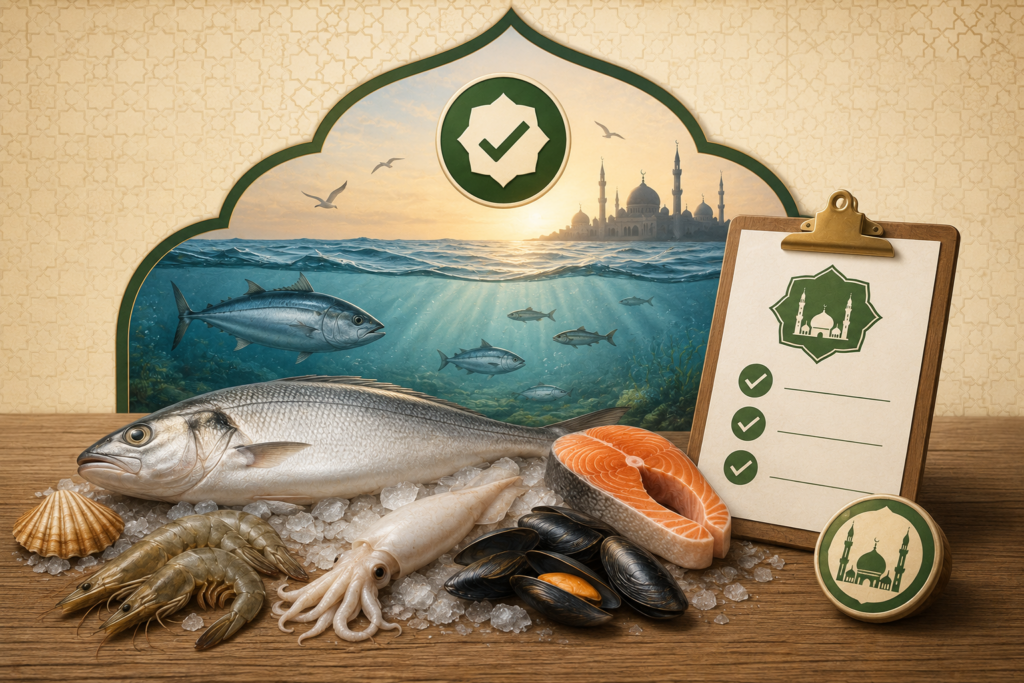
Here’s a question that trips up a lot of Muslims at the grocery store and the answer is more reassuring than you might expect.
Plain, unprocessed fish does not need halal certification. A fresh salmon fillet, a frozen bag of tilapia, or a can of tuna in water is halal as purchased, regardless of whether it carries a halal label. The fish itself is permissible, and no special slaughter or blessing is required.
Where certification starts to matter is with processed fish products:
- Fish sticks or fish burgers that contain additives, flavor enhancers, or bread coatings
- Sauces and marinades that may contain alcohol or non-halal meat derivatives
- Surimi (imitation crab) often made from fish but may contain non-halal additives
- Ready-to-eat sushi from grocery stores, which may use rice wine vinegar or mirin
For these products, checking the ingredient list or looking for halal certification is the smart move.
When Does Farmed Fish Become a Concern?
Most fish you buy in American supermarkets is farmed. Atlantic salmon, tilapia, catfish the majority comes from aquaculture operations. This raises a legitimate question among conscientious Muslims: what are these fish being fed?
Some farmed fish are raised on feed that includes animal by-products, which in some cases may include pork-derived ingredients. The scholarly consensus is that this does not make the fish haram the transformation through digestion means the fish itself remains pure. However, if this is a concern for you personally, here’s a simple checklist:
- For fresh whole fish or plain fillets no action needed; it’s halal as-is
- For farmed fish with a specific feed concern look for wild-caught alternatives or halal-certified farmed fish
- For processed farmed fish products check the label for non-halal additives in the product itself
The bottom line: farmed fish is generally considered halal by the vast majority of scholars. The feed question is a personal caution, not a mainstream ruling.
Can Muslims Eat Fish at a Non-Halal Restaurant?
You’re out to dinner with colleagues. The restaurant isn’t halal-certified. You scan the menu and spot grilled salmon. Is it okay to order?
For most Muslims yes, it is. Here’s why.
The fish itself is inherently halal. It doesn’t require a Muslim cook, a halal kitchen, or any special preparation. The core concern when eating at a non-halal restaurant isn’t the fish it’s cross-contamination with haram ingredients.
Specifically, you’d want to consider:
- Cooking surfaces was the salmon grilled on the same surface as pork or bacon? If yes, some scholars consider this a concern; others say it doesn’t affect the fish’s permissibility.
- Cooking oils and butter are they pure, or do they contain lard or other animal fats?
- Sauces and marinades does the dish come with a wine reduction, beer batter, or other alcohol-based sauce?
- Shared fryer oil if ordering fried fish, was it cooked in oil also used for non-halal items?
A practical approach: order fish that is simply grilled, baked, or steamed, and ask for sauces on the side so you can verify what’s in them. At chain restaurants like Red Lobster, Applebee’s, or most American seafood spots, a grilled fish fillet is one of the safest menu choices a Muslim can make.
Expert Insight: How American Muslims Navigate Fish in Daily Life
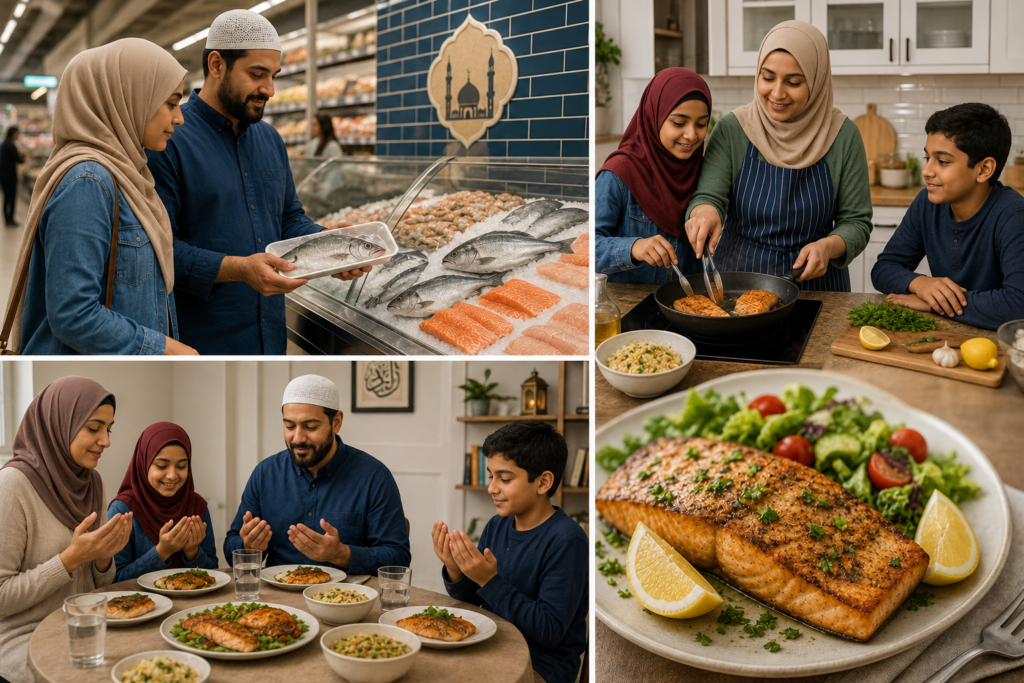
Imam Khalid Latif, Executive Director of the Islamic Center at New York University and one of America’s most prominent Muslim chaplains, has spoken about how American Muslims can approach halal eating in a non-Muslim-majority society with confidence, not anxiety.
His guidance reflects a broader scholarly position: Islam is a religion of ease, not hardship. The rules around fish were made simple on purpose. An entire category of protein — one of the most nutritious and widely available in the world is halal without ceremony, without certification, and without stress.
For everyday American Muslims, this plays out in real, practical ways:
- At the grocery store: picking up a bag of frozen tilapia at Walmart or a can of tuna at Target is completely fine. No label check needed for plain fish.
- At school or work: when the cafeteria serves fish on Fridays, most American Muslims can eat it without concern as long as it’s a clearly fish-based item without non-halal additives.
- At sushi restaurants: plain fish nigiri (salmon, tuna, yellowtail) is generally halal. The main caution is rice that may contain rice wine vinegar, which some scholars flag as a concern though many others permit it.
- At family dinners with non-Muslim hosts: a fish dish is almost always the safest thing on the table, and graciously accepting it is both practically sound and socially graceful.
The experience of millions of American Muslims confirms what Islamic law has always said: fish is one of the easiest halal foods to navigate in any environment.
Conclusion
Fish is generally accepted as halal in Islam and can be eaten by Muslims without the special slaughter requirements that apply to land animals. However, opinions on certain seafood types may vary among Islamic schools of thought. For most Muslims, fish remains a healthy and permissible food choice that aligns with Islamic dietary guidelines.
FAQs
Is all fish halal without certification?
Yes plain, unprocessed fish does not require halal certification. Fish is inherently halal in Islam, and no ritual slaughter is needed. Certification becomes relevant for processed fish products that may contain non-halal additives.
Is catfish halal in Islam?
It depends on your school of thought. Catfish is a scaleless fish, so it’s not permitted under Hanafi rulings followed by most South Asian and Turkish Muslims. However, the Shafi’i, Maliki, and Hanbali schools permit it, as they allow all sea creatures. If you follow the Hanafi school, it’s best to avoid catfish.
Can Muslims eat sushi?
Generally yes, with some caveats. Plain fish sushi (salmon, tuna, yellowtail nigiri) is halal. The main points to be aware of: some sushi rice is seasoned with rice wine vinegar or mirin (a rice wine), which some scholars consider problematic. Eel (unagi) is debated for Hanafi Muslims. When in doubt, opt for sashimi just the fish, no rice complications.
Is farmed salmon halal?
Yes. Farmed salmon is halal. While some farmed fish are fed animal-based feed that may include by-products, the scholarly consensus is that this does not affect the permissibility of the fish itself. The transformation through the fish’s biology means it remains pure and halal to eat.
Does fish need a halal label?
For a plain fish fillet, steak, or whole fish no. The fish is halal as-is. You only need to check for halal certification on processed products (fish fingers, fish burgers, imitation seafood, flavored canned fish) where non-halal additives might be present.
Is canned tuna halal?
Yes plain canned tuna in water or oil is halal. Check the ingredient list for any non-halal additives. Most major US brands (StarKist, Bumble Bee, Chicken of the Sea) produce plain tuna that is fully permissible.