
Marriage in Islam is a sacred contract and a highly valued institution that brings a man and woman together in a lawful and committed relationship. Known as Nikah, it is based on mutual respect, love, compassion, and shared responsibilities. For those wondering what is marriage in Islam, it is a union designed to foster faith, companionship, and family life according to Islamic teachings. Islam encourages marriage as a means of building strong families and maintaining a balanced society.
What Does “Marriage” Actually Mean in Islam?
Here’s what most people get wrong straight away: Islamic marriage is not primarily a romantic ceremony. It’s not just about the dress, the venue, or the flowers.
In Islam, marriage is a sacred legal contract a formal agreement between two people that carries spiritual weight, legal obligations, and lifelong consequences. The Arabic word for it is Nikah, and it comes with rights and responsibilities for both the husband and wife, enforced by Islamic law.
That doesn’t mean romance is absent. Far from it. The Quran speaks of marriage with breathtaking tenderness, describing spouses as “garments for one another” (Surah Al-Baqarah 2:187) protection, comfort, and dignity, all wrapped into one relationship.
What makes Islamic marriage unique is this combination: it’s legally structured AND spiritually intentional. You’re not just signing a contract. You’re entering a relationship that Islam considers an act of worship. If you’re new to Islam and exploring what this faith truly teaches, start your learning journey here to build a strong foundation before taking such an important step.
The Word “Nikah” What It Really Means
The word Nikah (Arabic: نكاح) literally means “to collect and bind together.” That’s telling.
Islamic marriage isn’t a loose arrangement. It’s a binding commitment legally defined, spiritually witnessed, and morally serious. Unlike the Christian concept of marriage as a sacrament (a holy mystery administered by the Church), Nikah is a civil contract which means its terms can be negotiated, its conditions can be added, and its dissolution, while serious, is legally possible.
This distinction matters a lot, especially for non-Muslims trying to understand how Islamic marriage actually works.
Is Islamic Marriage a Religious Duty or a Personal Choice?
Short answer: it’s one of the strongest recommendations in Islam just short of obligatory.
The Prophet Muhammad ﷺ said: “Marriage is my tradition. Whoever turns away from my tradition is not of me.” (Sahih al-Bukhari)
Scholars classify marriage as Sunnah Mu’akkadah a confirmed and strongly emphasized practice. It’s not technically a sin to remain unmarried, but Islam views marriage as the natural, healthy, and spiritually beneficial path for most adults. Celibacy, by contrast, is not celebrated or encouraged in Islamic tradition.
Why Does Islam Place Such High Importance on Marriage?
Because Islam sees human beings as whole people spiritual, emotional, physical, and social and marriage addresses all four dimensions at once.
The Quran outlines four core purposes of marriage:
- Spiritual protection marriage channels natural human desires into a halal, God-conscious relationship
- Emotional companionship the concept of sakina (tranquility) that Quran 30:21 describes
- Social stability marriage forms the family unit, which Islam considers the foundation of a healthy society
- Procreation and continuity bringing children into a stable, loving, structured home
Here’s what sets this apart from a purely romantic view of marriage: Islam doesn’t expect the relationship to be built on feelings alone. Feelings fluctuate. Commitment, respect, and shared values? Those are built to last.
That’s why the Prophet ﷺ advised: “Choose the one who is religious and you will prosper.” (Sahih al-Bukhari 5090) because a shared foundation in faith creates resilience that romantic chemistry alone simply can’t.
The 4 Conditions Every Valid Nikah Must Meet
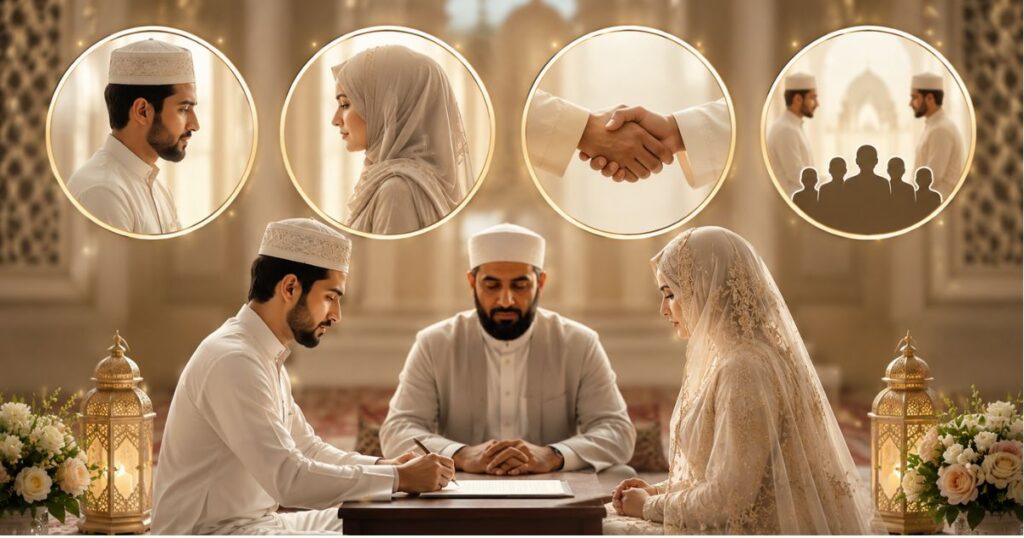
This is where Islamic marriage gets precise. A Nikah isn’t valid unless all four conditions are met no exceptions, no shortcuts.
1. Mutual Consent (Ijab and Qabul) Both the bride and groom must agree to the marriage freely and verbally. The groom makes an offer (Ijab) and the bride or her representative gives acceptance (Qabul). Islam is unambiguous here: forced marriage is not a valid marriage. The Prophet ﷺ said a previously married woman cannot be married without her explicit command, and a virgin cannot be married without her permission. Full stop.
2. The Presence of a Wali (Guardian) The bride must have a male guardian typically her father, brother, or another close male relative who represents her interests and formally agrees to the marriage on her behalf. This isn’t about ownership. It’s about protection and accountability. Note: the Hanafi school of Islamic jurisprudence allows a mature, sane woman to contract her own marriage directly but involvement of a Wali is still strongly recommended across all schools.
3. Two Muslim Witnesses At least two adult Muslim witnesses must be present when the marriage contract is concluded. Their role is to confirm the marriage is publicly known secret marriages are invalid in Islam. Marriage in Islam is a community event, not a private arrangement.
4. Mahr The Mandatory Gift to the Bride The groom must give the bride a Mahr a gift of value agreed upon before the marriage. It can be money, gold, jewelry, property, or even something non-material like teaching her the Quran. Whatever it is, it belongs entirely and exclusively to the bride. Not her family. Not her father. Her.
Missing even one of these four conditions renders the Nikah invalid under Islamic law.
What Is Mahr and Why It’s Not a “Bride Price”
Let’s kill this misconception right now.
Mahr is not a bride price. It’s not the groom “purchasing” a wife. That framing is both inaccurate and deeply offensive to what Islam actually teaches.
Mahr is a mandatory gift from the groom to the bride a Quranic right (“And give the women their Mahr as a free gift.” Surah An-Nisa 4:4) that symbolizes commitment, respect, and financial security.
It can be paid immediately (called Mu’ajjal) or deferred to a later date (Muwajjal) perhaps payable in the event of divorce or death. The bride can choose. She can even gift it back to her husband later if she wishes but the offer must be made first.
The Prophet ﷺ said: “The best marriage is the one with the least burden.” (Sunan Ibn Majah 1905) meaning Islam encourages a reasonable, not extravagant, Mahr.
Does the Bride Always Need a Wali (Guardian)?
In the majority of Sunni schools of thought Maliki, Shafi’i, and Hanbali yes, a Wali is required for the Nikah to be valid, especially for a woman marrying for the first time.
The Hanafi school takes a different position: a mature, sane woman can contract her own marriage without a Wali, though scholars still strongly recommend her guardian’s involvement.
The key principle across all schools? The Wali is there to protect her interests not override her consent.
How a Nikah Ceremony Actually Works Step by Step
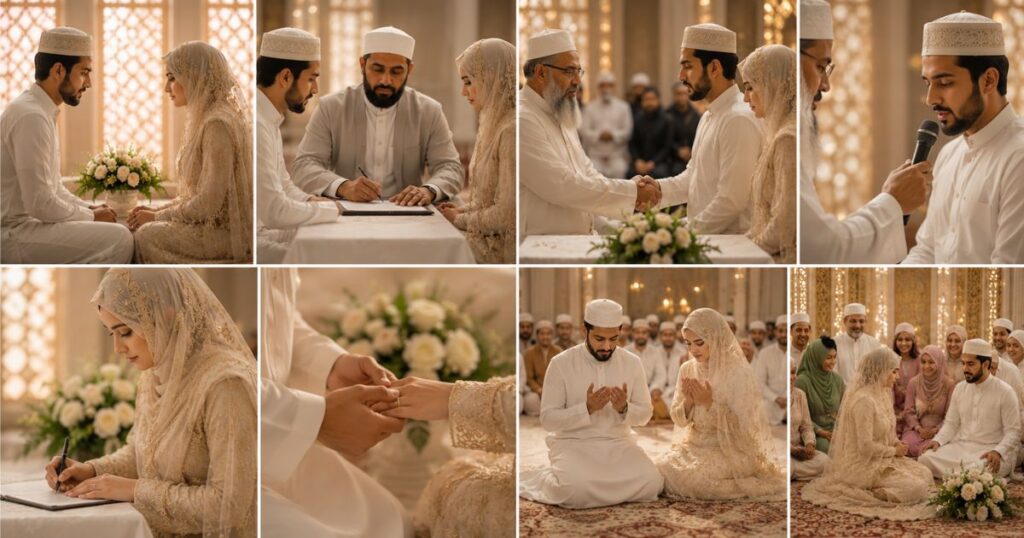
The Nikah itself can be remarkably simple. It doesn’t require a mosque, a fancy venue, or a crowd of hundreds. What it requires is the right people, the right words, and the right intention.
Here’s how a standard Nikah unfolds:
Step 1 The Opening Sermon (Khutbah al-Hajah) The imam or officiating scholar opens with a brief sermon a reminder of God-consciousness (Taqwa), the importance of marriage, and key Quranic verses. Think of it as setting the spiritual tone for everything that follows.
Step 2 Confirming Eligibility Both parties must confirm they are legally eligible to marry not in a prohibited relationship, not in an existing marriage that prevents this one, not in an Iddah (waiting period) after a previous divorce.
Step 3 The Wali Presents the Bride The bride’s guardian formally presents her for marriage and states the agreed Mahr.
Step 4 Ijab and Qabul (Offer and Acceptance) This is the heart of the Nikah. The Wali makes the formal offer “I give my daughter in marriage to you for a Mahr of…” and the groom accepts verbally and clearly in front of the witnesses. This exchange, spoken aloud, is what legally constitutes the marriage.
Step 5 Witnesses Confirm The two witnesses confirm they heard the offer and acceptance clearly. Their testimony is what makes the marriage publicly valid.
Step 6 Signing the Nikah Nama A Nikah Nama the Islamic marriage certificate is signed by both parties, the Wali, and the witnesses. This document records the names, the Mahr amount, any conditions agreed upon, and the date.
Step 7 Prayers and Celebration The imam typically leads a short prayer (dua) for the couple’s happiness. The formal Nikah is done. The celebration called the Walima traditionally follows within three days.
The entire Nikah contract can take as little as 15 minutes. The Walima is where the party happens.
Rights and Responsibilities What Islam Says About Husbands and Wives
Islamic marriage is built on mutual obligation, not one-sided authority. Both partners have defined rights and defined duties.
| Husband | Wife | |
| Financial duty | Must provide housing, food, clothing (Nafaqah) | Not financially obligated to contribute |
| Emotional duty | Must treat wife with kindness — “Live with them in kindness” (Quran 4:19) | Must maintain the home and family with care |
| Sexual rights | Has rights within marriage | Has equal rights within marriage |
| Decision-making | Has primary leadership role (Qiwamah) | Has full autonomy over personal decisions and property |
| Financial independence | Has no claim on wife’s money or property | Keeps all personal wealth independently |
| Divorce rights | Can initiate Talaq (divorce) | Can initiate Khul’ (wife-initiated divorce) |
The Quran is explicit: “And due to the wives is similar to what is expected of them, according to what is reasonable.” (Al-Baqarah 2:228) rights flow both ways.
What Are a Wife’s Rights in Islam That Many People Don’t Know About?
This surprises people but Muslim wives have extensive legal rights under Islamic law:
- Right to Mahr her exclusive property, non-negotiable
- Right to financial maintenance (Nafaqah) husband must provide housing, food, and clothing regardless of her own wealth
- Right to initiate divorce (Khul’) she can end the marriage by returning the Mahr
- Right to refuse marriage no valid Nikah exists without her consent
- Right to keep her surname Islam doesn’t require a wife to take her husband’s name
- Right to her own property and earnings her money is hers alone, even in marriage
These rights were established 1,400 years ago centuries before most Western legal systems recognized women’s property rights.
Islamic Marriage vs. Civil Marriage What’s the Difference?
| Nikah (Islamic Marriage) | Civil Marriage | |
| Legal Standing | Religious contract may not be legally recognized by US courts | Legally binding under state law |
| Spiritual Dimension | Central marriage is an act of worship | Not required |
| Contract Terms | Governed by Islamic law (Sharia/Fiqh) | Governed by state family law |
| Witnesses Required | Yes two Muslim witnesses mandatory | Varies by state |
| Dissolution Process | Talaq, Khul’, or Faskh (Islamic divorce) | Civil divorce through family court |
| Mandatory Gift | Mahr is required | No equivalent requirement |
The bottom line: A Nikah and a civil marriage serve different purposes and in the United States, you typically need both to be fully protected legally.
Is a Nikah Legally Valid in the United States?
Here’s the honest truth that neither Wikipedia nor most Islamic marriage guides tell you clearly: a Nikah alone is generally not legally recognized by US courts.
That matters. Without civil registration, you have no legal rights to inheritance, insurance, next-of-kin decisions, or divorce settlements under US family law.
Here’s what American Muslims need to do to ensure full protection:
- Obtain a civil marriage license from your county clerk before or at the time of the Nikah
- Ensure your imam is a licensed officiant in your state most states allow religious leaders to legally solemnize marriages
- Sign your Nikah Nama (Islamic marriage certificate) as a religious record
- Register the marriage with the county clerk after the ceremony
Requirements vary by state always verify the specific rules with your local county clerk’s office. The good news? In most US states, a single Nikah ceremony conducted by a licensed imam, with a civil marriage license in hand, satisfies both Islamic and legal requirements simultaneously.
What Does the Quran Say About Marriage?
Three verses stand above all others when it comes to understanding Islamic marriage:
Surah Ar-Rum (30:21) “And among His signs is that He created for you mates from among yourselves, that you may find tranquility in them, and He placed between you affection and mercy.” This is the foundation. Marriage in Islam isn’t about convenience or social status it’s about tranquility, affection, and mercy. That’s the standard Islam sets.
Surah Al-Baqarah (2:187) “They are garments for you and you are garments for them.” This verse is poetic and profound. Garments protect, cover, and comfort. Spouses are each other’s protection. This mutual framing is central to how Islam views the husband-wife relationship.
Surah An-Nisa (4:19) “Live with them in kindness.” Four words. That’s Allah’s direct command to husbands. Not authority. Not dominance. Kindness. It’s as simple and as demanding as that.
Common Misconceptions About Islamic Marriage Addressed Honestly
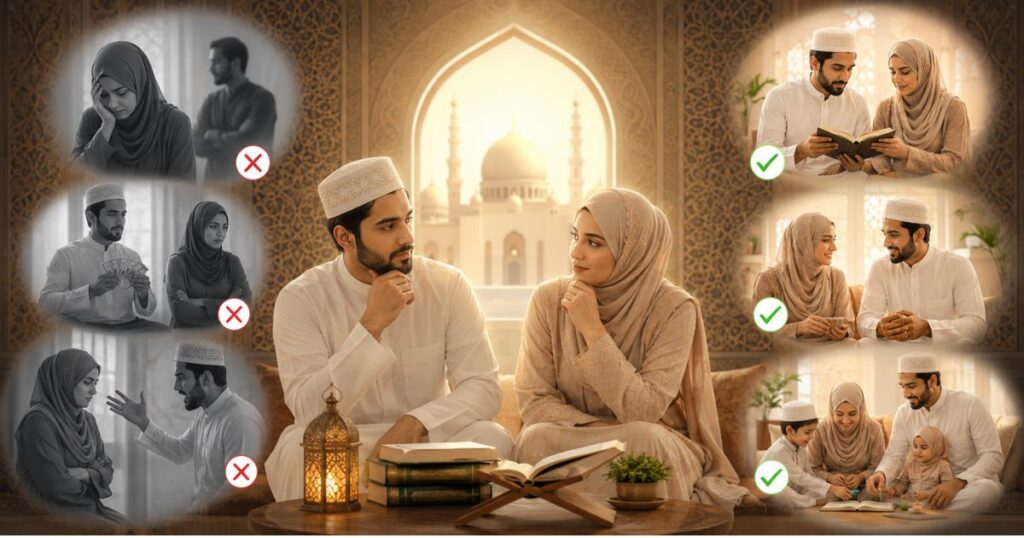
Neither of the top-ranking articles on this topic tackle this head-on. We will.
MYTH 1: Muslim women are forced into marriage. REALITY: Forced marriage is explicitly invalid in Islam. The Prophet ﷺ annulled marriages where women were coerced. Consent isn’t a cultural courtesy in Islam it’s a legal requirement.
MYTH 2: Mahr is a bride price the groom is “buying” a wife. REALITY: Mahr is a mandatory gift that belongs entirely to the bride. It’s a symbol of commitment and a financial safeguard not a transaction. Islam categorically rejects the commodification of women.
MYTH 3: Islam encourages men to have multiple wives. REALITY: The Quran permits polygyny under strict conditions primarily justice and equal treatment but scholars across all traditions note that the same verse says “if you fear you cannot be just, then marry only one.” (Surah An-Nisa 4:3). Monogamy is the norm for the vast majority of Muslims worldwide.
MYTH 4: Muslim women can’t divorce their husbands. REALITY: Muslim women have the legal right to initiate divorce through Khul’ by returning the Mahr to the husband. This right is 1,400 years old.
MYTH 5: The Nikah is just a religious ritual with no legal weight. REALITY: The Nikah is a legally binding contract under Islamic law. In many Muslim-majority countries it carries full civil legal weight. In the US, pairing it with a civil license gives it complete legal protection.
Expert Insight What Islamic Scholars and Muslim Americans Say About Marriage Today
Islamic marriage isn’t a relic of the past it’s actively evolving within the American Muslim community.
According to Yaqeen Institute for Islamic Research (2025), one of the most pressing challenges facing Muslim couples today is navigating the tension between Islamic principles and Western cultural expectations around gender roles, financial equality, and emotional intimacy. Their research highlights that shared religious commitment remains the single strongest predictor of marital satisfaction among Muslim Americans.
Pew Research Center data shows that approximately 3.45 million Muslims currently live in the United States a community that is young, educated, and increasingly navigating marriage between two worlds: Islamic tradition and American culture.
Scholar Sheikh Hamza Yusuf has described Islamic marriage as “a spiritual partnership where both individuals are on a journey toward God together” a framing that resonates far beyond religious obligation and speaks to the deep human need for purposeful companionship.
The Prophet ﷺ himself set the standard plainly: “The best of you are those who are best to their wives.” (Tirmidhi) a Hadith that has anchored Islamic marriage ethics for fourteen centuries.
Conclusion
Marriage in Islam is more than a social agreement; it is a spiritual and legal bond that promotes companionship, stability, and family values. By fulfilling the rights and responsibilities of marriage, spouses can build a harmonious relationship that aligns with Islamic teachings.
FAQs
Can a Muslim woman refuse a marriage proposal?
Absolutely and not just culturally, but legally under Islamic law. A woman’s consent is a non-negotiable condition of a valid Nikah. Any marriage contracted without her genuine, free consent is considered invalid. The Prophet ﷺ explicitly stated that a woman cannot be given in marriage without her permission.
Is polygamy legal for Muslims in the United States?
Civilly, no. Polygamy is illegal under US law in all 50 states a Muslim man cannot legally marry more than one woman in America. While Islamic law permits up to four wives under strict conditions of justice and equal treatment, American Muslims are bound by US civil law and may only have one civil spouse.
What happens if the husband doesn’t pay the Mahr?
Unpaid Mahr becomes a legal debt the husband owes the wife. She retains the right to claim it at any time including at the point of divorce. In countries where the Nikah Nama is legally recognized, courts can enforce Mahr payment. In the US, this depends on how the marriage contract is documented and whether it meets contract law requirements.
Can a Muslim woman divorce her husband?
Yes. A Muslim woman has the right to Khul’ a wife-initiated divorce in which she typically returns her Mahr to the husband in exchange for the dissolution of the marriage. She can also petition an Islamic court for Faskh (annulment) on specific grounds such as neglect, abuse, or non-maintenance.
Do Muslims date before marriage?
Not in the conventional Western sense. Islam prohibits unmarried men and women from being alone together privately. However, prospective couples are permitted to meet and get to know each other for the purpose of marriage with a third party present. Many American Muslims navigate this through family introductions, Islamic matrimonial events, or halal marriage apps.
Can a non-Muslim attend a Nikah ceremony?
Yes non-Muslims are generally welcome to attend a Nikah as guests. The ceremony is not a closed religious ritual. Many American Muslim couples actively invite non-Muslim friends and family to witness the ceremony, which serves as a beautiful introduction to Islamic values and tradition.