
Sheath (AS) also spelled Sheeth, Shees, or Seth was the third son of Prophet Adam (AS) and Hawwa (Eve), born as a “gift” after the murder of his brother Habil. Islamic tradition holds that he became Adam’s successor and a prophet in his own right, though he is not named directly in the Quran. Much of his popular story comes from hadith and later devotional narrations rather than the Quran itself.
Who Was Prophet Sheeth (AS)?
Sheeth (AS) is the son Allah gave to Adam (AS) and Hawwa after the loss of Habil (Abel). His name is generally understood to mean “gift” , a direct reference to how he came into his parents’ lives at a moment of grief.
According to a hadith narrated by Abu Dharr, Prophet Muhammad ﷺ said that Allah revealed 50 of the 104 scrolls (suhuf) to Sheeth, making him the first person in this tradition to receive revelation in written form. That detail matters, because it’s the basis for a distinction many articles on this topic skip entirely.
Is Sheeth Mentioned in the Quran or Hadith?
No, Sheeth is not named anywhere in the Quran. His status rests on hadith and scholarly commentary, not scripture and even scholars disagree on how solid that hadith evidence is.
The hadith identifying Sheeth as a recipient of scrolls appears in collections like Sahih Ibn Hibban, but some contemporary scholars have raised questions about the strength of its chain of narration. Islamic Q&A forums addressing this directly note that certain scholars consider the hadith about the 104 scrolls to be weak, while others accept it. The Quran’s silence doesn’t mean Muslims are required to deny Sheeth’s existence or role; it means the details of his story sit in a different category of certainty than, say, the story of Nuh (AS) or Musa (AS), which the Quran narrates directly.
This is worth sitting with for a moment. Islam draws a real line between what’s confirmed in the Quran, what’s supported by authentic hadith, and what circulated as popular narration often absorbed from earlier Judeo-Christian storytelling traditions, known in Islamic scholarship as Israiliyyat. Sheeth’s story leans heavily on that third category. If these foundational distinctions Quran, hadith, and later tradition are new to you, our guide on What Is Islam is a good starting point for understanding how these sources of knowledge fit together.
The Meaning of the Name Sheath
You’ll see this prophet’s name spelled several different ways across English-language sources, and it’s the same person every time.
| Spelling | Common context |
| Sheeth | Most common transliteration in devotional writing |
| Shees / Shees (AS) | Alternate transliteration, common in South Asian sources |
| Sheath (AS) | Anglicized spelling, sometimes confused with the unrelated English word “sheath” (a blade casing) |
| Seth | Used when referencing the shared Biblical/Torah figure |
The classical scholar Ibn Katheer explained the name as meaning “the gift from Allah” Adam and Hawwa named their son this because he arrived as a source of comfort after Habil’s death. Names carrying meaning like this are a running theme in Islamic tradition; if you’re exploring names with similar spiritual weight, our Muslim Boy Names guide covers meaningful Islamic names drawn from the Quran and prophetic history.
Adam’s Final Advice to Sheeth
As Adam’s (AS) death approached, tradition holds that he called Sheeth to him and passed on specific guidance:
- How to use the hours of the day and night for worship
- Naming him successor over the children of Adam
- Advice on marriage to choose a spouse carefully, since Sheeth’s descendants would include the line of future prophets
- Instructions not to share this knowledge with Qabil (Cain) and his children, who had turned away from obedience to Allah after the murder of Habil
After Adam passed away, Sheeth took on leadership of his people, ruling with justice and trying to hold the community together.
The Story of Music, Iblis, and the First Collective Sin
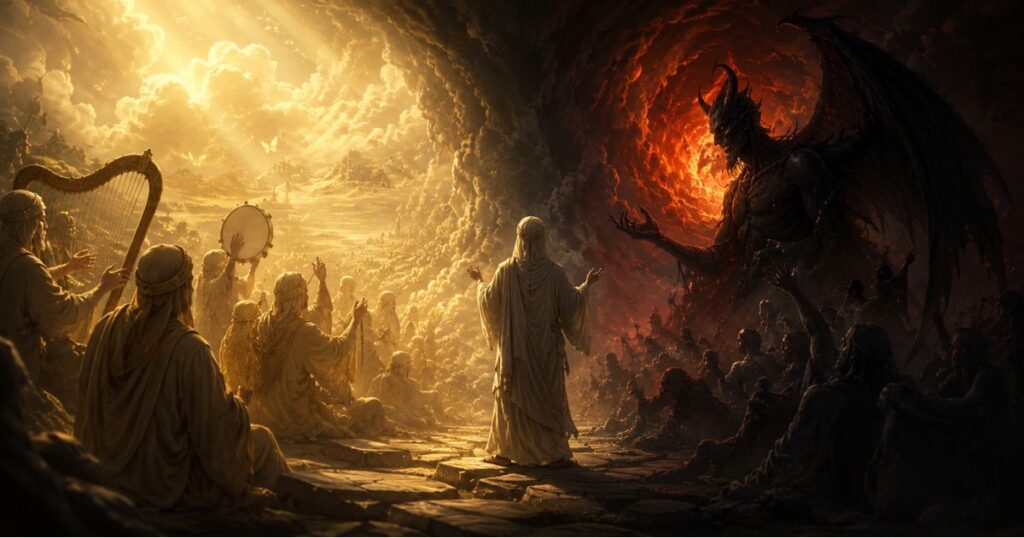
This is the part of Sheeth’s story you’ll find repeated across nearly every article on the topic and it deserves a clear caveat up front: this narrative is popular in devotional retellings, but it is not established in the Quran or in authenticated hadith. It’s part of the broader body of stories passed down about the early generations of humanity, and readers should treat it as tradition rather than confirmed religious fact.
With that caveat in place, here’s the story as it’s commonly told: Qabil and his descendants had separated from Sheeth’s community and drifted from the guidance Adam had taught. Iblis (Shaitan), looking for a way to pull more people away from worship, is said to have disguised himself as an apprentice to a blacksmith and crafted a flute, an instrument nobody had heard before.
The unfamiliar sound drew people from Sheeth’s community to investigate, and in doing so, men and women who were not married to each other began mixing socially in ways that hadn’t happened before. Some accounts describe this as the first instance of free-mixing between genders leading toward inappropriate relationships. Sheeth is said to have continued warning his people, but the pull of the gathering, and Iblis’s influence, kept drawing them in.
The two family lines are said to have remained largely separate after this Sheeth’s descendants continued in obedience, Qabil’s line drifting further from it.
Was Sheeth a Nabi or a Rasul?
A nabi (prophet) receives guidance from Allah but isn’t necessarily given a new scripture or law; a rasul (messenger) is sent with a specific message or book for a specific people. Islamic tradition places Adam as the first nabi. Sheeth, because of the hadith describing scrolls revealed to him, is sometimes described as the first rasul, the first to be given something closer to a written revelation to pass on.
This distinction is more than trivia. It’s the actual basis scholars use when debating what “prophet” means in Sheeth’s case, and it’s a detail most articles covering this topic leave out entirely.
Sheeth’s Lineage From Adam to Muhammad ﷺ
Tradition holds that Sheeth had many children; some accounts describe 32 sons and 23 daughters, though these numbers come from later narrations rather than the Quran or a verified hadith count. One named son, Anoush (also written Anosh), is described in multiple sources as continuing his father’s line.
Genealogical traditions place Prophet Muhammad ﷺ many generations down this same family line, with some sources citing roughly 80 generations between Sheeth and Muhammad ﷺ. As with the birth and death details you’ll see cited elsewhere online (such as specific years or ages), treat these as traditional estimates passed down through storytelling rather than confirmed historical or religious fact. No article covering this topic, including this one, can verify them against a primary Islamic source. To learn more about the final messenger this lineage leads to, see our full profile of Prophet Muhammad ﷺ.
Sheath (Islamic) vs. Seth (Biblical) What’s the Difference?
| Islamic Tradition (Sheeth) | Biblical/Torah Tradition (Seth) | |
| Role | Prophet/messenger; successor to Adam | Patriarch; ancestor in Genesis genealogies |
| Scriptural mention | Not named in the Quran; appears in hadith | Named directly in Genesis (Bible) |
| Core story | Succession, revelation of scrolls, the music/mixing narrative | Primarily genealogical establishing the line to Noah |
| Shared ground | Both traditions agree he was a son given to Adam and Eve/Hawwa after Abel/Habil’s death | Same |
The overlap here is genuinely interesting from a comparative-religion standpoint: both traditions independently preserve the idea of a “replacement son” who becomes central to the surviving human lineage even though the Quran itself doesn’t name him.
Why the Sourcing Matters
Most of what circulates online about Sheeth blends three different levels of certainty into one seamless story: confirmed hadith, weaker or disputed hadith, and popular narration with roots in earlier religious storytelling traditions. That’s not a criticism of the storytellers it’s just how oral and written tradition tends to work over centuries.
If you’re reading or sharing this story, it’s worth holding the pieces separately: Sheeth’s existence as Adam’s son and his role as a righteous successor is broadly accepted; the flute-and-mixing narrative and specific birth/death dates are traditional additions, not Quranic or firmly authenticated hadith material. That distinction protects the integrity of the story instead of flattening it into something it isn’t. If stories like Sheeth’s have sparked your curiosity about Islam more broadly, our Start Your Journey guide is a gentle, step-by-step place to begin exploring further.
Conclusion:
Prophet Sheeth (AS), son of Adam (AS) and Hawwa (AS), was born as a mercy from Allah following the grief of Habil’s murder his name meaning “gift of God.” He was blessed with prophethood and entrusted by his father with sacred knowledge and guidance for humanity after Adam’s passing.
Sheeth (AS) carried forward the message of Tawheed, teaching his people patience, righteousness, and devotion to Allah. His life stands as a reminder that after every hardship, Allah grants relief and blessing to those who remain faithful. As one of the earliest prophets, he played a vital role in preserving true faith for future generations.
FAQs
Was Sheeth (Seth) a prophet in Islam?
Islamic tradition generally regards Sheeth as a prophet and Adam’s successor, based on hadith rather than the Quran. Some scholars accept the hadith describing him as a recipient of revealed scrolls; others question its chain of narration.
Is Prophet Sheeth mentioned in the Quran?
No. Sheeth does not appear by name anywhere in the Quran. References to him come from hadith literature and later Islamic scholarship and storytelling.
What does the name Sheeth or Sheath mean?
The name is traditionally understood to mean “gift” or “the gift from Allah,” reflecting how he came to Adam and Hawwa after the death of their son Habil.
Is Sheeth the same person as Seth in the Bible?
Yes, both refer to the same figure the son gave to Adam and Eve/Hawwa after Abel/Habil’s death. The Islamic and Biblical traditions diverge on the details of his story but agree on this basic identity and placement in the family line.
How is Sheeth connected to Prophet Muhammad’s ﷺ lineage?
Genealogical traditions trace Muhammad’s ﷺ ancestry back through many generations to Sheeth, though the specific generation count and dates come from traditional sources rather than the Quran.
Did Sheeth build the Ka’bah?
Some narrations attribute an early version of the Ka’bah’s construction to Sheeth, while others attribute it to Adam. The Quran itself doesn’t address this directly, so it remains a point where different traditions vary.