
Eid Salah is a special prayer performed by Muslims on Eid ul-Fitr and Eid ul-Adha. It is usually offered in congregation at mosques or open prayer grounds after sunrise. The prayer includes two rakats with extra takbeers and is followed by a khutbah (sermon). Learning the correct method helps Muslims perform this important act of worship with confidence and devotion.
What Is Eid Salah and Why Does It Matter?
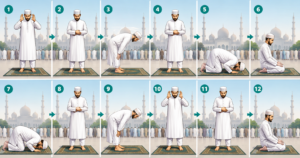
Eid al-Salah isn’t just another prayer on the calendar. It’s a communal declaration millions of Muslims, all facing the same direction, saying the same words, on the same morning. There’s nothing quite like it.
The Prophet Muhammad ﷺ placed enormous importance on this prayer. A narration recorded in Sahih al-Bukhari reports that Abu Sa’id al-Khudri (may Allah be pleased with him) said: “The Prophet ﷺ used to go out on the day of Eid al-Fitr and Eid al-Adha to the prayer ground.” He didn’t pray it at home. He didn’t send someone in his place. He went every single time.
That consistency tells you everything you need to know about how seriously this prayer is taken in Islamic tradition.
Eid al-Fitr vs Eid al-Adha: Are They Prayed Differently?
The short answer: the prayer itself is the same. Two rakats, the same structure, the same extra takbeers. But the context and a few sunnah acts differ significantly.
| When | 1st Shawwal (after Ramadan) | 10th Dhul Hijjah (Hajj season) |
| Eat before prayer? | Yes — eat dates (sunnah) | No fast until after prayer |
| Special charity | Zakat al-Fitr due before prayer | Qurbani (sacrifice) after prayer |
| Takbeer timing | Said on way to mosque on Eid morning | Said from Fajr of 9th Dhul Hijjah through 13th |
| Prayer structure | Identical two rakats | Identical two rakats |
Both prayers are equally important, equally sacred. The structure of how to pray Eid Salah is the same for both, so everything in this guide applies to both Eids.
Is Eid Prayer Obligatory? What the Four Schools of Thought Say
This is one of the most searched questions attached to this topic and the answer depends on which school of Islamic jurisprudence (madhab) you follow.
Here’s a clear breakdown:
| Hanafi | Strongly obligatory | Wajib | Imam Abu Hanifa |
| Shafi’i | Confirmed sunnah | Sunnah Mu’akkadah | Imam al-Shafi’i |
| Maliki | Confirmed sunnah | Sunnah Mu’akkadah | Imam Malik |
| Hanbali | Communal obligation | Fard Kifayah | Imam Ahmad ibn Hanbal |
What this means for you practically: If you follow the Hanafi school the most widely followed madhab among Muslims in the USA, particularly South Asian communities missing Eid prayer without a valid excuse is considered sinful. For Shafi’i, Maliki, and many Hanbali followers, it is a very strongly emphasized act that the Prophet ﷺ never abandoned.
Regardless of which madhab you follow, the consensus is clear: Eid Salah is one of the most important prayers of the year. Don’t miss it.
What Time Is Eid Prayer in the USA? (And How to Find Your Local Schedule)
Eid prayer has a specific time window. You can’t pray at Fajr time. You can’t pray at Dhuhr. The valid window opens approximately 15–20 minutes after sunrise and closes at solar midday (zawaal) roughly between 7:00 AM and 12:00 PM.
Most mosques in the USA hold Eid prayer between 8:00 AM and 10:00 AM, with multiple time slots to accommodate large congregations.
How ISNA Moon Sighting Affects Your Eid Date in the USA
Here’s something most guides completely ignore and it matters enormously for American Muslims.
In the USA, Eid dates are not universally agreed upon. The Islamic Society of North America (ISNA) is the primary moon-sighting authority, followed by many mosques across the country. They use an astronomical calculation method combined with actual moon sighting to announce Eid.
However, some local communities follow Saudi Arabia’s announcement. Others follow their own regional moon-sighting committees. This means your Eid might fall on a different day than your neighbor’s, depending on which authority your mosque follows.
The fix: Always check with your specific mosque. Don’t rely on social media rumors. ISNA publishes its announcement at isna.net that’s your most reliable starting point.
How to Find Your Local Eid Prayer Time in 3 Steps
- Visit your local mosque’s website most publish Eid prayer schedules 1–2 weeks in advance.
- Check isna.net for the official Eid date announcement for your region.
- Use the Islamic Finder app enter your zip code, and it pulls up verified local mosque timings.
What to Do Before Eid Prayer The Morning Sunnah Checklist
The morning of Eid is supposed to feel different. And it will if you follow the prophetic tradition of preparing properly. Here’s exactly what to do, with Eid-specific differences clearly noted.
| Perform Ghusl (ritual bath) | Yes before prayer | Yes before prayer |
| Wear your best clothes | Yes | Yes |
| Apply perfume | Yes (for men) | Yes (for men) |
| Eat before leaving | Yes eat an odd number of dates | No recommended to fast until after prayer and sacrifice |
| Use different routes to and from mosque | Yes sunnah | Yes sunnah |
| Recite the Eid Takbeer on the way | Yes | Yes from 9th Dhul Hijjah through 13th |
The Eid Takbeer You Recite on the Way to the Mosque
This is the declaration you should quietly say on your walk or drive to the mosque. Most people don’t know it. Here it is in full:
Arabic: اللَّهُ أَكْبَرُ، اللَّهُ أَكْبَرُ، لَا إِلَهَ إِلَّا اللَّهُ، وَاللَّهُ أَكْبَرُ، اللَّهُ أَكْبَرُ، وَلِلَّهِ الْحَمْدُ
Transliteration: Allahu Akbar, Allahu Akbar, La ilaha ill-Allah, Wallahu Akbar, Allahu Akbar, Wa lillahil hamd
Meaning: “Allah is the Greatest, Allah is the Greatest. There is no god but Allah. Allah is the Greatest, Allah is the Greatest. And to Allah belongs all praise.”
Say this softly, it’s not announced loudly in public like the adhan. It’s a personal, heartfelt declaration on your way to meet your community.
How to Pray Eid Salah Step-by-Step (With All Four Madhab Methods)
This is the section you came for. Let’s make it crystal clear.
The Structure of Eid Salah at a Glance
| Extra takbeers | 3 additional (Hanafi) or 7 (Shafi’i, Maliki, Hanbali) | 3 additional (Hanafi) or 5 (Shafi’i, Maliki, Hanbali) |
| Surah al-Fatiha | Yes, after extra takbeers | Yes, after extra takbeers |
| Additional Surah | Yes (al-A’la recommended) | Yes (al-Ghashiyah recommended) |
| Ruku and Sujood | Normal | Normal |
Step-by-Step: First Rakat
Step 1 Make your intention (niyyah) in your heart, intend to pray two rakats of Eid Salah. You don’t need to say this out loud the intention is in your heart. Something like: “I intend to pray two rakats of Eid Salah, following the imam, for the sake of Allah.”
Step 2 Opening Takbeer The imam says “Allahu Akbar” aloud. You raise your hands to your earlobes (or shoulders) and say it with him. This is the Takbeeratul Ihram — the opening declaration that officially begins the prayer.
Step 3 Opening supplication (du’a al-istiftah) Silently recite the opening supplication (Subhanakallahumma wa bihamdika…). The imam will do this too, silently.
Step 4 The additional takbeers (which make the Eid prayer unique). The imam says additional takbeers. Follow him each time raise your hands and say “Allahu Akbar.”
- Hanafi: 3 additional takbeers, with a brief pause between each
- Shafi’i, Maliki, Hanbali: 7 additional takbeers
Between each takbeer, you may say quietly: Subhanallah, Walhamdulillah, Wala ilaha illallah, Wallahu Akbar (Hanafi) or remain silent for a brief moment (Shafi’i).
Step 5 Recitation of Surah al-Fatiha. The imam recites Surah al-Fatiha aloud. Listen attentively. Say “Ameen” at the end.
Step 6 Recitation of an additional Surah. The imam recites another Surah. The Prophet ﷺ often recited Surah al-A’la (Surah 87) in the first rakat. Listen quietly.
Step 7 Ruku, Sujood, and rise to standing. Perform ruku (bowing), then two sujood (prostrations), exactly as in any regular prayer. Rise to standing for the second rakat.
Step-by-Step: Second Rakat
Step 8 Recitation of Surah al-Fatiha. The second rakat begins immediately with Surah al-Fatiha before the additional takbeers this time (opposite order from the first rakat).
Step 9 Recitation of an additional Surah. The imam recites another Surah. The Prophet ﷺ often recited Surah al-Ghashiyah (Surah 88) in the second rakat.
Step 10 The additional takbeers in the second rakat. After the additional surah, the imam says the extra takbeers before going into ruku.
- Hanafi: 3 additional takbeers before ruku
- Shafi’i, Maliki, Hanbali: 5 additional takbeers before ruku
Step 11 Ruku Follow the imam into ruku. Subdue your body, say Subhana Rabbiyal Adheem three times.
Step 12 Rise and stand. Rise from ruku, say Sami’Allahu liman Hamidah with the imam. Stand briefly.
Step 13 Two sujood Perform two prostrations as normal, with the sitting position between them.
Step 14 Final tashahhud and tasleem. Sit for the final tashahhud, recite At-Tahiyyat, then follow the imam in closing the prayer with tasleem turning the head right: Assalamu Alaikum Wa Rahmatullah, then left.
You have completed Eid Salah.
How the Takbeer Count Differs by Madhab
This single point causes more confusion than anything else in the Eid prayer. Here it is, clearly laid out:
| Hanafi | 3 (after opening du’a) | 3 (before ruku) | After additional surah |
| Shafi’i | 7 (before Fatiha) | 5 (before ruku) | After additional surah |
| Maliki | 6 (before Fatiha) | 6 (before ruku) | After additional surah |
| Hanbali | 6 (before Fatiha) | 5 (before ruku) | After additional surah |
If you don’t know your madhab, follow your local imam. If they say three extra takbeers, you’re in a Hanafi mosque. If they say more, adjust accordingly. The prayer is valid either way don’t stress.
How to Pray Eid Salah at Home (When You Can’t Reach the Mosque)
Life happens. Maybe you’re unwell. Maybe the weather is brutal. Maybe you’re a new Muslim and too nervous to attend a large congregation yet. Can you still pray?
Can You Pray Eid Alone?
Hanafi position: Eid prayer requires a congregation praying alone at home is generally not considered valid in the Hanafi school.
Shafi’i, Maliki, and Hanbali position: It is permitted to pray individually at home, though the congregation is strongly preferred.
If you’re unsure pray. The intention to worship Allah is never wasted.
Praying With Your Family at Home
If you have even one other person at home, you can form a congregation and lead the prayer together. Here’s how:
- Designate one adult as the imam (anyone doesn’t have to be male if it’s an all-female household)
- Stand in rows the imam at the front, others behind
- Follow the full step-by-step structure above all the extra takbeers, both rakats
- One person delivers a brief reminder after the prayer (a few words of gratitude are sufficient a formal khutbah is not required at home)
- Make du’a together this is one of the most blessed moments of Eid.
Is the Khutbah Required at Home?
No. The sermon (khutbah) is a sunnah that accompanies congregational Eid prayer at the mosque. It is not required when praying at home. A few sincere words of remembrance are more than enough.
Eid Prayer for Women: Rulings, Attendance, and Praying at Home
Let’s be direct: the prophetic guidance on this is unambiguous.
Umm Atiyyah (may Allah be pleased with her) narrated: “The Messenger of Allah ﷺ commanded us to bring out the unmarried women, the menstruating women, and the secluded women to the Eid prayer ground, so that they could witness the good and the call of the Muslims.” (Bukhari and Muslim)
The Prophet ﷺ specifically included women who were menstruating — meaning they couldn’t actually pray. He still wanted them present, to feel the communal joy of Eid and hear the khutbah. That’s how important attendance was considered.
When Is It Valid for Women to Pray at Home?
There are valid reasons a woman may pray Eid Salah at home:
- Health or illness that prevents travel
- Caring for young children who cannot be brought to the mosque
- Safety concerns in certain environments
- Menstruation — in this case, she attends if possible, but does not pray; she may pray at home if she cannot attend
- No accessible mosque within a reasonable distance
If none of these apply, the sunnah is clear: attend the prayer, bring your children, and be part of the community.
Why Is There No Adhan or Iqamah for Eid Prayer?
If you’ve attended Eid prayer, you’ve probably noticed something strange: it starts without the usual call to prayer. No adhan. No iqamah. Just the prayer begins.
This is intentional, and it goes back directly to the Prophet ﷺ. Ibn Abbas and Jabir ibn Abdullah (may Allah be pleased with them both) both narrated that no adhan was called for Eid prayer during the time of the Prophet ﷺ, Abu Bakr, or Umar. It was never part of the practice.
The reason scholars give: the adhan was established to call people from far away to prayer at specific daily times. Eid prayer is a community event everyone already knows about and its time is widely known. The gathering itself is the announcement.
So if you’re sitting in a mosque and the imam starts without an adhan that’s exactly right. You haven’t missed anything.
Expert Insight: 5 Common Mistakes Muslims Make in Eid Prayer (And How to Avoid Them)
After years of leading and observing Eid congregations, Islamic scholars and imams consistently flag these five mistakes. You’re now officially warned.
Mistake 1: Losing count of the extra takbeers.
It happens to everyone at some point. You’re nervous, you’re excited and suddenly you can’t remember if that was takbeer two or three. The fix: Follow the imam to the letter. Don’t try to count independently. Your job is to say “Allahu Akbar” when the imam says it. Let him lead, you follow.
Mistake 2: Raising hands too late or not at all during takbeers.
Some people say the takbeers but forget to raise their hands. This is a sunnah act not raising them doesn’t invalidate the prayer, but it means missing out on the full prophetic practice. The fix: Each time you hear “Allahu Akbar” in the additional takbeer sequence, raise your hands to your earlobes as you say it.
Mistake 3: Talking or moving during the khutbah.
The Eid khutbah is not optional entertainment. Listening to it is a sunnah and in the Hanafi school, talking during it is considered disrespectful and sinful. The fix: Sit down, settle in, and listen from the beginning. This is part of your Eid prayer experience.
Mistake 4: Leaving immediately after the prayer, before the khutbah.
People do this all the time. The prayer ends; they stand, exchange greetings, and head home missing the khutbah entirely. The fix: Stay. The khutbah takes 10–15 minutes. It’s part of the Eid experience and contains reminders specifically chosen for this day.
Mistake 5: Missing Zakat al-Fitr (Eid al-Fitr-specific).
Zakat al-Fitr must be paid before the Eid prayer—not after. Many people delay it until later in the day, not realizing the window has technically closed. The fix: Pay your Zakat al-Fitr the night before Eid or the morning of Eid. The recommended amount is approximately $10–15 per household member in the USA, donated to a qualifying local charity or Islamic organization.
What Happens After Eid Prayer? The Khutbah, Greetings, and Your Eid Day
The khutbah comes after the prayer and this surprises first-timers, because in regular Friday (Jumu’ah) prayer, the khutbah comes first. Eid is the other way around.
The imam delivers two short sermons covering topics relevant to the occasion of gratitude at Eid al-Fitr, the lessons of sacrifice and Hajj at Eid al-Adha. Listen attentively. This is a sunnah, not just a cultural addition.
After the khutbah, exchange greetings with those around you. The most authentic Eid greeting narrated from the companions of the Prophet ﷺ is: “Taqabbal Allahu minna wa minkum” “May Allah accept from you and from us.”
The rest of your Eid day carries its own sunnah acts:
- Visit family and strengthen ties Eid is specifically a day for community and connection.
- Eat and celebrate there is no fasting on Eid days; in fact, fasting on Eid is forbidden.
- Take a different route home a small sunnah with a big spiritual symbolism: spreading the blessing across different paths.
Conclusion
Praying Eid Salah is a beautiful way to celebrate Eid and thank Allah for His blessings. By following the step-by-step method, including the extra takbeers and listening to the khutbah, Muslims can complete the prayer correctly and spiritually. Eid Salah also strengthens unity, faith, and happiness within the Muslim community.
FAQs
How many rakats is Eid Salah?
Eid Salah consists of two rakats (units of prayer). What makes it distinct from regular two-rakat prayers is the addition of extra takbeers, additional declarations of “Allahu Akbar” in both rakats, the number of which varies slightly by madhab.
Can I pray Eid Salah if I missed the congregation?
Yes, though the rulings differ slightly. Shafi’i, Maliki, and Hanbali scholars permit praying individually at home. Hanafi scholars generally require a congregation, so even two people at home can form one. If in doubt, pray the act of worship is never wasted.
Do I need wudu for Eid prayer?
Yes, absolutely. Wudu (ritual purification) is a prerequisite for all formal prayers in Islam, including Eid Salah. Additionally, it is a sunnah to perform a full ghusl (ritual bath) on the morning of Eid before heading to prayer.
What time does Eid prayer start in the USA?
The valid window is approximately 15–20 minutes after sunrise until solar midday roughly 7:00 AM to 12:00 PM, depending on your location and time of year. Most US mosques schedule Eid prayer between 8:00 AM and 10:00 AM. Always confirm with your local mosque or check isna.net for your region’s timing.
Is Eid prayer the same for Eid al-Fitr and Eid al-Adha?
The prayer structure is identical two rakats with the same extra takbeers. What differs are the sunnah acts surrounding the prayer: for Eid al-Fitr, you eat before the prayer and pay Zakat al-Fitr; for Eid al-Adha, you fast until after the prayer and perform Qurbani (sacrifice) afterward