
What do Muslims eat? Muslims eat foods that are considered halal, meaning permissible according to Islamic dietary laws. Halal foods include properly prepared meat, fruits, vegetables, grains, dairy products, and seafood. Muslims avoid pork, alcohol, and foods prepared with non-halal ingredients. Many traditional Muslim meals include rice, chicken, lamb, beef, fresh vegetables, and flavorful spices commonly used in Middle Eastern, Asian, and African cuisines.
Halal and Haram: The Foundation of the Muslim Diet
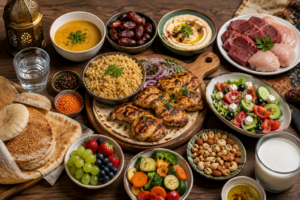
If you’ve ever wondered what Muslims eat, the answer starts with two short words: halal and haram.
Halal is Arabic for “permissible.” Haram means “forbidden.” These aren’t just food labels they’re a way of life. Every meal a Muslim eats is shaped by these two principles, drawn straight from the Quran (Islam’s holy book) and the Hadith (the teachings of Prophet Muhammad ﷺ).
The Quran puts it beautifully: “Eat of what is lawful and good on the earth” (Quran 2:168). That word “good” matters. In Arabic, it’s tayyib meaning pure, clean, and wholesome. So the Muslim diet isn’t just about avoiding certain foods. It’s about choosing food that’s both permitted and pure.
Think of it like this: halal is the green light. Haram is the red light. Tayyib is the bonus food that’s not only allowed but actually good for your body and soul.
With that foundation, let’s explore each category of food in more detail.
What Foods Can Muslims Eat?
Most foods worldwide are halal. That surprises people. The list of forbidden items is actually pretty short. Here’s what’s freely on the table for Muslims everywhere.
Halal Meats and Poultry
Muslims eat all the meats most people enjoy beef, lamb, goat, chicken, turkey, duck, rabbit, and venison. The catch? The animal has to be slaughtered the right way (we’ll cover this in detail soon). This process is called dhabiha or zabihah.
Properly slaughtered, blessed, and drained of blood that’s the standard.
Halal Seafood
Good news for seafood lovers. All fish with scales salmon, tuna, cod, tilapia, sardines are considered halal, no special slaughter needed.
Shellfish like shrimp, crab, and lobster? Most Muslims eat them freely, though a few schools of Islamic thought debate this. If you’re hosting a Muslim guest, it’s polite to ask.
Fruits, Vegetables, Grains, and Legumes
Here’s where Islam gets easy: all fruits and vegetables are halal. Apples, mangoes, spinach, sweet potatoes eat them all.
The same goes for:
- Grains: rice, wheat, oats, barley, corn
- Legumes: chickpeas, lentils, kidney beans, black beans
- Nuts and seeds: almonds, walnuts, cashews, sunflower seeds
These foods are naturally pure and need no special preparation.
Dairy Products
Milk, yogurt, butter, cream, and most cheeses are halal as long as the rennet (the enzyme used to make cheese) is plant-based or microbial, not from a non-halal animal. Halal-certified dairy products take the guesswork out.
Plant Oils, Herbs, and Spices
Olive oil, sunflower oil, coconut oil, avocado oil all halal. Same with every herb and spice you can think of, from cumin to cinnamon. The only exception? Flavor extracts that contain alcohol, like some vanilla extracts.
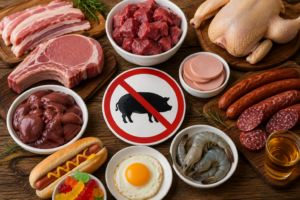
What Foods Can Muslims Not Eat?
This list is shorter, but important. These are the foods every observant Muslim avoids no matter the country, culture, or cuisine.
Pork and Pork By-Products
Pork is the #1 forbidden food in Islam. This includes everything pig-related: bacon, ham, sausage, pepperoni, lard, and even pork-derived gelatin.
The Quran mentions this rule four separate times, making it one of the clearest dietary commands in Islam.
Alcohol and Intoxicants
All forms of alcohol are haram beer, wine, whiskey, you name it. This rule extends to cooking with alcohol (like wine reductions), alcoholic vanilla extracts, and even some mouthwashes.
The reasoning? Islam forbids anything that clouds the mind. This rule is connected to the broader Islamic value of keeping the body and mind pure something new Muslims learn about alongside performing Wudu (purification) before prayer.
Improperly Slaughtered Meat
If an animal isn’t slaughtered following Islamic rules, the meat becomes haram — even if it’s normally a halal animal. This includes:
- Animals are killed by strangulation, electrocution, or blunt force.
- Animals that died on their own
- Animals are slaughtered without invoking God’s name.
That’s why “halal-certified” labels matter so much at US grocery stores.
Blood and Carnivorous Animals
Blood is haram, which is why halal meat is fully drained during slaughter. Also forbidden: any predator that hunts with claws or fangs lions, tigers, hawks, eagles, dogs, and cats.
Hidden Haram Ingredients to Watch For
Here’s where things get tricky. Many everyday products contain ingredients that quietly slip past most shoppers. Watch out for:
- Gelatin (often pork-derived found in gummy candies, marshmallows, some yogurts)
- Animal rennet (in some cheeses)
- Carmine / cochineal (red food coloring made from insects)
- L-cysteine (a dough conditioner sometimes from feathers or hair)
- Brewer’s yeast (sometimes alcohol-derived)
- Mono- and diglycerides (can be from animal fat)
Reading labels becomes second nature for most Muslims. Halal certification logos make life easier.
Halal vs Haram: Quick Comparison Table
Sometimes a table beats a thousand words. Here’s the halal vs haram breakdown at a glance:
| Meat | Beef, lamb, goat, chicken (slaughtered properly) | Pork, improperly slaughtered meat, dead animals |
| Seafood | All scaled fish, most shellfish | Some shellfish (debated in certain schools) |
| Beverages | Water, juice, tea, coffee, milk | Beer, wine, spirits, anything alcoholic |
| Dairy | Halal-certified cheese, milk, yogurt | Cheese with animal rennet from haram sources |
| Additives | Plant gelatin, microbial rennet | Pork gelatin, alcohol-based extracts |
| Animals | Cattle, sheep, goat, chicken, turkey, fish | Pig, predators, birds of prey, donkey |
| Plants | All fruits, vegetables, grains, legumes | None — all plants are halal |
Save that one. It answers most questions in under 10 seconds.
How Is Halal Meat Prepared? The Dhabiha Process
You’ve probably seen the word “halal-certified” on a meat package and wondered what it really means. The process is called dhabiha and it’s older than most modern food laws.
The 5 Steps of Halal Slaughter
- The animal must be healthy and alive at the time of slaughter. Sick or dead animals don’t qualify.
- A Muslim performs the slaughter, invoking Allah’s name by saying “Bismillah, Allahu Akbar” (In the name of God, God is greatest).
- A sharp knife is used to make one swift, clean cut to the throat, severing the windpipe and major arteries. This minimizes the animal’s suffering.
- The blood is fully drained from the body, since consuming blood is forbidden in Islam.
- The animal must not see other animals being slaughtered, and must be treated humanely throughout.
Halal slaughter isn’t just a rule it’s a philosophy. It puts animal welfare, gratitude, and respect for life at the center of the meal. For Muslims, it turns a meal into something sacred just as the five daily prayers turn ordinary moments into acts of worship.
Why This Matters in Islam
Halal slaughter isn’t just a rule it’s a philosophy. It puts animal welfare, gratitude, and respect for life at the center of the meal. Studies by veterinary scientists have shown that, when performed correctly, the swift cut method results in rapid loss of consciousness in the animal.
For Muslims, it turns a meal into something sacred. You’re not just eating chicken. You’re acknowledging its origin.
What Do Muslims Eat During Ramadan?
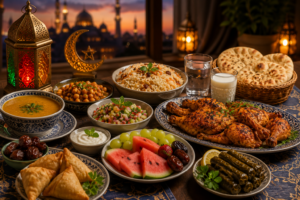
Once a year, the Muslim diet takes a special turn. Ramadan the ninth month of the Islamic calendar is the holy month of fasting. From dawn to sunset for 30 days, Muslims abstain from all food and drink (yes, even water).
It’s intense. It’s spiritual. And it has its own food culture built around two meals. The fast begins at Fajr (the pre-dawn prayer) and breaks at Maghrib (sunset). Understanding the prayer schedule is key to understanding Ramadan. Learn exactly how each prayer works in our guide to how to pray in Islam.
Suhur (The Pre-Dawn Meal)
Suhur is the meal eaten before sunrise, designed to fuel the body for the long day ahead. Think of it as breakfast with a mission. Common choices include:
- High-fiber foods like oats, whole-grain bread, and bran cereals
- Eggs and yogurt for slow-release protein
- Fruits like bananas, dates, and apples
- Plenty of water hydration is everything.
The trick is to eat foods that release energy slowly, so hunger doesn’t hit by 11 AM.
Iftar (Breaking the Fast)
At sunset, the fast breaks with iftar easily the most anticipated meal of the day. Tradition (following the Prophet ﷺ) calls for breaking the fast with dates and water first. Then comes dinner.
Iftar varies by culture. In a Pakistani-American household, you might see pakoras, samosas, and biryani. In a Middle Eastern home, lentil soup, hummus, and grilled meats. In Indonesia, sweet drinks and fried snacks.
Eid al-Fitr Foods
After 30 days of fasting comes Eid al-Fitr the Festival of Breaking the Fast. It’s a three-day celebration packed with food, family, and gifts.
Sweet dishes lead the way: baklava in Turkey, ma’amoul (date cookies) in the Arab world, sheer khurma (sweet vermicelli pudding) in South Asia, and butter cookies everywhere. It’s basically Christmas meets Thanksgiving, just halal.
Popular Muslim Dishes from Around the World
Here’s something most people don’t realize: Muslim food isn’t one cuisine it’s hundreds. Islam has followers in nearly every country on Earth, and each culture has shaped its own halal traditions.
Middle Eastern Favorites
The Middle East gave the world some of its most beloved foods. Highlights include:
- Shawarma spiced meat roasted on a spit
- Hummus creamy chickpea dip
- Falafel crispy chickpea balls
- Kebabs grilled meat skewers
- Tabbouleh fresh parsley and bulgur salad
South Asian Classics
Pakistan, India, and Bangladesh bring the spice and depth:
- Biryani fragrant spiced rice with meat
- Samosa fried pastry pockets stuffed with potato or meat
- Nihari slow-cooked beef stew
- Haleem wheat and meat porridge
- Chicken tikka grilled marinated chicken
North African Specialties
From Morocco to Egypt, North African food is rich and aromatic:
- Tagine slow-cooked stew named after its clay pot
- Couscous steamed semolina grains served with meat and vegetables
- Brik Tunisian fried pastry with egg
Indonesian and Malay Dishes
Indonesia is the world’s largest Muslim-majority country, and its food shows it:
- Rendang slow-cooked beef in coconut milk (often called the world’s best dish)
- Nasi lemak coconut rice with sambal
- Satay grilled meat skewers with peanut sauce
American Muslim Cuisine
Here’s a hidden gem most articles ignore: American Muslim food is its own thing now.
In Dearborn, Michigan home to one of the largest Muslim communities in the US you’ll find halal pizza joints, halal burger spots, halal soul food restaurants, and even halal Tex-Mex. There’s also the bean pie a sweet pie made from navy beans, popularized by African-American Muslim communities in the mid-20th century.
The Muslim American kitchen mixes everything: a Pakistani mom’s biryani next to a Lebanese dad’s hummus, served alongside a halal Thanksgiving turkey. It’s beautiful chaos. And it’s growing fast.
Where Can You Find Halal Food in America?
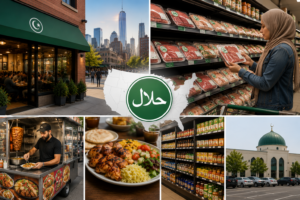
If you’re new to halal eating or hosting a Muslim friend finding halal options in the US is easier than ever. Here’s your roadmap.
Halal Grocery Chains in the USA
Big chains have caught on to the growing halal market. You can find halal-certified products at:
- Whole Foods carries multiple halal-certified brands.
- Costco offers halal meat and pantry items in many regions.
- Trader Joe’s limited but reliable halal options
- Walmart increasing halal sections in cities with large Muslim populations
- Specialty stores like Sahara Mart, Halal Meat Mart, and local Middle Eastern groceries
Halal-Certified Brands to Know
A few US brands have built strong reputations:
- Saffron Road halal frozen meals
- Crescent Foods halal poultry and beef
- Midamar one of America’s oldest halal brands
- American Halal Co. frozen halal options
Halal-Friendly US Chain Restaurants
Not all locations are halal, but many of these chains have certified halal branches across the country:
- Chipotle pork-free menu options
- KFC select halal locations in NYC, Detroit, and Houston
- Subway some halal-certified locations
- The Halal Guys fully halal, with locations nationwide
Apps That Help You Find Halal Food
Three apps every American Muslim should know:
- Zabihah the original halal restaurant locator
- HalalTrip great for travel and dining
- Muslim Pro combines prayer times with halal food finder.
How to Read US Food Labels for Halal Compliance
When in doubt, look for these signals on packaging:
- The halal certification logo (usually circular, often green)
- Certifying bodies like IFANCA (Islamic Food and Nutrition Council of America) or AHF (American Halal Foundation)
- The phrase “No pork, no alcohol” on simpler brands
- Vegan or vegetarian labels these are usually safe defaults.
Halal vs Kosher vs Vegan: Key Differences Explained
People often confuse these three. They overlap, but they’re not the same. Here’s how they break down:
| Religion | Islam | Judaism | Not religious |
| Pork allowed? | No | No | No |
| Alcohol allowed? | No | Mostly yes | Yes |
| Dairy + meat together? | Yes | Not allowed | No dairy at all |
| Special slaughter? | Dhabiha + Bismillah | Shechita + blessing | None no animal products |
| Shellfish allowed? | Mostly yes | No | No |
| Animal products? | Yes (with rules) | Yes (with rules) | None |
The big takeaway: kosher meat is often acceptable for Muslims when halal isn’t available, but the reverse isn’t always true. And vegan food is the safest option in any unfamiliar setting.
A First-Hand Perspective from American Muslim Communities
Walk into any Muslim home in Dearborn, Michigan, during Ramadan, and the first thing you’ll notice is the smell warm bread, sizzling lamb, fresh herbs, and a dish of dates on every table. It hits you before you even sit down.
According to data from the American Halal Foundation, the US halal food market crossed $25 billion in annual sales in recent years and is projected to keep climbing. Back in 1970, only 10 American grocery stores carried halal products. By 2012, that number had grown to over 2,300 stores. By 2030, it’s expected to top 7,000 (per Washington Post reporting cited by AHF).
That’s not just growth. That’s a quiet revolution.
For American Muslims, food is identity. It connects a Pakistani-American grandmother in Texas, a Lebanese-American father in New York, and a Somali-American student in Minneapolis. Different recipes same rulebook.
The Quran says: “O you who believe! Eat of the good things We have provided for you, and give thanks to Allah” (Quran 2:172). That gratitude is what makes a Muslim meal more than just food.
It makes it a small act of faith three times a day.
Conclusion
Understanding what Muslims eat helps explain the importance of halal food in Islamic culture and daily life. Halal dietary guidelines focus on cleanliness, ethical food preparation, and permissible ingredients. Muslim cuisine offers a wide variety of nutritious and flavorful dishes enjoyed around the world.
FAQs
What foods can Muslims not eat?
Muslims can’t eat pork, alcohol, blood, improperly slaughtered meat, carnivorous animals, or birds of prey. They also avoid foods containing hidden non-halal ingredients, such as pork gelatin, animal rennet, and alcohol-based extracts.
Why can’t Muslims eat pork?
The Quran forbids pork in four separate verses, making it one of the clearest dietary rules in Islam. Beyond the religious command, many Muslims also view pork avoidance as a matter of spiritual purity and ethical eating.
Can Muslims eat seafood and shrimp?
Most Muslims eat all seafood freely, including shrimp, crab, lobster, and squid. All fish with scales are universally accepted as halal. A few Islamic schools of thought debate the permissibility of shellfish, so when hosting, it’s polite to ask.
Is gelatin halal?
It depends on the source. Gelatin made from pork or non-halal animals is haram. Gelatin from halal-slaughtered cattle, fish, or plant sources (like agar-agar) is halal. Always check the label or look for halal certification.