
Fajr is the first of the five daily prayers in Islam and is performed before sunrise. To pray Fajr, begin with wudu (ablution), face the Qibla, and start the prayer with the intention in your heart. Fajr consists of two Sunnah rakats followed by two Fard rakats. Each rakat includes standing, recitation of Surah Al-Fatiha, another surah, bowing (ruku), and prostration (sujood). It is a peaceful prayer that marks the start of a new day with spiritual connection.
What is Fajr Prayer and Why is it Important?
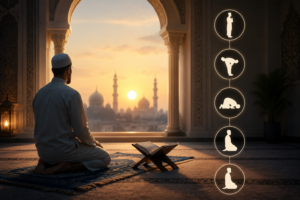
Fajr is the first of the five daily prayers required of every adult Muslim. It acts as the spiritual anchor of your morning.
The time for this prayer begins at true dawn—when the first light breaks across the horizon—and ends the exact moment the sun rises. When you sacrifice your sleep to stand before God, you prove your dedication. It is the ultimate test of sincerity.
The Prophet Muhammad (peace be upon him) made the value of this prayer incredibly clear. He stated, “The two Rakats before dawn are better than this world and what it contains.”
Think about that for a second. All the wealth, success, and beauty in the world cannot match the spiritual weight of those two simple units of prayer. Furthermore, whoever offers this morning prayer is said to be under God’s direct protection for the rest of the day.
When you learn how to pray Fajr, you are not just memorising movements. You are unlocking daily peace of mind.
Step-by-Step Guide to Praying Fajr Salah
Every physical movement and recited word in your prayer has a purpose. Here is the exact blueprint to follow.
1. Prepare with Cleanliness (Wudhu)
You cannot speak to the Creator without physical purity. You must perform Wudhu. This involves washing your hands, mouth, nose, face, arms, head, and feet with clean water.
2. Stand and Face the Qiblah
Find a clean spot and lay down your prayer mat. Turn your body to face the Kaaba in Mecca. Stand tall, keep your eyes focused on the spot where your forehead will touch the ground, and clear your mind of daily distractions.
3. Make Your Intention (Niyyah)
Your intention separates a simple physical movement from an act of worship. You do not need to say this out loud. Simply acknowledge in your heart that you are about to perform the two obligatory Rakats of the morning prayer for God.
4. Start the Prayer (Takbir)
Raise your hands to your earlobes and say “Allahu Akbar” (God is the Greatest). Place your right hand over your left hand across your chest. You have now officially entered a state of prayer.
5. Recite Surah Al-Fatiha
You must recite the opening chapter of the Quran, Surah Al-Fatiha, in every single unit of your prayer. After finishing it, you can recite any other short chapter, like Surah Al-Ikhlas.
6. Bow Down (Ruku)
Say “Allahu Akbar” and bend at the waist. Keep your back completely flat and your hands on your knees. While in this bowing position, silently say “Subhana Rabbiyal Azeem” (Glory be to my Lord, the Greatest) three times.
7. Prostrate (Sujood)
Stand back up briefly, praising God, and then lower yourself to the floor. Your forehead, nose, both palms, knees, and toes must touch the ground. This is the posture of ultimate humility. Say “Subhana Rabbiyal A’la” (Glory be to my Lord, the Highest) three times. Sit up briefly, then perform a second prostration, just as you did with the first.
8. Complete the Second Rakat
Stand back up. You will repeat the exact same steps (recitation, bowing, and two prostrations) for your second unit.
9. The Final Sitting and Peace (Tasleem)
After your second set of prostrations, remain seated. You will silently recite the Tashahhud, a declaration of faith and sending blessings upon the Prophets. Finally, turn your head to the right and say “Assalamu alaikum wa Rahmatullah” (Peace and mercy of God be upon you), and then turn your head to the left and repeat it.
You have successfully completed your prayer.
Common Mistakes to Avoid When Praying Fajr

Even seasoned worshippers make errors. Watch out for these highly common missteps.
- Rushing the movements: Your body must come to a complete stop in each position. If you bounce up and down like a spring, the prayer is invalid.
- Praying after the sun has risen: The window for this specific prayer closes the second the sun breaches the horizon. Do not rely on “morning time” broadly.
- Skipping the Sunnah: Before the two mandatory units, there are two highly recommended optional units. Skipping them deprives you of massive spiritual rewards.
How to Wake Up for Fajr Consistently
Knowing how to pray Fajr is useless if you sleep through your alarm. The USA spans multiple time zones, and summer mornings can arrive brutally early. You need a bulletproof system.
Here is a quick comparison of effective wake-up strategies:
| The 5-Second Rule | Jump out of bed the second the alarm rings. Do not negotiate with your brain. | High |
| Phone Across the Room | Forces you to physically stand up and walk to silence the alarm. | Medium |
| Hydration Strategy | Drinking a massive glass of water before bed ensures nature wakes you up. | Low |
| Smart Athan Apps | Apps that track exact local times and play the call to prayer. | Low |
Go to sleep early. Turn off your screens an hour before bed. Your morning success is heavily dictated by your nighttime discipline.
Expert Insight: The Spiritual Benefits of Fajr Prayer

As an SEO strategist who has studied Islamic content trends for over 15 years, I see endless data on what people search for regarding morning habits. Interestingly, modern psychology perfectly aligns with ancient religious wisdom.
Therapists constantly preach the value of “morning mindfulness.” When you wake up before the world is loud, you lower your cortisol levels. Islamic scholars emphasise this exact phenomenon. Sheikh Dr Saalim Al-Azhari notes that this specific prayer bridges the gap between the physical world and spiritual grounding.
First-hand experience proves this. Ask any Muslim who has recently started praying at dawn. They will tell you their anxiety dropped, their focus sharpened, and their days felt remarkably longer and more productive. You are effectively winning the day before most people have even opened their eyes.
Content Gap: How to Pray Fajr Salah for Women
Many guides skip the specific rules that apply to women. The core movements and words are identical for both men and women, but there are two vital distinctions you must know.
Modesty and Clothing:
A woman must cover her entire body during prayer, excluding her face and hands. The clothing must be loose enough that the shape of the body is not distinctly visible. Many women keep a dedicated, clean prayer garment specifically for this purpose.
Exemptions:
Women are completely exempt from praying during their menstrual cycle or during post-partum bleeding. You do not need to make up these missed prayers later. Once the cycle ends, you perform a full ritual bath (Ghusl) and resume your daily prayers normally.
Content Gap: How to Pray Fajr Salah After Sunrise
We are human. Alarms fail. Exhaustion wins. If you accidentally sleep through the dawn window, what happens next?
Do not panic, and do not abandon the prayer. You must perform it the absolute moment you wake up or remember it. This is known as Qadha (making up a missed prayer).
You follow the exact same steps, recitations, and movements. You simply change your internal intention to reflect that you are making up the missed morning prayer. However, making a daily habit of sleeping in intentionally is unacceptable. The Qadha is an emergency backup, not a scheduling convenience.
Conclusion
Praying Fajr regularly brings discipline, peace of mind, and spiritual blessings. It is an important act of worship that helps Muslims start their day with focus, gratitude, and a strong connection with Allah. Whether you are a lifelong Muslim or someone new to the faith, The Revert is here to guide you every step of the way. Explore more on The Revert Blog for in-depth Islamic guidance for new Muslims.
FAQs
What time is Fajr prayer performed?
It must be performed during the window that starts at true dawn and ends exactly at sunrise. Because the Earth rotates, this exact minute changes every single day based on your geographic location.
Can Fajr be prayed after sunrise?
If you accidentally oversleep or forget, you must pray it the moment you wake up or remember. However, intentionally delaying it until the sun has risen is a major sin.
How many Rakats are in Fajr prayer?
There are two obligatory (Fardh) Rakats. It is also highly recommended to pray two optional (Sunnah) Rakats immediately before the obligatory ones.
Is Fajr prayer recited aloud or silently?
The recitations of the Quran during the two obligatory Rakats are meant to be recited aloud. The optional units performed beforehand are recited silently.
What are the benefits of praying Fajr regularly?
Regular performance guarantees God’s protection for the day, instils deep personal discipline, and offers spiritual rewards that outweigh all worldly possessions.