
Yes, you can pray voluntary (nafl) prayers before Asr. In Islamic teachings, there are no strongly emphasized Sunnah (Sunnah Mu’akkadah) prayers specifically before Asr like there are for Fajr or Zuhr, but you are allowed to perform 4 rakats of non-mu’akkadah nafl prayer before Asr. These voluntary prayers bring extra reward but are not compulsory.
What Are Sunnah Prayers?
Think of your daily obligatory prayers (Fard) as the foundation of a house. You need them for the house to stand. Sunnah prayers are the beautiful decorations you add to the walls.
Sunnah prayers are voluntary prayers practiced by the Prophet Muhammad (Peace Be Upon Him). They act as a spiritual shield. On the Day of Judgment, if your obligatory prayers have any shortcomings, your voluntary prayers will fill the gaps. Muslims perform them before or after the five daily obligatory prayers to build a closer relationship with God.
There are two main types of Sunnah prayers:
- Mu’akkadah (Emphasized): The Prophet rarely skipped these. Examples include the two rak’ahs before Fajr.
- Ghayr Mu’akkadah (Non-emphasized): The Prophet prayed these often but sometimes left them out to show they were not mandatory.
Sunnah Before Asr: What the Hadiths Say
When asking if can you pray sunnah before asr, we must look at the historical records (Hadiths). The evidence here is crystal clear.
The Prophet Muhammad highly encouraged praying before the Asr congregation. According to a famous Hadith recorded in Sunan At-Tirmidhi, the Prophet said: “May Allah have mercy on the one who prays four (rak’ahs) before Asr.”
This is a massive statement. You are literally receiving a prayer for mercy directly from the Prophet himself just for taking a few extra minutes to pray. Because the Prophet occasionally skipped this specific prayer, Islamic scholarscategorize it as non-emphasized. You do it for the bonus rewards, not out of strict obligation.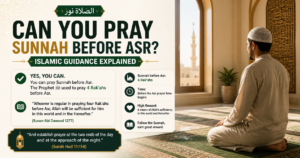
How to Pray Sunnah Before Asr (Step-by-Step)
Performing this prayer is straightforward. Even a ten-year-old can master this routine. You will perform four rak’ahs (units of prayer) in total.
Here is exactly how you do it:
- Make the Intention (Niyyah): Quietly in your heart, intend to pray four rak’ahs of Sunnah for Asr.
- Pray the First Two Rak’ahs: Start your prayer just like any other. Recite Surah Al-Fatihah, followed by another short chapter from the Quran. Complete the bowing (Ruku) and prostrations (Sujood).
- Sit for Tashahhud: After the second rak’ah, sit and recite the Tashahhud.
- Stand for the Final Two Rak’ahs: Stand back up. Repeat the process for rak’ah three and four.
- Finish with Tasleem: Conclude your prayer by turning your head to the right and left, saying “As-salamu alaykum wa rahmatullah.”
Note: Some scholars suggest offering these four rak’ahs in sets of two. You pray two, say the Tasleem, and then stand up to pray another two. Both methods are entirely acceptable.
Benefits of Praying Sunnah Before Asr
Why should you carve out time for this prayer? The benefits go far beyond just checking a box.
- Earning Divine Mercy: As mentioned in the Hadith, you receive a direct supplication of mercy from the Prophet.
- Building Discipline: Mid-afternoon in the USA is usually peak hustle hour. Stepping away from your desk, school, or errands to pray requires serious focus. It builds incredible mental discipline.
- Forgiveness of Sins: Every prostration you make elevates your spiritual status and wipes away minor mistakes.
- Preparing for Fard: Rushing straight from a loud meeting into your obligatory Asr prayer usually means a distracted mind. The Sunnah prayer acts as a buffer. It calms your heart so you are completely focused when the main prayer begins.
Expert Insight: What Scholars Say About Sunnah Before Asr
Islamic scholars generally agree that there is no strongly emphasized Sunnah (Sunnah Mu’akkadah) prayer specifically before Asr. However, they also clarify that voluntary (nafl) prayers before Asr are permissible, as long as they are not performed during the disliked time right before Asr begins. The opinions are based on various hadith interpretations where the Prophet Muhammad (ﷺ) encouraged voluntary worship but did not establish a fixed Sunnah prayer before Asr like he did for Fajr or Zuhr.
Scholarly View on Voluntary Prayers Before Asr
Many scholars explain that praying nafl before Asr is allowed and can bring reward, especially if performed earlier in the time window after Zuhr. However, they also caution that after the Asr time begins and especially closer to sunset, performing additional voluntary prayers should be avoided based on authentic hadith guidance. This is why scholars emphasize balance—doing nafl prayers without neglecting the obligatory Asr prayer.
Difference Between Sunnah Mu’akkadah and Nafl Prayers
Scholars highlight an important distinction: Sunnah Mu’akkadah are regularly practiced and strongly recommended prayers (like those before Fajr and after Zuhr), while nafl prayers are optional and flexible. Since there is no confirmed Sunnah Mu’akkadah before Asr, any prayer performed in that time is considered voluntary only. This distinction helps Muslims understand that while extra worship is rewarded, it should always align with authentic Sunnah practices and timing guidelines.
Common Misconceptions About Sunnah Before Asr
Let us bust some common myths right now.
Myth 1: It is forbidden to pray near Asr.
Fact: It is strictly forbidden to pray after the obligatory Asr prayer until the sun sets (Maghrib). However, the time before Asr is perfectly fine for voluntary prayers. People often mix up the “before” and “after” rules.
Myth 2: You must pray four rak’ahs, or it does not count.
Fact: While four rak’ahs is the recommended standard based on the Hadith, praying two rak’ahs is also perfectly valid. God rewards you for whatever extra effort you can manage.
Myth 3: You are sinning if you skip it.
Fact: This is a Ghayr Mu’akkadah (non-emphasized) Sunnah. Skipping it brings zero sin. You simply miss out on the bonus rewards.
Sunnah Prayer Timing: Before Asr and Other Obligatory Prayers
To make things incredibly easy to scan, here is a breakdown of how the Asr Sunnah compares to the other daily prayers.
| Obligatory Prayer | Sunnah Before (Rak’ahs) | Sunnah After (Rak’ahs) | Status |
| Fajr | 2 | None | Emphasized (Highly recommended) |
| Dhuhr | 4 | 2 | Emphasized |
| Asr | 4 | None | Non-emphasized (Optional bonus) |
| Maghrib | None (or 2 optional) | 2 | Emphasized |
| Isha | None (or 2 optional) | 2 | Emphasized |
Conclusion
In short, you can pray nafl (voluntary) prayers before Asr, and it is completely permissible in Islam. However, these prayers are not considered a strongly emphasized Sunnah (Sunnah Mu’akkadah), so they are optional and not compulsory. A Muslim should always prioritize the five obligatory prayers first, as they are the foundation of worship. After fulfilling the fard (compulsory) prayers, one can add nafl prayers whenever possible to gain extra rewards and strengthen their connection with Allah. These voluntary acts of worship are a great opportunity to increase spiritual growth, but they should be done with balance and without neglecting the obligatory duties.
FAQs
Can I pray 2 rakhats instead of 4 for Asr Sunnah?
Yes, you can. While the Hadith specifically mentions the rewards for praying four rak’ahs, praying two rak’ahs is still a valid voluntary prayer that earns you immense blessings.
Is it a sin if I miss the Sunnah before Asr?
No, it is never a sin to miss this prayer. It falls under the category of non-emphasized Sunnah (Ghayr Mu’akkadah). You do not get punished for leaving it, but you earn great rewards for doing it.
When exactly does the time for Asr Sunnah start?
The time begins the moment the call to prayer (Adhan) for Asr goes off, and it ends the moment the congregational obligatory Asr prayer begins.
What if the congregational prayer starts while I am praying the Asr Sunnah?
If the Imam starts the obligatory Asr prayer, you should quickly finish your current rak’ah and join the congregation. The obligatory prayer always takes priority over any voluntary prayer.
Can you pray sunnah before asr if you are traveling?
Yes, but it is not expected. When traveling, Islam shortens the obligatory prayers to make the journey easier. Most scholars agree that travelers can skip the Sunnah prayers altogether, though you can still perform them if you wish.