
Jahannam is the Islamic term for Hell, a place of punishment in the Hereafter for those who reject faith, commit major sins, and fail to repent. Islamic teachings describe Jahannam as having seven levels, each associated with different degrees of punishment based on a person’s actions and beliefs. Understanding the meaning of Jahannam and its levels helps Muslims reflect on accountability, divine justice, and the importance of living a righteous life.
What Does Jahannam Mean? Etymology and Origins
To really grasp the jahannam meaning, we need to look at where the word actually comes from. Words hold incredible history, and this one has traveled across ancient languages.
The term roots itself deeply in history, deriving directly from the ancient Hebrew word Gehenna (or Ge-hinnom).
Originally, Ge-hinnom was not a mystical underworld. It was a literal, physical valley located just outside the walls of ancient Jerusalem. Because this valley had a dark history of fire and destruction, the name eventually became a powerful symbol for hellfire in several major world religions.
Over time, as languages shifted and mixed, this Hebrew term transformed into the Arabic word we know today.
Here is a quick breakdown of how the word translates across these ancient languages:
| Language | Word | Meaning / Origin |
| Arabic | جهنم (Jahannam) | The Islamic term for Hell, a place of punishment. |
| Hebrew | גֵּיהִנּוֹם (Ge-hinnom) | “Valley of Hinnom,” a literal valley outside Jerusalem. |
| English | Hell / Gehenna | A spiritual realm of suffering and purification. |
What Are the 7 Levels of Jahannam?
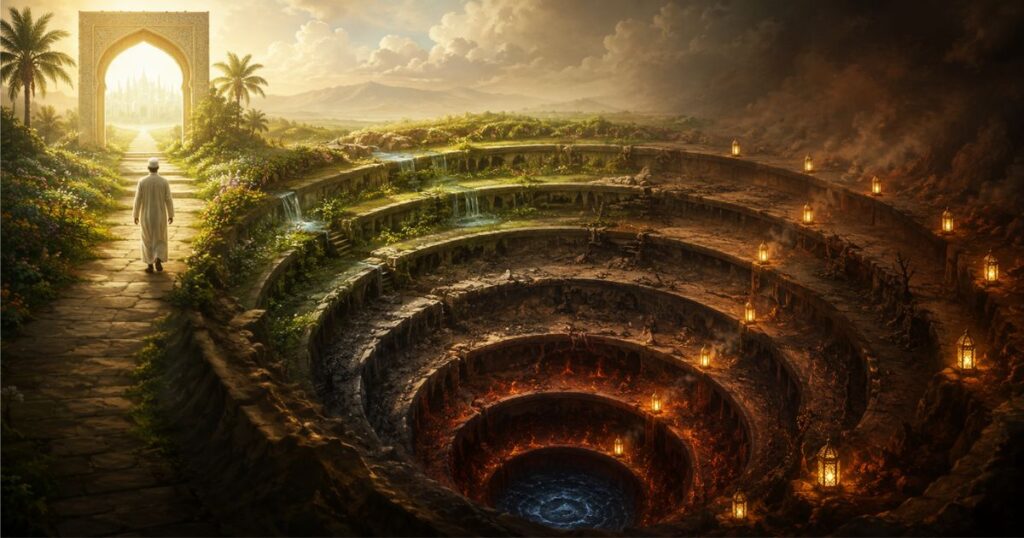
Islamic hell is not just one giant, chaotic pit. It is a highly structured, organized system of divine justice.
According to Islamic theology, Jahannam features seven distinct gates or levels. As you go deeper, the heat intensifies, and the punishment becomes much more severe.
Let us look closely at each of these seven levels and see who exactly ends up there.
1. Jahannam The First Level
The first level shares its name with the entire realm. Jahannam is the uppermost and least severe level.
It serves as a temporary place of purification specifically for Muslims who committed grave sins during their earthly lives. According to Islamic belief, the fire here burns the flesh, which Allah then continuously renews. However, because it is temporary for believers, those placed here will eventually enter Paradise once their sins are fully cleansed.
2. Ladha (Fierce Blaze)
As we move down, we reach Ladha, which translates to the “Fierce Blaze.”
This second level targets individuals who actively rejected faith and stubbornly hoarded their wealth. According to [Quran 70:15], this fierce fire violently strips away the outward flesh and internal organs. It serves as a brutal reminder that hoarding riches on Earth cannot save you in the afterlife.
3. Saqar
The third level is Saqar. This terrifying domain specifically punishes people who abandoned their required daily prayers.
It also houses those who completely ignored the poor and needy. According to [Quran 74:42–47], the flames of Saqar eat up a person’s flesh but leave their bones completely intact. It is a harsh reality for those who walked the path of falsehood and neglected their basic religious duties.
4. Al-Hutamah (Crushing Fire)
Next is Al-Hutamah, or the “Crushing Fire.”
This fourth level is reserved for backbiters, slanderers, and those who relentlessly mocked others. According to [Quran 104:4–9], the flames here burn straight down to the sinner’s bones and emblaze their internal organs. The emotional and physical pain is so intense that sinners weep until their tear glands completely dry out.
5. Jaheem
Jaheem is the fifth level, and it is essentially a massive, blazing piece of coal.
This level exists for people who lack the correct belief in Allah. It also holds those who refused to give creations their proper rights or failed to encourage feeding the poor. The immense heat here reflects the gravity of living a life completely devoid of spiritual truth.
6. Saeer (Pit of Agony)
The sixth level, Saeer, translates to the “Pit of Agony.”
This level has been kindling since the very moment it was created. It contains 300 massive castles, each filled with hundreds of huts and rooms designed for unique penalties. Sinners here face unimaginable torment involving scorpions, snakes, heavy chains, and ropes. It is a realm of constant, physical agony.
7. Al-Hawwiyah
Finally, we reach Al-Hawwiyah, the seventh, deepest, and absolute worst level of Islamic hell.
This pitch-black abyss targets extreme hypocrites and absolute non-believers. It is a place of no return. Sinners are crushed under the weight of giant mountains, their hands bound tightly to their necks. Angels known as Zabaniyah deal out heavy punishments. There is zero light, zero hope, and zero escape.
Islamic Hell vs. Christian Hell: What’s the Difference?
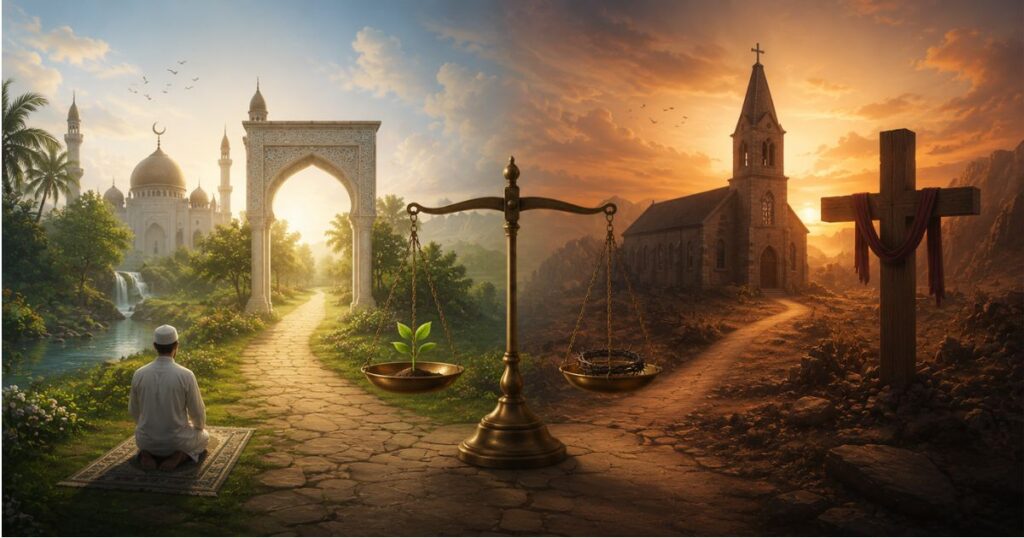
When you study world religions, you notice some fascinating overlaps and sharp contrasts.
If you compare the jahannam meaning to Christian views of hell, you will find both similarities and major differences. Both faiths use intense imagery of fire and view hell as the ultimate separation from God.
However, the structure and duration look quite different. Dante’s famous poem, Inferno, describes the Christian hell with nine distinct circles, heavily focusing on ironic punishments for specific sins. Meanwhile, the Catholic concept of Purgatory is a temporary waiting room for souls to get clean before entering Heaven.
In Islam, Jahannam combines both concepts. The uppermost level acts much like Purgatory a temporary cleansing for sinful believers. The lower levels, however, function as a permanent, eternal punishment for extreme wrongdoers.
Here is a quick comparison table to make the differences crystal clear:
| Feature | Jahannam (Islamic Hell) | Christian Hell (Dante / Catholic) |
| Structure | 7 levels based on severity | 9 circles (Dante) or singular realm |
| Duration | Temporary for sinful Muslims; Permanent for non-believers | Permanent (Hell); Temporary (Purgatory) |
| Primary imagery | Blazing fire, chains, deep pits, physical renewal | Fire, brimstone, ironic tortures, darkness |
| Role of angels | Guarded by strict angels (Zabaniyah) | Associated with fallen angels and demons |
Expert Insight How Is Jahannam Described in the Quran and Hadith?
To truly understand the jahannam meaning, we must look at the original, trusted sources: the Quran and the Hadith (the recorded sayings of Prophet Muhammad).
The Quran provides a very clear blueprint of this terrifying place. According to [Quran 15:44], “It has seven gates; for each of those gates is a designated portion of them.” This directly confirms the structured, tiered nature of divine punishment.
The Hadith goes even further, offering vivid, terrifying details about the actual heat of the fire.
According to trusted Islamic scholars, Prophet Muhammad stated that the fire of Jahannam was heated for 1,000 years until it turned red. Then, it was heated for another 1,000 years until it turned blindingly white. Finally, it was heated for a third 1,000-year period until it turned pitch black. Today, Islamic tradition holds that the fire of hell is completely dark and incredibly intense.
Conclusion
The concept of the seven levels of Jahannam highlights the seriousness of human accountability in Islam. While Jahannam represents Allah’s justice, Islam also emphasizes His mercy and forgiveness for those who sincerely repent. By understanding these teachings, Muslims are encouraged to strengthen their faith, perform good deeds, and seek Allah’s guidance throughout their lives.
FAQs
Who will go to Jahannam?
According to Islamic theology, Jahannam is for people who commit grave sins, reject faith in Allah, abandon their prayers, or hoard wealth while ignoring the poor. Sinful Muslims may enter the top level temporarily, while absolute non-believers and extreme hypocrites face the deeper, permanent levels.
How many gates does Jahannam have?
Jahannam has exactly seven gates or levels. Each gate corresponds to a specific category of sinners, with the punishment increasing in severity as you travel further down into the depths.
What is the worst level of Jahannam?
The worst and deepest level of Islamic hell is Al-Hawwiyah. It is a pitch-black abyss reserved for extreme hypocrites, featuring unimaginable crushing punishments from which there is absolutely no escape.
Is Jahannam permanent or temporary in Islam?
Jahannam functions as both, depending entirely on the individual’s faith. It is a temporary place of purification for sinful Muslims, but it serves as an eternal, permanent punishment for those who completely reject God and the prophets.
What is the difference between Jahannam and Jannah?
Jahannam is the Islamic concept of hell, representing ultimate punishment and suffering. On the flip side, Jannah is the Islamic concept of Paradise or heaven, representing eternal peace, massive reward, and closeness to Allah.