
How to Raise Muslim Children isn’t a single method it means guiding them through three life stages: play (0–7), teaching (7–14), and advising (14–21), using kindness before correction, your own example before your words, and consistent du’a throughout. Discipline is gentle and purposeful, never harsh. The goal isn’t obedience out of fear. It’s a child who chooses Islam because they’ve seen it lived, understood it, and felt loved inside it.
What Does Islam Say About Raising Children?
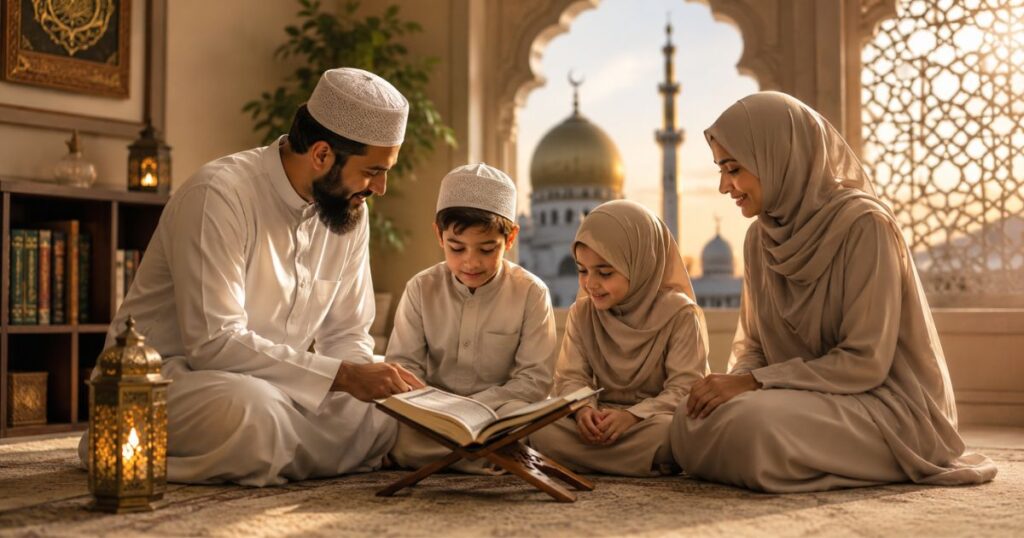
Tarbiyah is the Islamic term for raising and nurturing a child not just teaching facts, but shaping character, faith, and conduct over time. It comes from a root meaning “to grow” or “to increase,” and it’s the word Muslim scholars use for the whole job of parenting.
In Islam, your child isn’t your possession. They’re an amanah a trust from Allah, placed in your care for a limited number of years. That single idea changes everything about how you parent. You’re not raising a child to please yourself, your relatives, or your community. You’re raising a soul you’ll answer for.
The Qur’an captures this in the du’a of the righteous:
“Our Lord, grant us from among our spouses and offspring comfort to our eyes, and make us an example for the righteous.” (Qur’an 25:74)
That’s not a passive wish. It’s a life’s work.
The 7-7-7 Framework Islam’s Stage-by-Stage Approach to Parenting
A widely cited piece of Islamic parenting wisdom attributed to the companion Ali ibn Abi Talib (RA), and echoed in the pedagogical writings of scholars like al-Ghazali and Ibn Qayyim divides childhood into three seven-year phases. It’s worth noting up front: this is a wisdom saying (hikmah), not a verified hadith of the Prophet ﷺ, though its content aligns closely with authenticated hadith about child development. Being upfront about that distinction matters Islam values accuracy over convenience, even in advice we like.
Here’s how the three stages break down in practice:
| Stage | Age Range | Parenting Focus | Supporting Guidance |
| Play | 0–7 years | Bond, observe, model good behavior | Child imitates parents; no formal discipline expected |
| Teach | 7–14 years | Instruct in faith, values, and responsibility | Prophet ﷺ instructed parents to have children begin praying at age 7 |
| Advise | 14–21 years | Mentor as an equal; guide through counsel, not control | Treat the young person as a capable decision-maker |
Ages 0–7: Play and Bond
This is the foundation-laying stage. Your child isn’t ready for lectures; they’re absorbing everything you do, not what you say. If you want a child who prays, they need to see you pray. If you want a child who speaks gently, they need to hear gentleness at home first.
There’s no formal discipline expected here beyond redirection and modeling. This is the age for warmth, play, and simple exposure to Islamic rhythms: the adhan, bismillah before meals, a goodnight du’a.
Ages 7–14: Teach and Train
At seven, the responsibility shifts. A well-known hadith instructs parents:
“Command your children to pray when they are seven years old…” (Sunan Abi Dawud)
This is the stage for structured teaching of salah, halal and haram, Qur’an, adab (manners), and academic and physical skills. The Prophet ﷺ also encouraged teaching children practical skills like swimming, archery, and horseback riding a reminder that Islamic upbringing was never meant to be purely devotional; it includes competence and physical strength too.
This is also the stage where light, purposeful discipline can begin if needed covered in detail below.
Ages 14–21: Advise and Release
By adolescence, your child should already have the internal compass you spent 14 years building. Now your role shifts from instructor to advisor. Heavy-handed control at this stage tends to backfire; teenagers who feel controlled often disengage; teenagers who feel trusted and consulted tend to stay close.
Talk with them, not at them. Ask their opinion. Let them wrestle with “why” questions about faith that wrestling is often how ownership of belief actually happens.
How Do You Discipline a Child in Islam?
Islamic discipline in Islam is graduated, purposeful, and never abusive. The default is calm correction reminders, redirection, and consequences that teach. The Prophet ﷺ is not reported to have ever struck a child. Scholars describe a hierarchy: verbal correction first, then withdrawal of a privilege, with anything physically treated as a last resort, narrowly defined, and never in anger.
Here’s the step-by-step hierarchy scholars draw from Islamic sources:
- Correct gently and immediately. Explain what was wrong and why don’t just say “no.”
- Use natural, related consequences. If screen time was misused, screen time is reduced, not an unrelated punishment.
- Escalate calmly if the behavior repeats. A longer consequence, more clearly tied to the behavior.
- Reserve anything physical for narrow, specific cases scholars point to the specific instruction about prayer at age 10 as the clearest example, and even then, it must be light, never on the face, and never driven by anger.
- Always return to connection. Discipline should end with reassurance, not distance.
It’s worth being honest here: this is a topic scholars discuss with real nuance, and cultural practices in many Muslim communities have drifted from the Prophet’s actual example, which was overwhelmingly gentle. If you’re unsure where a specific situation falls, a local, qualified scholar is a better resource than a general guide like this one.
Self-contained answer: Islamic discipline prioritizes kindness and explanation over punishment. The Prophet ﷺ never hit a child and taught that mercy toward children invites Allah’s mercy toward you. Correction should be calm, proportionate, and tied to the specific behavior with anything physical treated as a rare, narrowly limited last resort, not a first response.
At What Age Should a Muslim Child Start Praying?
Self-contained answer: Muslim children are typically introduced to salah around age 7, when parents begin actively instructing and reminding them to pray not as a strict rule, but as gentle habit-building. By age 10, if a child consistently neglects prayer despite consistent teaching, scholars describe light disciplinary correction as permissible, based on the hadith instructing parents to “separate them in their beds” and use measured correction at that point. Before age 7, the goal is simply exposure, praying alongside them, letting them see and imitate not enforcement.
Raising Muslim Children in America: Balancing Faith and Culture

This is where most guides fall short and where American Muslim parents most need real talk, not theory.
Raising Muslim kids in the U.S. means your children are absorbing two operating systems at once: the values at home, and the values at school, on their feed, and among friends. That’s not automatically a crisis. Muslim families have been doing this successfully for generations. But it does require intention that parents in Muslim-majority countries simply don’t have to think about.
A few things consistently make the difference for families that navigate this well:
- Explain the “why,” not just the “what.” Kids who understand the reasoning behind a practice why we fast, why modesty matters, why we pray hold onto it far longer than kids who were only told “because it’s haram.” Unexplained rules tend to get discarded the moment a child leaves the house.
- Don’t frame Islam as a list of restrictions. A faith presented only as “things you can’t do” invites resentment. A faith presented as a source of meaning, identity, and belonging invites ownership.
- Let them be both. A Muslim child in America doesn’t have to choose between their faith and their country. Little league, band practice, and Friday prayers can coexist in the same childhood; plenty of families make this work without either side feeling like a betrayal of the other.
- Build community deliberately. Since the surrounding culture won’t reinforce Islamic values by default, seek out a mosque, Islamic school, or youth group where your child sees other kids living the same values. Isolation is one of the biggest predictors of a child drifting from faith; a peer group is one of the biggest protectors against it.
Original insight: The families who do this well tend to treat identity less like a wall to defend and more like a bridge to build one that lets a child walk confidently between their Islamic values and their American life, instead of feeling torn between two competing worlds. If you’re a parent trying to figure out your own approach, ask yourself which metaphor you’re currently modeling for your kids: a wall, or a bridge. It shapes more than you’d think.
Screen Time, Social Media & Muslim Kids in 2026
Every parent Muslim or not, is fighting this battle right now. For Muslim families, it comes with an extra layer: social media doesn’t just compete for attention, it often models values directly at odds with Islamic ones around modesty, relationships, and speech.
Practical steps that work:
- Set boundaries before problems appear, not after. Decide what’s watched, for how long, and where devices live at night before handing over a phone, not in reaction to a crisis.
- Stay present, not just restrictive. Kids who feel spied on tend to hide more. Kids who feel like their parents are genuinely curious about what they’re watching tend to talk more openly.
- Use it as a conversation starter. If your child sees something online that conflicts with Islamic values, that’s an opening to explain the “why” behind your family’s values, not just a moment to shut the device off.
- Model it yourself. Kids notice if a parent lectures about screen time while scrolling for hours themselves.
Raising Muslim Daughters vs. Sons What’s the Same, What’s Different
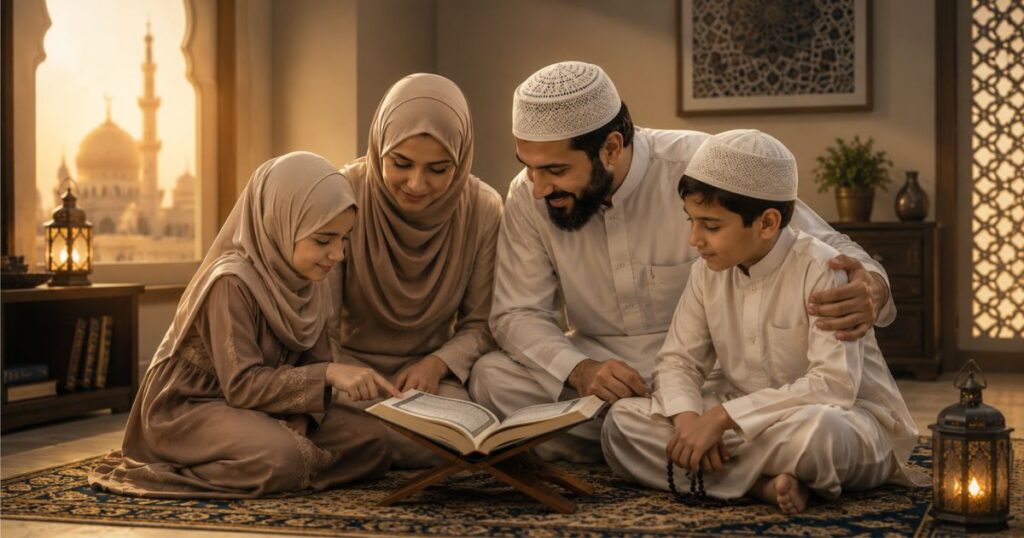
Most are the same: both need the same tarbiyah, the same gentleness, the same spiritual grounding, the same explanations behind Islamic practice.
Where it differs is largely about the specific pressures each will face. Daughters often navigate more scrutiny around modesty and appearance, both from inside and outside the community and benefit from parents who frame modesty as a source of dignity and self-respect, not restriction. Sons often absorb narrower ideas of what “strong” or “masculine” looks like from wider culture, and benefit from parents who actively model emotional openness, the idea that it’s fully Islamic for a boy to cry, ask for help, and express what he’s feeling.
Neither should be raised with a double standard dressed up as tradition. If a rule exists for a daughter, ask honestly whether the same standard is being held for her brother.
The Power of Du’a in Parenting
You can do everything right and still not control the outcome. That’s by design guidance is ultimately from Allah, not from parenting technique alone. This is why du’a isn’t an optional extra in Islamic parenting; it’s central to it.
A few du’as parents are encouraged to make regularly:
- “Our Lord, grant us from among our spouses and offspring comfort to our eyes, and make us an example for the righteous.” (Qur’an 25:74)
- “My Lord, make me an establishment of prayer, and [many] from my descendants. Our Lord, and accept my supplication.” (Qur’an 14:40)
- Personal, specific du’a for your child’s guidance, protection, and righteousness made consistently, especially in the last third of the night, during prostration, and on Fridays, times traditionally associated with greater likelihood of acceptance.
Make this a visible habit, not a private one. A child who grows up watching a parent make du’a for them learns something no lecture can teach: that they are loved beyond what they can see.
Conclusion
Raising Muslim children is a lifelong responsibility that begins with leading by example and nurturing their faith with wisdom, patience, and compassion. By following the teachings of the Qur’an and the authentic Sunnah, parents can help their children develop strong Islamic values, good character, and a lasting connection with Allah. Consistent prayer, Islamic education, loving guidance, and a supportive home environment lay the foundation for raising confident, practicing Muslims who positively contribute to their families and communities.
FAQs
What does Islam say about raising children?
Islam teaches that children are an amanah (trust) from Allah, and that raising them well tarbiyah is a spiritual responsibility, not just a practical one. The core principles are kindness, good example, a supportive environment, and consistent du’a.
How do you discipline a child in Islam?
Islamic discipline starts with gentle, explained correction and only escalates gradually. The Prophet ﷺ never struck a child, and physical discipline is treated by scholars as a narrow, last-resort measure never harsh, never in anger.
At what age should a Muslim child start praying?
Around age 7, parents begin actively teaching and reminding children to pray. By age 10, if prayer is consistently neglected despite teaching, scholars describe light, non-harmful correction as permissible but the emphasis before age 7 is exposure and example, not enforcement.
What is tarbiyah in Islam?
Tarbiyah is the Islamic concept of nurturing a child’s character, faith, and conduct over time more than teaching facts, it’s the ongoing process of shaping who a child becomes.
How can I raise my Muslim child well while living in America?
Explain the reasoning behind Islamic practices instead of just enforcing rules, build a real Muslim community around your child, and let them see their American life and Islamic identity as compatible rather than in conflict.
Did the Prophet Muhammad ﷺ ever hit his children?
No authenticated report describes the Prophet ﷺ striking a child. He is instead described as affectionate and gentle with children, including his own grandchildren, and he taught that mercy toward children invites Allah’s mercy in return.