
How Many Times Do Muslims Pray a Day? Muslims pray five times daily: Fajr (dawn), Dhuhr (midday), Asr (afternoon), Maghrib (sunset), and Isha (night). Each prayer takes about 5–10 minutes and must be performed within its specific time window. Missing the window doesn’t cancel the obligation; it simply means making it up (qada) as soon as possible.
The 5 Daily Prayers, Named and Explained

Each prayer has an Arabic name, a general time window, and a set number of rakahs (units of prayer a cycle of standing, bowing, and prostrating). For a full breakdown of each prayer’s name, time, and rakah count, see our complete guide to the 5 Muslim prayers in English.
| Prayer | Arabic Name | Time Window | Rakahs (obligatory) |
| Dawn Prayer | Fajr | Before sunrise | 2 |
| Midday Prayer | Dhuhr | After the sun passes its peak | 4 |
| Afternoon Prayer | Asr | Mid-to-late afternoon | 4 |
| Sunset Prayer | Maghrib | Just after sunset | 3 |
| Night Prayer | Isha | After twilight fades | 4 |
Fajr opens the day before sunrise, often before most people’s alarms go off. Dhuhr falls right around lunchtime. Asr lands in the mid-afternoon slump. Maghrib arrives the moment the sun dips below the horizon. Isha closes the day once the sky is fully dark. Our step-by-step Isha prayer guide for beginners walks through exactly how it’s performed, rakah by rakah.
Because these windows follow the sun, not the clock, prayer times shift by a few minutes daily and vary by city a Muslim in Chicago and a Muslim in Miami won’t pray at the exact same clock time, even on the same day.
How Long Does Each Prayer Take?
A single prayer typically takes 5 to 10 minutes, including washing beforehand. Fajr and Maghrib, with fewer rakahs, tend to run shorter. Dhuhr, Asr, and Isha, with four rakahs each, run slightly longer especially if extra voluntary units are added before or after. If you’re new to Salah and want the full mechanics of standing, bowing, and prostrating, our easy step-by-step guide on how to pray in Islam is a good beginner-friendly starting point.
Across a full day, the five prayers add up to roughly 30–45 minutes total less time than most people spend scrolling their phone before bed.
What Time of Day Are the Prayers?
Because prayer times are calculated from the sun’s position, they’re published daily and vary by location. As an example, on a typical day in a US city like New York, the rough order might look like this:
- Fajr: early morning, well before sunrise
- Dhuhr: just after solar noon
- Asr: mid-to-late afternoon
- Maghrib: right at sunset
- Isha: roughly 60–90 minutes after sunset
Most Muslims use a prayer-times app or check their local mosque’s schedule, since the exact minute shifts throughout the year as daylight hours change.
Can Muslims Pray More Than 5 Times a Day?

Yes. The five daily prayers are obligatory (fard), but Islam also encourages voluntary prayers on top of them. Two well-known examples:
- Tahajjud an optional night prayer performed after Isha, often in the last third of the night
- Duha an optional mid-morning prayer performed after sunrise
These aren’t required, but many practicing Muslims add them for extra spiritual reward a reward ultimately tied to the concept of Jannah. If you want to understand what that reward actually looks like in Islamic belief, see What Is Jannah in Islam? Meaning, Beauty, and Rewards. So while five is the daily minimum, the ceiling is open and some people pray considerably more.
What If a Muslim Misses a Prayer?
If a prayer window passes without the prayer being performed due to sleep, work, illness, or simply forgetting it isn’t erased from the obligation. Instead, it’s made up later, called qada. The missed prayer is performed as soon as it’s remembered, even if the next prayer’s time has already begun.
This system reflects a core theme in Islamic practice: consistency matters more than perfection, and a missed prayer is a gap to close, not a failure to dwell on.
Praying at Work or School in the USA
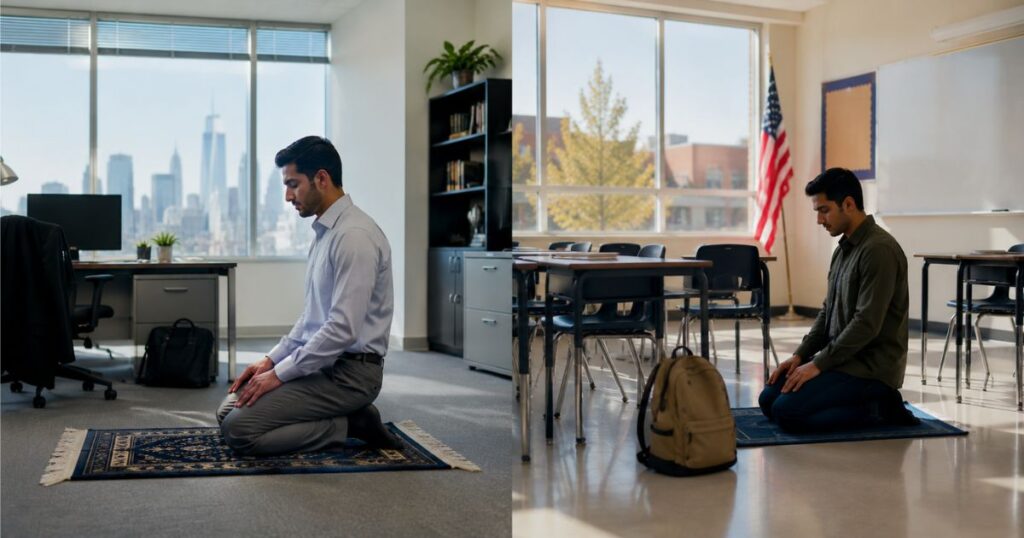
For many American Muslims, the real challenge isn’t remembering to pray, it’s fitting five short prayers into a workday built around back-to-back meetings and class schedules.
In practice, this often looks like: stepping into an empty conference room or a quiet corner for Dhuhr during a lunch break, catching Asr in the last few minutes before leaving the office, and finishing Maghrib and Isha at home after work. Fajr, before sunrise, usually happens before the workday even starts.
Under US federal law, employers generally must provide reasonable accommodation for religious practices, including short prayer breaks, unless doing so creates undue hardship for the business. Many US employers and universities now offer designated quiet or prayer rooms, especially in cities with sizable Muslim communities.
Is There a Special Weekly Prayer?
Yes Jummah, the Friday congregational prayer, replaces the Dhuhr prayer once a week. It’s performed in a group at a mosque and includes a sermon (khutbah) before the prayer itself. Friday holds special significance in Islam, similar to how Sunday functions for many Christian traditions, though it isn’t a day off from work in most of the US.
Conclusion
Muslims pray five obligatory times each day as one of the core pillars of Islam. These daily prayers strengthen faith, encourage discipline, and provide regular moments to remember Allah throughout the day. Alongside the five required prayers, Muslims may also perform voluntary prayers for additional spiritual rewards. By praying consistently and with sincerity, believers deepen their connection with Allah and find peace, gratitude, and guidance in their daily lives.
FAQs
How many times do Muslims pray in a day?
Five times: Fajr, Dhuhr, Asr, Maghrib, and Isha. Each is performed within its own time window tied to the sun’s position, not a fixed clock time.
What are the five daily prayers called?
Fajr (dawn), Dhuhr (midday), Asr (afternoon), Maghrib (sunset), and Isha (night). Together they make up one of the Five Pillars of Islam.
Can Muslims pray more than 5 times a day?
Yes. The five are obligatory, but voluntary prayers like Tahajjud (night) and Duha (mid-morning) can be added for extra spiritual reward.
What happens if a Muslim misses a prayer?
It’s made up later as soon as possible, a practice called qada. Missing a prayer isn’t treated as canceled, it’s treated as delayed.
Do Muslims pray at work in the USA?
Many do, often using a short break or quiet room. US employers are generally required to reasonably accommodate religious prayer practices under federal law.