
Qurbani (sacrifice) during Eid al-Adha is an important Islamic ritual performed by Muslims around the world. Many people often get confused about how many animals should be sacrificed per family. The ruling depends on Islamic guidelines, financial ability, and whether individuals in the household are eligible to perform Qurbani.
What Is Qurbani and Why Does It Matter?
Picture this. A father is asked to give up the most precious thing in his life, his son. He says yes. Not because it’s easy. Because his love for God is bigger than his love for anything else.
That’s the story of Prophet Ibrahim (AS) and his son Prophet Ismail (AS). When Ibrahim was about to make the sacrifice, God replaced his son with a ram. The lesson? True faith means being ready to give up what you love and trusting that God knows best.
Every year, Muslims around the world honor that moment with qurbani also called udhiyah. It’s the ritual sacrifice of an animal during Eid al-Adha, the festival of sacrifice. The meat gets shared. The hearts get warmed. The community grows closer.
So qurbani isn’t really about the animal. It’s about your devotion. And that’s why so many families ask the same question every year: how many qurbani per family do we actually need?
How Many Qurbani Does a Family Need? (The Direct Answer)
Here’s where it gets interesting. There isn’t one single answer there are two main views, and both are correct depending on which madhab you follow.
A madhab is simply a school of Islamic thought. Think of it like different teachers explaining the same subject they agree on the big stuff, they just teach the details differently. The four major madhabs are Hanafi, Shafi’i, Maliki, and Hanbali.
Now let’s see how each one answers the question.
The Hanafi View One Qurbani Per Eligible Adult
In the Hanafi madhab, qurbani is wajib (obligatory) for every adult Muslim who meets the wealth threshold. That means if you, your spouse, and your adult children all meet that threshold, each of you gives your own qurbani.
This is the view followed by most Muslims of South Asian, Turkish, and Afghan backgrounds a huge community in the USA. The reasoning comes from rulings by Imam Abu Hanifa and supporting hadith. According to Tirmidhi, the Prophet (peace be upon him) emphasized the personal nature of the sacrifice for those able to give it.
So if you’re a Hanafi family of four with two eligible adults, you’d give two qurbanis.
The Shafi’i, Maliki & Hanbali View One Qurbani Per Household
The other three madhabs see it differently. They consider qurbani a Sunnah Mu’akkadah a strongly recommended sunnah, not strictly obligatory. And one qurbani from the head of the household covers everyone.
This view rests on a powerful hadith reported by Abu Ayyoob al-Ansaari:
Scholars like Ibn al-Qayyim, al-Shawkaani, and Shaykh Ibn Uthaymeen all confirmed this is sound practice. Ibn Uthaymeen even said: “A man may offer a single sheep on behalf of himself and the members of his household, even if they are one hundred strong.”
So a Shafi’i, Maliki, or Hanbali family no matter how big needs just one qurbani.
Madhab Comparison Table
| Madhab | Ruling | Common Practice | Communities Mostly Following |
| Hanafi | Wajib for each eligible adult | 1 qurbani per adult Muslim | Pakistani, Indian, Bangladeshi, Turkish, Afghan |
| Shafi’i | Sunnah Mu’akkadah for the household | 1 qurbani per family | Indonesian, Malaysian, Egyptian, Yemeni |
| Maliki | Sunnah Mu’akkadah for the household | 1 qurbani per family | North African, West African |
| Hanbali | Sunnah Mu’akkadah for the household | 1 qurbani per family | Saudi, Gulf Arab |
Both views are valid. Follow the school your family follows, and if you’re unsure, ask your local imam.
How Many Shares Are in One Qurbani Animal?
Not all sacrificial animals are equal. Some count as one qurbani. Some count as seven. Knowing the difference helps you plan smart especially for bigger families.
Here’s the breakdown:
| Animal | Number of Shares | Minimum Age | Best For |
| Sheep | 1 share | 6 months | One person or small family |
| Goat | 1 share | 1 year | One person or small family |
| Cow / Cattle | 7 shares | 2 years | Big families and extended relatives |
| Buffalo | 7 shares | 2 years | South Asian community favorite |
| Camel | 7 shares | 5 years | The most rewarded sacrifice |
Got a Hanafi family with five eligible adults? One cow covers all of you with two shares to spare which you can give in someone else’s name, like a deceased loved one.
For most American Muslims giving qurbani through a charity, you’ll typically pick a sheep or goat share for individual coverage, or a cow share if you want to combine with others. Most USA charities handle the logistics overseas.
Who Is Required to Give Qurbani in 2026?
Not every Muslim needs to give qurbani. There are clear conditions you must meet first.
The 4 Conditions for Qurbani Eligibility
- You are Muslim
- You are an adult (post-puberty)
- You are sane and mentally sound
- You possess wealth above the nisab threshold
If you check all four boxes, qurbani applies to you (wajib in Hanafi, strongly recommended in the others). If you don’t meet the wealth threshold, you’re exempt and there’s no shame in that. God doesn’t burden anyone beyond their capacity.
What Is the Nisab for Qurbani in 2026?
The nisab is the minimum amount of wealth that makes qurbani applicable. It’s based on the value of silver (612.36 grams) or gold (87.48 grams).
In 2026, the silver-based nisab usually falls in the $700 to $900 range in the USA but silver prices change, so always check a current zakat calculator before deciding. If your savings, gold, or extra wealth exceed that amount on the day of Eid al-Adha, qurbani becomes applicable.
When in doubt, use a trusted nisab calculator from Islamic Relief USA, ICNA, or your local mosque.
Qurbani Rules for Real-Life Family Scenarios
Religious rulings can feel abstract. Real life isn’t. So let’s talk about your actual family — the messy, modern, beautiful version of it.
Qurbani for Husband and Wife
If you’re Hanafi, both spouses give their own qurbani if both meet the nisab. If you follow another madhab, one qurbani from either spouse covers you both.
Qurbani for Children Do Kids Need Their Own?
Children below puberty don’t need qurbani. They’re not yet religiously responsible. Once they hit puberty and have their own wealth above the nisab, the rules apply to them individually in the Hanafi view.
Qurbani for Adult Children Living at Home
If your adult son or daughter has their own income above nisab, they give their own qurbani in the Hanafi view. Living under your roof doesn’t change their personal obligation. In other madhabs, your one household qurbani still covers them.
Qurbani for College Students Away from Family
Same rule. A 22-year-old college student with savings above nisab gives their own qurbani in Hanafi. If their parents follow Shafi’i, Maliki, or Hanbali, the parental qurbani covers them.
Qurbani for Deceased Parents or Loved Ones
Yes you can absolutely give qurbani on behalf of someone who has passed away. It’s a beautiful way to send ongoing reward to your loved one. Most USA charities offer a “qurbani for the deceased” option at checkout.
Qurbani for New Muslim Reverts
Welcome to the family. Once you’ve taken your shahada and meet the nisab threshold, the same rules apply to you. No special version of qurbani for reverts you’re a Muslim, full stop.
Qurbani for Single Parents and Unmarried Adults
If you’re a single mom or dad above nisab, you give your own qurbani. Your kids below puberty are covered under your household. If you’re unmarried and meet nisab, qurbani applies to you personally.
Qurbani for Pregnant Mothers and Unborn Babies
Qurbani isn’t required for unborn babies. But if you want to give an extra qurbani in your baby’s name as a beautiful gesture of gratitude, scholars say that’s perfectly acceptable.
Where to Give Qurbani in the USA in 2026
Most American Muslims don’t slaughter the animal themselves. Halal slaughterhouses are limited, and city living makes it tough. So we donate through trusted charities they handle the sourcing, slaughter, and distribution overseas, often in crisis zones where the meat is needed most.
| Charity | What They Do Best | Where Distributed |
| Islamic Relief USA | Most established global reach | 30+ countries |
| ICNA Relief | Strong USA + Pakistan focus | Domestic + South Asia |
| Helping Hand (HHRD) | Crisis zones, fast distribution | Yemen, Gaza, Africa |
| Penny Appeal USA | Tech-forward, easy app experience | War zones, refugee camps |
| Zakat Foundation of America | Refugee + Rohingya focus | Conflict and refugee areas |
| LaunchGood | Crowdfunded campaigns | Variable by campaign |
Pricing changes every year always check the charity’s current rates before donating.
How to Choose the Right Qurbani Charity
Pick the one that matches your values. Here’s what to look for:
- Halal certification verify the slaughter follows Islamic guidelines
- Distribution transparency they show you photos and reports of where the meat went
- Tax-deductible receipt most legitimate USA charities are 501(c)(3)
- Reasonable pricing compare across 2-3 charities before committing
A good charity should make you feel confident, not confused.
When Is Qurbani Performed? (Eid al-Adha 2026 USA Dates)
Qurbani has a specific window. Slaughter outside of it, and it doesn’t count as qurbani — it counts as regular sadaqah.
The window covers four days, starting after Eid prayer:
- Day 1 10 Dhul Hijjah (Day of Nahr) — Eid al-Adha itself
- Day 2 11 Dhul Hijjah First Day of Tashreeq
- Day 3 12 Dhul Hijjah Second Day of Tashreeq
- Day 4 13 Dhul Hijjah Third Day of Tashreeq (allowed in some madhabs)
In 2026, Eid al-Adha is expected to fall around May 26 or May 27 in the USA, depending on moon sighting. Always check with your local mosque or the Fiqh Council of North America for the confirmed date close to the time.
Important: Qurbani must happen after the Eid prayer, not before. If you slaughter before the prayer, it’s just a regular meal, not a valid qurbani.
How Is Qurbani Meat Distributed?
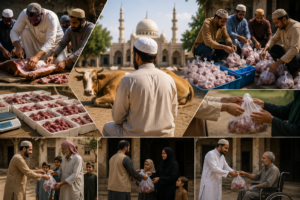
Once the animal is sacrificed, the meat is divided into three equal parts:
- One-third for your family eat, enjoy, and share at your Eid table
- One-third for relatives, friends, and neighbors Muslim or not, the gift spreads love
- One-third for the poor and needy those who rarely taste meat all year
This three-way split is rooted in the Sunnah of the Prophet (peace be upon him). It transforms qurbani from a personal act into a community celebration.
When you give qurbani through a USA charity, you typically don’t receive any meat back. The full amount goes to people in crisis zones, refugees, war-affected families, and the deeply poor. For many of them, this is the only meat they’ll eat all year.
That’s not just a sacrifice. That’s a lifeline.
A Word From Our Scholars Expert Insight on Family Qurbani
The beauty of Islam is its scholarly depth. For 1,400 years, brilliant minds have studied these rulings and their guidance helps modern American Muslim families navigate qurbani with confidence.
Shaykh Ibn Uthaymeen, in his classic work al-Sharh al-Mumti’ (volume 5), confirmed that there’s no upper limit on how many people one sacrifice can cover in spiritual reward. “A man may offer a single sheep on behalf of himself and the members of his household, even if they are one hundred strong,” he wrote.
The Assembly of Muslim Jurists of America (AMJA) , one of the most respected American Islamic authorities regularly addresses qurbani questions specific to Muslims living in the West. Their fatwa council confirms the validity of donating qurbani through reputable international charities for Muslims who cannot perform the slaughter locally.
SeekersGuidance, founded by Shaykh Faraz Rabbani, has published extensive guidance on family qurbani that respects all four madhabs. Yaqeen Institute offers research-backed perspectives on the spiritual and social dimensions of the ritual.
The takeaway? You’re not alone in figuring this out. Centuries of scholars have walked this path and modern American imams continue that tradition. When in doubt, ask your local imam, consult your madhab’s resources, or reach out to AMJA directly.
That’s not just smart. That’s how Muslims have always practiced with humility, knowledge, and community.
Conclusion
In general, one goat or sheep is sufficient for one person or a family, while a cow or camel can be shared by up to seven people. In many households, one Qurbani is commonly offered on behalf of the entire family as a Sunnah practice. However, those who are financially able can perform individual Qurbani as well.
FAQs
Is one qurbani enough for the whole family?
It depends on your madhab. In the Shafi’i, Maliki, and Hanbali schools, one qurbani covers your entire household. In the Hanafi school, every adult Muslim above the nisab gives their own qurbani. Both views are valid.
Do my children need their own qurbani?
Children below puberty don’t need qurbani; they’re not religiously responsible yet. Once they hit puberty and meet the nisab threshold, qurbani applies to them in the Hanafi view. In other madhabs, the parental qurbani covers them.
Can my husband and I share one qurbani?
If you follow the Shafi’i, Maliki, or Hanbali school, yes one qurbani covers both of you and the rest of the household. In the Hanafi school, both spouses give their own qurbani if both meet the nisab.
Can I do qurbani for my deceased parents?
Yes, absolutely. Giving qurbani on behalf of deceased loved ones is a beautiful way to send them ongoing rewards. Most USA charities like Islamic Relief and ICNA Relief offer a “qurbani for the deceased” option during checkout.
Is qurbani fard, wajib, or sunnah?
This is where madhabs differ. The Hanafi school considers it wajib (obligatory) for every eligible adult. The Shafi’i, Maliki, and Hanbali schools consider it a Sunnah Mu’akkadah a strongly recommended sunnah. Either way, it’s deeply rewarding.