
Two positions exist, and both are argued by serious scholars. The traditional account based on a hadith attributed to Aisha herself in Sahih al-Bukhari and Sahih Muslim states she was six at the marriage contract and nine at consummation. A separate body of revisionist scholarship recalculates her age using other chronological data (chiefly her sister Asma’s age and the dating of the Hijra) and estimates she was likely in her late teens. Neither position has fully displaced the other; the debate turns on how much weight to give a single, widely-transmitted hadith versus indirect chronological inference.
The Traditional Position What the Hadith Says

The core textual basis for the “six and nine” account is a hadith narrated by Aisha herself, preserved in Sahih al-Bukhari (Hadith 5134) and Sahih Muslim. In it, Aisha states that the Prophet Muhammad married her when she was six years old, and that the marriage was consummated when she was nine. A companion note from the narrator Hisham ibn Urwah adds that Aisha remained married to the Prophet for nine years, until his death.
This report is transmitted through a specific chain: Aisha → her nephew Urwah ibn al-Zubayr → his son Hisham ibn Urwah the same chain cited in classical scholarship as the origin of the “six and nine” account.
Why traditional scholarship treats this as settled:
- The report appears in both Sahih al-Bukhari and Sahih Muslim the two most authoritative hadith collections after the Qur’an in Sunni Islam.
- Over a dozen of Aisha’s students are reported to have transmitted this same statement from her with no significant change in wording, which traditional scholars treat as strong corroboration.
- Classical scholars across centuries treated the age as essentially uncontested. Early authorities such as Ibn Hazm and Ibn Kathir described it as a matter with no recorded difference of opinion among earlier generations of scholars.
- Contemporary defenders of the traditional view, such as the Yaqeen Institute, argue that questioning the age only became a live issue in modern times not at the time of the marriage or in the many centuries of scholarship that followed which they take as evidence the ages were never historically in doubt.
Definition block: A mursal hadith is a report where a narrator relays something without an unbroken chain reaching the original source firsthand some revisionist critics apply this label to the Aisha age report, though this classification is itself disputed, since the report is attributed to Aisha as a direct participant, not a secondhand transmitter.
How Hadith Authentication Works
To understand why this debate is possible at all, it helps to know how hadith scholars evaluate a report’s reliability.
Every hadith is judged on two things: the isnad (chain of narrators back to the source) and the matn (the content itself). Scholars check whether each narrator in the chain was known to be trustworthy, whether they could plausibly have met the person before them in the chain, and whether the wording is consistent across independent transmissions.
By classical standards, the Aisha age report scores well: it appears in the two most rigorously vetted collections in the Sunni tradition, and multiple independent students of Hisham ibn Urwah transmit it with consistent wording.
Where critics push back is not on the chain’s formal soundness by classical criteria, but on questions modern historians ask that classical hadith criticism didn’t: when did this specific numerical detail enter the written tradition, and does it match up with other chronological evidence from the period? That’s a different kind of question than “is the chain sound by hadith science,” and it’s where the two camps talk past each other.
The Revisionist Position: Recalculating Aisha’s Age

A separate line of argument pursued by some Muslim scholars as well as non-Muslim historians starts not from the hadith itself but from other chronological anchors in early Islamic history, then checks whether “nine” is consistent with them.
The Asma bint Abu Bakr argument. Aisha’s older sister, Asma, is widely reported to have died at age 100, roughly in the year 73 AH. Historical sources describe Asma as about ten years older than Aisha. Working backward from Asma’s death and reported lifespan places her at around 27 years old at the time of the Hijra (622 CE) which would put Aisha at around 17 at that same point, and therefore around 17–19 at the time she married the Prophet, since the marriage is traditionally dated to shortly after the Hijra.
The chronology/silence argument. Revisionist scholars also point out that some of the earliest biographical sources on the Prophet’s life including material transmitted through Ibn Ishaq via Ibn Hisham either omit the specific “six and nine” detail entirely or introduce it at a later point in the textual tradition, which raises the question of when and how that specific numerical formulation became fixed in the record.
The chain-provenance argument. Because the surviving reports trace through a fairly narrow set of transmitters, some critical scholars argue the tradition may reflect a detail that entered communal memory and textual transmission later, rather than a fixed eyewitness figure preserved from the start. This is contested, defenders of the traditional account point out that having a narrow, well-identified chain is exactly how hadith science expects strong reports to look, not a weakness.
Range of revisionist estimates. Different revisionist calculations land in slightly different places; some put Aisha‘s age at marriage in the low-to-mid teens, others closer to 17–19 depending on which chronological anchors and assumptions they use. None of these estimates comes from a report as direct as the Bukhari/Muslim hadith; all are inferred indirectly.
Comparison Table
| Traditional Position | Revisionist Position | |
| Core claim | Aisha was 6 at marriage contract, 9 at consummation | Aisha was likely in her late teens at marriage |
| Primary evidence | Hadith in Sahih al-Bukhari (5134) and Sahih Muslim, attributed directly to Aisha | Indirect chronological inference: Asma’s age and death date, Hijra dating, gaps/variance in early biographical sources |
| Type of evidence | Direct textual report with a named, traceable chain | Cross-referenced chronological calculation |
| Historical continuity | Held as consensus by classical scholars for centuries | A modern re-reading; not raised as a live dispute historically |
| Main objection from the other side | Revisionists argue it doesn’t account for a chronology-based counter-case | Traditionalists argue indirect inference can’t outweigh a direct, well-attested report |
Why This Became a Modern Controversy
One thing both sides broadly agree on: this wasn’t a live controversy for most of Islamic history. The age wasn’t treated as scandalous or unusual by contemporaries, and classical jurists across centuries discussed it as settled biographical detail rather than a point requiring defense.
The dispute took on its current shape mainly in the last century or so, as marriage-age norms shifted sharply in much of the world and child marriage came to be viewed very differently than it was in 7th-century Arabia a society where early marriage, for both economic and social reasons, was broadly common, not specific to this case. That shift in outside perception is part of why the question gets asked with such different stakes today than it did historically both by critics of Islam raising it polemically, and by Muslim apologists and historians responding to that framing.
This context matters for reading either position fairly: the traditional account isn’t a modern invention defending an indefensible claim, and the revisionist account isn’t simply a modern attempt to explain away an inconvenient fact both are working from real historical material, using different methods, in response to a question that itself has a modern shape.
What Contemporary Islamic Scholars Say
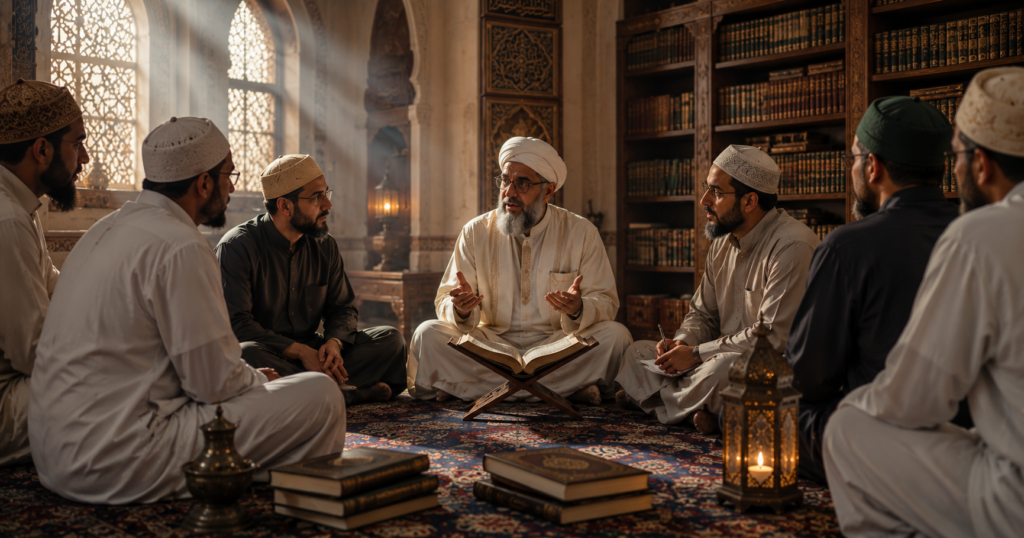
Institutions like the Yaqeen Institute have published detailed defenses of the traditional six/nine account, arguing that the hadith’s chain is exceptionally strong by classical standards and that ambiguity in secondary historical dating (such as when a particular Qur’anic chapter was revealed) isn’t sufficient grounds to override a well-established primary report. Other Muslim scholars and writers, drawing on the Asma bint Abu Bakr chronology, argue the opposite, that the primary report itself may reflect an early misunderstanding or later insertion, and that the weight of circumstantial chronology should count for more than a single, if well-attested, hadith.
Neither camp is fringe within its own methodology. The disagreement is less about the raw evidence both sides look at largely the same sources and more about how much interpretive weight to give a direct textual report versus indirect chronological reconstruction.
Conclusion
The question of Aisha’s age at marriage remains a subject of scholarly discussion. The traditional view, based on several hadith reports, holds that she was married at a young age, while some modern revisionist scholars argue for an older age by drawing on historical timelines and other sources. Understanding both perspectives with respect for the evidence and the diversity of scholarly opinion allows readers to approach the topic thoughtfully and in its historical context.
FAQs
How old was Aisha when she married the Prophet Muhammad?
Traditional sources place her at six at the marriage contract and nine at consummation, based on a hadith in Sahih al-Bukhari and Sahih Muslim. A separate body of revisionist scholarship estimates she was likely in her late teens, based on chronological calculations rather than direct report.
Is the hadith about Aisha’s age authentic?
By classical hadith science, yes it appears in both Sahih al-Bukhari and Sahih Muslim with a consistent, well-documented chain of transmission. Some modern critics question it on chronological rather than isnad grounds, which is a different kind of critique than authenticity in the traditional sense.
What’s the main evidence for the revisionist view?
Primarily the age of Aisha’s sister Asma, who is reported to have died at 100 around 73 AH, placing her and by extension Aisha at an older age around the time of the Hijra and the marriage than the traditional account suggests.
Was child marriage common in 7th-century Arabia?
Early marriage was broadly common in that era and region for both economic and social reasons, not specific to this case. That historical context is separate from the specific age dispute about Aisha.
Why is this only controversial now, not historically?
Classical scholars across centuries treated the age as settled and didn’t dispute it. The debate took its current form largely in the modern era, as global norms around marriage age shifted and the question began to be asked both critically and apologetically with different stakes than it had historically.