
Linguistically, “Allah” is simply the Arabic word for God, used by Arabic-speaking Christians and Jews centuries before Islam existed. Theologically, however, it’s more complicated. The Qur’an and the Bible describe God’s nature very differently; one rejects the Trinity, while the other centers on it. So the honest answer is: it depends on which question you’re asking. Christian groups themselves disagree, and there’s no single “official” answer everyone accepts to the question, “Is Allah and God the Same?”
What Does “Allah” Actually Mean?
Allah is the Arabic word for “God.“ It comes from al-ilāh, meaning “the god” , a contraction that collapsed into “Allah” over time. It’s not a made-up name invented by Islam; it’s a standard Semitic word for deity, related to the Hebrew El and Elohim and the Aramaic Elah, all of which appear throughout the Old Testament.
Because of that shared root, Arabic-speaking Christians and Jews were using “Allah” to refer to God long before Muhammad was born. Pre-Islamic Christian inscriptions in the Arabian Peninsula use the term, and the earliest Arabic Bible translations dating back to the 9th century translate the Hebrew word for God as “Allah.” Today, Arabic Bibles still use “Allah” the same way English Bibles use “God.”
So on pure linguistics: “Allah” is a title, like “God,” not the personal name of a specific deity similar to how “Theos” is simply Greek for “God,” used by pagan Greek philosophers and Christian writers alike.
The Short Answer Depends on Which Question You’re Asking
This is the piece most articles on this topic skip, and it’s the reason the debate feels so unresolved. There are really two separate questions hiding inside “is Allah the same as God”:
1. The linguistic question: Does the word “Allah” simply mean “God” in Arabic? Answer: Yes. This is settled among linguists and confirmed by Arabic Christian and Jewish usage going back over a thousand years.
2. The theological question: Is the being the Qur’an calls Allah the same being the Bible calls God with the same nature, character, and attributes? Answer: This is where Christians genuinely disagree, and it’s the real center of the debate. Someone can affirm the linguistic point completely and still say “no” to the theological one because the question isn’t about the word, it’s about whether the two texts describe the same person.
Keeping these separate solves most of the confusion. A missionary group and an Evangelical seminary can both be right at the same time, because they’re often answering different versions of the question.
Allah vs. God: Comparison Table
| Attribute | God (Christianity) | Allah (Islam) |
| Nature | Trinity one God, three persons (Father, Son, Holy Spirit) | Strictly one person; the Trinity is explicitly rejected as shirk (idolatry) |
| Relationship to humans | Personal, relational; described as a Father who seeks intimacy with people | Sovereign and merciful, but relationality is debated mainstream Sunni theology emphasizes God’s transcendence over personal closeness |
| Incarnation | God became human in Jesus Christ | Rejected entirely; God cannot take human form |
| Jesus’s identity | The eternal Son of God, fully divine and fully human | A prophet and messenger, but not divine and not the Son of God |
| How God is known | Through Scripture and, centrally, through the person of Jesus | Through the Qur’an as God’s literal, dictated word |
| Central names/attributes | Father, Shepherd, Love (1 John 4:8), among many biblical names | 99 Names of Allah, including The Merciful, The Compassionate, The Just |
| Salvation | Grace through faith in Christ’s death and resurrection | Submission (the literal meaning of “Islam“) to God’s will and law |
The overlap is real: both traditions affirm one Creator, one final judgment, and mercy as a core divine attribute. The differences aren’t cosmetic, either the Trinity and the incarnation sit at the very center of Christian theology, and Islam was formulated in part as a direct rejection of both.
It’s worth noting this table looks different depending on which tradition within Christianity you’re drawing from. Catholic and Orthodox theology tend to emphasize God’s transcendence and mystery in ways that create more apparent overlap with Islamic theology on paper. Evangelical and Reformed theology, by contrast, tends to emphasize God’s personal, relational nature, closeness, fatherhood, and covenant intimacy which sharpens the contrast with the Islamic emphasis on divine transcendence and submission. Neither framing is “wrong”; they’re simply drawing attention to different parts of a genuinely complex comparison.
A useful comparison point: Christians and Jews are almost universally described as worshipping “the same God,” even though Judaism also rejects the Trinity and the incarnation just as firmly as Islam does. Some scholars use this to argue that if shared ancestry and monotheism are enough to call the Jewish and Christian God “the same,” the same logic should extend to Islam. Others push back, arguing that Christianity emerged directly out of Jewish scripture and covenant history in a way Islam did not, making the Jewish-Christian relationship a continuation rather than a separate later claim. This comparison doesn’t settle the debate, but it shows why the standard used to answer the question matters as much as the facts themselves.
What the Catholic Church Teaches
The Catholic Church’s official position is more affirming than many people expect. The Catechism of the Catholic Church, paragraph 841, quotes the Second Vatican Council’s document Lumen Gentium directly, teaching that Muslims profess to hold the faith of Abraham and, along with Catholics, adore the one merciful God who will judge humanity. That teaching is reinforced in Nostra Aetate 3, the Vatican II declaration on non-Christian religions, which describes Muslims as adoring the one God, the living and self-subsisting Creator of heaven and earth.
Catholic theologians are careful to clarify what this doesn’t mean. The Church isn’t saying Islam and Catholicism are theologically interchangeable it explicitly maintains that Muslims reject the Trinity and the divinity of Christ, both essential Catholic doctrines. The point is narrower: Catholic teaching holds that Muslims are referring to the one true Creator God, even while holding a seriously incomplete and, in Catholic terms, doctrinally mistaken understanding of that God’s nature.
Popes John Paul II and Francis both continued this posture of acknowledging common ground while maintaining doctrinal differences, framing Muslim-Christian dialogue around shared belief in one Creator rather than shared theology.
What Evangelical and Reformed Christians Say
Many Evangelical and Reformed theologians take a firmer “no.” Their argument centers on one point: a being’s identity is defined by its attributes, not just its label. If the Qur’an describes a God who has no Son, cannot become incarnate, and exists as a single undivided person, they argue that’s not a partial picture of the biblical God, it’s a description of a fundamentally different being wearing a related name.
This view often draws a distinction between knowing something about God and knowing God. Evangelical writers commonly point out that the God of the Bible is defined specifically by the relationships within the Trinity and by the person of Jesus Christ removing those, they argue, and what’s left isn’t an incomplete version of the same God, but a different conception entirely.
This isn’t a fringe position. It’s the majority view among Evangelical seminaries, and it became a national news story in 2015 when Wheaton College, a prominent Evangelical institution, placed a political science professor on leave after she stated publicly that Muslims and Christians worship the same God, a controversy covered below.
Some Reformed theologians add a philosophical layer to this argument: the difference between referring to something and accurately describing it. Two people can point at the same star and both be “referring” to it, even if one describes it with wildly inaccurate facts. Applied here, a Muslim and a Christian might both intend to refer to “the one Creator of the universe” the same target, in that narrow sense while giving descriptions of that being’s nature and character that are, in Evangelical eyes, incompatible. Whether shared reference is enough to say they worship “the same God,” or whether the description matters just as much as the target, is really the crux of the entire debate. Catholic teaching tends to lean on the first framing (shared reference to the Creator); Evangelical teaching tends to lean on the second (the description defines the identity).
Why Do Arabic-Speaking Christians Call God “Allah”?
This is the detail that resolves a lot of confusion, and it’s worth sitting with. Arabic-speaking Christians in Egypt, Lebanon, Syria, Iraq, and across the Middle East have called God “Allah” continuously since long before Islam existed, and they still do today. When a Coptic or Maronite Christian prays in Arabic, they say “Allah,” not because they’ve adopted an Islamic term, but because it’s simply the word for God in their language.
The same pattern holds outside the Arab world. Indonesian and Malaysian Bible translations, a tradition going back to 16th-century missionary work, use “Allah” to translate the biblical Hebrew word for God, because Malay and Indonesian borrowed the term from Arabic centuries ago as their general word for deity.
The confusion mostly happens in English. When an English speaker who doesn’t speak Arabic hears “Allah,” they reasonably associate it with Islam specifically, because in English, “Allah” isn’t used as a generic word for God only “God” is. So the same word carries different weight depending on the language it’s spoken in: generic in Arabic, specifically Islamic in English usage. That’s a linguistic and cultural fact, not a theological argument for or against the two religions describing the same being.
The Moon-God Theory Fact or Myth?
You may have come across the claim that “Allah” was originally the name of a pre-Islamic pagan moon god, worshipped in Mecca before Muhammad. This idea circulates widely online and in some Evangelical literature, but it does not hold up to scholarly scrutiny.
Here’s the actual history: pre-Islamic Arabia was polytheistic, and the Kaaba in Mecca did house numerous idols representing different deities. But historical and archaeological evidence indicates that “Allah” (from al-ilāh, “the god”) was already understood among pre-Islamic Arabs including Christians as a term for the supreme Creator deity, distinct from the lesser gods in the pagan pantheon. Islam’s core innovation was insisting that only Allah should be worshipped, rejecting the other deities entirely, not inventing a new name for God.
Mainstream scholars across religious lines, including many Evangelical linguists, reject the moon-god theory as historically unsupported. It’s a popular internet claim, not an academic consensus, and using it in an argument tends to undermine credibility rather than strengthen it.
Why does this matter for the broader question? Because it’s a good test of which arguments in this debate are historically grounded and which are rhetorical shortcuts. The linguistic case for “Allah” as a generic Semitic word for God is well-documented and accepted by scholars on both sides of the theological debate. The moon-god claim isn’t and leaning on it, even with good intentions, tends to weaken an otherwise legitimate theological argument rather than strengthen it.
The Wheaton College Controversy
In December 2015, Wheaton College, a flagship Evangelical institution placed political science professor Dr. Larycia Hawkins on administrative leave after she wore a hijab during Advent in solidarity with Muslims and stated publicly that Christians and Muslims worship the same God, citing Catholic teaching as part of her reasoning.
The college’s leadership disagreed with her framing of the theological question and said it conflicted with the school’s statement of faith. The episode became a national flashpoint precisely because it captured the core tension this article has walked through: a Wheaton spokesperson and Hawkins were both drawing on real theological traditions she pointed to language echoing the Catholic Church’s teaching, while the college leaned on the mainstream Evangelical position that the Trinity is definitional to God’s identity. Neither side was inventing their position; they were standing in two long-established but conflicting theological camps.
Is Allah Mentioned in the Bible?
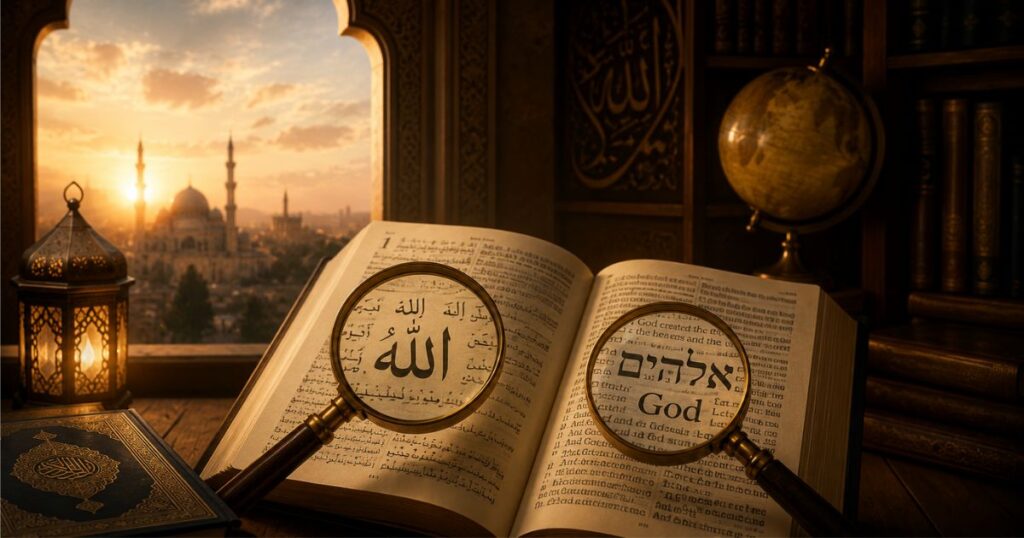
The English word “Allah” doesn’t appear in the Bible, since the Bible wasn’t written in Arabic. But the Hebrew and Aramaic words that “Allah” is linguistically related to El, Eloah, and Elohim appear throughout the Old Testament as words for God, including in Genesis 1:1. Arabic translations of the Bible use “Allah” to render these same Hebrew terms, which is why Arabic-speaking Christians have always used the word in their Scriptures.
Is “Allah” a Name or a Title?
In Islamic theology, Allah functions as both it’s treated as God’s proper, personal name (Lafẓ al-Jalālah, “the Word of Majesty”) and as the title for the one God. In Christian Arabic usage, by contrast, “Allah” functions purely as a title, equivalent to “God” the way “Theos” or “Elohim” function as titles rather than personal names in their respective languages.
Islamic tradition adds another layer here that’s genuinely distinctive: the 99 Names of Allah, drawn from the Qur’an and Hadith, each describing a different attribute Ar-Rahman (The Compassionate), Al-Ghaffar (The Constant Forgiver), As-Sami (The Hearer), and so on. These function similarly to the many biblical names and titles for God Jehovah-Jireh (“the Lord will provide”), El Shaddai (“God Almighty”), Adonai (“Lord”) in that both traditions use a constellation of names to describe different facets of a single divine being, rather than treating one label as exhaustive. The practice of naming God in multiple ways to capture different attributes isn’t unique to either faith; it’s a shared feature of how monotheistic traditions try to put a limitless being into human language.
Conclusion
Whether someone says “Allah” or “God,” they are using a word that refers to God in different languages and religious traditions. “Allah” is simply the Arabic word for God and has been used for centuries by Arabic-speaking Muslims, Christians, and Jews. While Islam, Christianity, and Judaism have important theological differences in how they understand and describe God, understanding the meaning of the word “Allah” can help promote greater respect, clarity, and interfaith understanding.
FAQs
Is Allah just the Arabic word for God?
Yes, linguistically. “Allah” comes from al-ilāh (“the god”) and shares a root with Hebrew Elohim and Aramaic Elah. Arabic-speaking Christians and Jews have used it for centuries, predating Islam.
Do Muslims and Christians believe in the same God?
It depends who you ask. Catholic teaching affirms Muslims worship the one Creator God, while acknowledging serious doctrinal differences. Many Evangelical and Reformed theologians say no, because the Qur’an’s God rejects the Trinity and the incarnation core to the Christian understanding of who God is.
What does the Catholic Church officially teach about Allah?
The Catechism (paragraph 841), citing Vatican II’s Lumen Gentium, teaches that Muslims profess the faith of Abraham and adore the one merciful God alongside Christians, while still holding significant doctrinal differences from Catholic belief.
Is the moon-god theory about Allah true?
No. It’s a popular but historically unsupported claim. Scholarly consensus, including among many Evangelical linguists, is that “Allah” derives from the standard Semitic word for God, not from a specific pagan moon deity.
Why do Arabic Christians say “Allah” if it’s associated with Islam?
Because in Arabic, “Allah” isn’t an Islamic-specific word; it’s simply the word for God, used by Christians and Jews in the region since before Islam existed. The Islamic association is mainly an English-language phenomenon.