
The Islamic Golden Age Inventions spanning roughly from the 8th to the 14th century, was a period of remarkable scientific, medical, mathematical, and technological advancement. Muslim scholars, inventors, and scientists made groundbreaking contributions that influenced civilizations across the world. Innovations in algebra, medicine, astronomy, optics, and engineering laid the foundation for many modern discoveries and technologies.
What was the Islamic Golden Age?
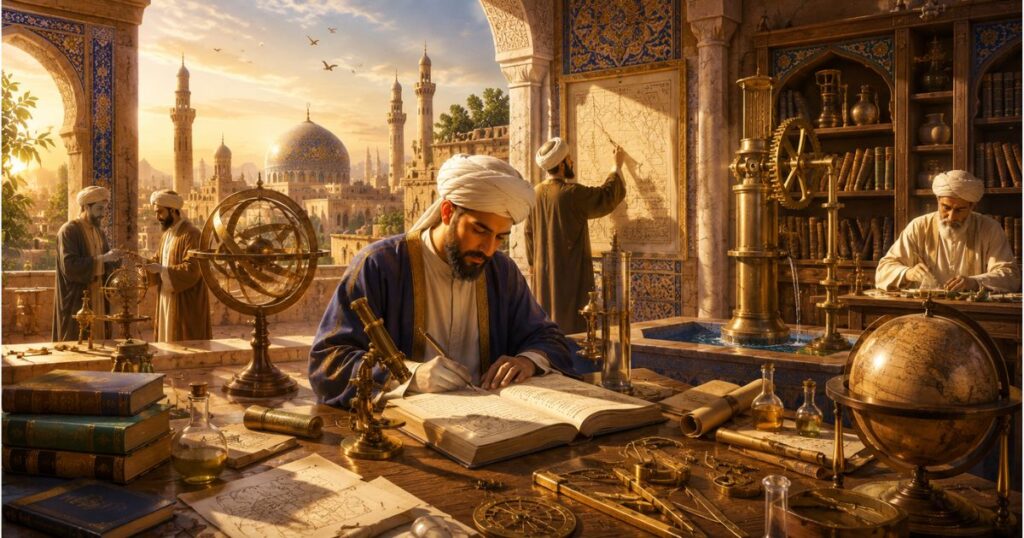
The Islamic Golden Age was a roughly 600-year period of explosive learning across the Muslim world. It kicked off after the founding of Baghdad in 762 CE, which quickly became a magnet for scholars.
Rulers paid good money to support scientists, doctors, and mathematicians. That patronage created a culture where curiosity was rewarded, not feared.
The brilliance wasn’t limited to one city. It spread from Córdoba in Spain to Baghdad in Iraq, with hubs in Cairo and Damascus too. Scholars of many faiths and backgrounds worked side by side. This mix of cultures made the science and technology of the Islamic Golden Age richer and faster-moving.
The House of Wisdom: the engine of innovation
Picture a place that mixed a library, a university, and a research lab centuries before any of those existed in their modern form. That was the House of Wisdom (Bayt al-Hikma) in Baghdad.
Scholars there launched a massive translation movement. They gathered the best books from Greek, Persian, and Indian thinkers, then translated them into Arabic. Texts that might have been lost forever were saved here.
But here’s the part most stories skip: they didn’t just copy old ideas. They tested them, corrected them, and built on top of them. A Greek math proof might go in, and a sharper, more useful version would come out.
This habit of questioning and improving is the real secret behind so many House of Wisdom inventions. Knowledge wasn’t a museum piece. It was a starting line.
Mathematical inventions that built modern computing
Every time you open a spreadsheet or run an app, you’re standing on math invented in this era. Islamic mathematicians turned numbers into tools that power your digital world.
| Invention | Inventor | Century | Modern Impact |
| Algebra | Al-Khwarizmi | 9th c. | Equations, spreadsheets, coding |
| Algorithms | Al-Khwarizmi | 9th c. | Computer science foundations |
| Arabic numerals & functional zero | Al-Khwarizmi / Al-Kindi | 9th c. | Modern arithmetic |
| Trigonometry advances | Al-Battani | 9th–10th c. | GPS, engineering |
| Cryptography & frequency analysis | Al-Kindi | 9th c. | Encryption, cybersecurity |
The star of this list is Al-Khwarizmi. His work gave us algebra, the branch of math that lets you solve for the unknown “x.” Without it, there would be no spreadsheets, no engineering software, and no coding as we know it.
He’s also the reason we have the word algorithm it comes from a Latin version of his name. So the next time someone mentions a social media algorithm, you can thank a 9th-century scholar. These Islamic Golden Age scientists and inventions truly built the foundation of computing.
Medical breakthroughs that save lives today
While much of Europe relied on guesswork, doctors in the Muslim world treated medicine as a science. Many of their methods still shape how you’re cared for today.
| Invention | Inventor | Century | Modern Impact |
| 200+ surgical instruments | Al-Zahrawi | 10th c. | Modern surgical tools |
| First teaching hospitals | Ahmad ibn Tulun | 9th c. | Hospital model |
| Regulated pharmacies | Islamic physicians | 9th c. | Modern pharmacy |
| Distinguishing smallpox from measles | Al-Razi | 9th–10th c. | Clinical diagnosis |
| Cataract surgery techniques | Islamic surgeons | 10th–11th c. | Ophthalmology |
The surgeon Al-Zahrawi wrote a 30-volume medical encyclopedia called Kitab al-Tasrif. It described over 200 surgical instruments, many of which look strikingly like the scalpels and forceps in operating rooms today. European surgeons leaned on his work for more than 500 years.
Then there’s Al-Razi, who was the first physician to clearly describe the difference between smallpox and measles through careful clinical observation. He also advanced distillation, a process used to make purer medicines. These are real Islamic inventions still used today every time you check into a hospital or pick up a prescription.
Mechanical and engineering marvels
Long before robots and cameras, Islamic engineers were building automated machines and studying light. They were inventors, tinkerers, and dreamers all at once.
- Al-Jazari’s elephant clock and automata. This 12th-century genius built incredible machines, including a giant elephant-shaped water clock packed with moving figures. Many historians call him the father of robotics.
- Ibn al-Haytham’s camera obscura. He used a dark room with a tiny hole to project images, laying the groundwork for every camera and photo you’ve ever taken.
- The magnifying glass and convex lens. In his Book of Optics, Ibn al-Haytham explained how lenses bend light knowledge that led to glasses, microscopes, and telescopes.
- Abbas ibn Firnas’s glider experiments. In the 9th century, he attempted human flight with a winged contraption, centuries before the Wright brothers.
- Windmills with multiple sails. Engineers designed efficient windmills to grind grain and pump water, boosting food production.
- Advanced textile machines. Improvements in spinning and weaving made cloth faster and cheaper to produce.
These medieval Islamic inventions show a culture obsessed with how the physical world actually works.
Navigation and astronomy tools
Want to cross an ocean or map the stars? You’d need the right gear. Islamic scholars refined the tools that made long-distance exploration possible.
- The astrolabe was refined into a multifunction device for navigation, timekeeping, and astronomy. Think of it as an early handheld computer for the sky.
- Compass refinements improvements that made the compass more reliable for ocean travel.
- Al-Idrisi’s world map (1154) one of the most accurate maps of its time. European explorers relied on it for centuries afterward.
These Islamic Golden Age discoveries didn’t just help sailors. They reshaped how humans understood their own planet.
Everyday inventions you use without realizing

Some of the biggest contributions aren’t in textbooks, they’re in your kitchen and bathroom. Here are a few Muslim inventions hiding in plain sight:
- Coffee culture coffee spread through the Muslim world and grew into the daily ritual billions enjoy today.
- Hard soap recognizable bars of soap, made with oils and lye, trace back to this era.
- The toothbrush miswak, a natural teeth-cleaning twig, was used long before modern brushes.
- Irrigation and crop rotation are smart farming methods that boosted food supplies.
- The first university al-Qarawiyyin, founded by a woman named Fatima al-Fihri around 859 CE, is recognized as the oldest existing degree-granting university.
Cultural and intellectual contributions
Innovation wasn’t only about science. It shaped games, music, and art too.
The earliest known strategic chess manuals, including Kitab ash-shatranj by Al-Adli, came from this era. They broke down openings and tactics, much like the chess guides players study today.
Music advanced as well. The oud, a stringed instrument, influenced the European lute and helped shape Western musical theory. So a piece of this golden age echoes in modern guitars too.
How knowledge traveled from the Islamic world to Europe
Great ideas don’t stay put. So how did these breakthroughs reach Europe and spark the Renaissance?
The answer lies in a few key crossroads. Toledo in Spain, Sicily, and Al-Andalus (Córdoba) became busy translation centers. Scholars there flipped Arabic texts into Latin, opening a floodgate of knowledge for European readers.
This second translation movement handed Europe centuries of advances in math, medicine, and astronomy all at once. It’s hard to imagine the Renaissance without it.
One famous example is Fibonacci, the Italian mathematician. After learning Arabic numerals through trade in North Africa, he helped popularize them across Europe replacing clunky Roman numerals. That shift made bookkeeping, science, and commerce far easier. This story of knowledge transfer is one of the most overlooked chapters in world history.
Did Islamic scholars invent the scientific method?
This is a big question, and the honest answer is nuanced. Islamic scholars didn’t invent the scientific method single-handedly, but one figure pushed it forward dramatically.
Ibn al-Haytham studied light using a clear cycle: observe, form a hypothesis, then test it with experiments. He insisted that ideas had to be proven, not just believed. That’s the heart of modern science.
Remarkably, he did this around the 11th century centuries before Europeans like Francis Bacon and Galileo championed similar methods. Many historians credit him as one of the earliest practitioners of experimental science.
So while it’s an overstatement to say one person “invented” the scientific method, Ibn al-Haytham deserves a front-row seat in its history.
Islamic Golden Age vs. the European Middle Ages

It helps to see how the two regions compared during the same centuries.
| Field | Islamic World (8th–14th c.) | Contemporary Europe |
| Medicine | Teaching hospitals, advanced surgery, regulated pharmacies | Limited care, often faith-based remedies |
| Mathematics | Algebra, algorithms, Arabic numerals | Cumbersome Roman numerals |
| Hospitals | Free, organized public hospitals | Few formal institutions |
| Education | Universities and major libraries | Mostly monastery-based learning |
| Scientific approach | Experiments and observation | Reliance on ancient authority |
A fair note: the idea that Europe sat in total “darkness” is overstated. Europe had its own achievements, and not everything in the Muslim world advanced evenly. Still, in many fields, the Islamic world was clearly ahead during these centuries.
Why this history still matters
Here’s something worth sitting with: you use the legacy of this era constantly, yet it rarely gets full credit. That gap is finally starting to close.
Look around and you’ll spot the fingerprints. The word algorithm runs through every tech conversation. NASA uses star tables and astronomical methods rooted in this period’s discoveries. University history programs now teach these contributions as essential, not optional.
Recognizing this legacy isn’t about rewriting history. It’s about telling it completely. When you give credit where it’s due, you get a truer picture of how human progress actually happened as a shared, global effort.
Conclusion
The inventions of the Islamic Golden Age transformed human knowledge and played a crucial role in shaping modern science and technology. From advanced medical practices to mathematical principles and engineering achievements, the contributions of Muslim scholars continue to impact the world today and remain an important part of global history.
FAQs
What is the Islamic Golden Age known for?
The Islamic Golden Age is known for major advances in math, medicine, astronomy, and engineering between the 8th and 14th centuries. Scholars created algebra, built early hospitals, refined the astrolabe, and preserved and improved knowledge from many cultures.
What is the most important invention of the Islamic Golden Age?
Many historians point to algebra, developed by Al-Khwarizmi in the 9th century. It transformed mathematics and now powers computer coding, engineering, and data analysis. The related concept of algorithms is equally foundational to modern computing.
Who invented algebra?
The mathematician Al-Khwarizmi is widely credited as the father of algebra. His 9th-century book introduced systematic methods for solving equations. The word “algebra” comes from “al-jabr,” a term in the title of his influential work.
What inventions from the Islamic Golden Age do we still use today?
You still use algebra, algorithms, surgical instruments, hospitals, pharmacies, soap, coffee culture, and the camera concept daily. Arabic numerals the digits 0 through 9 also come from this era and underpin all modern math.
Did the Islamic Golden Age influence the European Renaissance?
Yes. Arabic texts translated into Latin in Spain and Sicily gave Europe centuries of advances in science, math, and medicine. Figures like Fibonacci spread Arabic numerals, helping spark the intellectual revival of the Renaissance.
Where did the word “algorithm” come from?
The word “algorithm” comes from the name of the 9th-century mathematician Al-Khwarizmi. When his work was translated into Latin, his name became “Algoritmi,” which eventually evolved into the modern term used in computing.