
Embracing Islam is the beginning of a meaningful spiritual journey. A new Muslim guide helps beginners understand the core beliefs, daily practices, and values of Islam. Learning about the five pillars of Islam, daily prayers, the Quran, and Islamic manners can provide a strong foundation for growing in faith. Taking small, consistent steps is often the best way to build knowledge and confidence as a new Muslim.
What Is a New Muslim? (Convert vs. Revert Explained)
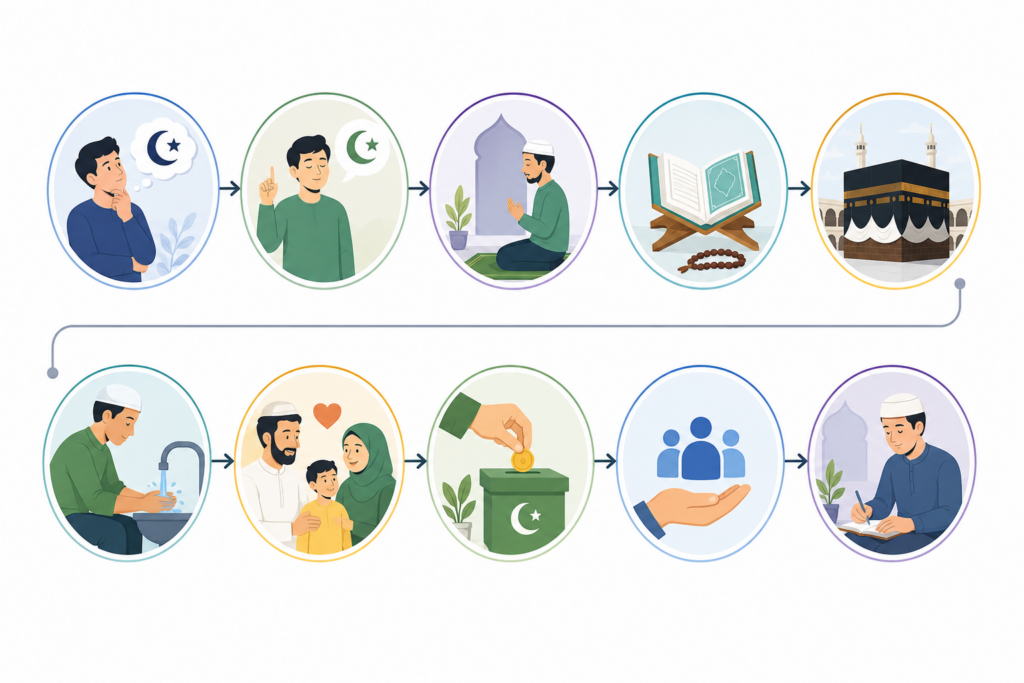
A “new Muslim” is simply someone who has recently accepted Islam. That’s it. Whether you came to faith last week or last month, this guide is for you.
You’ll hear two words a lot: convert and revert. They cause more confusion than they should, so let’s clear it up.
Convert vs. revert what’s the difference?
A convert is someone who changed from one belief (or no belief) to Islam. A revert comes from the idea that everyone is born in a natural state of faith, so accepting Islam is “returning” to that state.
Here’s the honest truth: both words mean the same person. Use whichever one feels right to you. Nobody is keeping score.
You don’t need to be perfect on day one
Many new Muslims feel pressure to know everything instantly. Please let that go. Even people born into Muslim families are still learning their whole lives.
Keep these reassurances close:
- You won’t get everything right at first, and that’s fine.
- Small, steady habits beat giant, exhausting efforts.
- Your sincerity matters more than your speed.
Your First 7 Days as a New Muslim (Step-by-Step Roadmap)
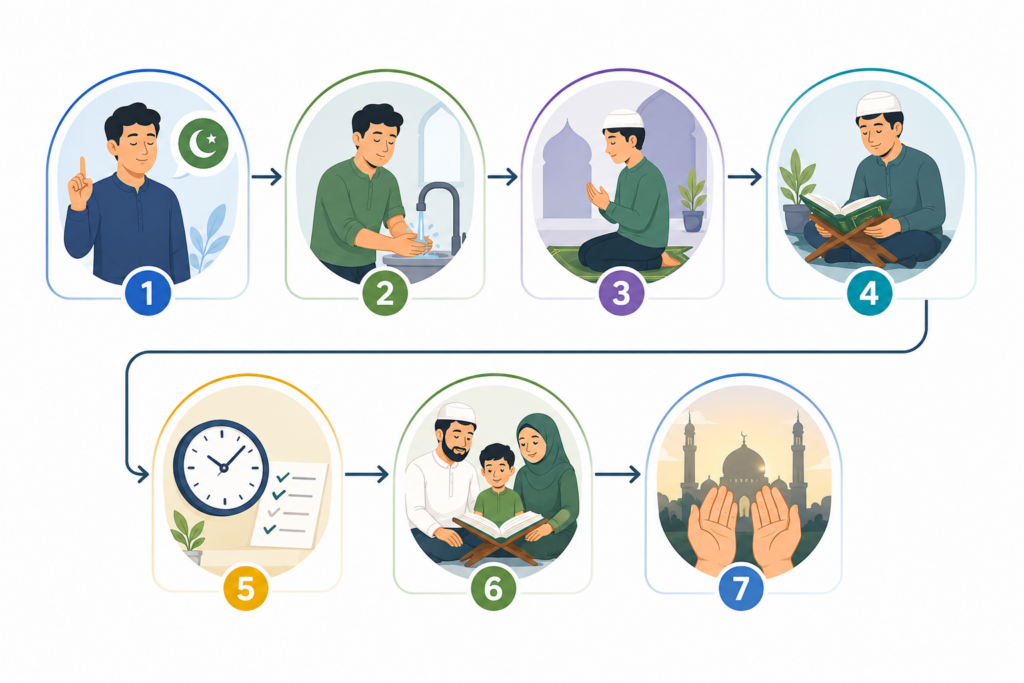
The biggest mistake new Muslims make? Trying to learn it all at once. So let’s slow things down with a gentle, day-by-day plan you can actually follow.
Days 1–2 Confirm your faith and learn purification
Start by settling into your Shahadah. You’ve made your declaration of faith, so take a breath and let it sink in.
Then learn wudu (a simple wash before prayer) and ghusl (a full-body wash). These keep you clean for worship and are easy once you’ve done them a couple of times. Our complete guide on how to pray as a Muslim covers Wudu step by step with full instructions for beginners.
Days 3–4 Learn one prayer at a time
Don’t try to memorize all five daily prayers in one sitting. Pick one prayer and learn its movements and words slowly. Our step-by-step Islamic prayer guide is designed exactly for this — taking you through each movement and recitation at a beginner’s pace.
Master one, then add the next. Within a week or two, the rhythm starts to feel natural.
Days 5–6 Sort out halal eating and daily habits
Take a quick look at what you eat. Swap out anything clearly off-limits, like pork and alcohol, and build simple halal habits.
You don’t need a perfect kitchen overnight. Small swaps count.
Day 7 Connect with a local community
Reach out to a nearby mosque or a Muslim friend. A warm hello can turn a lonely week into a supported journey.
Your first-week checklist:
- Settle into your Shahadah
- Learn wudu and ghusl
- Learn one daily prayer
- Make a few halal food swaps
- Contact a local mosque or community
The Faith Foundation Understanding Your Shahadah
Your Shahadah is the heart of everything. It’s your declaration of faith, and saying it sincerely is what makes you a Muslim.
In plain English, it means you believe there is only one God, and that Muhammad (peace be upon him) is His messenger. Simple words, life-changing meaning.
What is the Shahadah and why does it matter?
The Shahadah is the first of the Five Pillars of Islam, the core practices every Muslim builds their life around. It’s your foundation, the thing everything else rests on.
Saying it isn’t a one-time event you forget about. It’s a promise you carry forward, gently, every day. If you are ready to take your Shahadah or want to understand the full conversion process, read our complete guide on how to convert to Islam.
What changes (and what doesn’t) after you convert
People often imagine their whole life flips upside down. Mostly, it doesn’t. Here’s a realistic look:
| Before vs. After | What Actually Happens |
| Your name | Stays the same unless you choose to change it |
| Your family | Still your family relationships continue |
| Your job and hobbies | Continue, as long as they’re not harmful or forbidden |
| Your daily routine | Adds prayer and some new habits over time |
| Your past | Forgiven — Islam treats your fresh start as a clean slate |
The big shift is internal: more peace, more purpose, more mindfulness. The outside stuff changes slowly, at your pace.
How to Pray as a New Muslim (Beginner Salah Guide)
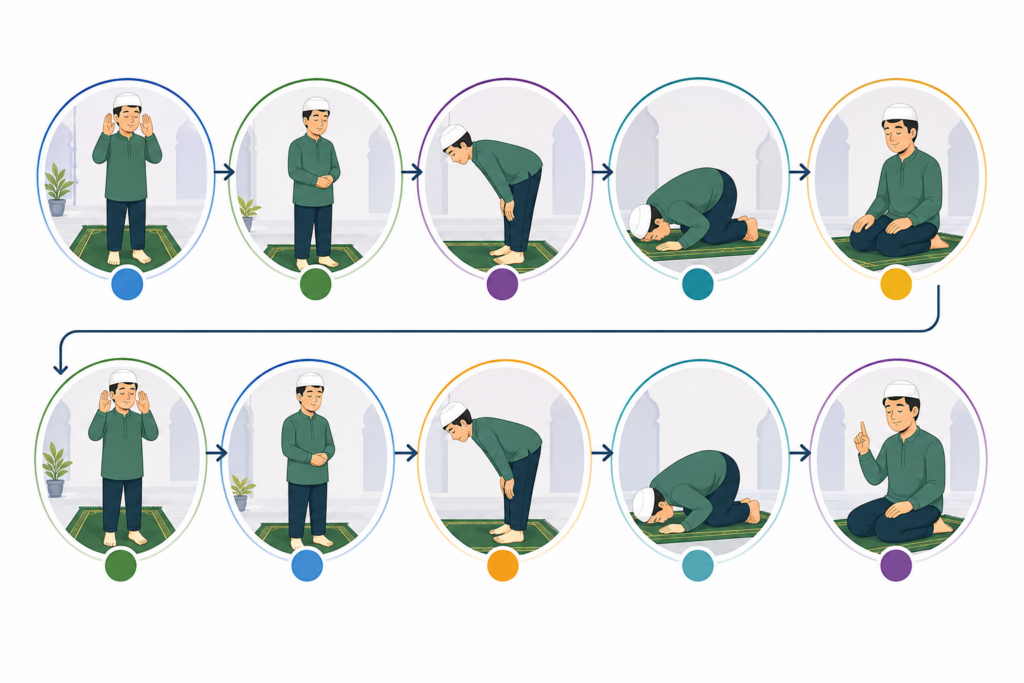
Prayer, called salah, is the most important habit to build early. Muslims pray five times a day, and yes, it feels like a lot at first. It gets easier fast. Our complete guide on how to pray in Islam walks you through every detail — from the opening Takbir to the closing Tasleem.
How to make wudu (ablution) step by step
Before prayer, you do a quick wash called wudu. Here’s the simple version:
- Wash your hands three times.
- Rinse your mouth three times.
- Rinse your nose three times.
- Wash your face three times.
- Wash your arms to the elbows, three times each.
- Wipe your head once and wipe your ears.
- Wash your feet to the ankles, three times each.
That’s it. After a few tries, it takes about a minute. Full details with visuals are available in our guide on how to pray as a Muslim.
The five daily prayers and their times
Here’s a quick map so you know what’s coming each day:
| Prayer | Time of Day | Units (Rakahs) |
| Fajr | Before sunrise | 2 |
| Dhuhr | Midday | 4 |
| Asr | Afternoon | 4 |
| Maghrib | Just after sunset | 3 |
| Isha | Night | 4 |
Don’t stress about the units yet. A prayer-time app will tell you exactly when each one starts.
How to find the Qibla direction in the U.S.
When you pray, you face the Qibla, the direction of the Kaaba in Mecca. From the United States, that’s roughly toward the northeast.
The easiest fix? Use a free Qibla compass app. It points you the right way in seconds, no guessing required.
Finding Halal Food in America (Practical U.S. Guide)
Eating halal in the U.S. is far easier than most new Muslims expect. Halal means permitted, and haram means forbidden. Once you know the basics, grocery shopping gets simple again.
What foods can Muslims eat and not eat?
Here’s a clear side-by-side:
| Halal (Allowed) | Haram (Not Allowed) |
| Fruits and vegetables | Pork and pork products |
| Fish and seafood | Alcohol |
| Halal-slaughtered meat | Meat not slaughtered properly |
| Grains, beans, nuts | Foods with hidden alcohol or gelatin from pork |
| Most dairy | Anything mixed with the above |
When in doubt, plant-based and seafood options are almost always safe.
How to read U.S. food labels for halal and haram ingredients
American labels are actually helpful. Watch out for sneaky ingredients like gelatin, lard, and vanilla extract (which can contain alcohol).
A few quick tips:
- Scan the ingredient list, not just the front of the box.
- Look for “halal certified” stamps when buying meat.
- When unsure, choose vegetarian versions to stay safe.
Where to buy halal meat and groceries in the U.S.
Most cities have halal grocery stores, and many big chains now stock halal-certified meat. Online halal butchers ship nationwide too.
Apps like Zabihah help you find halal restaurants and stores near you. One search and you’ll likely spot options you never noticed before.
Mosque Etiquette for New Muslims (What to Expect Your First Visit)
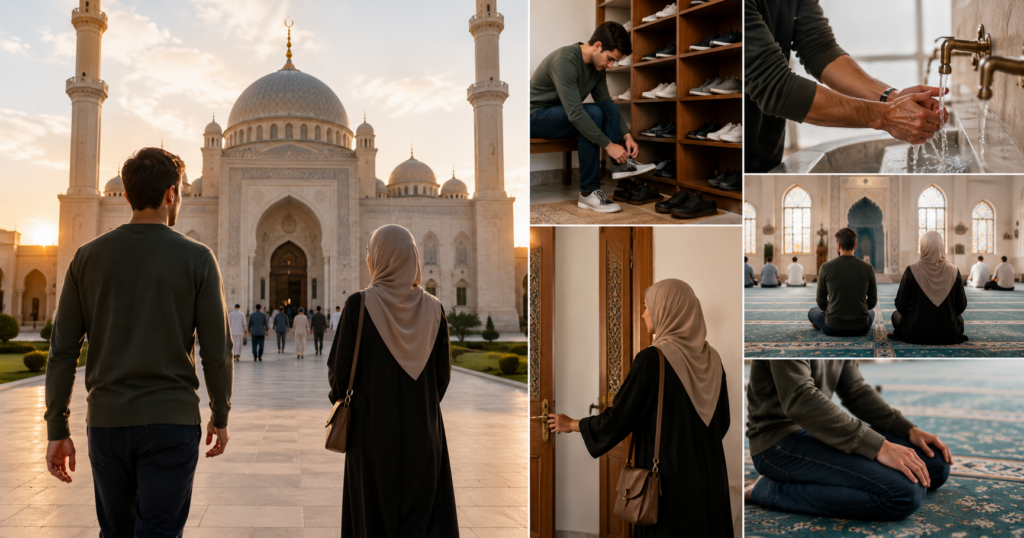
Walking into a mosque for the first time can feel scary. Take heart: mosques are welcoming places, and people love seeing new faces.
What to do before entering a mosque
A little prep makes everything smoother:
- Dress modestly loose, clean clothes that cover well.
- Make wudu at home or use the mosque’s washing area.
- Remove your shoes before stepping onto the prayer carpet.
- Arrive a few minutes early so you can settle in calmly.
Common etiquette mistakes to avoid
Nobody expects you to be flawless. Still, these small things help you feel confident:
- Don’t walk in front of someone who’s praying.
- Keep your phone on silent.
- It’s okay to sit quietly and watch if you’re unsure.
- Ask questions Muslims are usually thrilled to help a new Muslim.
Telling Your Family You Converted to Islam
For many new Muslims, this is the hardest part. Sharing your faith with family can feel terrifying, especially if you’re not sure how they’ll react.
How do I tell my family I converted to Islam?
Lead with love, not a lecture. Choose a calm moment, speak honestly, and focus on how this brings you peace.
Some gentle ways to start:
- “I’ve found something that gives me real peace, and I want to share it with you.”
- “I’m still me. This just helps me be a better person.”
- “I’d love for you to ask me anything you’re curious about.”
Handling difficult reactions with patience
Some families embrace the news. Others need time. Both responses are normal.
Stay patient and keep showing kindness through your actions. Often, your calm, caring behavior speaks louder than any explanation ever could.
Emotional Support You’re Not Alone
Let’s be real: becoming Muslim is exciting and overwhelming. If your emotions are all over the place, you’re not broken. You’re human.
Dealing with anxiety and overwhelm after converting
Big life changes stir up big feelings. You might feel joy one hour and doubt the next.
When the overwhelm hits, try this:
- Pause and pray even a short, simple prayer grounds you.
- Talk to someone you trust at a mosque or community group.
- Limit the noise step away from heated online debates.
- Rest faith isn’t a race, and burnout helps no one.
Why “one step at a time” beats trying to learn everything at once
Think of Islam like learning to swim. You start in the shallow end, not the deep one.
Master prayer first. Then food. Then the rest. Each small win builds your confidence and keeps your faith joyful instead of stressful.
Praying at Work and School in the U.S.
You can absolutely fit prayer into an American workday or class schedule. It takes a little planning, but thousands of Muslims do it every single day.
How to ask for prayer breaks at work
Most prayers take five minutes or less. A short, polite conversation usually solves everything.
Here’s a simple approach:
- Pick the right moment talk to your manager or HR privately.
- Keep it brief explain you need short breaks for prayer.
- Offer flexibility suggest using your lunch or regular break time.
- Stay positive most employers are happy to accommodate.
Under U.S. law, employers must reasonably accommodate religious practices, so you’re well within your rights to ask.
Finding a quiet space to pray on campus or in the office
You don’t need a fancy prayer room. A clean, quiet corner works fine.
Try an empty meeting room, a library study room, or a calm spot outdoors. Many colleges even have multi-faith prayer rooms just ask student services.
From One Convert to Another Real Experience and Expert Insight
Let’s get personal for a moment, because raw advice from people who’ve walked this road matters.
What I wish I knew in my first month as a Muslim
Talk to almost any convert and you’ll hear the same lessons again and again:
- You’ll feel like you’re behind. You’re not. Everyone starts at zero.
- One good habit beats ten half-finished ones. Prayer first, always.
- Find your people early. A supportive community changed everything for so many new Muslims.
- Mistakes aren’t failures. They’re proof you’re trying.
Many converts say their biggest regret was rushing and their biggest relief was finally slowing down.
An imam’s advice for pacing your learning
Experienced imams and teachers say the same thing again and again: go slow and build firm roots. A faith built in a hurry often cracks under pressure.
Trusted U.S. organizations like the Islamic Society of North America (ISNA) and the Islamic Circle of North America (ICNA) offer beginner programs designed exactly for this gentle, steady pace. Leaning on real teachers keeps your learning accurate and grounded.
Common Mistakes New Muslims Make (and How to Avoid Them)
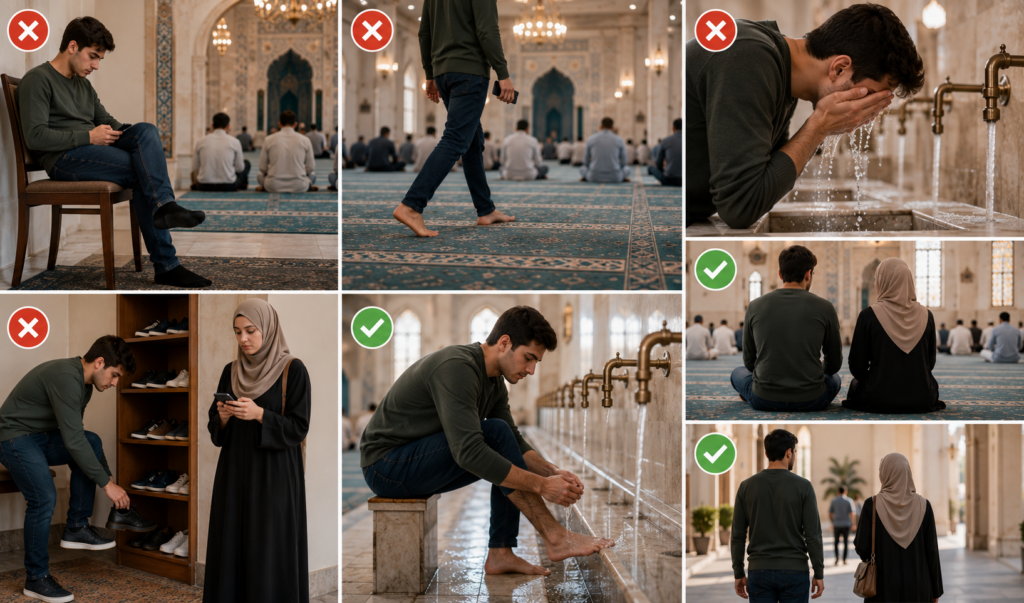
A little heads-up now saves a lot of stress later. Here are the most common slip-ups and easy fixes:
- Trying to learn everything at once → Focus on prayer first, then build slowly.
- Jumping into religious debates → Listen and learn before you argue.
- Rushing into marriage → Give yourself time to grow in faith first.
- Changing your name immediately → It’s optional, so don’t pressure yourself.
- Trusting every voice online → Stick to qualified teachers and trusted sources.
Avoid these, and you’ll dodge the burnout that trips up so many beginners.
Best Resources for New Muslims in the U.S.
You don’t have to figure this out alone. Plenty of trusted tools and groups exist to support you.
| Resource | Type | What It Helps With |
| Muslim Pro / Athan | App | Prayer times, Qibla, Quran |
| Zabihah | App | Finding halal food nearby |
| Quran.com | Website | Reading and learning the Quran |
| ISNA | Organization | Community, education, support |
| ICNA | Organization | New Muslim programs and mentoring |
Best apps for prayer times and Quran learning
A good prayer app is your new best friend. It handles prayer times, the Qibla direction, and even gentle reminders so you never lose track of your day.
U.S. organizations and communities that support new Muslims
Local mosques often run new-Muslim classes and pair you with a mentor. National groups like ISNA and ICNA can connect you to that support, wherever you live.
Conclusion
Becoming a Muslim is a life-changing experience that opens the door to spiritual growth and a closer relationship with Allah. By focusing on the basics, seeking authentic knowledge, and connecting with a supportive Muslim community, new Muslims can develop a strong understanding of their faith and continue learning throughout their lives.
FAQs
I converted to Islam now what do I do?
Start with the basics: confirm your Shahadah, learn wudu, and begin praying one prayer at a time. Don’t try to master everything at once slow, steady steps work best. Reach out to a local mosque for support when you’re ready.
Do I have to change my name when I convert to Islam?
No. You only need to change your name if it carries a harmful or offensive meaning. Most new Muslims keep their original name, and that’s perfectly fine.
Do I have to learn Arabic to be a Muslim?
Not at all. You can practice your faith fully in English, and millions of Muslims worldwide don’t speak Arabic. Over time you’ll pick up a few short prayer phrases, but there’s no rush.
What can Muslims not eat?
Muslims avoid pork, alcohol, and any meat that wasn’t slaughtered properly. Watch for hidden ingredients like pork gelatin and lard on food labels. When unsure, vegetarian and seafood options are almost always safe.
How do I find a mosque near me in the U.S.?
Use a maps app and search “mosque” or “masjid near me,” or try a finder app like Zabihah. National groups like ISNA and ICNA can also point you to local communities and new-Muslim programs.
What should I do right after taking Shahadah?
Take a breath and celebrate you’re a Muslim now. Then focus on learning purification (wudu and ghusl) and your first prayer. Keep things simple, and let everything else come step by step.