
Understanding the number of rakaats in salaah is essential for performing daily prayers correctly. Each prayer—Fajr, Dhuhr, Asr, Maghrib, and Isha—has a specific number of obligatory and optional rakaats, ensuring both completeness and spiritual reward in worship. This guide breaks down every prayer so you can pray with confidence.
Why Prayer is the Pillar of Faith
Imagine building a magnificent, towering house. What keeps it from falling down when the wind blows hard? A strong, solid foundation. For Muslims, daily prayer is that unbreakable foundation. It is the steady pillar that holds everything else up.
When you take a few minutes out of your busy day to pray, you are hitting the pause button on life. You are stepping away from homework, chores, and screens to have a private, one-on-one conversation with your Creator. This builds an emotional bond that fills your heart with warmth and joy.
The Role of Prayer Units in Perfecting Your Worship
To keep this connection strong and organized, the prayer is broken down into specific sections or units. Think of a unit like a lap in a swimming pool or a level in a video game. You complete one, and then you move on to the next, building up your spiritual score. Understanding the exact number of rakaats in salah helps you perfect your worship. It gives you a clear map to follow so you never feel lost.
Foundational Knowledge: Getting the Basics Right
Before we dive into the specific times of day, let’s learn about the different types of units you will encounter. It is actually much easier than it sounds!
What Are the Different Types of Prayer Units?
Not all parts of the prayer are exactly the same. They are sorted into a few simple categories:
- Obligatory (Fard): These are the absolute must-do units. Think of them as your main meal. If you skip them, you go hungry.
- Recommended (Sunnah): These are the extra units that the Prophet practiced regularly. They are like a healthy side dish. You don’t have to eat them to survive, but they make the meal much better and bring you amazing extra rewards.
- Optional (Nafl): This is the spiritual dessert! You can do these whenever you want extra credit or just want to spend more time feeling close to the Creator.
The Importance of Time Management
Time moves fast, doesn’t it? One minute you are eating breakfast, and the next, the sun is setting. Because there are five specific prayer times sprinkled throughout the day, they act as gentle alarms. They help you manage your time better. Instead of letting the day slip away, you break your day into beautiful, peaceful chunks.
Detailed Breakdown: Your Daily Schedule
Now, let’s look at the daily schedule. Each time of day has a different feeling and a different number of units to complete.
Dawn Prayer: Starting Your Day with Worship
Waking up while the rest of the world is fast asleep is a magical feeling. The dawn prayer is short, sweet, and incredibly powerful.
- Total Units: 4
- The Breakdown: 2 Recommended units followed by 2 Obligatory units.
Starting your morning this way wraps your heart in a protective shield of peace. It sets a positive, calm mood for your entire day.
Midday Prayer: Balancing Work and Worship
Right in the middle of the day, when you are busy at school or work, the midday prayer calls to you. It is a wonderful break from the noise and stress.
- Total Units: 12
- The Breakdown: 4 Recommended, 4 Obligatory, 2 Recommended, and 2 Optional.
Taking this break helps you breathe, refocus, and remember what truly matters in life.
Afternoon Prayer: A Moment for Reflection
As the sun starts to slowly dip lower in the sky, it is time for the afternoon prayer. This is a great time to show gratitude for the energy you had during the day.
- Total Units: 4
- The Breakdown: Just 4 Obligatory units.
It is a short and highly focused time to recharge your batteries before the evening begins.
Sunset Prayer: Transitioning from Day to Night
Watching the sunset is beautiful, and pairing it with prayer makes it even more special. This prayer has a unique, odd number of units.
- Total Units: 7
- The Breakdown: 3 Obligatory, 2 Recommended, and 2 Optional.
This prayer feels like a warm hug at the end of a long, tiring day.
Night Prayer: Ending the Day with Devotion
Before you close your eyes to sleep, you have one final meeting with your Creator.
- Total Units: 17
- The Breakdown: 4 Obligatory, 2 Recommended, 2 Optional, followed by a special 3-unit closing prayer, and ending with 2 more Optional units.
Finishing your day with the correct rakaats in salah ensures you go to bed with a clean slate and a happy heart.
Practical Guidance: How to Actually Do It
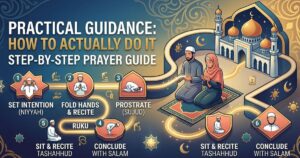
Knowing the numbers is great, but how do you actually make the physical movements? Let’s walk through it step by step, as if we are doing it together right now.
A Step-by-Step Guide to the Movements
- Standing: You start by standing up straight, looking respectfully down at the spot where your forehead will touch the ground. You raise your hands to your ears and say that the Creator is the Greatest.
- Reciting: While standing, you place your right hand over your left hand on your chest. Here, you recite the opening chapter of the holy book.
- Bowing: Next, you bend at the waist, resting your hands comfortably on your knees. Your back should be flat and straight.
- Standing Again: You pop back up to a standing position for just a brief moment.
- Prostrating (Resting on the Ground): This is the best part. You gently lower yourself so your forehead, nose, both hands, knees, and toes touch the floor. This is a moment of pure humility and the closest you can feel to the Creator.
- Sitting: You lift your head and sit back on your legs for a quick pause.
- Second Prostration: You go down and touch your forehead to the ground one more time.
Congratulations! You just completed one single unit.
What is the Correct Order of Movements?
You must always follow the steps exactly as they are listed above. You cannot bow before you stand, and you cannot rest on the ground before you bow. Keeping the order perfect shows discipline and respect.
How to Correct Mistakes
Did you accidentally forget a step? Don’t panic! We are all human, and mistakes happen. If you lose count or forget a movement, you can simply do two extra prostrations (resting your forehead on the ground) at the very end of your prayer before you finish. This acts like a magical eraser, fixing your little slip-up instantly.
Unique and Missing Topics: Real-Life Scenarios
Life does not always happen perfectly inside a quiet room. Sometimes you are on a plane, or you are feeling sick. Here is how to handle those tricky moments.
Praying While Traveling or in Difficult Situations
The Creator wants things to be easy for you, not hard! If you are traveling on a long journey, you are actually allowed to shorten your prayers. A 4-unit prayer can become a 2-unit prayer.
If you are sick or injured and cannot stand up, you can pray sitting down in a chair. If you cannot sit, you can even pray lying down in bed. The connection in your heart is what truly counts.
The Spiritual Benefits of Extra Prayers
Why would anyone do the optional units if they do not have to? Think of it like giving a surprise gift to someone you love. It brings incredible joy to both of you. Adding extra units builds a massive savings account of good deeds that will make you smile widely on a rainy day.
How to Use Prayer as a Stress-Relief Tool
Feeling worried about a big test? Did you have an argument with a friend? When you step onto your prayer mat and rest your forehead on the ground, let all those heavy worries slide right off your shoulders and into the floor. The physical movements help stretch your tired muscles, and the quiet words help slow down your racing mind. It is the best, free stress-relief program in the world.
Tips and Tricks for Beginners
Learning the rakaats in salah does not have to feel like studying for a difficult math test. Here are some fun and easy ways to master it.
How to Memorize the Units for Each Prayer
Use your fingers! Or better yet, write down a simple little cheat sheet.
- Dawn: 2
- Midday: 4
- Afternoon: 4
- Sunset: 3
- Night: 4
(These are just the obligatory ones). You can stick a colorful sticky note right next to where you pray until you have it memorized perfectly.
Using Visual Aids and Checklists
There is nothing more satisfying than checking a box. Create a fun daily chart. Every time you finish a prayer, put a bright sticker or a big checkmark in the box. Seeing your progress visually will make you feel incredibly proud of yourself.
Encouraging Family Members to Pray Together
Everything is better when you do it as a team! Grab your siblings, parents, or friends and pray together in a group. Moving at the exact same time creates a powerful feeling of unity and love. Plus, if you forget a step, the person next to you will help keep you on track.
The Journey of Devotion
You have learned so much today! You know why we pray, how to do the movements, and how to fix little mistakes along the way. Most importantly, you know that keeping track of the rakaats in salah is the secret key to building a strong, daily habit of talking to the Creator.
Conclusion
Knowing the rakaats for each prayer ensures that your salaah is complete and correct. Performing both fard and sunnah rakaats increases spiritual reward, strengthens your connection with Allah, and helps maintain consistency in daily worship. Remembering the rakaat structure for every prayer makes it easier to focus and pray with confidence.
FAQs
How many rakaats are there in Fajr prayer?
Fajr prayer consists of 2 obligatory (fard) rakaats and 2 optional (sunnah) rakaats before the fard. Performing both sunnah and fard brings maximum reward and spiritual benefit.
What are the rakaats for Dhuhr prayer?
Dhuhr prayer includes 4 fard rakaats and 4 sunnah rakaats before fard plus 2 sunnah rakaats after fard. Following this order helps maintain the full structure of prayer.
How many rakaats does Asr prayer have?
Asr prayer is 4 fard rakaats with 4 optional sunnah rakaats before fard. There are no confirmed sunnah rakaats after Asr, but performing pre-fard sunnah is recommended.
What is the rakaat structure for Maghrib prayer?
Maghrib prayer has 3 fard rakaats and 2 sunnah rakaats before fard plus 2 sunnah rakaats after fard. This makes it slightly shorter than other prayers but equally significant.
How many rakaats are in Isha prayer?
Isha prayer includes 4 fard rakaats and 4 sunnah rakaats before fard, plus 2 sunnah rakaats after fard. Many also perform Witr prayer (1–3 rakaats) after Isha for extra reward.