
Tahajjud is a voluntary night prayer performed after sleeping, ideally in the last third of the night before Fajr. The benefits of Tahajjud include closeness to Allah, forgiveness of sins, a higher chance of answered dua, and according to general sleep-science principles the mental clarity that comes from quiet, low-stimulation time. It isn’t obligatory, but it’s one of the most rewarded acts of worship in Islam.
What Is Tahajjud?
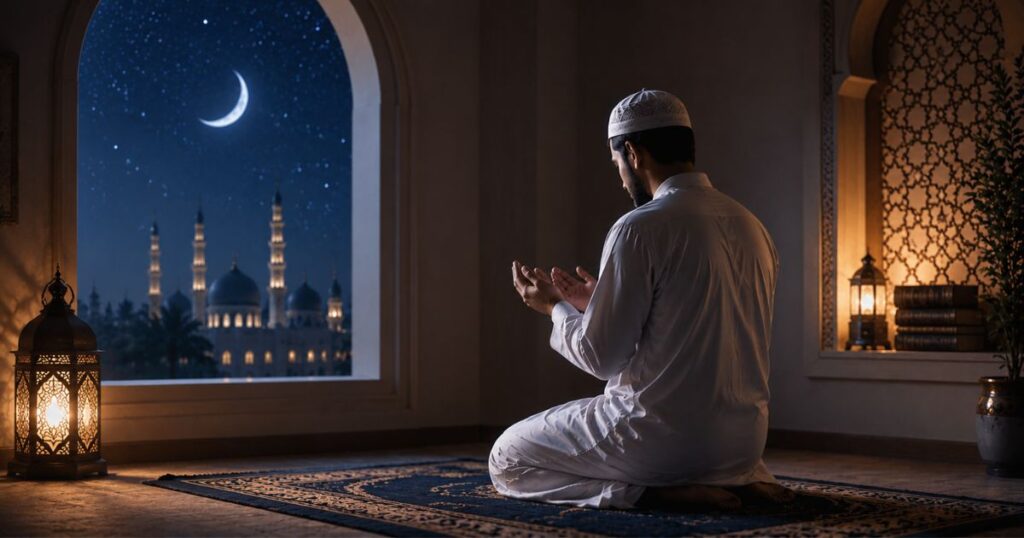
Tahajjud is a nafl (voluntary) prayer offered after waking from sleep, at any point in the night after Isha and before Fajr. It’s most virtuous when prayed in the final third of the night the window Islamic scholarship treats as spiritually the most valuable part of the 24-hour day. If you’re still getting comfortable with the five daily obligatory prayers that come before tahajjud, it’s worth mastering those first.
Tahajjud isn’t a single, isolated ritual. It sits inside a small family of night-worship terms that get mixed up constantly. Here’s the actual difference.
Tahajjud vs. Qiyam al-Layl vs. Witr vs. Taraweeh
| Term | What it is | When it’s prayed | Obligatory? |
| Tahajjud | Voluntary night prayer, prayed after sleeping | Any time after waking, ideally last third of the night | No sunnah/nafl |
| Qiyam al-Layl | The broader category of “standing in night worship” tahajjud is one form of it | Any part of the night, sleep not required first | No sunnah/nafl |
| Witr | An odd-numbered closing prayer (1, 3, 5… rakahs) | Prayed after Isha, often as the final prayer of the night, sometimes combined with tahajjud | Highly recommended; considered obligatory by the Hanafi school |
| Taraweeh | Special congregational night prayer during Ramadan only | After Isha, throughout Ramadan | No sunnah, but widely practiced |
In short: all tahajjud is qiyam al-layl, but not all qiyam al-layl is tahajjud. The defining feature of tahajjud is that you slept first, then woke up to pray. And if you’re curious how a whole night of voluntary prayer looks during Ramadan, our guide to Ramadan salat times and Taraweeh breaks that down too.
The Spiritual Benefits of Tahajjud (Quran and Hadith)
The Quran doesn’t just permit night prayer, it praises the people who do it. In Surah Al-Furqan, the righteous are described as those who spend part of the night in prostration and standing before their Lord. Surah Al-Isra similarly instructs believers to pray in part of the night as “an increase” of good deeds, hinting that its reward sits above the five obligatory prayers.
Here’s what that reward looks like in practical terms.
Closeness to Allah. According to a hadith recorded in Sahih al-Bukhari and Sahih Muslim, Allah descends to the lowest heaven in the final third of every night and asks who is calling on Him, so that He may answer who is asking, so that He may give who is seeking forgiveness, so that He may forgive. That window is treated as a uniquely open line of communication.
Forgiveness of sins. Multiple hadiths tie consistent night prayer to the erasure of past wrongdoing. It’s framed less as a one-time transaction and more as a habit that steadily reshapes character.
A stronger chance of answering dua. Scholars consistently point to the last third of the night as one of the most favorable times for supplication alongside moments like between the adhan and iqamah, or the last hour of Friday. Tahajjud gives that window a fixed, repeatable home in your routine.
Elevated rank and sincerity. Because it’s prayed alone, in private, with no one watching, tahajjud is widely regarded by scholars as one of the purest tests of sincerity in worship there’s no social reward for doing it, which is exactly why it’s valued so highly. This is very much in the same spirit as the extra sunnah prayers around Asr: nobody’s checking, so the sincerity is the whole point.
Following the example of the Prophet ﷺ. Historical accounts describe the Prophet Muhammad ﷺ maintaining tahajjud consistently, even praying to the point of swollen feet, according to hadith literature a detail scholars use to illustrate devotion rather than obligation, since he was not required to pray it.
What Does Science Say About Waking at Night to Pray?
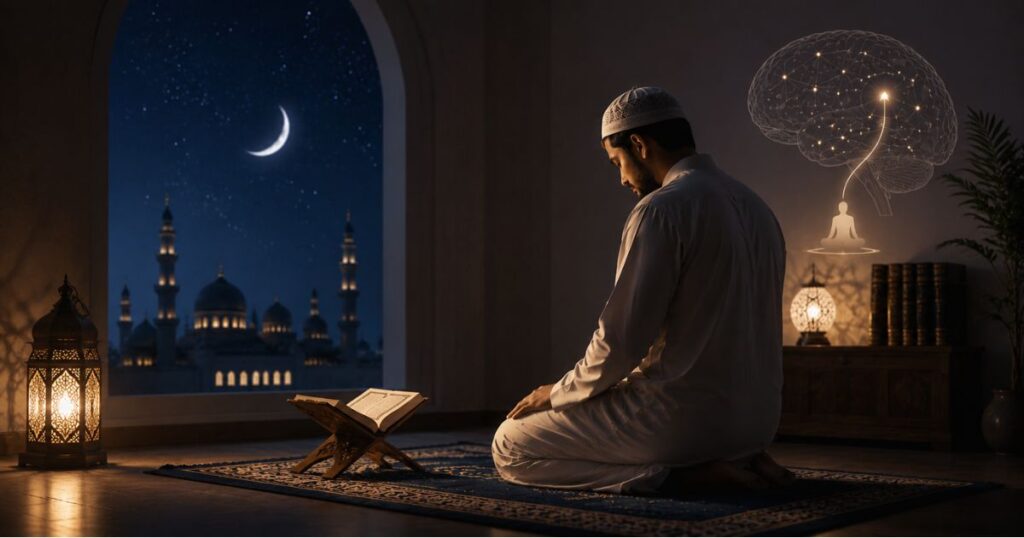
Here’s an honest note before this section: there’s no clinical study measuring “tahajjud” specifically this is devotional territory, not a lab-tested intervention. What can be said, grounded in general sleep science, is this:
- Brief nighttime waking is normal. Human sleep naturally cycles through lighter and deeper stages roughly every 90 minutes, and short wake periods between cycles are common. Tahajjud fits into a window your body may already be passing through.
- Quiet, low-stimulation environments are linked to lower stress reactivity. A dark, silent room with no screens is close to the ideal environment sleep researchers recommend for calming the nervous system before returning to sleep.
- Consistent routines (like a fixed wake-and-pray time) tend to support more stable circadian rhythms than irregular sleep-wake patterns, though this depends heavily on total sleep duration staying adequate.
The takeaway: praying tahajjud doesn’t have to fight your biology. Done with a reasonable total sleep window, it can align with how your body already works but it’s a spiritual practice first, not a productivity hack, and shouldn’t be pursued at the cost of chronic sleep deprivation.
How to Pray Tahajjud
- Sleep first. Tahajjud requires sleeping before you pray; that’s what separates it from general night prayer.
- Make your intention (niyyah). Silently intend that this prayer is for tahajjud.
- Perform wudu. Complete ablution before starting. If you need a refresher on the steps, our step-by-step wudu guide covers it in detail.
- Pray in sets of two rakahs. Each set follows the same structure as any two-rakah prayer Surah Al-Fatiha followed by another surah or verses of your choosing. If you’re still building confidence with the mechanics of a rakah, this step-by-step guide to praying in Islam walks through every movement and recitation.
- Take your time. Tahajjud is meant to be unhurried; longer recitation and reflection are part of the reward.
- Make dua after finishing. Use this time for personal supplication for forgiveness, guidance, or specific needs.
- Close with Witr, if you haven’t already prayed it after Isha.
How Many Rakahs Should You Pray?
There’s no fixed number; this is one of the most flexible acts of worship in Islam.
| Approach | Rakahs | Notes |
| Minimum | 2 | Widely cited as sufficient to fulfill the sunnah |
| Common practice | 8 | A frequently referenced pattern from descriptions of the Prophet’s ﷺ night prayer |
| Reported maximum | Up to 11–13 | Higher counts described in some hadith accounts, prayed in pairs, closed with Witr |
The consistent principle across all of this: pairs of rakahs, however many you can sustain with focus, matter more than hitting a specific number.
When Is “The Last Third of the Night”? How to Calculate It in the U.S.
This is where most tahajjud content stops short and it’s exactly where American Muslims get stuck, because “the last third of the night” isn’t a clock time. It shifts with sunset, sunrise, season, and your location.
Here’s the simple math:
- Find your local Maghrib (sunset) and Fajr (dawn) times for the day and any prayer-times app calibrated to your city works. Our breakdown of the five daily prayer times and what makes each one distinct is a good place to understand how Maghrib and Fajr are defined.
- Calculate the total time between Maghrib and Fajr. That’s your “night.”
- Divide that total by three.
- The last third begins two-thirds of the way through the night and runs until Fajr.
Example: If Maghrib is 8:00 p.m. and Fajr is 5:00 a.m., the night is 9 hours long. Two-thirds of 9 hours is 6 hours, so the last third begins at 2:00 a.m. and runs until 5:00 a.m.
Because the U.S. spans multiple time zones and daylight-saving shifts, this window moves throughout the year; it’s noticeably shorter in summer in northern states and longer in winter. Recalculating it monthly (not just once) keeps your timing accurate.
A Simple System for Actually Waking Up
Wanting to pray tahajjud and actually getting up for it are two different problems. Most people fail at the second one, not the first. Here’s a repeatable four-step system:
- Sleep-anchor first. Go to bed early enough after Isha that your total sleep still lands around 6–7 hours minimum. Tahajjud shouldn’t come at the cost of chronic exhaustion.
- Alarm placement, not alarm volume. Put your phone or alarm clock across the room, not beside your pillow. The extra 8 steps to turn it off breaks the half-asleep snooze cycle.
- Pre-decide your rakah count the night before. Deciding “I’ll do 2 rakahs tonight” before you’re tired removes the negotiation your groggy brain will try to have with you at 2 a.m.
- Stack it onto something existing. If you already wake for a bathroom break or your child’s feeding time, treat that as your trigger to pray 2 rakahs before going back to sleep, instead of trying to build an entirely separate wake-up event.
If staying consistent with any prayer not just tahajjud has been a struggle, this reader Q&A on having trouble praying consistently has some grounded, honest advice worth reading.
Tahajjud for Beginners, Families, and Those Who Are Sick or Traveling
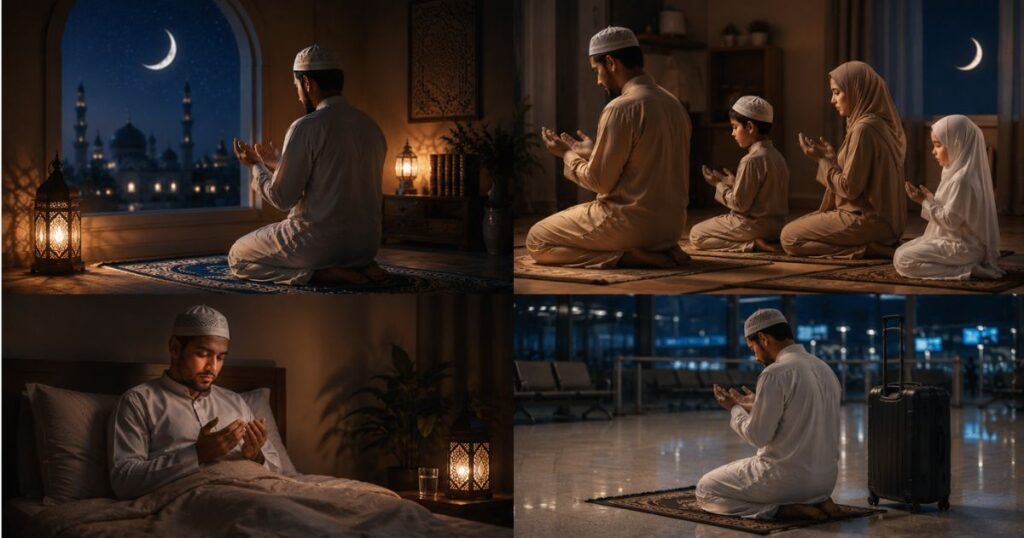
New to tahajjud? Start with 2 rakahs, 2–3 nights a week, before scaling up. Consistency in a small amount beats an ambitious routine that burns out in a week.
Praying with kids in the house? Many parents fold tahajjud into an already-broken sleep schedule, a feeding, a diaper change, a child’s nightmare rather than trying to protect a separate block of silence. A short, quiet 2-rakah prayer fits into those gaps without needing a perfectly still house.
Sick or unable to stand? Tahajjud, like other prayers, can be prayed sitting, or even lying down if standing and sitting both aren’t possible. The intention and sincerity carry the weight, not the physical posture.
Traveling? Prayers can be shortened while traveling under general Islamic travel allowances, and tahajjud remains voluntary either way even 2 rakahs in a hotel room count.
Conclusion
The benefits of Tahajjud extend far beyond the prayer itself. It is a powerful act of worship that strengthens your relationship with Allah, brings inner peace, increases spiritual awareness, and provides an opportunity to seek forgiveness and guidance during the quietest part of the night. Even praying a small number of rak’ahs consistently can have a lasting impact on your faith and daily life. Making Tahajjud a regular habit is a meaningful step toward spiritual growth and closeness to Allah. If you’re just starting to build your daily prayer foundation before adding tahajjud on top, our beginner’s guide to how to pray in Islam is the natural place to start.
FAQs
Is tahajjud obligatory or voluntary?
Tahajjud is voluntary (sunnah/nafl), not one of the five obligatory daily prayers. It carries significant reward but skipping it isn’t sinful.
Can you pray tahajjud without sleeping first?
Not technically tahajjud specifically follows a period of sleep. Praying extra units after Isha without sleeping first is generally categorized as general qiyam al-layl rather than tahajjud.
How many rakahs is tahajjud?
There’s no fixed number. Two rakahs fulfills the minimum; historical accounts describe the Prophet ﷺ praying up to 11–13 rakahs, always in pairs, closed with Witr.
What time should I pray tahajjud?
Any time after Isha and before Fajr technically counts, but the last third of the night calculated from your local Maghrib and Fajr times is considered the most rewarded window.
Do tahajjud duas actually get answered?
Islamic scholarship consistently describes the last third of the night as one of the times prayer is most likely to be accepted, based on hadith. It isn’t a guarantee tied to a specific outcome, but it’s treated as a spiritually optimal window for sincere supplication.
What’s the difference between tahajjud and qiyam al-layl?
Qiyam al-layl is the general term for standing in night worship. Tahajjud is a specific form of it that is prayed only after you’ve slept first.