
Islam teaches kindness and compassion toward all animals, including dogs. While dogs can be kept for specific purposes such as guarding, hunting, farming, or assistance, Islamic teachings also provide guidance regarding cleanliness and interaction with them. Understanding what does Islam say about dogs helps Muslims approach the topic with balance, respect, and proper knowledge.
What Does the Quran Say About Dogs?

Here’s something that surprises a lot of people: every time dogs show up in the Quran, they’re described in a neutral or positive light. Not once are they called evil.
Let’s look at the actual verses.
Dogs in Surah Al-Kahf (The Cave)
In Chapter 18, the Quran tells the story of a group of faithful young people who hid in a cave to protect their beliefs. Guarding the entrance? A loyal dog, stretching out its paws (Quran 18:18).
That dog isn’t a villain. It’s a quiet symbol of protection and companionship sitting right alongside righteous believers.
Hunting Dogs and Permissible Game
In Chapter 5, God allows Muslims to eat game that a trained dog catches for them (Quran 5:4). Think about that for a second. A trained hunting dog is trusted enough that the food it brings back is considered lawful to eat.
That’s a strong vote of confidence in a dog’s value and reliability.
“Communities Like You”
One of the most beautiful verses says that animals “form communities like you” (Quran 6:38). In plain English, animals aren’t random objects. They have dignity, purpose, and a place in creation dogs included.
What Did Prophet Muhammad Say About Dogs?
Prophet Muhammad’s teachings about dogs include both encouraging and cautious narrations. To be fair and accurate, you need both sides not cherry-picked quotes.
The Reward for Showing Mercy to a Thirsty Dog
This is one of the most touching stories in Islamic tradition:
A man walking in the desert was dying of thirst. He found a well, climbed down, and drank. As he came out, he saw a dog panting and licking the dirt, desperate for water. So he climbed back down, filled his shoe with water, and gave it to the dog. God forgave his sins for that act of mercy. (Bukhari)
When his companions asked if helping animals brought reward, the Prophet replied: “Helping any living thing has a reward.” Let that sink in. A man earned forgiveness because he was kind to a thirsty dog.
The Hadith on Working Dogs and Lost Reward
There’s also a narration that says whoever keeps a dog except for hunting, herding, or farming loses some reward each day (Bukhari).
Notice the wording. It doesn’t say keeping a dog is forbidden. It points to a loss of reward, which scholars have understood in different ways for centuries.
The “Black Dog” Hadith Context Matters
Some narrations sound harsh, including one where a black dog is described in a negative way. Critics love to quote these out of context.
But here’s the fuller picture: most scholars connect these statements to a specific danger at the time likely a rabies outbreak. Public safety came first. Many scholars hold that this ruling was later set aside once the danger passed. Today, Muslims are not allowed to harm dogs unless one poses a real threat.
Are Dogs Haram or Impure in Islam?
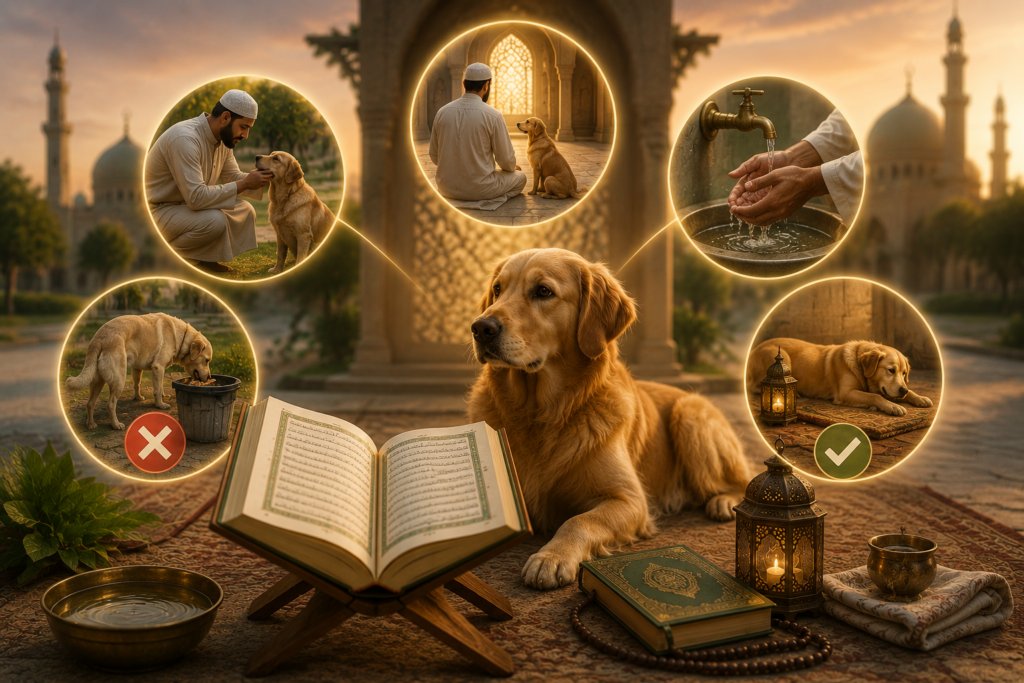
This is where most confusion lives. People mix up two very different ideas: haram (forbidden) and najis (ritually impure). They are not the same thing.
Owning a dog for a valid reason is allowed. The debate is mostly about a dog’s saliva and whether it affects your ritual cleanliness before prayer. If a dog licks you, many scholars say you simply wash that spot and you’re good to go.
Here’s a simple breakdown:
| Question | Common scholarly answer |
| Is owning a dog haram? | No — permitted for valid purposes |
| Is dog saliva impure (najis)? | Most schools: yes; minority: no |
| Is touching a dog sinful? | No — only saliva requires washing |
| Are dogs “evil”? | No — that’s a misconception |
So no, dogs aren’t “dirty creatures” in Islam. The concern is narrow and specific: keeping your body and prayer space clean.
Can Muslims Keep Dogs as Pets?
Here’s the honest nuance. Working dogs are clearly allowed. Keeping a dog purely as an indoor companion is where scholars disagree.
Permitted Roles for Dogs in Islam
Most scholars agree dogs are welcome for these purposes:
- Hunting bringing back game
- Guarding property and homes
- Herding and farming work
- Protection of people and livestock
Why Many Muslims Avoid Keeping Dogs Indoors
The main reason is ritual purity. Muslims pray five times a day, and prayer requires a clean body and clean space. A dog wandering through that space adds complications some prefer to avoid.
There’s also a narration about angels not entering a home that keeps a dog without need. For many Muslims, that’s enough reason to keep dogs outdoors rather than in the bedroom.
To be clear, this is about practical religious life not punishing the animal.
Service Dogs, Guide Dogs, and Emotional Support Dogs in Islam
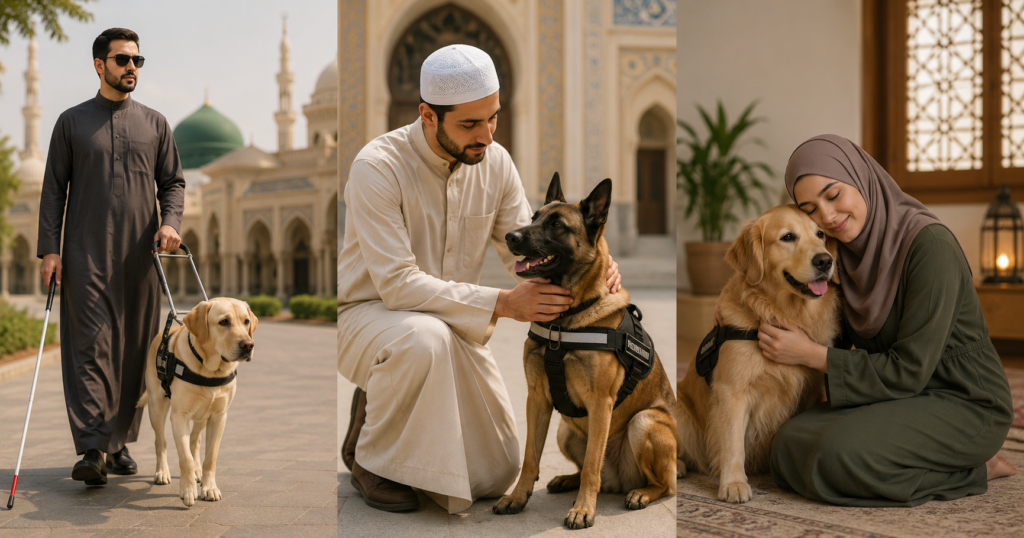
Now for a modern question the old textbooks didn’t address: What about service dogs?
Are Guide Dogs and Service Dogs Allowed?
Islamic law includes a powerful principle: necessity. When someone genuinely needs help, general preferences step aside. A blind person who relies on a guide dog isn’t keeping it for fun they need it to live safely and independently.
Because of this, most scholars permit guide dogs, medical alert dogs, and other service dogs. The need is real, so the allowance follows.
What About Emotional Support Animals?
This one is a little more layered. Scholars look at whether the need is genuine and documented, or simply a desire for company.
Here’s how the reasoning generally goes:
- Strong, verified medical need → widely permitted
- Mild preference for companionship only → more debated
- In all cases → kindness to the animal is still required
If you have a real need, most scholars will support you. The faith bends toward mercy and practicality.
How Do the Major Schools of Thought View Dogs?
Islam isn’t a monolith. There are different schools of legal thought (called madhhabs, meaning established methods of interpretation), and they don’t all see dogs the same way.
| School of thought | View on dog purity | View on keeping dogs |
| Hanafi | Saliva impure; body not fully impure | Discouraged unless for a purpose |
| Maliki | Dogs considered pure | Permitted; some say disliked |
| Shafi’i | Dog fully impure | Restricted to needed uses |
| Hanbali | Saliva impure | Permitted for valid purposes |
Notice the Maliki view stands out it treats dogs as pure, which is the most relaxed position. The Shia tradition tends to be stricter on saliva purity.
The big takeaway? If you ever hear “Islam says X about dogs,” remember there’s real, respectful disagreement among qualified scholars. The truth is more textured than a single yes or no.
Culture vs. Religion Why Some Muslims Fear Dogs
Here’s a truth that clears up a lot of misunderstanding: not every Muslim attitude about dogs comes from religion. A lot of it is culture, upbringing, and personal experience.
Think about it. Many people grew up in places where dogs weren’t pampered pets but wild street animals, sometimes aggressive and unvaccinated. If you were chased or bitten as a kid, you’d keep your distance too and that has nothing to do with faith.
Common reasons behind the hesitation include:
- Childhood fear or a past dog bite
- Allergies that make contact uncomfortable
- Cultural norms where dogs simply weren’t house pets
- Exaggerated interpretations of scripture passed down over generations
Separating culture from religion matters. Sometimes a Muslim avoids dogs out of genuine religious caution. Other times, it’s just personal preference dressed up as a rule.
Practical Questions About Dogs and Prayer
Let’s get practical. You’re a dog owner, your Muslim friend visits, and your golden retriever gives them a friendly lick. Now what?
How to Purify After a Dog Licks You
For many scholars, the steps are simple:
- Identify the spot the dog’s saliva touched your hand, arm, or clothing.
- Wash that area with water.
- For a licked dish or vessel, a well-known narration recommends washing it seven times, with one of those washings using earth or soil (or a modern equivalent like soap).
- Carry on once cleaned, you’re ready to pray.
That’s it. No drama, no panic.
Does Having a Dog Affect Your Prayer?
Owning a dog doesn’t automatically cancel your prayer. What matters is that your body, clothes, and prayer spot are clean when you pray. Keep your prayer area dog-free and washed, and your prayer stands. The dog can exist in your life without invalidating your worship.
Expert Insight A Scholar’s Perspective on Dogs in Islam
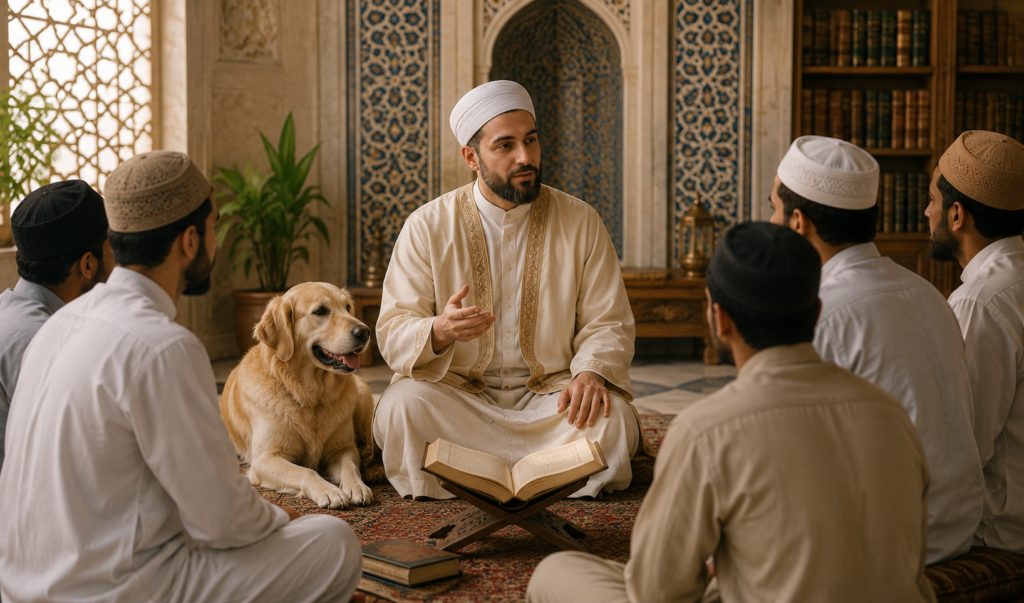
One voice worth knowing is Dr. Khaled Abou El Fadl, a professor of Islamic Law at UCLA and a respected authority on classical Islamic tradition. He happens to be a dog rescuer himself.
After years of digging through original sources, he questioned whether some of the harsher dog narrations were reliable at all. He noted that several trace back to weak chains of transmission, while a strong report describes the Prophet praying calmly as dogs moved nearby.
“Dogs represent my rebellion against ignorance about the basis of actual historical law,” he has said, pointing to the gap between authentic teaching and inherited bias.
This insight comes from comparing classical legal texts with modern scholarship side by side — the goal being balanced research, not personal opinion. It’s a reminder that careful study often reveals a kinder, more nuanced picture than the loudest assumptions suggest.
Kindness to Dogs What Islam Commands
If there’s one thing the sources agree on loudly, it’s this: mercy to animals is rewarded, and cruelty is forbidden.
A man was forgiven for giving water to a thirsty dog. That single story tells you where Islam’s heart lies.
Here’s what kindness looks like in practice:
- Feed strays and provide clean water
- Offer shelter and protection from harm
- Never take part in dog fighting or blood sports
- Don’t abandon an animal you’ve taken responsibility for
- Provide vet care when your dog is sick or hurt
Caring for a dog isn’t a loophole in your faith. For many scholars, treating animals well is part of being a good Muslim.
Conclusion
Islam encourages mercy toward dogs and all living creatures while outlining certain rules related to purity and keeping dogs. By following Islamic guidance and treating animals with kindness, Muslims can maintain both religious obligations and ethical responsibility.
FAQs
Are dogs haram in Islam?
No. Owning a dog isn’t forbidden, and dogs are permitted for hunting, guarding, and farming. The main concern is ritual purity for prayer, not prohibition. Dogs are never described as evil in the Quran.
Can Muslims have dogs as pets?
Most scholars permit dogs for useful roles like guarding or hunting. Keeping one purely as an indoor pet is debated, with the Maliki school being the most lenient. Outdoor working dogs face far less disagreement.
What should I do if a dog licks me?
Simply wash the area the dog’s saliva touched. For a licked dish, many scholars recommend washing it seven times, once using earth or soap. After cleaning, you’re free to pray normally.
Are black dogs treated differently in Islam?
One narration singled out a black dog, but most scholars link this to a specific past danger like rabies. It’s widely viewed as a temporary safety measure, not a lasting ruling against black dogs today.
Does Islam teach hatred toward dogs?
No, not at all. Islam commands mercy to every creature, and a man once earned forgiveness for helping a thirsty dog. The avoidance some Muslims practice relates to ritual cleanliness, never hatred.
Can Muslims own service or guide dogs?
Yes. The principle of necessity allows guide dogs, medical alert dogs, and other service animals. When someone genuinely needs the dog’s help, that real need outweighs the general preference to keep distance.