
Dhuhr prayer is the second of the five daily prayers in Islam. It begins shortly after the sun passes its highest point in the sky (solar noon) and continues until the time for Asr prayer starts. Since prayer times depend on your location and the date, the exact Dhuhr time changes every day.
In most places, Dhuhr is usually performed between 12:00 PM and 1:30 PM, but the precise timing should be checked through a local prayer timetable or mosque schedule. If you’re wondering what time is Dhuhr prayer, checking a reliable prayer time app or your local mosque is the best way to get the most accurate daily timing.
What Is Dhuhr Prayer?
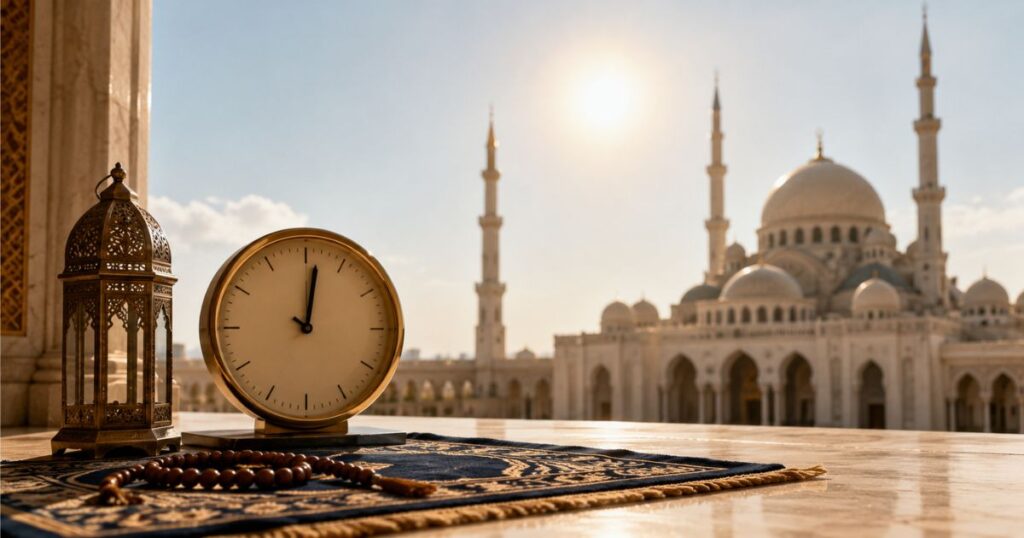
Dhuhr is the second of the five daily prayers in Islam, and it’s the one that marks the midpoint of your day. The word itself simply refers to the noon period, think of it as Islam’s built-in midday reset button.
Here’s what makes Dhuhr special: it’s the first prayer the sun “permits” after sunrise. Fajr happens before the sun rises. But Dhuhr can’t begin until the sun has fully crossed its highest point and started its descent, a concept Islamic scholars have tied to the sun’s position for over a thousand years, long before satellites or smartphones existed.
For most adult Muslims, Dhuhr consists of four obligatory units of prayer, called rakats, though many also add optional units before and after. We’ll break that down fully in a moment.
What’s worth remembering right now: Dhuhr isn’t just “lunchtime prayer.” It’s a deliberate pause built into the busiest stretch of your day, a moment to step back before you’re swallowed by meetings, errands, or screen time.
What Time Does Dhuhr Start and End?
This is the question everyone actually wants answered, so let’s get specific.
Dhuhr starts the moment the sun passes its zenith its highest point and begins moving toward the west. Dhuhr ends when the shadow of an object becomes longer than the object itself, which marks the start of Asr.
Here’s a simple breakdown:
| Stage | What Triggers It | Typical US Timing |
| Dhuhr Start | Sun passes solar noon | ~12:00 PM – 1:00 PM |
| Dhuhr End | Shadow length exceeds object height (Asr begins) | ~3:30 PM – 5:00 PM |
| Total Window | Roughly 3–4 hours |
That window matters. You’re not racing a five-minute timer — you have hours, not minutes, to fit Dhuhr into your day. That’s a relief if you’ve ever panicked mid-meeting wondering if you’ve already missed it.
Why Does Dhuhr Time Change Every Day?
Here’s the part almost nobody explains clearly and it’s honestly kind of fascinating once you get it.
The Earth doesn’t orbit the sun in a perfectly neat circle, and it’s tilted on its axis. Because of that, the sun reaches its highest point at a slightly different moment every single day, depending on where you are on the planet and what time of year it is.
Think about it like this: solar noon in New York City might be 12:58 PM in January but 1:31 PM in July. That’s nearly a 30-minute swing across the seasons. Your prayer app isn’t being inconsistent it’s tracking the actual sun, not a fixed clock number like 12:00.
This is also why Dhuhr time genuinely differs by city. Someone praying in Chicago and someone praying in Miami on the same day will see different times, sometimes by 20 minutes or more, simply because the sun reaches its peak at different moments depending on longitude.
What Is the Earliest and Latest You Can Pray Dhuhr?
The earliest you can pray Dhuhr is the moment solar noon passes you genuinely cannot pray it a second before, no matter how early you want to start your day.
The latest you can pray Dhuhr is right before Asr begins, which, as we covered above, is usually mid-to-late afternoon depending on your location and season.
If you’re someone who likes buffer room, here’s a practical tip: most people aim to pray Dhuhr within the first half of its window, just to avoid any last-minute scrambling if the day runs long.
How Is Dhuhr Time Calculated?
This is where things get genuinely interesting and where most prayer-time websites quietly skip over the explanation.
Different Islamic organizations use slightly different calculation methods to determine exact prayer times, based on subtle variations in how they define the sun’s angle relative to the horizon. Here’s a comparison of the major ones used across the US:
| Calculation Method | Commonly Used By | Typical Variance |
| ISNA (Islamic Society of North America) | Most US mosques and apps | Baseline |
| Muslim World League | Widely used internationally | ±1–3 minutes |
| Umm Al-Qura | Common in Gulf-region apps | ±2–5 minutes |
| Karachi (University of Islamic Sciences) | Popular in South Asian communities | ±2–4 minutes |
Here’s the honest truth: for Dhuhr specifically, the variance between methods is small usually just a few minutes because Dhuhr’s calculation depends mostly on solar noon, which is a fixed astronomical fact. The bigger differences between methods show up in Fajr and Isha calculations, not Dhuhr.
So if your app and your friend’s app show Dhuhr times three minutes apart, don’t panic. You’re both right. You’re just using slightly different equally valid calculation standards.
Here’s a number worth knowing: ISNA’s method is the one most commonly built into apps and websites serving the US, since it’s the calculation standard set by the largest Islamic organization in North America. If you’ve never changed your app’s default settings, there’s a strong chance ISNA is already the method you’re using without realizing it.
One more thing worth clearing up these methods don’t disagree on what Dhuhr is. They agree completely on the core definition: solar noon, then a short buffer, then the prayer window opens. The differences are razor-thin technical adjustments in how each organization rounds or defines that buffer. Think of it less like a disagreement and more like four slightly different rulers, all measuring the exact same distance.
Dhuhr vs. Other Daily Prayers How They Compare

Sometimes the easiest way to understand Dhuhr is to see it next to its neighbors.
| Prayer | Typical Timing | Rakats (Obligatory) | Congregational Requirement |
| Dhuhr | Midday | 4 | Recommended, not mandatory (except Friday) |
| Asr | Mid-to-late afternoon | 4 | Recommended |
| Jummah (Friday Dhuhr replacement) | Early afternoon Friday | 2 (plus sermon) | Mandatory for men in community settings |
Notice that last row? That’s not a typo Jummah genuinely replaces Dhuhr every Friday, and it works a little differently.
A quick gut-check most people find genuinely helpful: Dhuhr and Asr feel similar because they’re both daytime prayers, but they’re triggered by completely different signals. Dhuhr is anchored to the sun’s peak. Asr is anchored to shadow length specifically, the moment an object’s shadow grows longer than the object itself. That’s why Dhuhr’s window has a hard, predictable start (solar noon) but Asr’s start can feel a little less intuitive if you’re new to tracking it.
Here’s a real-world way to picture it: stand a yardstick upright in direct sunlight around midday. Right after solar noon, its shadow will be short barely a sliver. As the afternoon stretches on, that shadow grows. The exact moment the shadow becomes equal to, then longer than, the yardstick itself is the moment Dhuhr closes and Asr opens. It’s a method scholars have used for over a thousand years, long before there was any other reliable way to track the sun’s position.
Is Friday Prayer the Same as Dhuhr?
Not exactly but it’s close enough that the confusion makes total sense.
On Fridays, Muslim men are required to attend a congregational prayer called Jummah, which happens during the Dhuhr time window but replaces the regular Dhuhr prayer rather than adding to it. It includes a sermon (khutbah) and only two obligatory rakats instead of four.
Women and those unable to attend congregational prayer typically still pray a regular four-rakat Dhuhr at home, on their own schedule within the same time window.
How to Pray Dhuhr A Quick Step-by-Step Overview
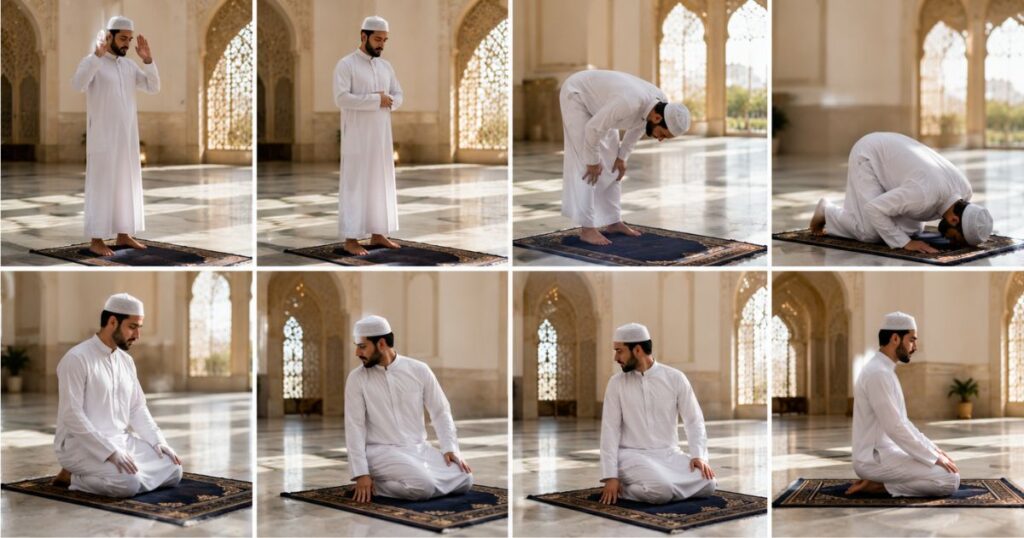
If you’re newer to this or just want a refresher, here’s the basic structure:
- Perform ablution (wudu) the ritual washing required before prayer
- Face the Qibla the direction of the Kaaba in Mecca
- Begin with the intention (niyyah) for Dhuhr specifically
- Complete four rakats, each involving recitation, bowing, and prostration
- Finish with the closing salutation (Tasleem)
Many people also add optional Sunnah rakats before and after the obligatory four but the four Fardh rakats are the non-negotiable core of Dhuhr.
A Personal Note on Staying Consistent With Dhuhr
Here’s something I’ve noticed firsthand, and maybe you’ve felt it too: Dhuhr is genuinely the hardest prayer to protect on a typical American workday.
Fajr happens before most people are even fully awake; there’s no competing obligation. Isha happens after work, when your evening is mostly your own. But Dhuhr? It lands right in the danger zone: back-to-back meetings, lunch rushes, school pickup windows.
I’ve watched friends miss Dhuhr not because they forgot, but because their calendar simply ate the window without warning. The fix that actually works isn’t willpower, it’s building a small buffer into your schedule, like blocking 15 minutes right after your typical solar-noon window, before the day has a chance to fill it up.
It sounds small. But that one scheduling habit is the difference between scrambling to catch Dhuhr at 4:45 PM and praying it calmly at 1:15 PM with time to breathe.
There’s another trick that’s made a real difference for people I know: treating Dhuhr like a recurring calendar event, the same way you’d block time for a doctor’s appointment. Not a vague reminder of an actual block, sitting right there next to your 1 PM stand-up or your lunch run. The moment Dhuhr lives on the same calendar as everything else competing for your attention, it stops losing that competition by default.
It’s a small shift in how you think about the day. But once Dhuhr has its own slot, it stops being the prayer you squeeze in if you remember and starts being the one thing in your afternoon that was already locked in before anything else got the chance to crowd it out.
Conclusion
Dhuhr prayer starts after the sun has crossed its zenith and remains valid until Asr prayer begins. Because prayer times vary by location and season, it is best to follow your local Islamic prayer calendar for accurate daily timings.
FAQs
What time is Dhuhr prayer today?
Dhuhr’s exact time changes daily based on your location and the sun’s position, typically falling between 12:00 PM and 1:30 PM in the US. Check a location-based prayer time tool for your specific city and date.
How many rakats are in Dhuhr prayer?
Dhuhr consists of four obligatory (Fardh) rakats. Many people also pray optional Sunnah rakats before and after, bringing the total higher for those who choose to.
What happens if I miss Dhuhr prayer time?
If you miss Dhuhr, Islamic teaching generally encourages making it up as soon as possible afterward, known as Qada. It’s treated seriously, but the emphasis is on returning to consistency, not guilt.
What’s the difference between Dhuhr and Zuhr?
There’s no real difference Dhuhr and Zuhr are simply two different spellings of the same Arabic word, both referring to the same midday prayer.