
What Makes Islam Different comes down to three core distinctions from other religions: it teaches absolute, undivided monotheism (Tawhid), it functions as a complete way of life rather than a set of Sunday beliefs, and it presents itself as the final chapter in a single prophetic tradition that includes Abraham, Moses, and Jesus. Add the Five Pillars, a scripture Muslims hold to be textually unchanged since revelation, and a claim to universality across race and culture, and you get a religion structured differently from Christianity or Judaism at almost every level theology, practice, and community.
Tawhid: Absolute, Undivided Monotheism
Tawhid is the Islamic doctrine that God (Allah) is one, indivisible, and without partners, equals, or intermediaries.
This sounds similar to Judaism’s monotheism at first glance, and in some ways it is. But Islam draws a sharper line than Christianity specifically around the nature of God. Where Christian theology holds that God exists as Father, Son, and Holy Spirit, Islam explicitly rejects any division within the Godhead. There is no Trinity, no incarnation, and no intermediary between the individual and God, not a priest, not a saint, not a prophet. If you want a broader foundation on this idea, our overview of what Islam actually teaches is a good starting point.
Muhammad, in this framework, is not divine and never claimed to be. He is understood strictly as a messenger, and Islamic theology treats any hint of divinizing him as a serious deviation from the faith. That single distinction, one undivided God, reached directly, without mediation shapes almost everything else that follows in Islamic practice.
Islam Is a Complete Way of Life, Not Just a Belief
Many religious traditions separate the “spiritual” from the “everyday” belief on one side, ordinary life on the other. Islam is built to resist that separation.
Sharia, often mistranslated simply as “law,” is better understood as a comprehensive framework covering worship, ethics, finance, family life, diet, and social conduct. It’s less a legal code bolted onto belief and more an attempt to make belief and daily behavior the same thing. A Muslim’s five daily prayers, dietary choices, business ethics, and treatment of neighbors are all, in theory, expressions of the same underlying submission to God including how families are raised, which is why practical guidance like raising children within Islamic teaching matters just as much as doctrine.
This is part of why Islam is frequently described by its own scholars and by researchers of comparative religion as less a “religion” in the Western sense and more a total framework for living. Brookings scholar Shadi Hamid has argued that Islam’s outsized role in law and governance what he calls “Islamic exceptionalism” is one of the more structurally distinctive features of the faith compared to Christianity, particularly regarding how resistant it has been to full separation from political life.
The Five Pillars: Belief Turned Into Daily Practice
If Tawhid is the theology, the Five Pillars are the mechanism that turns it into lived practice. They are:
- Shahada the declaration that there is no god but Allah, and Muhammad is His messenger. This is the entry point into the faith itself; anyone can make this declaration, including through reciting the Shahada and converting to Islam online.
- Salah prayer performed five times daily, facing Mecca, at fixed times.
- Zakat obligatory charitable giving, typically 2.5% of accumulated wealth, directed to those in need.
- Sawm fasting from dawn to sunset during the month of Ramadan.
- Hajj a pilgrimage to Mecca required once in a lifetime for those who are physically and financially able.
No single pillar stands alone. Each reinforces the same idea from a different angle: belief (Shahada), routine devotion (Salah), social responsibility (Zakat), self-discipline (Sawm), and communal unity (Hajj). Few other religious traditions codify practice into such a clear, repeatable, five-part structure that every adherent is expected to follow in the same form, worldwide. If you’re new to any of this, our step-by-step guide to prayer for beginners walks through exactly how Salah works in practice.
Finality of Prophethood: Where Islam Fits in the Prophetic Chain
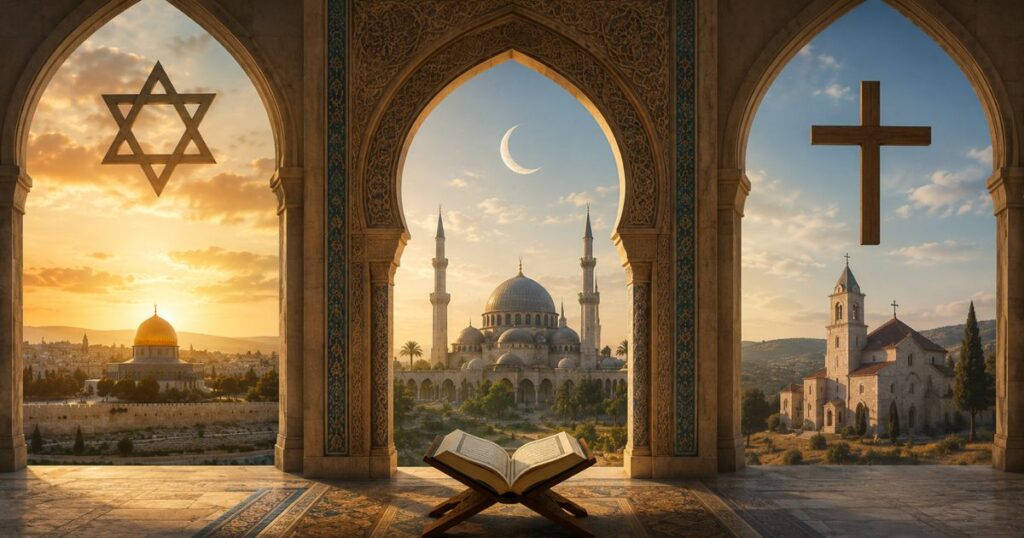
Islam presents itself not as a new religion, but as the final restatement of a single message delivered through many prophets including figures central to Judaism and Christianity.
Islamic theology holds that Adam, Abraham, Moses, and Jesus (Isa) were all prophets sent with the same essential message: worship one God alone. Muhammad is understood as the last in that chain the “Seal of the Prophets” meaning no further prophet or scripture is expected after him.
This creates a genuinely different relationship to Judaism and Christianity than either has to the other. Islam doesn’t reject the earlier prophets; it claims continuity with them while asserting that their followers, over time, altered or lost parts of the original message which is why, in Islamic belief, a final, unaltered revelation was necessary.
Islam vs. Christianity vs. Judaism: A Side-by-Side Comparison
| Islam | Christianity | Judaism | |
| View of God | Strictly one, indivisible (Tawhid); no Trinity | One God in three persons (Trinity) | Strictly one (monotheism) |
| Central scripture | Quran, held to be unchanged since revelation | Bible (Old + New Testament) | Torah / Tanakh |
| Founding figure | Muhammad final prophet, not divine | Jesus Christ believed divine, Son of God | No single founder; covenant with Abraham/Moses |
| View of Jesus | Respected prophet, born of a virgin, not divine, not crucified for salvation | Divine, Son of God, crucified for humanity’s sins | Not a central or messianic figure |
| Path to salvation | Faith plus righteous deeds, God’s mercy and judgment | Grace through faith in Christ | Covenant faithfulness, Torah observance |
| Core practice structure | Five Pillars (prayer, fasting, charity, pilgrimage, creed) | Sacraments, worship, varies by denomination | Torah observance, mitzvot, Sabbath |
This table isn’t meant to rank the traditions it’s meant to show where the actual differences sit. Most of the daylight between Islam and Christianity is in the nature of God and the status of Jesus. Most of the daylight between Islam and Judaism is in scripture, the identity of the final prophet, and the specific practice structure.
Why Islam Claims Universality Across Race and Culture
Islam does not tie religious identity to a specific ethnicity, nation, or bloodline a point Islamic scholars frequently emphasize when explaining the religion’s rapid global spread. Unlike some earlier monotheistic traditions historically tied to a particular people, Islam is presented as open to anyone, anywhere, regardless of race, language, or social status. The declaration of faith (Shahada) is the only requirement for entry, and it can be made by anyone in any country.
This universality is also structural: the five daily prayers, the Hajj pilgrimage, and the fasting calendar are performed identically by a factory worker in Lagos, a student in Toronto, and a merchant in Jakarta. Islam’s practice framework doesn’t flex by geography or class which is part of why it functions similarly across such a wide range of cultures.
A First-Hand Perspective: What Changes for People Who Convert
People who choose Islam later in life are often called “reverts” within the Muslim community, based on the belief that everyone is born in a natural state of monotheism frequently describing a similar shift: the appeal isn’t abstract theology first, it’s structure. Five fixed prayer times, a clear daily and yearly rhythm (Ramadan, Zakat), and a direct relationship with God without a clergy hierarchy are commonly cited as what made the practice feel immediately actionable rather than purely conceptual. . You can read this pattern echoed across dozens of real revert stories from people around the world.
Note for the brand: this section is strongest with real, attributed testimonials from converts you can interview or license a first-hand quote here (with permission) would meaningfully outperform a generalized summary for both trust signals and originality.
Conclusion
Islam’s core distinctions come down to five structural features: strict undivided monotheism (Tawhid), a belief-and-practice framework that doesn’t separate religion from daily life, the Five Pillars as a repeatable global practice structure, a claim to being the final message in the same prophetic line as Judaism and Christianity, and a universality that isn’t tied to any single ethnicity or culture. Together, these make Islam structurally distinct not just in what it teaches, but in how consistently that teaching is meant to be lived out day to day.
If any of this raised more questions than it answered, our FAQs page covers the most common ones directly, and the 7-Day Learning Plan or Learning Library are good next steps for going deeper.
FAQs
What makes Islam different from Christianity?
The clearest difference is the nature of God. Islam teaches strict, undivided monotheism (Tawhid) with no Trinity and no divine intermediary, while Christianity holds that God exists as Father, Son, and Holy Spirit, with Jesus as divine.
What are the Five Pillars of Islam?
The Five Pillars are Shahada (declaration of faith), Salah (five daily prayers), Zakat (charitable giving), Sawm (fasting during Ramadan), and Hajj (pilgrimage to Mecca once in a lifetime, if able).
Why is Islam described as a complete way of life?
Because Islamic teaching doesn’t separate belief from daily conduct, prayer times, diet, finance, and ethics are all treated as expressions of the same submission to God, rather than separate “religious” and “secular” categories.
Do Muslims believe in Jesus?
Yes. Muslims regard Jesus (Isa) as one of the major prophets of Islam, born of a virgin, but not divine and not crucified for the salvation of humanity a significant point of divergence from Christian theology.
Why do Muslims believe Muhammad was the final prophet?
Islamic theology holds that Muhammad is the “Seal of the Prophets,” meaning his message completes and finalizes the same core revelation given earlier to Abraham, Moses, and Jesus, and that no further prophet is expected.
Is Islam open to people of any race or culture?
Yes. Islam does not require any particular ethnicity, nationality, or ancestry; the declaration of faith is the sole requirement for entry, which is part of why the religion has spread across such a wide range of cultures and regions.