
How to pray for beginners Islam is a simple guide that helps new Muslims and learners understand the basics of Salah (Islamic prayer). Prayer is one of the Five Pillars of Islam and is performed five times a day. It includes purification (wudu), facing the Qibla, and performing specific movements and recitations. Learning the correct method helps build a strong connection with Allah and strengthens faith.
Preparing for Salah: Wudu and Cleanliness
Before you stand for prayer, you need to be in a state of physical and spiritual purity.
How to Perform Wudu Step by Step
Wudu is the Islamic act of washing specific body parts using water.
- Intention: Silently intend to perform Wudu for prayer.
- Wash hands: Wash your hands up to the wrists three times.
- Rinse mouth: Take water into your mouth and rinse three times.
- Sniff water: Gently sniff water into your nose and blow it out three times.
- Wash face: Wash your entire face three times.
- Wash arms: Wash your right arm up to the elbow three times, then the left.
- Wipe head: Wipe wet hands over your hair from front to back.
- Wash feet: Wash your right foot up to the ankle three times, then the left.
What Is Ghusl and When Is It Required?
Sometimes, Wudu is not enough. Ghusl is a full-body ritual bath. You need it after specific situations, such as intimacy or the end of a menstrual cycle, before you can perform Salah again.
Step-by-Step Guide to Performing Salah
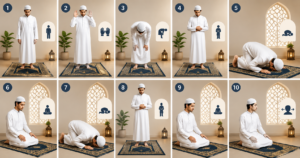
When researching how to pray for beginners islam, the physical movements are often the biggest hurdle.
How to Perform the First Rakah of Salah
A Rakah is a single unit of prayer. Here is how you complete the first one:
- Stand up straight: Face the Qibla (Mecca).
- Takbeer: Raise your hands to your ears and say “Allahu Akbar” (God is the greatest).
- Al-Fatihah: Recite the opening chapter of the Quran.
- Ruku (Bowing): Bow at the waist, hands on knees, saying “Allahu Akbar”. Say “Subhana Rabbiyal Adheem” three times.
- Stand back up: Say “Sami Allahu liman hamidah” as you rise.
- Sujood (Prostration): Go down to the floor. Your forehead, nose, both palms, knees, and toes must touch the ground. Say “Subhana Rabbiyal A’la” three times.
- Sit up: Sit briefly on your heels.
- Second Sujood: Prostrate one more time.
What Are the Differences Between the Five Daily Prayers?
| Prayer Name | Time of Day | Number of Obligatory (Fard) Rakahs |
| Fajr | Dawn | 2 |
| Dhuhr | Midday | 4 |
| Asr | Afternoon | 4 |
| Maghrib | Sunset | 3 |
| Isha | Night | 4 |
Common Mistakes Beginners Make in Salah (and How to Avoid Them)
Everyone makes mistakes when starting out. Do not let them discourage you.
- Rushing the movements: Take your time. Pause for a full second in each position.
- Stressing over perfect Arabic: God appreciates your effort. Do your best with the pronunciation while you learn.
- Forgetting the Qibla: Always double-check your direction using a reliable app before you start.
Preparing for Prayer: What You Need to Know
You cannot just jump out of bed and dive straight into the prayer. There is a beautiful runway leading up to it, designed to shift your mindset from worldly stress to spiritual focus.
What Are the Conditions for the Prayer?
Before you even begin, you need to check a few boxes.
First, you must be wearing clean clothes free from impurities.
Second, you need to cover your body respectfully. For men, this means covering from the navel to the knee. For women, it means covering the entire body except for the face and hands.
Third, you need to know the correct time. The five daily prayers are spread throughout the day: dawn, midday, afternoon, sunset, and night.
Finally, you must face the correct direction toward the holy city of Mecca. Do not worry about carrying a compass; there are plenty of free smartphone apps that will point you in the exact right direction.
How to Perform the Washing Rituals
Before you stand before God, you must be physically and spiritually clean. This is achieved through a specific washing routine. Here is how you do it step by step:
- Intention: Silently tell yourself that you are performing this wash for the prayer.
- Wash your hands: Wash both hands up to the wrists three times, making sure water reaches between your fingers.
- Rinse your mouth: Take a handful of water, rinse your mouth thoroughly, and spit it out. Do this three times.
- Clean your nose: Sniff water gently into your nose and blow it out three times.
- Wash your face: Wash your entire face, from the hairline to the chin, three times.
- Wash your arms: Wash your right arm up to the elbow three times, then repeat with your left arm.
- Wipe your head: Run your wet hands over your hair, starting from the front of your forehead to the back of your neck.
- Wash your feet: Finally, wash your right foot up to the ankle three times, then your left foot three times.
In certain situations like after intimate relations a full-body bath is required before you can pray again. This ensures you are in the highest state of physical purity.
Expert Insight: How to Stay Consistent with Salah
Consistency beats intensity. When mastering how to pray for beginners islam, your goal is building a lifelong habit, not passing a one-time exam.
Set alarms on your phone for each prayer time. If you miss one, do not spiral into guilt. Simply make it up (Qada) as soon as you remember.
Conclusion
Learning how to pray for beginners Islam becomes easier with regular practice and understanding the basic steps of Salah. By following proper guidance, performing wudu, and praying with focus, anyone can develop a strong spiritual routine. Consistency in prayer brings peace, discipline, and closeness to Allah.
FAQs
Do I have to pray in Arabic?
Yes, the core recitations of Salah must be in Arabic. However, personal supplications (Dua) after the prayer can be in English or any language you speak.
What if I make a mistake during prayer?
If you forget a step or mess up a recitation, you can perform two extra prostrations at the end of your prayer, known as Sujood al-Sahw.