
A Muslim revert is someone who accepts Islam as their faith, using a term rooted in the Islamic belief that every person is born with an innate awareness of God, called fitrah. What Is a Muslim Revert is a question often explained through this concept of returning to one’s original spiritual state. Rather than seeing this person as adopting something entirely new, “revert” frames their embrace of Islam as a return to that original spiritual state, not a conversion into it.
Muslim Revert: Definition
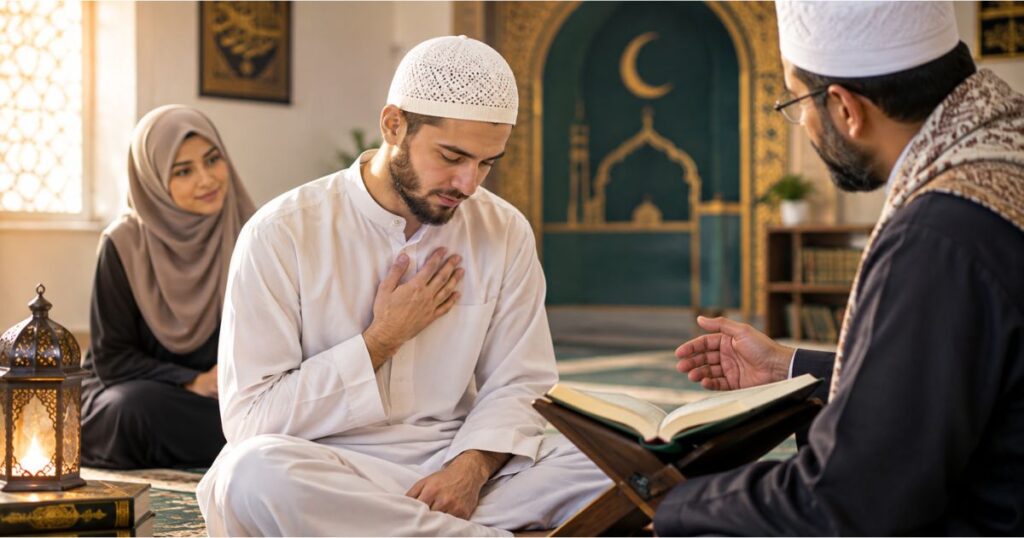
A revert is a person who has become Muslim, described using language that reflects the Islamic teaching that all humans are born Muslim by nature. The word draws on the concept of fitrah, an inborn disposition toward recognizing and submitting to one God and implies the person is going back to that state rather than starting fresh. If you’re asking this question because you’re considering the step yourself, Can Anyone Be Muslim? Yes Here’s Your Complete Guide is a natural next read.
Functionally, a revert and a convert are the same person doing the same thing: declaring the shahada and beginning to practice Islam. The difference is entirely in the framing, not the process.
Why Do Muslims Use “Revert” Instead of “Convert”?
The term traces back to a hadith a recorded saying of the Prophet Muhammad found in the collections of Bukhari and Muslim, which states that every child is born upon the fitrah, and it is their upbringing that shapes them into a Jew, Christian, or another faith. Two Quranic verses are commonly cited alongside it:
- Quran 30:30 describes the fitrah as a natural disposition that God has built into every person.
- Quran 7:172 refers to a primordial moment in which all human souls testified to God’s lordship before being placed into bodies.
Together, these texts form the theological basis for saying that becoming Muslim isn’t adopting a foreign belief system, it’s realigning with the one you were born with.
Revert vs. Convert What’s the Difference?
Both words describe the same life event. Here’s how they actually differ in meaning and usage:
| Convert | Revert | |
| Literal meaning | To change from one belief to another | To return to a former state |
| Theological basis | Neutral no religious claim | Based on the fitrah belief (born Muslim) |
| Where it’s more common | Non-Muslim audiences, general English usage, media | Muslim communities, especially in the US, UK, and Gulf countries |
| Connotation for critics | Implies active choice and transformation | Some scholars argue the word “revert” usually carries a negative sense of relapsing or regressing in everyday English |
| Familiarity | Instantly understood by anyone | Often requires explanation to non-Muslims |
Is “Revert” Linguistically Accurate?
Not everyone agrees that “revert” is the right word and this is worth taking seriously rather than glossing over.
Critics point out that in standard English, “revert” usually describes going back to something negative: a person reverting to old habits, or a system reverting to a previous, less desirable state. Writer Amjad Tarsin has argued that using it to describe embracing Islam actually undersells the significance of the decision, and that the fitrah hadith supports the idea that people have the natural capacity to recognize truth, not that they were once active, practicing Muslims who then lapsed.
Others go further, arguing the reasoning behind “revert” doesn’t hold up linguistically or theologically, since the Arabic word for someone who returns from Islam murtad actually means an apostate, someone who has left the faith. That’s the opposite of what a new Muslim is doing, which is exactly why some scholars avoid the “revert” framing altogether: it borrows the logic of returning without meaning to invoke the word murtad itself.
Important distinction: “Revert” and “murtad” are not the same word and are not related linguistically; “revert” is an English word chosen to reflect the fitrah concept, not a translation of any Arabic term. The overlap in meaning (both involve a kind of “return”) is where the confusion comes from, even though the two describe opposite spiritual outcomes.
What Do You Call Someone Who Becomes Muslim?
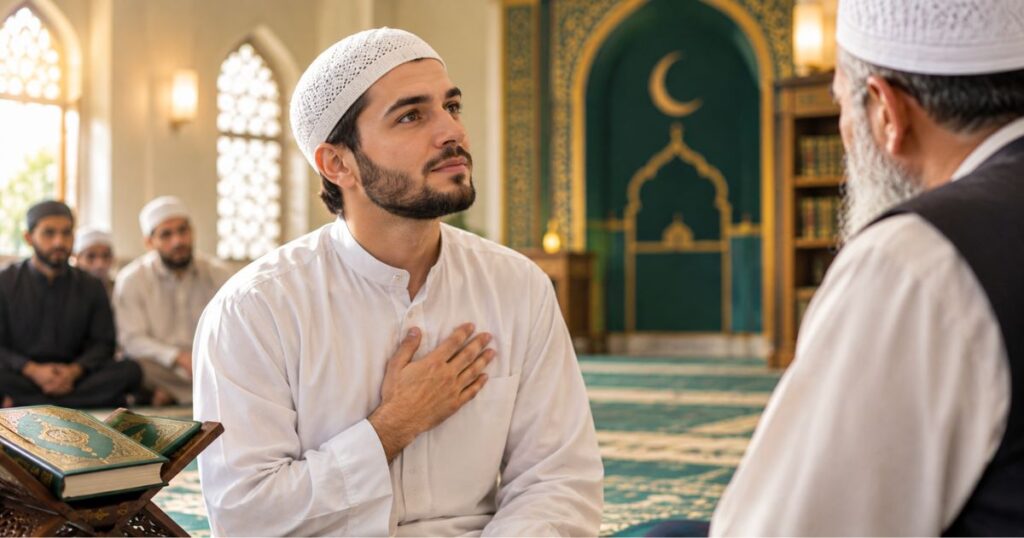
There’s more than one accepted term, and which one you’ll hear depends on where you are and who you’re talking to:
- Convert the most universally understood term in English, used across media, academic writing, and everyday conversation.
- Revert common within Muslim communities, particularly in the US, UK, and Gulf countries, reflecting the fitrah belief.
- New Muslim a neutral, increasingly preferred term used by organizations like the UK’s Convert Muslim Foundation, avoiding the theological debate entirely.
- Mualaf is the equivalent term used in Malaysia and Indonesia, referring to someone whose heart has been “inclined” toward Islam.
None of these terms is officially mandated. Islam doesn’t assign a specific label to new believers; the Quran simply refers to them as entering the faith or being counted among the Muslims.
How Does Someone Become a Muslim Revert?
Becoming Muslim is a straightforward process, regardless of which term someone chooses for themselves afterward:
- Sincerely believe in the core tenets of Islam the oneness of God and the prophethood of Muhammad.
- Recite the shahada the declaration of faith: bearing witness that there is no god but God, and that Muhammad is His messenger. For exactly what to say and how this moment works, see What to Say to Convert to Islam: A Simple Guide.
- Say it with intention, ideally in front of witnesses (often at a mosque), though this isn’t a strict requirement the sincerity of the declaration is what matters.
- Begin learning the basics of how to pray (salah), the five pillars, and daily practice, usually with support from a local mosque or a more experienced Muslim mentor.
- Connect with a community many mosques and organizations run dedicated support programs for people new to the faith, since the adjustment period (socially, culturally, sometimes with family) can be significant.
There’s no waiting period and no formal registration required by the religion itself; the shahada itself is the entry point.
Which Term Should You Use?
There’s no wrong answer here, but context helps:
- Talking to a general audience? “Convert” is instantly understood and carries no unintended assumptions.
- Talking within a Muslim community? “Revert” is widely used and understood, though not universally loved, some Muslims who’ve embraced Islam as adults strongly prefer “convert” for exactly the reasons outlined above.
- Not sure, or writing for a mixed audience? Many writers use “revert/convert” together, or simply ask the individual which term they prefer for themselves. Preference varies person to person, and it’s generally seen as respectful to follow someone’s lead when they introduce themselves.
Conclusion
A Muslim revert is simply someone who has become Muslim, using language built around the belief that everyone is born with an innate awareness of God (fitrah). “Revert” and “convert” describe the exact same life event; the real difference is theological framing, not process. Both terms are accepted; which one to use often comes down to personal preference and audience. If you’re at the very start of this journey, our Prayer Guide and 7-Day Learning Plan are good next steps.
FAQs
Is it offensive to call someone a convert instead of a revert?
No. “Convert” is the more universally recognized term and isn’t considered offensive. Some Muslims strongly prefer it over “revert” for personal or linguistic reasons, so it’s always safest to use whichever term the individual uses for themselves.
What does fitrah mean?
Fitrah refers to the innate, God-given disposition every person is believed to be born with in Islam an inborn inclination toward recognizing and submitting to one God, before upbringing and environment shape a person’s beliefs.
Is “revert” a real English word?
Yes. Outside of Islamic usage, “revert” is a standard English word meaning to return to a former condition, often used in contexts like software (“revert to a previous version”) or behavior (“revert to old habits”).
Do all Muslims agree on using the word “revert”?
No. Usage varies by community, country, and personal preference. It’s common in the US, UK, and Gulf countries, but a meaningful number of scholars and everyday Muslims prefer “convert” or “new Muslim” instead.
How is a Muslim revert different from someone born into a Muslim family?
Functionally, they’re both Muslim once the shahada has been declared. “Revert” specifically describes someone who embraced Islam as an adult (or older child) after being raised in a different faith or no faith, rather than someone raised Muslim from birth.