
What Is the Shahada in Islam? The Shahada is the Islamic testimony of faith, stating: “There is no god but Allah, and Muhammad is the messenger of Allah.” It’s the first of the Five Pillars of Islam, and reciting it sincerely with understanding and belief is the act that makes someone a Muslim. It’s spoken in daily prayers and is often the very first and last phrase a Muslim says in life.
The Shahada in Arabic, Transliteration & English
Arabic: أشهد أن لا إله إلا الله وأشهد أن محمداً رسول الله
Transliteration: Ashhadu an la ilaha illallah, wa ashhadu anna Muhammadan rasulullah
English translation: “I bear witness that there is no god but Allah, and I bear witness that Muhammad is the messenger of Allah.”
The word Shahada itself comes from the Arabic root shahida, meaning “to witness” or “to testify.” It’s not just a belief statement it’s framed as testimony, the same word used for a witness in a courtroom. You’re not simply agreeing with an idea. You’re declaring it as fact, on record.
The Two Parts of the Shahada
The Shahada is built from two distinct declarations, and both are required together:
- Tawhid (Oneness of God): “There is no god but Allah” an affirmation that God is one, without partners, equals, or intermediaries.
- Risalah (Prophethood): “Muhammad is the messenger of Allah” an affirmation that Muhammad was sent by God as His final prophet.
Saying only the first half isn’t the Shahada. Both halves have to be spoken and believed for it to count as the Islamic testimony of faith.
How to Pronounce the Shahada
For English speakers, the phonetic breakdown looks like this:
- Ash-ha-du an lā i-lā-ha il-lal-lāh
- wa ash-ha-du an-na Mu-ham-ma-dan ra-sū-lul-lāh
A few tips that help most beginners:
- The “la ilaha illallah” section is the phrase you’ll hear most often; it’s worth practicing on its own first.
- Arabic has sounds that don’t exist in English (like the guttural “h” in “ilaha”), so hearing it recited aloud from a teacher, imam, or reliable audio source will get you further than text alone.
- There’s no requirement to sound perfect. What matters is genuine understanding and belief, not flawless Arabic accent.
Why the Shahada Matters in Islam
The Shahada isn’t a slogan, it’s the theological foundation of the entire religion. It establishes Tawhid, the core Islamic concept that God is absolutely one, with no equal and no partner. Everything else in Islamic belief and practice builds on that single idea.
It’s also deeply woven into daily life. Muslims recite the Shahada:
- During each of the five daily prayers (Salah)
- At the moment someone converts to Islam
- Ideally, as the last words spoken before death
That last point matters to many Muslims personally; the Shahada is often described as the sentence they hope to open and close their life with.
The Shahada and the Five Pillars of Islam
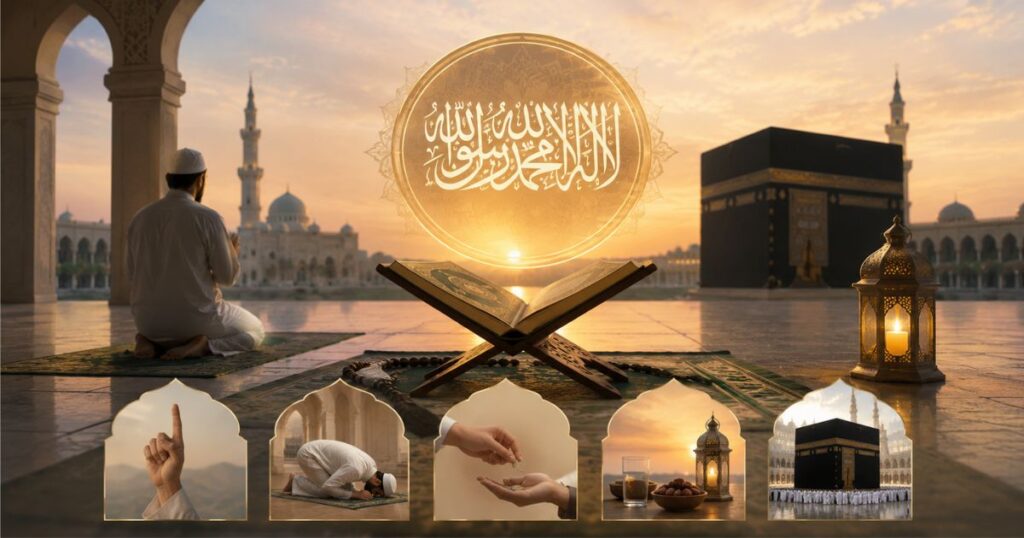
The Shahada is the first of the Five Pillars of Islam the core acts of worship that structure a Muslim’s practice:
| Pillar | What It Involves |
| 1. Shahada | Declaration of faith |
| 2. Salah | Five daily prayers |
| 3. Zakat | Obligatory charity |
| 4. Sawm | Fasting during Ramadan |
| 5. Hajj | Pilgrimage to Mecca (once in a lifetime, if able) |
It’s placed first for a reason: the other four pillars are acts of worship that flow from belief. Without the Shahada, the rest have no foundation to stand on.
How to Say the Shahada to Become Muslim
Converting to Islam through the Shahada is simple in mechanics, though meaningful in weight. There’s no formal ceremony required by Islamic law, just sincere declaration.
- Understand the meaning of both parts of the Shahada before saying its belief has to come first, not just the words.
- Recite it clearly, ideally in Arabic, though many scholars agree saying it with true belief in your own language also counts.
- Say it in front of witnesses if possible, commonly done at a mosque with an imam or community members present, though this is a recommended practice rather than a strict requirement.
- Perform ghusl (ritual purification bath) afterward, which many new Muslims choose to do as a symbolic fresh start, though it isn’t a condition for the Shahada itself to be valid.
That’s it. The moment someone says the Shahada with genuine belief, they are considered Muslim. If you’re coming from a specific background and want a more personal walkthrough, our guide on how to become Muslim from a Hindu background covers the same steps in more personal detail.
Is There a Difference Between Sunni and Shia Shahada?
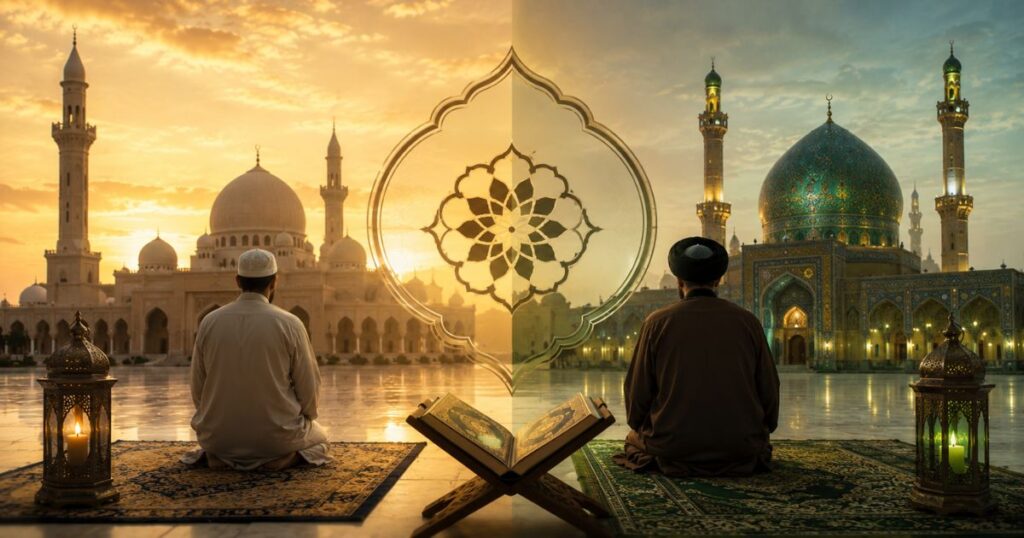
The core Shahada “There is no god but Allah, and Muhammad is the messenger of Allah” is shared by both Sunni and Shia Muslims and is what’s required to enter Islam.
In everyday practice and in the call to prayer (Adhan), some Shia traditions add a third phrase referencing Ali, the Prophet Muhammad’s cousin and son-in-law, as a statement of his spiritual authority. This addition is a matter of sectarian practice, not a change to the foundational testimony itself; the two-part Shahada remains the universal declaration across Islam.
A Note on Reciting the Shahada
People sometimes assume the Shahada is only spoken once, at conversion. In practice, it’s said dozens of times a day by practicing Muslims inside the call to prayer, inside the prayer itself, and quietly, privately, in moments that have nothing to do with ritual at all.
What tends to strike people learning about it for the first time isn’t the theology, it’s how ordinary the sentence sounds and how much is resting on it. Two lines. No embellishment. Just a plain statement of what someone believes to be true.
That simplicity is intentional. Islam doesn’t require an elaborate initiation. It requires clarity of belief, spoken honestly.
Conclusion
The Shahada is the foundation of Islam just two short lines, yet they carry the weight of the entire faith. “There is no god but Allah, and Muhammad is the messenger of Allah” isn’t just the phrase that makes someone Muslim; it’s a declaration repeated daily, in every prayer, as a living statement of belief. Its two parts Tawhid (God’s oneness) and Risalah (Muhammad’s prophethood) are both essential, and together they form the base on which the remaining Four Pillars rest.
FAQs
What is the Shahada in English?
The Shahada translates to: “I bear witness that there is no god but Allah, and I bear witness that Muhammad is the messenger of Allah.” It’s the Islamic declaration of faith.
What are the two parts of the Shahada?
The first part affirms the Oneness of God (Tawhid). The second part affirms Muhammad as God’s messenger (Risalah). Both are required together.
How do you say the Shahada correctly?
Phonetically: “Ash-ha-du an la ilaha illallah, wa ash-ha-du anna Muhammadan rasulullah.” Listening to a native or trained reciter helps with accurate pronunciation.
Is saying the Shahada enough to become Muslim?
Yes reciting the Shahada with sincere belief and understanding is what makes someone a Muslim, according to mainstream Islamic teaching. No additional ceremony is religiously required, though many choose to say it before witnesses.
Is the Shahada one of the Five Pillars of Islam?
Yes, it’s the first of the Five Pillars, alongside prayer (Salah), charity (Zakat), fasting (Sawm), and pilgrimage (Hajj).
Can the Shahada be said in a language other than Arabic?
Most scholars agree the Shahada should ideally be recited in Arabic since that’s its original and standard form, but many also hold that saying it with true belief in one’s own language is valid, especially for someone still learning Arabic.