
Islam didn’t start as an organized religion overnight; it unfolded over decades. Islam began with Prophet Muhammad’s first revelation in 610 CE in Mecca, Arabia. When did Islam become a religion? The answer depends on how “become a religion” is defined, but it evolved into an organized religious community over the next 20 years, especially after the Hijra (migration) to Medina in 622 CE and the conquest of Mecca in 630 CE. By the time of Prophet Muhammad’s death in 632 CE, Islam was a complete faith system with established laws, core practices, and a growing Muslim community.
| Date | Event | Significance |
| 610 CE | Prophet Muhammad’s first revelation | Islam’s spiritual birth |
| 622 CE | The Hijra (migration to Medina) | Islam becomes an organized religion |
| 630 CE | Conquest of Mecca | Spiritual unification of Arabia |
| 632 CE | Prophet Muhammad’s death | Islam fully codified; caliphate begins |
What Was Arabia Before Islam?
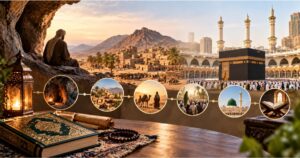
To understand when Islam became a religion, you need to know what Arabia was like before it arrived.
Pre-Islamic Arabia was fragmented and in spiritual chaos. The Arabian Peninsula in the 6th century was split into hundreds of independent tribes, each with its own gods and beliefs. Mecca, nestled in the western desert, wasn’t a religious hub it was a trading crossroads. Merchants from Persia, Egypt, and the Mediterranean passed through, bringing goods, stories, and foreign faiths.
The Ka’aba, Islam’s holiest shrine today, existed then too, but it was surrounded by pagan idols. Arabian tribes made pilgrimages to it annually, worshipping a pantheon of gods tied to rocks, wells, and stars. There was no unified law, no central authority, and no moral code that bound the tribes together. Blood feuds were endless. Infanticide of daughters was a common practice, and women had almost no rights.
Spiritually and socially, Arabia was ripe for change. A unified message, a strong moral code, and a charismatic leader who promised justice and community could transform it all. That’s exactly what Islam delivered.
Islam’s Timeline: From Revelation to Religion
610 CE The First Revelation
On a night Muslims call the Night of Power (Laylat al-Qadr), a 40-year-old merchant named Muhammad ibn Abdullah experienced what would reshape world history. He was meditating in a cave on Mount Hira, just outside Mecca, when he reported receiving a visitation from the Archangel Gabriel.
The angel’s message was simple but revolutionary: “Recite! In the name of your Lord who created.” These opening verses of the Quran became Islam’s spiritual foundation.
Muhammad was terrified. He didn’t understand what was happening. He rushed home to his wife, Khadijah, a wealthy widow and merchant. She believed him immediately. “By Allah,” she said, “Allah will never humiliate you. You are kind to your relatives, you help the poor, you are generous to guests, and you help people in times of hardship.” She became the first Muslim.
At this point, Islam was not a religion in the institutional sense. It was a personal spiritual experience, confined to Muhammad’s immediate family and a handful of trusted friends: Abu Bakr (his closest companion), Ali (his cousin), and a few others. They met in secret, fearing persecution from Mecca’s pagan elite, who profited from pilgrims visiting the Ka’aba’s 360 idols.
For the next 12 years, Muhammad preached monotheism to anyone who’d listen. His message was radical: abandon idols, worship only Allah, treat all humans as equals. The Meccan merchants hated it. They ridiculed him, threatened him, and boycotted anyone who followed him. His followers faced torture and public humiliation.
By 622 CE, Islam had maybe 100–150 believers in Mecca. It was a spiritual movement, not yet a religion with laws, institutions, or community infrastructure.
622 CE The Hijra (Migration to Medina): The Turning Point
This is when Islam truly became a religion. Not in 610 CE that was spiritual awakening. But here, in 622 CE, Islam shifted from an underground faith to an organized society.
A city 280 miles north of Mecca called Yathrib (later renamed Medina, “the City”) was in crisis. Rival tribes were locked in civil war. Fighting and blood feuds had paralyzed the city for generations. Medina’s leaders had heard about Muhammad and his message of unity and justice. They invited him and his followers to come and mediate their disputes.
The journey itself became sacred. Muslims abandoned their homes, their property, their tribal ties, and traveled across the Arabian desert to Medina. It was a radical act: leaving everything behind to build something new. Muslims mark this migration as Year 1 of the Islamic calendar, not the 610 CE revelation because this is when Islam became institutionalized.
Once in Medina, Muhammad didn’t just preach. He governed. He drafted the Medina Charter, often called history’s first constitution, which laid out the rules for living together: religious freedom for minorities (Christians and Jews), community responsibilities, conflict resolution, and shared defense. Muslims had to contribute to the Ummah (community) through taxes and civic duty. Prayer times were standardized. Alms-giving (Zakat) became a collective obligation, not charity.
For the first time, Islam had a legal code. A court system. A military. An economy. These aren’t spiritual concepts, they’re the machinery of a real religion, operating as a state.
Medina became Islam’s nursery. Here, the Five Pillars were formalized:
- Shahada declaration of faith (“There is no God but Allah, and Muhammad is his messenger”)
- Salat five daily prayers at specific times, facing Mecca
- Zakat mandatory charity to the poor
- Sawm fasting during Ramadan (the month Muhammad received his first revelation)
- Hajj pilgrimage to Mecca (once the city was conquered)
The Quran, still being revealed verse by verse, addressed the real challenges Medina faced: inheritance law, marriage contracts, warfare ethics, food rules. Islam wasn’t abstract philosophy, it was a practical legal system. Scholars often say Islam became an organized religion during the Medina period, not Mecca, because this is when it stopped being a belief system and started being a society.
630 CE Conquest of Mecca: Spiritual Unification
Eight years after fleeing Mecca, Muhammad returned not as a refugee, but as a leader with 10,000 followers. The conquest was bloodless. Most Meccans didn’t resist. Muhammad’s fair reputation and the obvious power of the growing Islamic movement meant the city surrendered peacefully.
What happened next was symbolically perfect. Muhammad entered the Ka’aba and personally destroyed all 360 idols inside. He recited the Quranic verse: “The truth has come, and falsehood has perished.” (Quran 17:81) The holiest site in Arabian paganism became Islam’s holiest shrine overnight.
The Hajj, the annual pilgrimage to Mecca, was now established as a central Islamic practice. It wasn’t just ritual; it was a yearly gathering where Muslims from across Arabia (and eventually the world) would assemble to worship together, trade, exchange knowledge, and reinforce their identity as a single Ummah.
By 630 CE, Islam had transformed Arabia. Pagan tribes were converting en masse. Tribal warfare was declining. A moral and legal code was binding formerly fractious peoples together. Islam was no longer a Meccan novelty or a Medina experiment, it was Arabia’s dominant force.
632 CE Prophet Muhammad’s Death & The Caliphate
When Prophet Muhammad died on June 8, 632 CE, he left behind a religion that was already institutionalized. There was no crisis of faith because Islam wasn’t built on Muhammad being invincible; it was built on a text (the Quran, now complete), a legal code (the Sharia, still developing), and a community (the Ummah).
The Caliphate system began immediately. The community elected Abu Bakr, Muhammad’s closest companion, as the first Caliph (leader). His title meant “successor” or “caliph,” and he had both religious and political authority. Over the next few decades, Sharia Islamic law was compiled from the Quran and the Sunnah (Muhammad’s recorded practices and sayings).
By the 8th century, Islam was no longer evolving; it was codified. Multiple schools of Islamic law had emerged (Hanafi, Maliki, Shafi’i, Hanbali), each interpreting Sharia slightly differently but all united by the Quran and core principles. Mosques were standardized. Ritual practices were formalized. Islamic civilization art, science, architecture, literature was flourishing.
That Defined Islam as a Religion
What separates a spiritual movement from a full religion? Three things: a sacred text, a legal code, and institutional structures.
Islam had all three by 632 CE.
The Quran: Sacred Text & Authority
The Quran is Islam’s heartbeat. Muslims believe it’s God’s direct word, revealed to Muhammad over 23 years. It’s not poetry; it’s not philosophy. It’s law, theology, and ethics all in one.
During Muhammad’s lifetime, the Quran existed in fragments written on leather, bones, and memorized by thousands. Within 20 years of his death, the third Caliph, Uthman, standardized a single written version around 650 CE. This wasn’t just religious; it was political. A unified text meant a unified faith across the expanding Islamic empire.
The Quran doesn’t just tell you what to believe. It tells you how to pray, what to eat, whom you can marry, how to distribute inheritance, how to wage war, how to treat prisoners. That’s a religion’s backbone: turning belief into practice and law.
Sharia: Islamic Law
Sharia emerged from three sources:
- The Quran explicit laws and ethical principles
- The Sunnah Muhammad’s example and recorded sayings (Hadith)
- Ijma & Qiyas community consensus and analogical reasoning by Islamic scholars
By the 9th century, Sharia scholars had systematized Islamic law into five categories: obligatory, recommended, neutral, discouraged, and forbidden. Every action a Muslim might take fit into one of these. That’s the machinery of a codified religion, not just faith, but governance.
Sharia courts began operating in Islamic cities. Judges (Qadis) settled disputes over contracts, inheritance, marriage, and crime. Islamic law became enforceable, not just aspirational.
Institutional Structures
A religion needs institutions to survive beyond its founder. Islam built them fast:
- The Caliphate a unified leadership structure (beginning 632 CE)
- The Mosque gathering places for prayer and community (formalized architecture by 670s CE)
- Madrasas schools for Islamic education (common by 9th century)
- Waqf System religious endowments funding public goods (formalized by 8th century)
- Sharia Courts judicial bodies enforcing Islamic law (operating by 650s CE)
These institutions made Islam self-perpetuating. It no longer depended on Muhammad’s personal charisma. A structure was in place to preserve, teach, and enforce Islam for centuries to come.
The Five Pillars: Religion in Practice
| Pillar | When Established | What It Means | Religious Significance |
| Shahada | 610 CE (revelation) | Declaration of faith in one God | Core belief; entry to Islam |
| Salat | 620–625 CE (Medina) | Five daily prayers, facing Mecca | Unifies Muslims in synchronized worship |
| Zakat | 622 CE (Medina Charter) | Mandatory charity (2.5% of wealth) | Creates community welfare system |
| Sawm | 624 CE (Medina) | Fasting during Ramadan daylight | Spiritual discipline; lunar calendar |
| Hajj | 630 CE (Mecca conquest) | Pilgrimage to Mecca | Annual gathering; physical unity |
Together, the Five Pillars make Islam livable as a religion. They’re not metaphorical. They’re daily, weekly, and annual practices that every Muslim performs. That transforms Islam from an idea into lived experience, the hallmark of a real religion.
How Islam Differs from Other Religions (Historical Perspective)
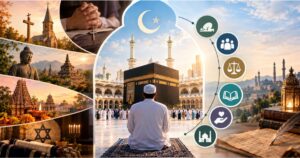
Here’s what makes Islam’s founding unique: it became an organized religion faster than any other major world faith.
Christianity took 300+ years to become institutionalized. Early Christians worshiped underground, had no unified law, no central authority, and no formal hierarchy until the Council of Nicaea (325 CE) nearly three centuries after Jesus.
Islam was codified within 50 years. By 650 CE, less than two decades after Muhammad’s death, Islam had a standardized scripture, a legal code, institutions, and a global empire spanning North Africa to Persia. That speed was possible because Muhammad was both a spiritual leader and a lawgiver. He didn’t just preach morality, he governed, settled disputes, and created structures.
Buddhism took even longer to institutionalize. Buddha (Siddhartha Gautama) lived 2,500 years ago, but Buddhism’s “canon” (like the Quran) wasn’t standardized for centuries. Multiple schools developed independently across Asia with different texts and practices.
Why does this matter for your question? Because “when Islam became a religion” depends on your definition. If you mean spiritual revelation, it’s 610 CE. If you mean a society with laws and institutions, it’s 622 CE (Medina). If you mean a global religion recognized by the world, it’s 650+ CE (after the Islamic empire’s military expansion).
Most scholars point to 622 CE the Hijra as the birth of Islam as a functional religion, because that’s when it stopped being a spiritual movement and started being a civilization.
Why the Hijra Matters: When Islam Truly Became a “Religion”
If someone asks you, “When did Islam become a religion?” The academic answer is usually 622 CE, the year of the Hijra.
Here’s why that date matters more than 610 CE (the first revelation):
610 CE was spiritual awakening. Muhammad received divine revelation. He believed. His family believed. A small circle of followers believed. But belief alone doesn’t make a religion. Millions of people around the world have personal spiritual experiences. They don’t establish religions.
622 CE was an institutional birth. When Muhammad and his followers migrated to Medina, they didn’t just bring their faith, they brought their law, their governance, their courts, and their community structure. The Medina Charter outlined rights, responsibilities, and consequences. Prayer times were synchronized. Charity became mandatory. Conflict resolution had procedures.
That’s the moment Islam became a religion in the sociological sense: a system of beliefs, practices, and institutions recognized and enforced by a community.
The Islamic calendar actually reflects this. Muslims count years from the Hijra (AH = Anno Hegirae, “Year of the Hijra”), not from Muhammad’s birth or his first revelation. That’s not arbitrary. It’s scholars and communities worldwide saying: “This is when Islam became real.”
The Spread: From Arabia to Global Faith
By 632 CE, Islam was the dominant faith in Arabia. But it didn’t stop there.
Within 100 years, Islamic empires stretched from Spain to India. Within 200 years, Islam was the world’s second-largest religion. Here’s how that happened:
First Century Expansion (632–732 CE)
After Muhammad’s death, the Caliphate became an expanding military and political force. This expansion happened so fast that historians still debate whether it was a calculated conquest or a series of rapid military responses.
The first Caliphs conquered:
- Syria and Palestine (634–636 CE)
- Egypt (641–643 CE)
- Persia (637–651 CE)
- North Africa (670–700 CE)
- Spain (711 CE)
- Central Asia (continuing through 8th century)
Why did people convert so quickly? Multiple reasons:
- Islamic law was fair and predictable compared to Byzantine or Persian rule if you were a non-Muslim, you paid a tax (Jizya) but had legal protection and autonomy. Many people actually preferred this to their previous rulers.
- The message was simple and universal: No priests. No caste system. All believers are equal before God. For conquered populations tired of hierarchies, this was radical liberation.
- Islam came with an infrastructure. It wasn’t just a belief system; it was a complete civilization: law courts, schools, hospitals, trade networks. Converts weren’t isolated believers; they joined a thriving society.
- The Quran and Sharia were portable. Unlike religions tied to temples or priests, Islam could be practiced anywhere. This made it resilient and scalable.
Institutional Complexity: Sunni and Shia
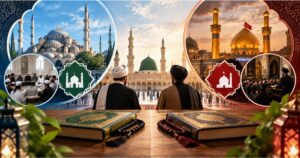
Almost immediately, Islam faced its first major split. When Muhammad died, a question arose: Who should lead Islam?
The majority (who became Sunnis) believed the community should choose the Caliph based on merit and consultation (Shura). They followed the four “Rightly Guided Caliphs” (632–661 CE) and believed authority was held by Caliphs and Islamic scholars (Ulama).
A minority (who became Shias) believed Muhammad had explicitly chosen Ali, his cousin, as his successor. They believed in a line of divinely guided leaders (Imams) from Muhammad’s family. This theological disagreement led to different legal schools, different ritual practices, and different authority structures.
This split happened within 50 years of Islam’s founding. The fact that Islam was institutionalized enough to splinter to have competing legal schools, different interpretations of Sharia, different authority structures proves it had become a full religion by then, not just a spiritual movement.
Conclusion
Islam began as a spiritual revelation in 610 CE but became an institutional religion in 622 CE. The Hijra to Medina marks the true birth of Islam as a functioning society: it’s when Muhammad shifted from preacher to lawgiver, when Islam got courts, governance, a standardized legal code (Sharia), and binding community structures.
By 632 CE (Prophet Muhammad’s death), Islam was fully codified. It had a scripture (Quran), a legal framework (Sharia), institutions (Caliphate, Mosque, Sharia courts), core practices (Five Pillars), and a unified community (Ummah). Within 100 years, Islamic empires spanned from Spain to India
FAQs
What’s the difference between 610 CE and 622 CE?
610 CE is when Prophet Muhammad received his first revelation Islam’s spiritual birth. 622 CE (the Hijra) is when Islam became an organized society with laws, courts, and institutions at its institutional birth. Most scholars use 622 CE when discussing “when Islam became a religion.”
Who founded Islam?
Prophet Muhammad ibn Abdullah (c. 570–632 CE), a merchant from Mecca. Muslims believe he was the final messenger of God (Allah). He didn’t claim to found a new religion; he believed he was reviving the original monotheism of Abraham, Moses, and Jesus.
Why is 7th-century Arabia important?
Arabia was fragmented, tribal, and spiritually polytheistic before Islam. Muhammad’s unified message and law gave Arabia its first cohesive identity and legal code. The Arabian Peninsula became the birthplace of Islamic civilization, which spread across three continents within 100 years.
When did Islam become the world’s second-largest religion?
By the 8th century (100 years after Muhammad’s death), Islam had already spread across North Africa, the Middle East, and into Central Asia. Today, Islam is the world’s second-largest religion with 1.8+ billion followers, representing about 24% of the global population.
What’s the Hijra and why do Muslims celebrate it?
The Hijra (Arabic: “migration” or “departure”) is Muhammad’s journey from Mecca to Medina in 622 CE. It’s sacred in Islam because it marks the moment Islam shifted from a spiritual movement to an organized society. Muslims celebrate the Islamic New Year on the anniversary of the Hijra. The Islamic calendar is dated from this event.
How quickly did Islam spread?
Remarkably fast. Within 100 years of Muhammad’s death, Islamic empires controlled territory from Spain to India. Within 200 years, Islam was the world’s second-largest religion. This speed was due to military expansion, missionary effort, a portable and universal message, superior legal and administrative systems, and mass conversion in newly conquered territories.
What’s the difference between Islam and Muslim?
Islam is the religion, the system of beliefs, practices, and laws. Muslim is a person who follows Islam. You might also hear “Islamic” (adjective describing something related to Islam, like “Islamic law” or “Islamic civilization”).
When was the Quran written down as a complete text?
The Quran was memorized by Muhammad’s followers during his lifetime and written on scattered materials (leather, bone, palm leaves). The first complete written compilation happened under Caliph Uthman around 650 CE, about 20 years after Muhammad’s death. Before that, it existed in fragments and in the memories of thousands of Hafiz (memorizers).