
Islam is built on two frameworks: the Six Articles of Faith (what Muslims believe one God, angels, holy books, prophets, the Day of Judgment, and divine decree) and the Five Pillars of Islam (what Muslims do the declaration of faith, prayer, charity, fasting, and pilgrimage). Together, belief and practice form the foundation of the Fundamentals of Islam: 5 Pillars & 6 Articles of Faith Explained.
If you’ve ever tried to understand Islam and come away confused about “pillars” versus “articles of faith,” you’re not alone. Most explanations either dive straight into a list without context, or they bury the framework in dense religious language. Here’s the clear version.
What Does “Islam” Mean?
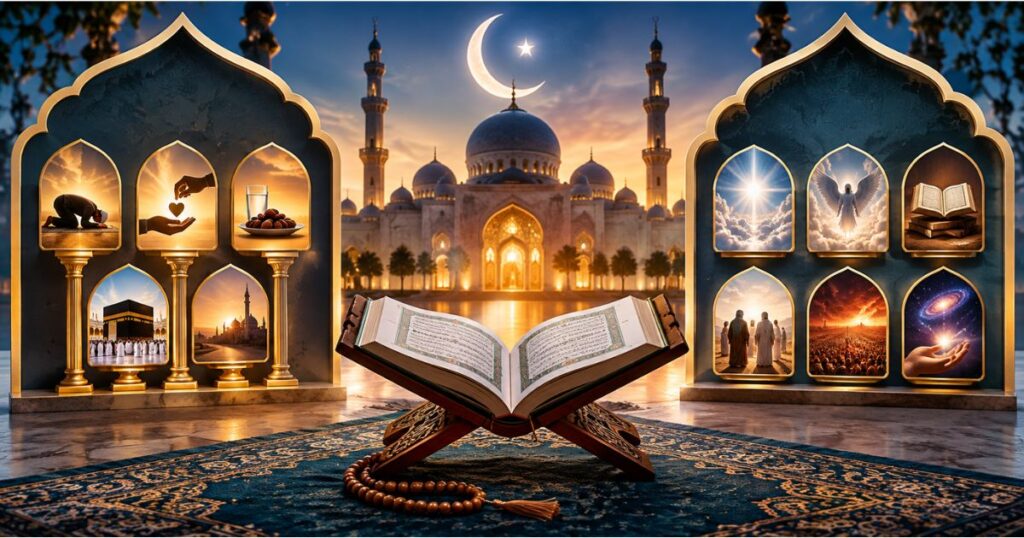
Islam is an Arabic word meaning “submission” or “surrender.” It describes the act of submitting one’s will to God (Allah) and, by extension, the religion built around that submission. Someone who practices Islam is called a Muslim, meaning “one who submits.”
Islam traces its roots to the same lineage as Judaism and Christianity the Abrahamic tradition. Muslims believe God sent a series of prophets throughout history, starting with Adam, including Abraham, Moses, and Jesus, and ending with Muhammad, born in Mecca around 570 CE. Muslims regard Muhammad as the final prophet, and the message he received recorded in the Qur’an as the completion of God’s revelation to humanity.
[Placeholder client input needed: if this is being used for a brand with an editorial or interfaith angle, insert a scholar-reviewed or first-party quote here for E-E-A-T. Do not fabricate an attribution.]
The Six Articles of Faith (Iman)
The Six Articles of Faith known in Arabic as Iman describe what a Muslim believes. These are internal, doctrinal commitments, distinct from the physical acts of worship covered by the Five Pillars.
- Belief in Allah (Tawhid) the core conviction that there is one God, without partners or equals. Tawhid is considered the foundation of the entire faith.
- Belief in Angels Muslims believe in unseen beings created by Allah to carry out specific duties, such as the angel Gabriel (Jibril), who is believed to have delivered revelation to the prophets.
- Belief in the Holy Books Muslims believe Allah revealed scripture to various prophets over time, including the Torah (to Moses), the Psalms (to David), the Gospel (to Jesus), and the Qur’an (to Muhammad) regarded as the final, unaltered revelation.
- Belief in the Prophets a chain of messengers sent to guide humanity, from Adam through Muhammad, including figures shared with Judaism and Christianity like Abraham, Moses, and Jesus.
- Belief in the Day of Judgment the belief that all people will be resurrected and held accountable for their actions, with eternal consequences based on their deeds.
- Belief in Divine Decree (Qadar) the belief that Allah has ultimate knowledge and authority over all events, while humans retain free will and moral responsibility for their choices.
Self-contained answer block: The Six Articles of Faith in Islam are belief in Allah, angels, holy books, prophets, the Day of Judgment, and divine decree. Together, they form the doctrinal core of Muslim belief, distinct from the Five Pillars, which govern religious practice rather than internal conviction.
The Five Pillars of Islam
If the Six Articles are what a Muslim believes, the Five Pillars are what a Muslim does. They’re the practical framework of worship covered in full depth in our dedicated guide to the 5 Pillars of Islam.
1. Shahada (Declaration of Faith)
The Shahada is the testimony: “There is no god but Allah, and Muhammad is His messenger.” Reciting it sincerely is what formally marks someone as Muslim it’s often described as the gateway into the faith. For a full breakdown of its wording and meaning, see What Is the Shahada in Islam?
2. Salah (Prayer)
Muslims pray five times daily at dawn, midday, afternoon, sunset, and night facing the direction of Mecca. Prayers are performed in Arabic and follow a prescribed sequence of standing, bowing, and prostration. Our guide to the 5 Daily Prayers in Islam: Namaz Times & Importance walks through the exact timing and significance of each one.
3. Zakat (Charity)
Zakat is obligatory almsgiving typically 2.5% of a Muslim’s qualifying wealth given annually to those in need. It’s treated as a financial act of worship, not just a donation.
4. Sawm (Fasting)
During the month of Ramadan, Muslims fast from dawn to sunset, abstaining from food, drink, and other physical needs. The practice is meant to build self-discipline and empathy for those less fortunate. Since Ramadan’s dates shift each year, our guide to the Islamic Calendar and the 12 Months of the Hijri Year explains how the lunar calendar determines when it falls.
5. Hajj (Pilgrimage)
Every Muslim who is physically and financially able is expected to make the pilgrimage to Mecca at least once in their lifetime. Hajj takes place during a specific window in the Islamic calendar and involves a set sequence of rites at sacred sites in and around the city.
Pillars vs. Articles of Faith: What’s the Difference?
| Six Articles of Faith | Five Pillars of Islam | |
| Category | Belief (internal) | Practice (action) |
| Arabic term | Iman | Islam |
| Focus | What a Muslim believes | What a Muslim does |
| Examples | Tawhid, angels, holy books | Prayer, fasting, pilgrimage |
| Function | Doctrinal foundation | Ritual and ethical framework |
Iman, Islam, and Ihsan: The Three Levels of Religion

Most explanations stop at Pillars and Articles but classical Islamic teaching actually describes three levels of religion, not two, based on a well-known hadith (recorded saying of the Prophet Muhammad):
- Islam outward submission through the Five Pillars
- Iman inward belief through the Six Articles of Faith
- Ihsan the highest level, meaning to worship “as if you see Allah, and if you do not see Him, He surely sees you.” It’s the pursuit of sincerity and excellence in worship, beyond mechanical compliance.
This three-tier structure explains why Islam isn’t just a checklist belief, practice, and sincerity are meant to work together. It’s a distinction most general-audience explainers skip entirely, but it’s central to how the fundamentals are actually taught within Islamic scholarship. Our piece on the Beauty of Islam goes deeper into how this sincerity shapes everyday worship, not just the rituals themselves.
Are the Fundamentals the Same for Sunni and Shia Muslims?
Largely, yes but with some framing differences. Sunni Muslims (roughly 85–90% of the global Muslim population) organize belief around the Six Articles of Faith and the Five Pillars described above. Shia Muslims use a related but distinctly structured framework called Usul al-Din (“roots of religion”), which includes Tawhid (oneness of God), Adl (divine justice), Nubuwwah (prophethood), Imamah (belief in a line of appointed spiritual leaders after Muhammad), and Ma’ad (resurrection/Day of Judgment).
The core content overlaps heavily with belief in one God, prophets, and the afterlife but Shia theology adds Imamah and Adl as distinct formal articles, reflecting differences in how religious authority is understood after Muhammad’s death.
How Do Islam’s Fundamentals Compare to Christianity and Judaism?
Islam, Christianity, and Judaism are all Abrahamic faiths, sharing a belief in one God, a lineage of shared prophets (including Abraham and Moses), and belief in an afterlife. Where Islam diverges:
- Muslims regard Muhammad as the final prophet, completing revelation started by earlier prophets.
- Muslims believe in Jesus as a prophet and messenger, but not as divine or the Son of God.
- Islam emphasizes strict, uncompromising monotheism (Tawhid) no intermediaries, no trinity, no divine sonship.
For a fuller comparison of these distinctions, see What Makes Islam Different From Other Religions?
How Does Someone Become a Muslim?
Becoming Muslim requires sincerely reciting the Shahada: “I bear witness that there is no god but Allah, and I bear witness that Muhammad is the messenger of Allah.” There’s no formal age requirement, though most scholars agree the person should be old enough to understand what they’re affirming. No clergy, ceremony, or witness is technically required sincerity is what matters though many people choose to do so at a mosque or with guidance from a local Islamic community. If you’re exploring this step yourself, our Start Your Journey page walks through what comes next.
Conclusion
The fundamentals of Islam are centred on the Five Pillars and Six Articles of Faith. Together, they provide a framework for Muslim belief, worship, character, and daily life. Understanding these essential principles offers a strong foundation for learning about Islam and appreciating how faith and practice are connected.
FAQs
What are the five pillars of Islam?
The Five Pillars are Shahada (declaration of faith), Salah (prayer), Zakat (charity), Sawm (fasting during Ramadan), and Hajj (pilgrimage to Mecca).
What are the six articles of faith in Islam?
Belief in Allah, angels, holy books, prophets, the Day of Judgment, and divine decree (Qadar).
What is Tawhid?
Tawhid is the belief in the absolute oneness of God, the foundational concept in Islamic theology, meaning Allah has no partners, equals, or divine offspring.
Is Iman the same as Islam?
No. Iman refers to internal belief (the Six Articles of Faith), while Islam refers to outward practice (the Five Pillars). Classical teaching adds a third level, Ihsan, meaning sincerity in worship.
How do Sunni and Shia beliefs differ?
Both share the same core beliefs in God, prophets, and the afterlife. Shia Islam uses a distinct five-part framework (Usul al-Din) that includes belief in Imamah a line of appointed spiritual leaders which Sunni Islam does not include as a formal article of faith.