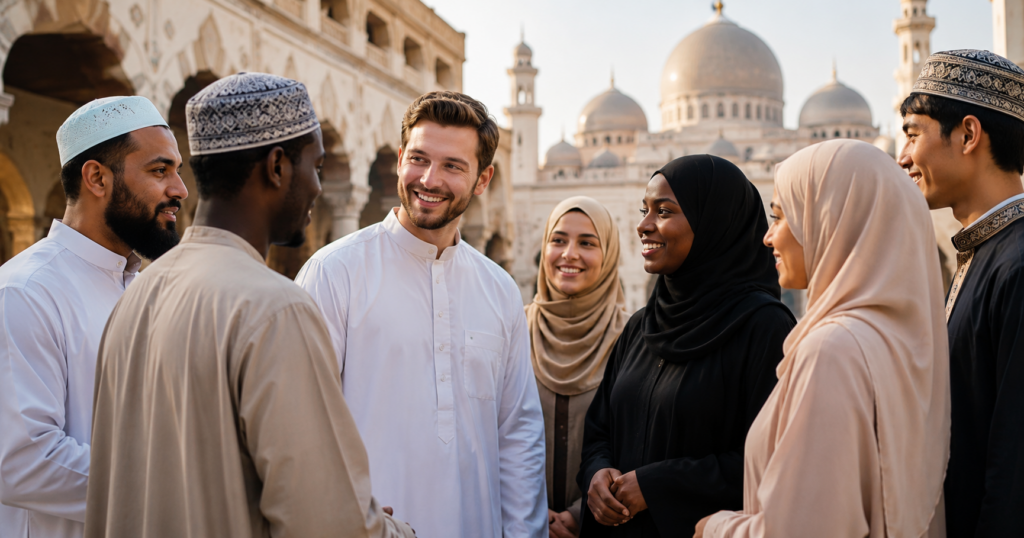
Can white people be Muslim? Yes, white people can be Muslim. Islam is a religion open to people of all races, ethnicities, and nationalities. Becoming a Muslim is based on faith and belief in Allah and the teachings of Islam, not on a person’s skin color, background, or heritage. Muslims come from diverse communities around the world, including Europe, North America, Africa, Asia, and the Middle East.
Islam teaches that all people are equal before God. Throughout history, many white individuals have embraced Islam and become active members of Muslim communities. The religion focuses on a person’s character, faith, and actions rather than their race or ethnicity.
Is Islam a Race or a Religion? Clearing Up the Biggest Misconception
Let’s get this straight right away, because it’s the root of so much confusion.
Islam is a religion. Not a race. Not a culture. Not an ethnicity.
Anyone from any background can be Muslim just as anyone can be Christian, Buddhist, or Jewish. Your DNA has absolutely nothing to do with it.
The misconception likely comes from the fact that Islam began in Arabia and the Prophet Muhammad was Arab. But that’s like saying Christianity is a Jewish religion because Jesus was Jewish. The origin of a faith and its intended audience are two very different things.
According to the Pew Research Center, Arab Muslims make up only around 20% of the global Muslim population. The other 80%? South Asian, Southeast Asian, African, European, American a mosaic of humanity.
So no being Muslim does not require being Arab, looking a certain way, or having a particular surname. If you are new to Islam and want to understand its foundations, our guide to Islamic prayer is a great place to start.
What Does the Quran Actually Say About Race and Equality?
This is where things really start to move.
The Quran doesn’t just tolerate diversity; it celebrates it. It celebrates it as a deliberate sign of God’s creative power.
Quran 49:13 The Verse That Ends the Debate
“O mankind, We have created you from male and female and made you peoples and tribes that you may know one another. Indeed, the most noble of you in the sight of God is the most righteous of you.”
Read that again. God addresses all of mankind not Arabs, not Muslims, not one tribe. All of humanity. And the only measure of worth He identifies? Righteousness. That’s it.
Not skin color. Not language. Not bloodline.
Quran 30:22 Why Diversity Is a Sign of God, Not a Division
“And among His signs is the creation of the heavens and the earth and the diversity of your languages and colors. Indeed, in that are signs for those of knowledge.”
Here the Quran takes human diversity different languages, different skin tones and frames it not as a source of conflict, but as evidence of God’s wisdom and artistry. Your difference is a feature, not a flaw.
These aren’t footnotes. These are central, foundational verses. Islam was built on the idea that the color of your skin is irrelevant to the content of your faith. For more on how the Quran shapes daily Muslim life, read our guide on the five daily prayers in Islam where Quranic recitation is at the heart of every single prayer.
The Prophet’s Farewell Sermon: The First Anti-Racism Speech in History
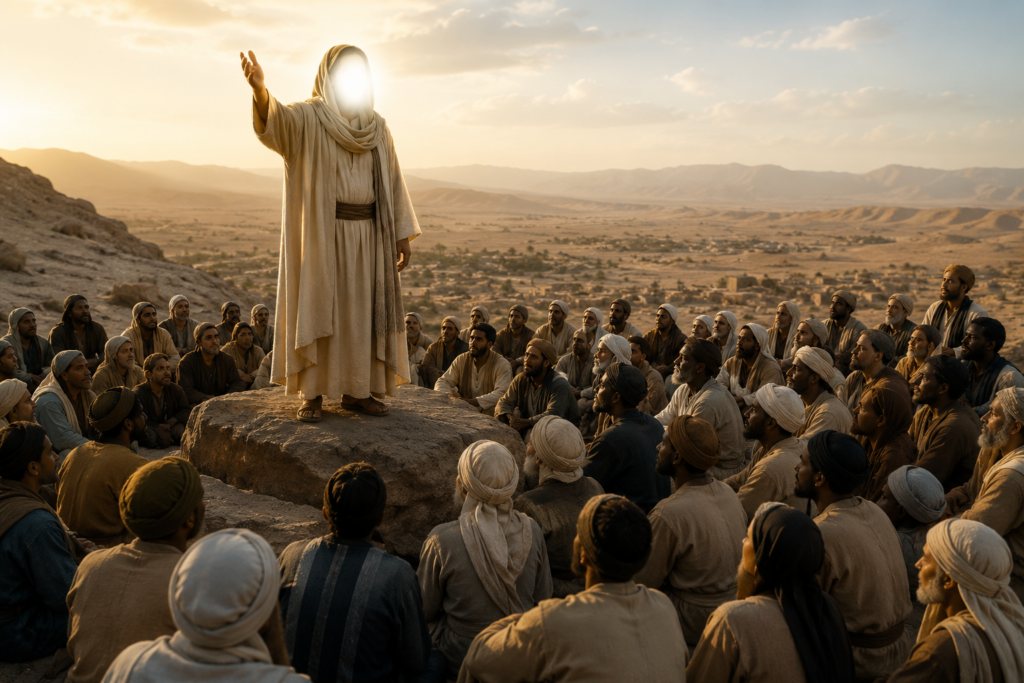
In 632 CE, the Prophet Muhammad delivered what would be his final public address on the plains of Mount Arafat. Over 100,000 people stood before him. And among everything he could have said legal guidance, theological instruction, political counsel he chose to say this:
“There is no superiority of an Arab over a non-Arab, nor of a non-Arab over an Arab, nor of a white person over a black person, nor of a black person over a white person except through piety.”
Think about the weight of that moment. This was a 7th-century society with deeply entrenched tribal hierarchies. Status was everything. Your tribe determined your worth.
And the Prophet dismantled it all in one sentence.
No race. No tribe. No bloodline. The only currency that matters is character.
Scholars and historians have called this address one of the earliest recorded declarations of universal human equality. It predates modern human rights frameworks by more than a thousand years.
Understanding the Prophet’s ﷺ Sunnah is a core part of the Muslim journey. Learn more about following his example in our guide on Sunnah prayers and their importance in daily Islamic life.
Bilal ibn Rabah and Salman al-Farsi: The Original Proof That Islam Belongs to Everyone
You want real-world evidence that Islam was never meant for just one race? Meet two of the most celebrated figures in early Islamic history.
Bilal ibn Rabah was an enslaved man from Ethiopia one of the first people to embrace Islam. The Prophet freed him, honored him, and chose him to become the first person ever to call Muslims to prayer. His voice echoed across Mecca as the faith’s most recognizable sound.
An African man. A formerly enslaved man. In the most visible religious role in early Islam.
Salman al-Farsi was Persian from what is now Iran. He converted after a years-long spiritual journey across the ancient world, searching for truth. The Prophet reportedly said of him: “Salman is from us, the people of the household.”
Not “Salman is tolerated.” Not “Salman is welcome here despite his background.” Salman is family.
| Bilal ibn Rabah | Ethiopia (African) | First Muezzin caller to prayer |
| Salman al-Farsi | Persia (Iranian) | Companion of the Prophet, military strategist |
| Suhayb ar-Rumi | Byzantine (European) | Early companion, known as “the Roman” |
Notice that last entry. Suhayb ar-Rumi “the Roman” was a white European man. One of the Prophet’s earliest and closest companions. His nickname literally announced his European origins. And it was worn with pride.
The diversity of early Islam wasn’t accidental. It was the point.
How Many White Muslims Are There? The Global Numbers Explained
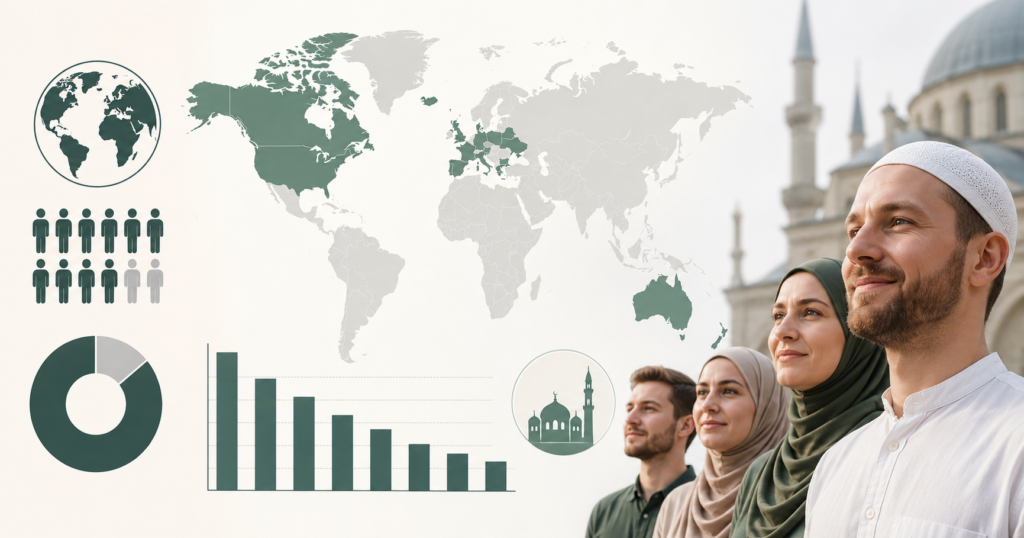
Nobody keeps a precise tally and in many ways, that’s the point. Islam doesn’t count its followers by race.
But the estimates tell a compelling story.
According to Pew Research data, Europe is home to approximately 25–26 million Muslims, many of whom are white converts or descendants of white converts from countries like Bosnia, Albania, and Kosovo where Islam has been the majority faith for centuries.
In the United States, studies suggest approximately 25–30% of Muslim converts are white Americans the second-largest group of converts after African Americans.
| Balkans (Bosnia, Kosovo, Albania) | 3–4 million | Indigenous white European Muslims |
| Western Europe | 20–25 million | Significant convert populations |
| United States | 3.5 million total | ~25–30% of converts are white |
| Russia/Central Europe | 20+ million | Majority ethnically Slavic or Turkic |
The Bosnian Muslims alone ethnically Slavic, white Europeans number over 2 million. They didn’t convert recently. Their families have been Muslim for 500 years.
White Islam isn’t new. It isn’t rare. It just doesn’t get much coverage.
Famous White Muslim Converts And What Drew Them to Islam
Sometimes the most powerful proof isn’t scripture or statistics. It’s a story.
Here are real people white Westerners who found their way to Islam and transformed their lives:
- Cat Stevens (Yusuf Islam) British singer-songwriter, one of the most famous musicians of the 1970s. Converted in 1977 after years of spiritual searching. He said Islam gave him “a sense of total clarity.”
- Yvonne Ridley British journalist who was captured by the Taliban in Afghanistan in 2001. She converted to Islam two years later not out of trauma, but after she promised to read the Quran and found herself convinced by it.
- Jeffrey Lang American mathematics professor who converted after reading the Quran in 1982. He went on to write one of the most widely read books on Western conversion to Islam: Struggling to Surrender.
- Hamza Yusuf Born Mark Hanson in California. Converted in his teens and became one of the most influential Islamic scholars in the Western world. He holds degrees from institutions across the Islamic world and advises governments and universities.
Each of these people came from entirely different backgrounds, different decades, different motivations. What they found wasn’t an Arab religion. They found a universal one. They found a universal one. If their stories resonate with you, read our complete guide on how to convert to Islam a step-by-step guide for anyone ready to take their Shahadah
What White Muslims Say About Finding Their Place in the Community
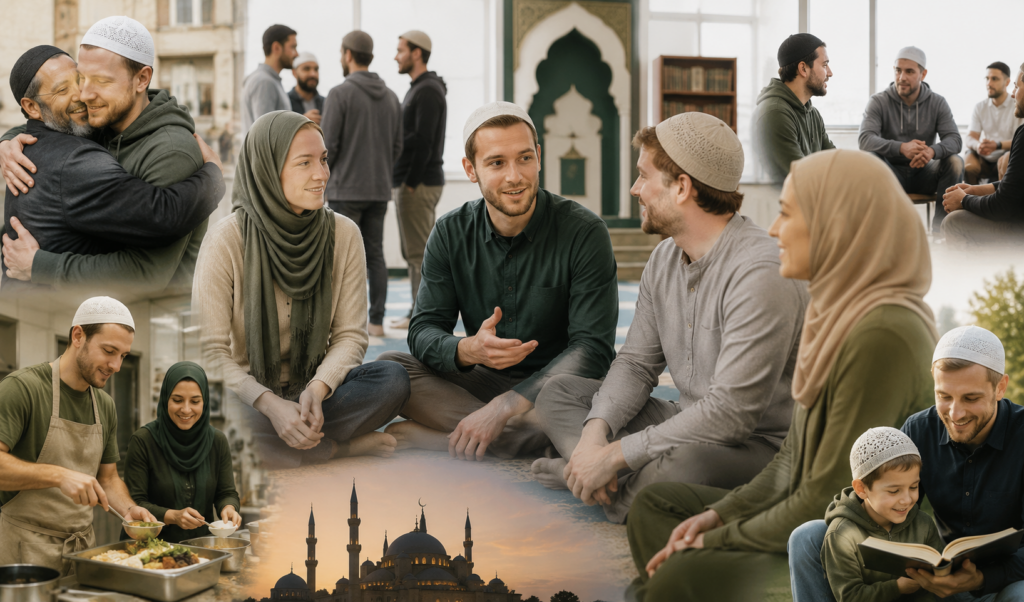
This is where the experience gets real.
White converts to Islam often describe a version of the same feeling: walking into a mosque for the first time and being welcomed not as an outsider, but as a long-lost family member.
Sarah, a 34-year-old from Manchester who converted in 2018, describes it this way: “I expected to feel like a guest. Instead, within minutes, women were hugging me, calling me their sister. I had never experienced that kind of immediate belonging anywhere.”
James, an American convert from Texas, put it differently: “People kept asking me why I converted, as if it was strange. But from the inside, it felt like the most natural thing I’d ever done. I didn’t become someone new. I became more myself.”
These aren’t isolated experiences. Researchers who study conversion patterns consistently note that a sense of community and belonging ranks among the top reasons white Westerners embrace Islam often surpassing theological conviction as the initial draw.
The faith doesn’t just accept you. It actively makes you family.
Common Concerns White Converts Face And How the Muslim Community Responds
Let’s be honest. Conversion doesn’t come without questions and some of them feel enormous.
Here are the ones that come up most often, answered plainly:
- “Will I be accepted?” Yes. Overwhelmingly, yes. The Islamic concept of brotherhood and sisterhood in faith the ummah transcends race by definition. You become part of the family the moment you sincerely believe.
- “Do I have to change my name?” No. It is not required. Some converts choose a new name as a personal marker of their new identity. Others keep their birth name entirely. Both are valid. Both are practiced widely.
- “Do I need to learn Arabic?” Not immediately. Arabic deepens your practice over time, and learning the words of your prayers is encouraged. But fluency is not a prerequisite for faith.
- “What will my family think?” This is the hardest one and there’s no easy answer. Many converts navigate complicated family dynamics. But most report that honest, patient conversation over time builds understanding, even when the initial reaction is difficult.
- “Do I need a certificate or formal ceremony?” No. Conversion in Islam requires sincere belief in the heart and the spoken declaration of faith the Shahadah. No intermediary, no institution, no paperwork required.
Conclusion
White people can absolutely be Muslim, just as people of any race can follow Islam. The religion welcomes everyone who sincerely believes in its teachings. Islam promotes unity, equality, and brotherhood among all people regardless of their color or background.
FAQs
Can a white person convert to Islam?
Yes, absolutely. Islam places no racial or ethnic requirements on its followers. Any person, regardless of skin color, nationality, or background, can become Muslim by sincerely declaring their belief in God and the prophethood of Muhammad.
Do you have to be Arab to be Muslim?
No. This is one of the most common misconceptions about Islam. The majority of the world’s 1.9 billion Muslims are not Arab. Countries like Indonesia, Pakistan, Bangladesh, and Nigeria have enormous Muslim populations with no Arab ethnicity.
Is Islam a race or a religion?
Islam is a religion not a race, ethnicity, or nationality. Just as Christianity or Buddhism transcends racial lines, so does Islam. Your ethnic background is entirely irrelevant to your eligibility to practice the faith.
Do you have to change your name when you convert to Islam?
No. Changing your name upon conversion is a personal choice, not a religious requirement. Many converts keep their birth names throughout their lives. Others adopt Arabic or Islamic names as meaningful personal symbols of their new identity.
What is the Shahadah and how does it work?
The Shahadah is the Islamic declaration of faith: “I bear witness that there is no god but God, and I bear witness that Muhammad is the messenger of God.” Saying it sincerely, with genuine belief, is what makes a person Muslim. No ceremony, certificate, or official permission is needed.
How many non-Arab Muslims are there in the world?
According to Pew Research, approximately 80% of the world’s 1.9 billion Muslims are non-Arab. The largest Muslim populations by country are in Indonesia, Pakistan, India, and Bangladesh none of which are Arab nations.