
To convert to Islam, you sincerely recite the Shahada, the declaration that there is no god but Allah and that Muhammad is His messenger. No ceremony, payment, waiting period, or witnesses are required, though saying it in front of others at a mosque is common. The moment you say it with genuine belief, you are Muslim.
What Does It Mean to Convert to Islam?
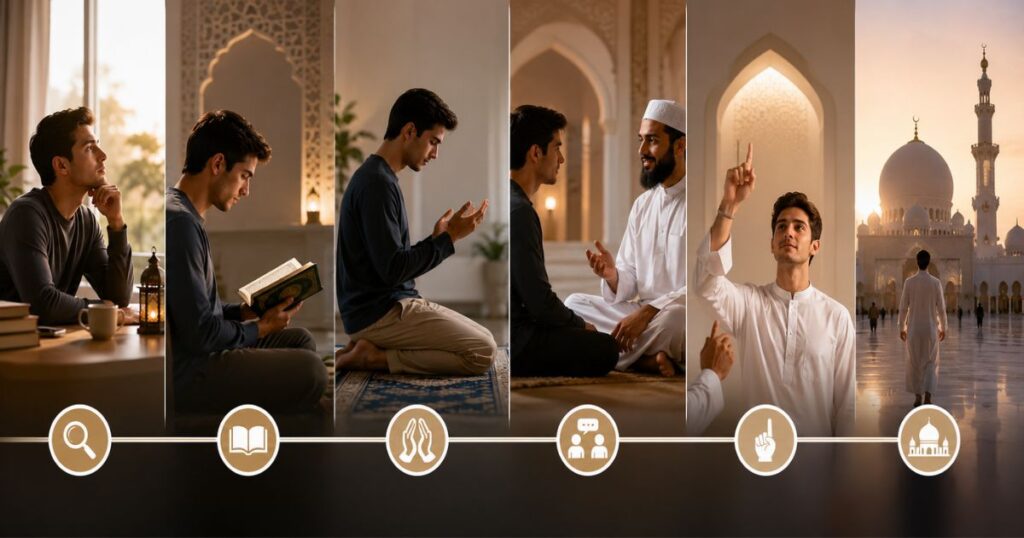
Converting to Islam means formally accepting the core beliefs of the faith that Allah is the one God, and that Muhammad is His final prophet by reciting a specific declaration called the Shahada.
There’s no application, no background check, and no religious authority who has to approve you. Islam considers belief a matter between a person and God. Once you say the Shahada with sincere conviction, the conversion is complete.
Convert or Revert? Understanding the Terminology
You’ll see both words used, and it’s worth knowing why before you go further.
Many Muslims use “revert” instead of “convert,” based on the Islamic belief that every human is born with an innate awareness of God (called fitrah), and that becoming Muslim is really a return to that original state rather than adopting something new. “Convert” is the more familiar English term and isn’t considered incorrect you’ll hear both in mosques, books, and online communities. Neither word affects your standing as a Muslim. Use whichever feels natural to you. Use whichever feels natural to you. The Revert supports people at every point in that journey.
How to Convert to Islam Step by Step
Here’s the actual process, broken into the three parts that matter.
Step 1 Understand and believe the core message. Before saying the Shahada, you should genuinely believe two things: that Allah alone is worthy of worship, with no partners or equals, and that Muhammad is His final messenger. You don’t need to have memorized Islamic law or Arabic first belief comes before mastery, not after.
Step 2 Recite the Shahada. This is the declaration itself:
Arabic: أَشْهَدُ أَنْ لَا إِلَٰهَ إِلَّا اللَّهُ وَأَشْهَدُ أَنَّ مُحَمَّدًا رَسُولُ اللَّهِ
Transliteration: Ash-hadu an la ilaha illa Allah, wa ash-hadu anna Muhammadan rasul Allah.
English: “I bear witness that there is no god but Allah, and I bear witness that Muhammad is the messenger of Allah.”
You can say it in English if you’re not yet comfortable with Arabic sincerity matters more than pronunciation. You’ll likely want to learn the Arabic version over time, since it’s used in daily prayer.
Step 3 Say it with witnesses, or say it alone. You can recite the Shahada by yourself, with a Muslim friend, over a phone or video call, or in person at a mosque. Witnesses aren’t a spiritual requirement; nothing in Islamic teaching says God’s acceptance of your declaration depends on who else is in the room. Having witnesses is simply a practical step: it lets the local Muslim community know you, welcome you, and support you going forward. If privacy or safety is a concern, converting privately first and connecting with a community later is completely valid.
What Happens After You Say the Shahada?
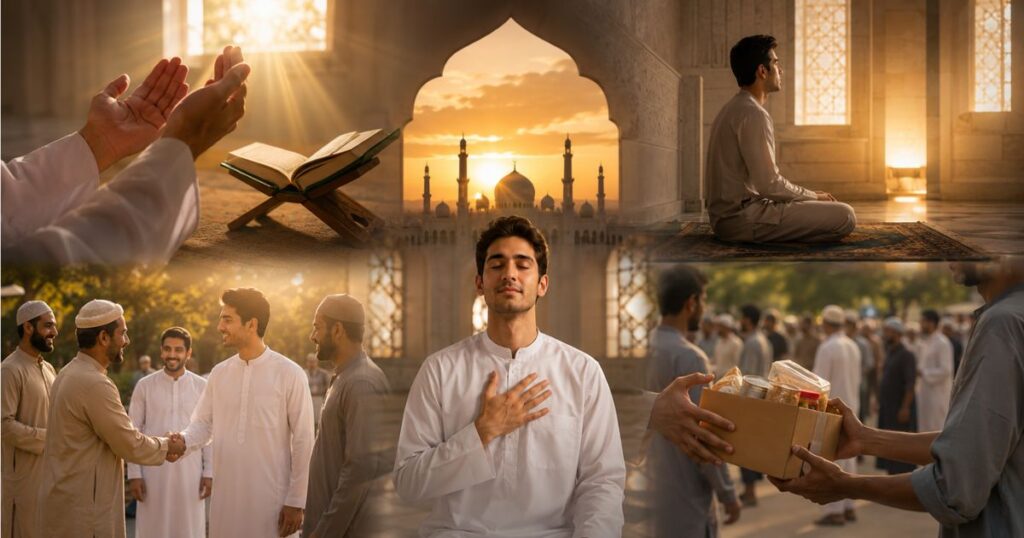
The moment you recite the Shahada with belief, you’re Muslim full stop. A few practical things typically follow:
- Ghusl (purification bath): Many scholars recommend a full-body ritual wash as a symbol of starting fresh, though it isn’t required for the conversion itself to be valid. Read our guide on how to pray in Islam step by step which covers Ghusl and Wudu in full detail.
- Learning to pray (Salah): Muslims pray five times a day. New Muslims usually start by learning the movements and a few short phrases, adding more over weeks and months.
- Past mistakes are considered forgiven. A core teaching in Islam is that sincerely accepting the faith wipes the slate clean you’re not expected to have your entire past sorted out first.
Nobody expects you to know everything on day one. Islam is treated as a gradual learning process, not a test you pass or fail at the start.
Do You Need to Change Your Name?
No not unless your current name has a meaning that directly conflicts with Islamic belief (for example, a name that translates to “servant of” a god other than Allah, which is rare). Most converts keep their name exactly as it is. Some choose to adopt an additional Muslim name later on, but this is a personal decision, not a requirement.
Telling Your Family What to Expect and How to Approach It
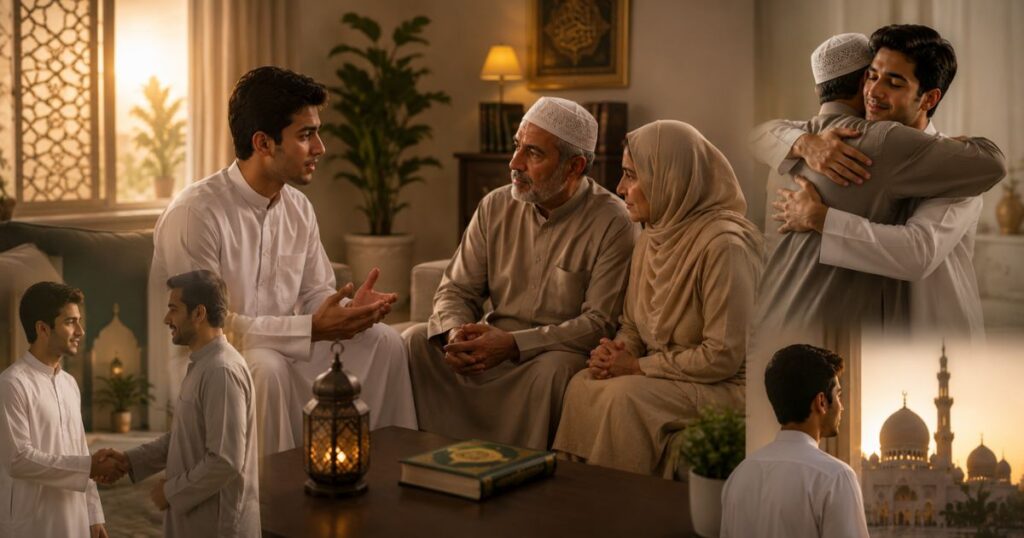
This is the part almost no conversion guide handles well, and it’s often the part people worry about most.
Reactions genuinely vary. Some families are surprised but supportive. Others react with confusion, hurt feelings, or outright rejection particularly if religion carries strong cultural or generational weight in your family. Neither extreme means you did something wrong.
A few things tend to help:
- Gauge the ground first. Casual conversations about religion, before you announce anything, can tell you a lot about how the conversation will land.
- Lead with reassurance, not just information. Family members often worry they’re “losing” you to a different culture, a different set of values, or a different life. Emphasizing continuity (you’re still their child, still involved in their lives) matters as much as explaining the faith itself.
- Give them time. A single conversation rarely changes anyone’s mind instantly, in either direction. It’s normal for a family’s response to soften over months, not days.
- You’re allowed to convert privately first. There’s no religious deadline that forces you to announce your conversion the same day you make it. Taking time to build confidence in your own understanding before that conversation is a reasonable, common choice not a sign of insincerity.
If the relationship becomes genuinely difficult, new-Muslim support groups (many mosques run them specifically for converts) can offer both practical advice and simple reassurance that this experience is common, not unusual.
Conclusion
Converting to Islam is a personal and meaningful decision that begins with sincere belief in the oneness of Allah and the prophethood of Muhammad (peace be upon him). By understanding the core teachings of Islam, sincerely reciting the Shahada, and gradually learning how to pray and practice the faith, new Muslims can build a strong spiritual foundation. Remember that Islam values sincerity, patience, and continuous learning, and every step taken toward Allah is significant.
FAQs
What do you say to convert to Islam?
You recite the Shahada: “I bear witness that there is no god but Allah, and I bear witness that Muhammad is the messenger of Allah.” Saying it once, sincerely and with understanding, is what completes the conversion no additional script is required.
Do you need witnesses to convert to Islam?
No. Witnesses aren’t a religious requirement you can convert alone. Having witnesses is a practical choice that helps the local Muslim community welcome and support you afterward, but it doesn’t affect the validity of your conversion.
Can you convert to Islam online or at home?
Yes. You can recite the Shahada privately at home, or with a Muslim community online, and it’s just as valid as doing it in person at a mosque. Many people start this way before later visiting a mosque in person.
How long does it take to convert to Islam?
The conversion itself takes as long as it takes to sincerely say the Shahada in a matter of seconds. Learning to practice Islam fully (prayer, fasting, deeper study) is treated as a lifelong, gradual process, not something completed on day one.
Is “convert” or “revert” the correct term?
Both are used and accepted. “Revert” reflects the belief that people are born with an innate awareness of God; “convert” is the more common English term. Neither changes your standing as a Muslim.
Do I have to change my name when I convert to Islam?
No, unless your existing name conflicts directly with Islamic belief, which is rare. Keeping your birth name is the norm.