Islam is the religion, a faith based on submission to one God (Allah) and the teachings of the Quran and Prophet Muhammad (peace be upon him). A Muslim is a person who follows that religion. In simple terms, Islam is the belief and way of life, while a Muslim is the one who practices it.
What Does “Islam” Mean?
Islam is the name of the religion. It’s an Arabic word that means submission, specifically, submitting yourself to God (Allah in Arabic).
The word comes from the Arabic root s-l-m. That same root gives us salam, the word for peace. The two ideas are linked: the faith teaches that peace comes from surrendering your will to God.
Islam is a monotheistic religion, which means it teaches that there is one God. Its holy book is the Quran. Muslims believe the Quran was revealed to the Prophet Muhammad in the 7th century.
What Does “Muslim” Mean?
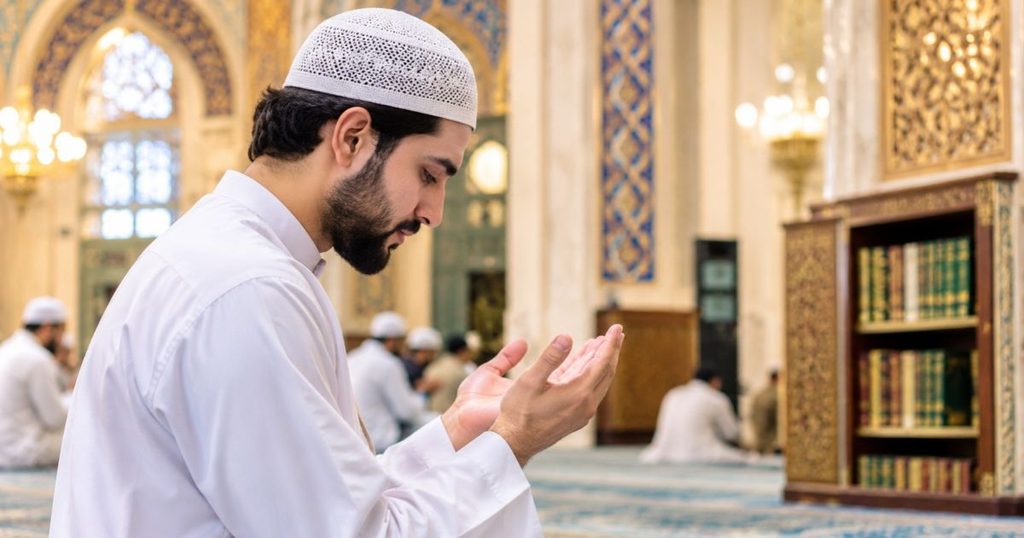
A Muslim is a person who follows Islam. In Arabic, the word means “one who submits”: someone who has accepted the faith.
Here’s the grammar made simple. Islam is the act (submission). Muslim is the person doing it (the one who submits). It works like teacher and teacher, or run and runner.
Most Muslims declare their faith through a short statement called the Shahada: that there is no god but God, and that Muhammad is God’s messenger.
Islam vs Muslim at a Glance
| Word | What it is | Part of speech | Example |
| Islam | The religion | Noun | “Islam teaches the Five Pillars.” |
| Muslim | A follower of Islam | Noun or adjective | “She is Muslim.” / “A Muslim family.” |
| Islamic | Describes things tied to the religion itself | Adjective | “Islamic law,” “Islamic art” |
| Islamist | Someone who pushes for a political system based on Islam | Noun or adjective | “An Islamist party” |
That last row trips people up most. We’ll come to it below.
Is It “Muslim Religion” or “Islam”?
The religion is Islam. “Muslim religion” is a common phrase, and people will usually understand it. But it’s like saying “Christian religion” when you mean Christianity.
If you want to be accurate (and respectful), say:
- “Islam” for the faith
- “Muslim” for a person who follows it
- “Muslim” also works as an adjective, as in “a Muslim neighborhood.”
What’s the Difference Between Islamic and Muslim?
Muslim usually describe people (and things tied directly to them). Islamic usually describes things connected to the religion itself.
- A Muslim doctor is a doctor who follows Islam.
- An Islamic school teaches the religion of Islam.
- Islamic art follows traditions tied to the faith.
The line isn’t perfectly strict, and some scholars argue the two words get blurred in everyday speech. But as a rule of thumb: Muslim = people, Islamic = the faith and its traditions.
What’s the Difference Between Islam and Islamism?
This is where definitions matter most, because the two words sound alike but mean different things.
Islam is a faith that nearly a quarter of the world’s people follow. Islamism is a political term. It generally describes movements that want to build laws and government around a particular reading of Islam.
Here’s the part many articles skip: “Islamism” is a contested word. Scholars and writers don’t agree on exactly what it covers. Some use it only for hardline or violent movements. Others use it more broadly for any political movement that draws on Islamic ideas, including ones that work peacefully through elections. Some Muslims object to the word altogether.
What most people agree on is this: being Muslim and being an Islamist are not the same thing. Many Muslims practice their faith privately and are not political activists. Those who push for a political program are only one part of a very large and varied community.
So if you read “Islamist” in a news story, notice how that writer is using it. The meaning shifts from source to source.
Learn: What Is Islam?
Muslim vs Arab: Are They the Same?
No. This is one of the biggest mix-ups.
Arab describes an ethnic and cultural identity tied to the Arabic language and the Arab world. Muslim describes a religion. They overlap, but neither one means the other.
- Not all Muslims are Arab. Large Muslim populations live in countries like Indonesia, Pakistan, Bangladesh and India, and many live in Africa, Europe and the Americas.
- Not all Arabs are Muslim. There are Arab Christians and Arabs of other faiths.
Islam began in the Arabian Peninsula, and the Quran is in Arabic, which is why the two get tangled together. But most of the world’s Muslims aren’t Arab.
How Many Muslims Are There?
Fact and stat block
- Muslims make up about a quarter of the world’s population, 25.6% by Pew Research Center’s latest estimate, second only to Christianity’s 28.8%.
- Pew’s research also shows Islam as the fastest-growing major religious group between 2010 and 2020.
- In the USA: the Muslim American community has grown sharply in recent decades. [Verify before publishing: pull the current U.S. Muslim population estimate and growth figure directly from Pew’s 2026 report, “25 years after 9/11: A portrait of Muslim Americans.”]
Quick Context: The Five Pillars and Sunni/Shia
To understand what “being Muslim” means in practice, here’s the short version.
The Five Pillars are the core practices of Islam:
- Shahada: declaring faith in one God and Muhammad as his messenger
- Salat: prayer, five times a day
- Zakat: giving to charity
- Sawm: fasting during the month of Ramadan
- Hajj: pilgrimage to Mecca, once in a lifetime if able
Sunni and Shia are the two largest branches of Islam. They share the core beliefs and the Quran but differ on questions of leadership after Muhammad’s death, along with some practices. Most Muslims worldwide are Sunni.
Start Learning: the Five Pillars
How to Write and Say These Words Correctly
- Pronunciation: Islam is ih-SLAHM (or iz-LAHM). Muslim is MUZ-lim.
- Capitalize both. They are proper words, like “Christian” and “Christianity.”
- Skip “Moslem.” It’s an older English spelling that many Muslims dislike. Use Muslim.
- Avoid “Mohammedan.” It’s an outdated term that is widely considered offensive, because it wrongly implies Muslims worship Muhammad. They worship God.
- Don’t treat “Islamic” and “Islamist” as interchangeable. They are very different.
Read More: Prophet Muhammad (S.A.W) A Mercy To Humanity
The Four-Word Ladder (A Simple Way to Remember)
Here’s a trick to keep all four words straight. Picture a ladder with four rungs, moving from the faith to the flag:
- Islam: the faith
- Muslim: the follower
- Islamic: the description (of things tied to the faith)
- Islamist: the ideology (a political program)
Try it: Imagine a coworker says, “Our new neighbor is an Islamic family.” The ladder tells you something is slightly off. People are Muslim; Islamic describes things like art, law or architecture. A better sentence: “Our new neighbors are a Muslim family.” No offense is meant either way, and it’s an easy fix once you know the rungs.
Follow 7-Day Plan: Learning Library
Conclusion
Islam is the religion, a faith built on belief in one God and the teachings of the Prophet Muhammad (peace be upon him), while a Muslim is a person who follows that faith. Put simply, Islam is the path and a Muslim is the one who walks it. Understanding this difference helps you speak about the religion and its followers accurately and respectfully.
FAQs
Is Muslim a religion?
No. Muslim is the word for a person who follows the religion. The religion’s name is Islam.
What does Islam mean in Arabic?
Islam means “submission,” specifically submission to God. It shares a root with the Arabic word for peace, salam.
What does Muslim mean in Arabic?
It means “one who submits”: someone who follows Islam.
Are Islamic and Muslim the same thing?
Not exactly. Muslim usually describe people. Islamic usually describes things tied to the religion itself, such as law, art or schools.
What is the difference between Islam and Islamism?
Islam is a faith. Islamism is a contested political term, used differently by different writers, for movements that want politics shaped by a particular reading of Islam. Not every Muslim is an Islamist.
Are all Arabs Muslim?
No. Arab is an ethnic and cultural identity. Many Arabs are Muslim, but some are Christian or of other faiths. Most Muslims in the world aren’t Arab.
Can you be Muslim without practicing Islam?
Some people identify as Muslim culturally or by family background without regularly practicing. Others see being Muslim as requiring faith and practice. Views differ, even among Muslims.