
Tahajjud is a voluntary (nafl) night prayer performed any time between Isha and Fajr, ideally during the last third of the night. If you’re wondering how to pray Tahajjud, the prayer has no fixed number of rakats two is the minimum, and it’s traditionally prayed in pairs, ending with Witr. You perform wudu, make your intention, and pray like any other salah.
What Is Tahajjud Prayer?
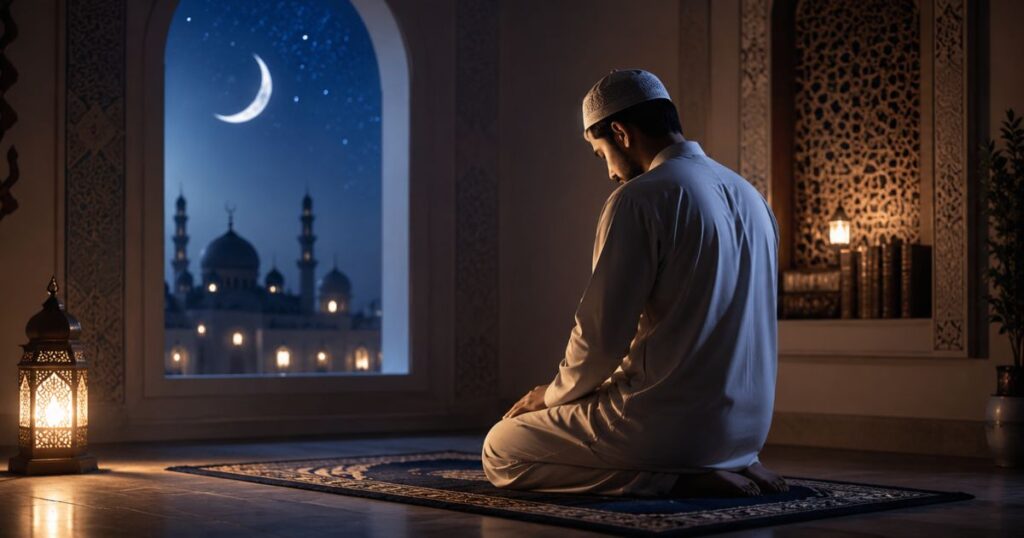
Tahajjud is a supererogatory night prayer in Islam meaning it’s not obligatory, but it carries exceptional reward. The word itself comes from the Arabic root hujud, which means “to give up sleep.” That’s the heart of it: you’re choosing to leave your bed for something that matters more than rest.
The Quran speaks directly to this practice. In Surah Al-Isra, Allah instructs the Prophet Muhammad ﷺ to pray during part of the night as an additional act of worship beyond what’s required of him, with the promise that this could raise him to a praised station (Quran 17:79).
Surah Al-Muzzammil goes further, describing night worship as more effective for the heart and more suited to careful recitation of the Quran (Quran 73:1-6). Historical reports describe the Prophet ﷺ as consistently keeping up this prayer throughout his life, and encouraging his companions to do the same.
You don’t need any special skill to start. You need wudu, a quiet corner, and a sincere intention.
Tahajjud vs. Qiyam-ul-Layl What’s the Difference?
People use these terms interchangeably, and honestly, most of the time that’s fine. But there’s a subtle distinction worth knowing it’ll help you understand why articles and scholars phrase things slightly differently.
| Tahajjud | Qiyam-ul-Layl | |
| Meaning | Night prayer performed after sleeping, even briefly | Any night worship prayer, Quran recitation, dhikr with or without sleeping first |
| Timing | After waking from sleep, before Fajr | Any time after Isha, before Fajr |
| Scope | A specific act of prayer | A broader category that includes Tahajjud |
| Ramadan link | Distinct from Taraweeh | Sometimes used to describe Taraweeh-style congregational night prayer |
In short: every Tahajjud prayer is a form of Qiyam-ul-Layl, but not every Qiyam-ul-Layl is technically Tahajjud. If you pray at night without having slept first, most scholars still count it as a form of night prayer worthy of reward; you’re just not using the strictest definition of the word “Tahajjud.”
When Is the Best Time to Pray Tahajjud?
Tahajjud can be prayed any time between Isha and Fajr. But not all of that window carries equal weight.
According to a widely reported hadith, Allah descends to the lowest heaven during the last third of every night and asks who is calling upon Him, so that He may answer who is asking, so that He may give who is seeking forgiveness, so that He may forgive (Sahih al-Bukhari 1145; Sahih Muslim 758). That’s why scholars consistently point to the last third of the night as the most rewarding window.
Here’s a simple 3-line formula you can do in your head no app required:
- Find your Isha time and your Fajr time.
- Subtract Isha from Fajr to get your total night length, then divide by 3.
- That final third is your window. Set your alarm anywhere inside it.
Work example: Isha at 9:00 PM, Fajr at 5:00 AM. That’s 8 hours of night. Divide by 3 = roughly 2 hours 40 minutes per segment. The last third starts at 2:20 AM so anywhere from 2:20 AM to 5:00 AM is your golden window.
You don’t need to nail this to the minute. Waking up 30–45 minutes before Fajr and praying even two rakats inside that window still counts.
How Many Rakats Do You Pray in Tahajjud?
This is one of the most common points of confusion, so let’s be precise.
Tahajjud has no fixed or maximum number of rakats. It’s traditionally prayed in sets of two, and reports describe the Prophet ﷺ praying anywhere from two rakats up to eleven or thirteen, including Witr at the end.
- Minimum: 2 rakats
- Commonly practiced: 4, 6, or 8 rakats
- Traditionally reported as most frequent: 8 rakats followed by Witr (bringing the total close to 11)
One important note: rakat counts and some procedural details (like whether Witr is 1, 3, or an extended set) vary slightly between schools of thought (madhabs). This guide follows the general, widely-practiced approach shared across most Sunni sources if you follow a specific madhab or school with its own detailed rulings, it’s worth checking with a local scholar for the precise structure your community follows.
The number matters far less than consistency. A hadith describes the most beloved deeds to Allah as those done regularly, even if small (Sahih al-Bukhari 6464; Sahih Muslim 2818). Two rakats every night beats eight rakats once a month.
How to Pray Tahajjud Step by Step
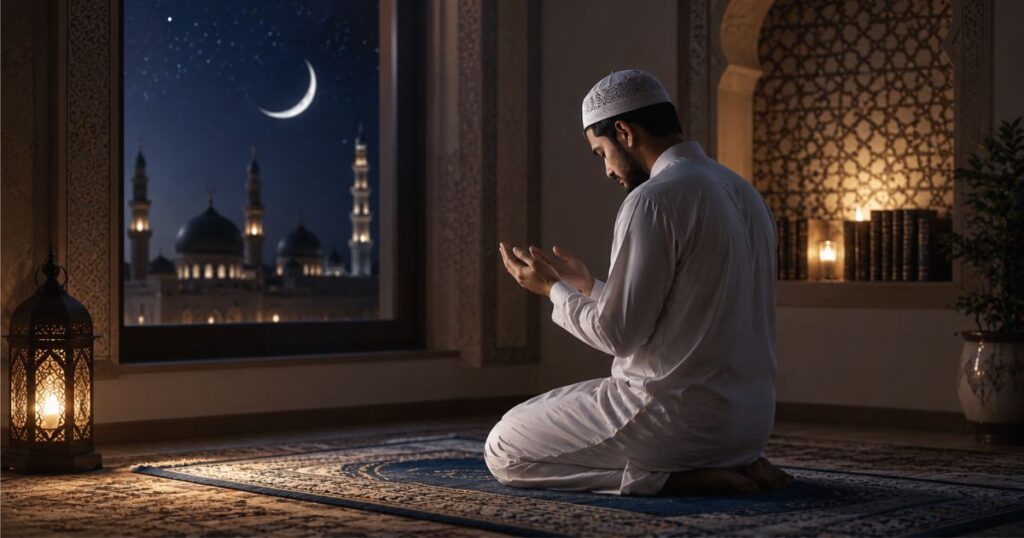
Here’s the full walkthrough, from getting out of bed to finishing your last rakat.
- Wake up (ideally after some sleep). Even a short nap before Isha or a partial night’s sleep counts the “giving up sleep” element is what defines Tahajjud specifically.
- Perform wudu (ablution). Wash as you would for any prayer hands, mouth, nose, face, arms, head, ears, and feet, in order.
- Find a quiet, clean space and make sure you’re covered appropriately for prayer.
- Make your niyyah (intention). This doesn’t need to be spoken aloud. A clear intention in your heart that you’re praying Tahajjud for Allah’s sake is enough.
- Stand facing the Qibla, feet shoulder-width apart, and say “Allahu Akbar” to begin.
- Recite Surah Al-Fatihah, followed by another surah or at least a few verses of your choice.
- Bow (Ruku), saying “Allahu Akbar,” hands on your knees, and glorify Allah a few times.
- Rise from Ruku, saying “Sami’ Allahu liman hamidah,” followed by “Rabbana lakal hamd.”
- Prostrate (Sujood), forehead and nose to the ground, glorifying Allah again.
- Sit briefly between the two prostrations, then prostrate a second time to complete the rakat.
- Repeat for your second rakat, then sit for Tashahhud and conclude with the closing salutations (Tasleem) exactly as you would for any two-rakat prayer.
- If you’re praying more rakats, continue in additional sets of two, finishing each pair with its own Tasleem.
- Finish with Witr (see below) if you haven’t already prayed it that night.
That’s it. The physical movements are identical to any prayer you already know. Tahajjud is defined by when you pray it and why, not by a different set of motions.
What Dua to Read After Tahajjud
The time right after Tahajjud is considered one of the most powerful moments for personal dua; this is when many scholars encourage sincere, unscripted supplication in your own words, in addition to any specific duas you know.
A commonly recited dua for seeking closeness and guidance:
Allahumma inni as’aluka rahmatan min ‘indika tahdi biha qalbi. (“O Allah, I ask You for mercy from You that guides my heart.”)
You can follow this with istighfar (seeking forgiveness), asking for specific needs, and making dua for your family or community. There’s no required script since sincerity matters more than the exact wording.
Do You Pray Witr Before or After Tahajjud?
Witr comes after Tahajjud, as its closing prayer. A hadith instructs that whoever prays during the night should make Witr the final prayer before dawn (Sahih Muslim, Book of Prayers, Travellers).
Practically, this means:
- If you’ve already prayed Witr after Isha (common for people unsure they’ll wake up later), you don’t repeat it after Tahajjud.
- If you haven’t prayed with Witr yet, you pray your Tahajjud rakats first, then close with Witr as an odd-numbered final prayer (commonly 1 or 3 rakats).
What If You Can’t Wake Up? Practical Tips for Beginners
Here’s something most guides skip: the hardest part of Tahajjud isn’t the prayer, it’s the alarm clock.
A practical, first-hand framework that works for many beginners is what you could call the “2-2-2 method”: sleep by a set time, set an alarm 2 hours before Fajr, and commit to just 2 rakats with no pressure to do more. Once two rakats become automatic, most people naturally extend it.
A few more things that genuinely help:
- Sleep with wudu. It’s a small habit that mentally primes you for the possibility of waking up to pray.
- Place your alarm across the room, not within arm’s reach, so silencing it means standing up.
- Don’t treat a missed night as failure. Consistency is built in weeks, not a single night. If you oversleep, the Fajr prayer itself is still your priority and there’s always tomorrow’s last third.
- Pair it with something you enjoy, like reciting a surah you already have memorized, so the prayer doesn’t feel like a chore.
The Benefits of Tahajjud (Quran & Hadith)
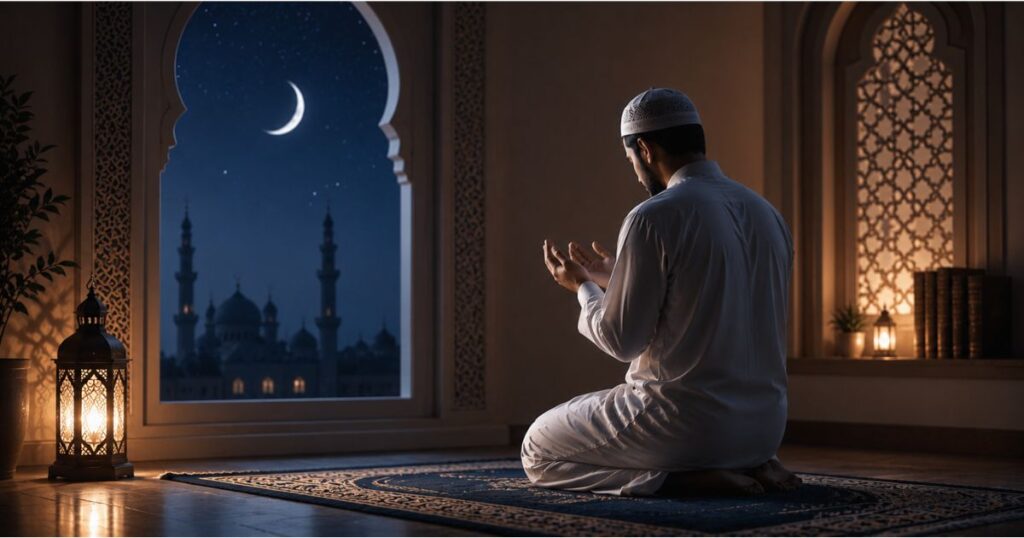
- Allah promises that consistent night prayer beyond what’s obligatory can raise a person to a praised, elevated station (Quran 17:79).
- Night worship is described in the Quran as more effective for the heart and better suited for careful, reflective recitation (Quran 73:6).
- A hadith describes the night prayer as the most excellent prayer after the obligatory ones (Sahih Muslim 1163).
- Holding onto the night prayer is described as the practice of the righteous people who came before, bringing a person closer to their Lord (reported via Tirmidhi).
- Allah’s special descent and invitation for forgiveness during the last third of the night is described directly in hadith (Sahih al-Bukhari 1145; Sahih Muslim 758).
Conclusion
Tahajjud is one of the most rewarding voluntary prayers in Islam, offering a special opportunity to strengthen your relationship with Allah through sincere worship and heartfelt supplication. Whether you pray two rak’ahs or more, consistency and sincerity matter more than the length of the prayer. By making Tahajjud a regular part of your routine, you can seek Allah’s mercy, guidance, forgiveness, and blessings while finding peace and spiritual growth in the quiet hours of the night.
FAQs
Is Tahajjud fard (obligatory) or sunnah?
Tahajjud is voluntary (nafl), not obligatory. It carries strong recommendation and significant reward, but skipping it doesn’t carry sin the way missing an obligatory prayer would.
How many rakats is Tahajjud?
There’s no fixed number. Two rakats is the minimum, and reports describe the Prophet ﷺ praying up to eight rakats followed by Witr, bringing the total close to eleven.
Can I pray Tahajjud without sleeping first?
Yes, praying at night without sleeping first is still rewarded as night worship, though strictly speaking, the term “Tahajjud” describes prayer performed after waking from sleep.
What time does Tahajjud start and end?
It starts after the Isha prayer and ends right before the Fajr adhan. The most rewarding window is the last third of that period.
Do you say a specific dua during Tahajjud?
There’s no single required dua you recite Quran during the rakats as in any prayer, and you’re encouraged to make personal, sincere dua afterward, in Arabic or your own language.