
In Islam, Resurrection Meaning in Islam is resurrection (al-Ba’th) the belief that Allah will bring every human being back to life after death, on a day called Qiyamah (the Day of Judgment), to be held accountable for their deeds. It’s a core article of Islamic faith not a metaphor and the Quran treats it as a certainty backed by evidence from creation itself.
If you’ve ever wondered what Muslims actually believe happens after death and why resurrection sits at the center of it all you’re in the right place. Let’s walk through it, piece by piece.
What Is Resurrection Called in Islam? (Al-Ba’th, Qiyamah, Ma’ad)
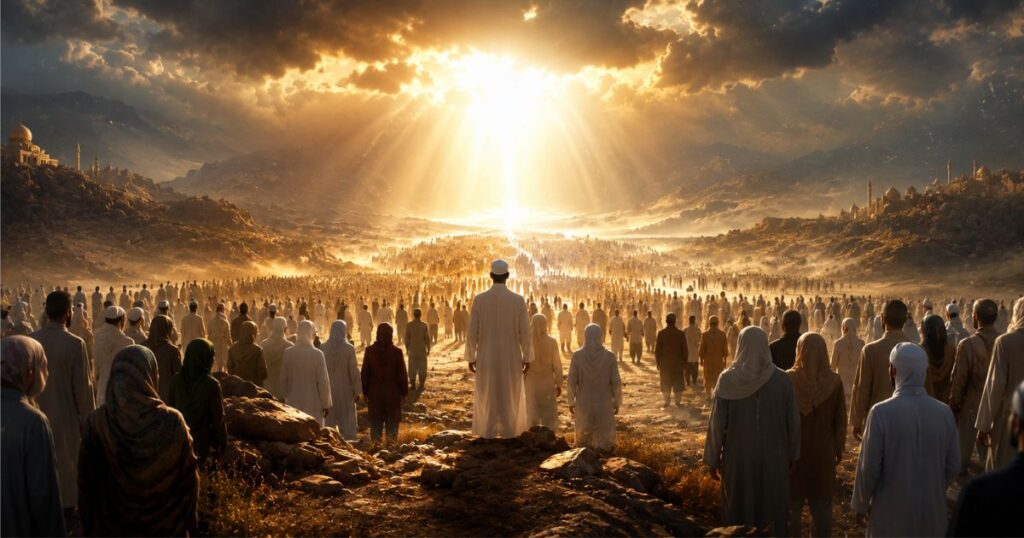
Islam doesn’t use just one word for resurrection. Three terms show up constantly, and knowing them will help everything else click into place.
Al-Ba’th is the Arabic word for “the resurrection” itself the literal act of being raised back to life. It comes from a root meaning “to send forth” or “to raise up.”
Qiyamah (also spelled Qiyama or Qiyamat) means “the standing” or “the rising,” and it refers to the event the Day of Judgment as a whole, not just the moment of resurrection. This is why you’ll often see it written as Yawm al-Qiyamah, “the Day of Standing.”
Ma’ad is a broader theological term meaning “the return” ; it covers the whole doctrine of an afterlife, including resurrection, judgment, and the eternal destinations of Paradise or Hell. You’ll see this term used especially in Islamic philosophy and Shia theology.
Put simply: al-Ba’th is the act, Qiyamah is the day, and Ma’ad is the whole belief system around it.
What Happens Between Death and Resurrection? (Barzakh)
Here’s something a lot of explainers skip: in Islamic belief, resurrection doesn’t happen the moment someone dies. There’s a waiting period first.
Barzakh is the intermediate state between death and resurrection, a kind of “life in the grave” where the soul remains until the Day of Judgment. The word literally means “barrier” or “partition.”
During barzakh, a person’s soul is believed to experience either comfort or distress based on their faith and actions, in a preview of what’s to come. Two angels, traditionally named Munkar and Nakir, are said to question the deceased about their beliefs and deeds. The body decays, but the soul persists waiting.
Barzakh isn’t the final judgment. Think of it less as a verdict and more as a holding room with the lights dimmed one way or the other, depending on how someone lived.
The Stages of Resurrection in Islam
Once Qiyamah arrives, Islamic tradition describes a sequence of events. Different scholars order the finer details slightly differently, but the broad sequence looks like this:
- The first trumpet blast. The angel Israfil blows a trumpet, and everything in creation except what Allah wills to remain comes to an end.
- The second trumpet blast. A second blast follows, and this is the moment of actual resurrection: every soul is reunited with its body and rises from the grave.
- The gathering (Hashr). All of humanity, from the first person to the last, is gathered together in one place to await judgment.
- The weighing of deeds (Mizan). Each person’s good and bad deeds are weighed, often described in the Quran as a literal scale.
- The bridge (Sirat). Souls are said to cross a bridge stretched over Hell the righteous cross with ease, while others fall.
- The final destination. Based on their deeds, each person enters either Jannah (Paradise) or Jahannam (Hell), both of which are described as having multiple levels.
This sequence is why Muslims often describe death not as an ending, but as a transition into a much longer story that isn’t finished yet.
What Does the Quran Say About Resurrection?
Resurrection isn’t a minor side-topic in Islamic scripture it’s one of the most heavily emphasized ideas in the Quran, and one Islamic scholar has noted that roughly a third of the Quran touches on the afterlife and resurrection in some way. The Quran doesn’t just assert resurrection; it argues for it, using comparisons drawn from everyday life. A few of the recurring lines of evidence:
- Human creation itself. The Quran points to how a person develops from a drop of fluid into a fully formed human (Quran 22:5) as proof that the same God can recreate a body after death.
- Dead land coming back to life. Barren earth that turns green after rainfall is repeatedly used as a parallel to reviving the dead (Quran 22:5, 41:39).
- Fire from green, moist wood. The Quran notes that fire can be struck from green trees, something seemingly contradictory as a sign of divine power over nature (Quran 36:80).
- “Repeating creation is easier.” Several verses argue that a being capable of creating something from nothing is certainly capable of restoring what already existed once before (Quran 30:27).
These aren’t presented as poetic flourishes; they function as a running argument aimed at people who doubted resurrection was possible at all, a group the Quran directly addresses in more than one place (e.g., Quran 23:82).
What Are the Signs of the Day of Judgment?
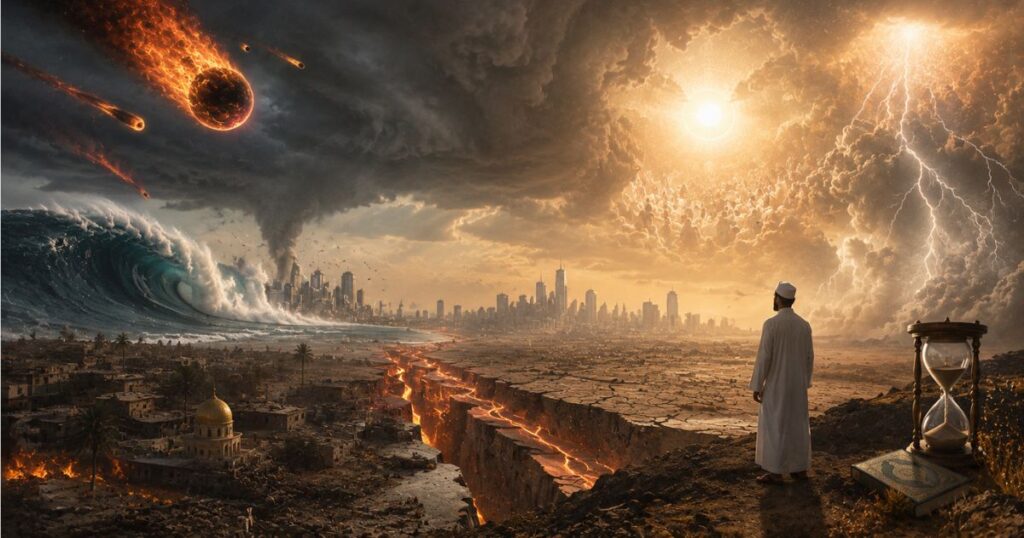
Islamic tradition holds that Qiyamah won’t arrive without warning. Scholars divide these signs into two categories:
Minor signs are smaller, gradual developments, many of which Islamic tradition describes as unfolding over long stretches of history, including widespread moral decline and the loss of religious knowledge.
Major signs are described as dramatic, unmistakable events closer to the end, including:
- The emergence of the Dajjal (a false messiah figure)
- The return of Isa (Jesus), who is expected to defeat the Dajjal
- The appearance of Ya’juj and Ma’juj (Gog and Magog)
- The sun rising from the west instead of the east
- A great smoke covering the earth
Crucially, Islamic teaching is firm that no one knows the exact timing of Qiyamah that knowledge belongs to Allah alone. The signs are meant to be recognized, not used to predict a date.
Is Resurrection in Islam Bodily or Spiritual?
This is a question mainstream explainers tend to skip entirely, and it’s worth a closer look.
The dominant, mainstream Islamic position supported by the plain reading of the Quranic verses above is that resurrection is bodily: the same body a person had in life is restored and reunited with the soul.
But this wasn’t universally accepted among Islamic philosophers. Ibn Sina (Avicenna), arguably the most influential philosopher in the Islamic intellectual tradition, argued that bodily resurrection couldn’t be proven through reason alone, since a body fully decomposes and its matter disperses. His conclusion wasn’t that bodily resurrection is false, it was that it’s a matter of revelation, not philosophy: because the Prophet Muhammad announced it, it must be accepted as true, even if reason alone can’t fully demonstrate it.
This distinction matters. It shows that even within Islamic scholarship, resurrection has been engaged with as a serious philosophical question, not just a devotional assumption and that the “bodily vs. spiritual” debate has real intellectual history behind it, rather than being a modern controversy.
How Is Resurrection in Islam Different From Christianity?
Resurrection shows up across Abrahamic religions, but the details diverge sharply. Here’s how the core ideas compare:
| Islam | Christianity | Judaism | |
| Whose resurrection is central? | All humanity’s, at the end of time | Jesus Christ’s, as a historical, past event | The righteous dead, at the end of days |
| Is it already happening or is it the future? | Entirely future (Qiyamah) | Jesus’s resurrection is past; general resurrection is future | Future |
| Theological role | Proof of God’s power and justice; basis for accountability | Central proof of Jesus’s divinity and the promise of salvation | Part of messianic-era hope; less doctrinally uniform |
| View of Jesus’s resurrection specifically | Rejected Islam holds Jesus was not crucified, so no resurrection occurred | The foundational event of the faith | Not applicable |
| Body or soul? | Mainstream view: bodily | Bodily (following the resurrection of Christ as the model) | Views vary; bodily resurrection affirmed in traditional Judaism |
The starkest difference is around Jesus. Since Islam teaches that Jesus was not crucified, the resurrection of Christ, the event Christianity treats as its foundation, has no equivalent in Islamic theology at all. Muslims do believe Jesus will return before Qiyamah, but as a sign of the end times and a defeater of the Dajjal, not as evidence of a past resurrection.
Why Belief in Resurrection Matters in Islam
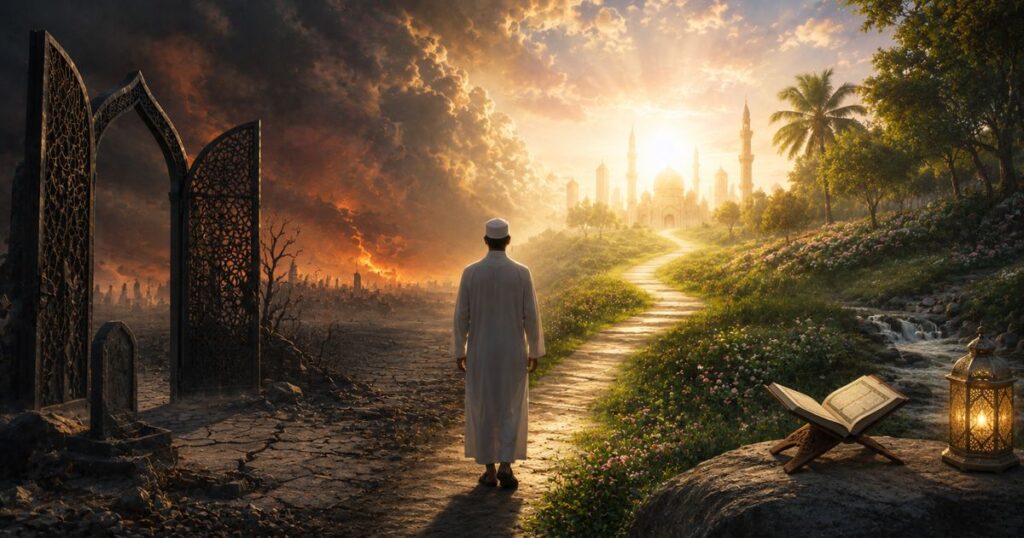
Resurrection isn’t treated as an abstract theological detail; it’s meant to shape how people live right now. Because every action is believed to be recorded and eventually weighed, the doctrine functions as a built-in accountability system that runs alongside the core practices of a Muslim’s daily life: nothing is wasted, and nothing is truly hidden.
This is also why repentance carries such weight in Islamic teaching. Since judgment is certain but its timing isn’t, the tradition consistently emphasizes turning back to God without delay, rather than treating repentance as something to postpone.
Conclusion
Resurrection in Islam (al-Ba’th) is the belief that Allah will physically raise every human being from death on Qiyamah, the Day of Judgment, to be held accountable for their deeds. It unfolds in stages of death, the waiting period of barzakh, the trumpet blasts, the gathering, the weighing of deeds, and finally Paradise or Hell and it’s treated in the Quran not as a symbol, but as a certainty argued for through evidence from nature and creation itself. While the mainstream view holds that resurrection is bodily, the question has a real philosophical history within Islamic scholarship, and the doctrine diverges sharply from Christianity’s Jesus-centered resurrection theology.
FAQs
What is Qiyamah?
Qiyamah is the Islamic term for the Day of Judgment, the day when all of humanity is resurrected, gathered, and judged according to their deeds before entering Paradise or Hell.
Do Muslims believe in the resurrection of Jesus?
No. Islam teaches that Jesus was not crucified, so the resurrection central to Christian theology has no equivalent in Islamic belief. Muslims do believe Jesus will return before the Day of Judgment, but in a different theological role.
What is Barzakh?
Barzakh is the intermediate state between death and resurrection, where the soul waits experiencing comfort or distress until the Day of Judgment arrives.
Is resurrection in Islam bodily or spiritual?
The mainstream position is bodily resurrection: the same body is restored and reunited with the soul. Some Islamic philosophers, notably Ibn Sina, held that this is accepted on the authority of revelation rather than something reason alone can prove.
Who are Munkar and Nakir?
Munkar and Nakir are the two angels Islamic tradition describes as questioning the deceased in the grave about their faith and deeds during the period of barzakh.
Can anyone know when the Day of Judgment will happen?
No. Islamic teaching holds that the exact timing of Qiyamah is known only to Allah. Signs are meant to be recognized as the end approaches, not used to calculate a specific date.