
Taraweeh prayer is a special voluntary prayer performed by Muslims during the month of Ramadan after the Isha prayer. It is a cherished act of worship that provides an opportunity to strengthen one’s connection with Allah, reflect on the Quran, and seek spiritual growth. Taraweeh is commonly prayed in congregation at mosques, where portions of the Quran are recited each night throughout Ramadan.
Why Do Muslims Pray Taraweeh During Ramadan?
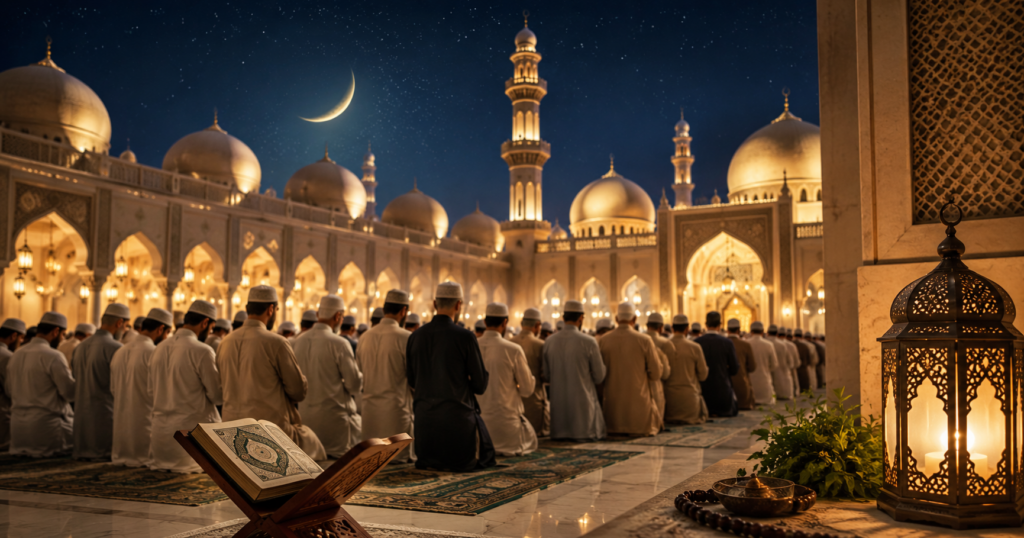
Here’s the honest answer: because the rewards are almost incomprehensible.
The Prophet Muhammad (peace be upon him) said, “Whoever stands in prayer during Ramadan with faith and seeking reward, his past sins will be forgiven.” That hadith, recorded in both Sahih Bukhari and Sahih Muslim the two most trusted collections of prophetic sayings in Islam is the foundation of why millions of Muslims around the world give up sleep every night for 29 or 30 consecutive evenings.
And it doesn’t stop there. During Ramadan, every good deed is multiplied in reward. So taraweeh isn’t just voluntary night prayer it’s voluntary night prayer during the single most spiritually charged month of the Islamic calendar. The math is extraordinary.
But the rewards go beyond sin forgiveness.
The hadith that makes taraweeh so powerful
The Prophet didn’t just perform taraweeh he gathered his companions and prayed with them. He described night prayer in Ramadan as one of the greatest acts of worship a believer can perform. Scholars across all four major Sunni schools of Islamic law Hanafi, Maliki, Shafi’i, and Hanbali unanimously agreed that taraweeh is a strongly emphasized Sunnah, meaning missing it repeatedly is considered a spiritual loss, even though it’s not obligatory.
Spiritual benefits beyond forgiveness
Praying taraweeh builds a direct, intimate connection with the Quran. Many mosques aim to complete the entire Quran across the 29 or 30 nights of Ramadan roughly one section (juz) per night. Imagine finishing the entire scripture in a single month, listening to it recited beautifully in prayer. That’s a unique experience you simply cannot replicate outside of Ramadan.
Beyond that, there’s the community dimension. Walk into any mosque in America during Ramadan at night and you’ll feel it immediately rows of people standing shoulder to shoulder, all focused on the same words, the same purpose. That collective worship is something taraweeh prayer creates like nothing else.
How to Pray Taraweeh: Step-by-Step Guide
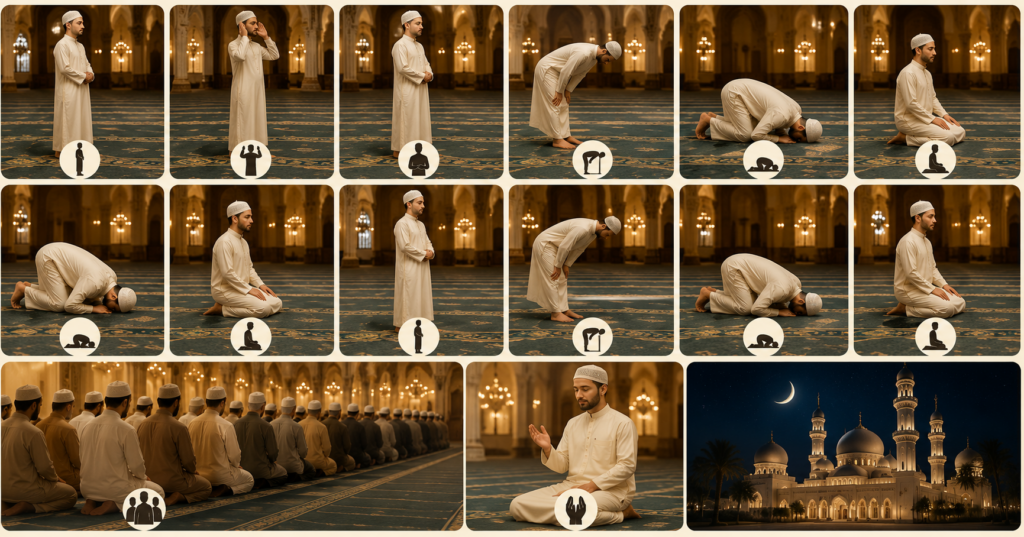
This is the section nobody writes clearly enough. Here’s exactly what to do whether you’re at a mosque or praying at home alone.
Before you begin: Make sure you’ve completed the obligatory Isha prayer first. Taraweeh always follows Isha never replaces it.
Step 1 Perform wudu (ritual purification). Wash your hands, mouth, nose, face, arms, wipe your head, and wash your feet. This physical act of cleansing is also a spiritual reset you’re preparing to stand before God. For a detailed guide to Wudu, read our complete guide on how to pray as a Muslim.
Step 2 Set your intention (niyyah) in your heart. You don’t need to say it aloud. Simply intend in your heart: “I am praying taraweeh prayer for the sake of Allah.” Sincerity here matters more than the exact words.
Step 3 Begin the first pair of rakats. Raise your hands to your earlobes and say “Allahu Akbar” (God is the Greatest) to open the prayer. Recite Surah Al-Fatiha, followed by any surah or verses you know. You do not need to recite specific chapters whatever you know by heart is perfectly valid.
Step 4 Complete the first two-rakat set. Go through the full sequence of standing, bowing (ruku), prostration (sujood), and sitting twice. End the pair by turning your head right and then left, saying the closing salutation each time. That’s one complete set.
Step 5 Rest briefly. This is the “taraweeh” moment itself. Take 1–2 minutes to sit quietly, make personal supplication, or recite short remembrances. This rest is sunnah, not wasted time.
Step 6 Repeat. Pray another two-rakat set in the same way. After every four rakats (two sets of two), take a slightly longer rest and recite the special taraweeh dua (see the section below).
Step 7 Continue until you’ve completed your chosen number of rakats. Whether you’re praying 8 or 20, keep going in pairs of two until you reach your total.
Step 8 Conclude with Witr prayer. Witr is an odd-numbered prayer (usually 1 or 3 rakats) that closes the night’s worship. It’s the final seal on your evening. Don’t skip it it’s one of the most recommended prayers in Islam.
That’s it. You just prayed taraweeh. And you can do it from your living room in 30 minutes or make it a two-hour mosque experience. Both are equally valid.
How Many Rakats Is Taraweeh 8 or 20?
This is the question that has sparked more mosque debates than almost anything else in modern Islamic practice. Here’s the clear, honest answe: both r8 and 20 are valid.
| Option | Rakats | School of Thought | Primary Evidence |
| Shorter version | 8 rakats + 3 witr | Supported across schools | Hadith of Aisha (Bukhari): the Prophet prayed 11 total |
| Longer version | 20 rakats + 3 witr | Hanafi, Maliki, Shafi’i, Hanbali | Established by Caliph Umar ibn al-Khattab |
| Flexible | Any even number | All schools agree | Prophet said: “Night prayer is two by two” |
The scholarly position on 8 rakats
Aisha (may Allah be pleased with her), the Prophet’s wife, was asked how many rakats he prayed at night during Ramadan. She replied that he never prayed more than 11 rakats four beautiful long ones, four more, then three witr. That’s 8 rakats of taraweeh plus 3 witr, totalling 11.
This hadith, preserved in Sahih Bukhari, is the evidence most commonly cited by those who pray 8 rakats. Scholars note that the Prophet’s 8 rakats were extraordinarily long and contemplative quality over quantity, always.
The scholarly position on 20 rakats
After the Prophet’s passing, Caliph Umar ibn al-Khattab gathered the Muslim community in Medina and organised 20 rakats of taraweeh in congregation. This became the standard practice across the majority of the Islamic world for over 1,400 years, and it remains what most mosques in the United States practice today.
The practical advice? If you’re at a mosque, pray what the imam prays and don’t leave early. If you’re at home, pray the number you can sustain with focus and sincerity. A short taraweeh prayed with full presence beats a long one prayed on autopilot every single time.
What Is the Difference Between Taraweeh and Tahajjud?
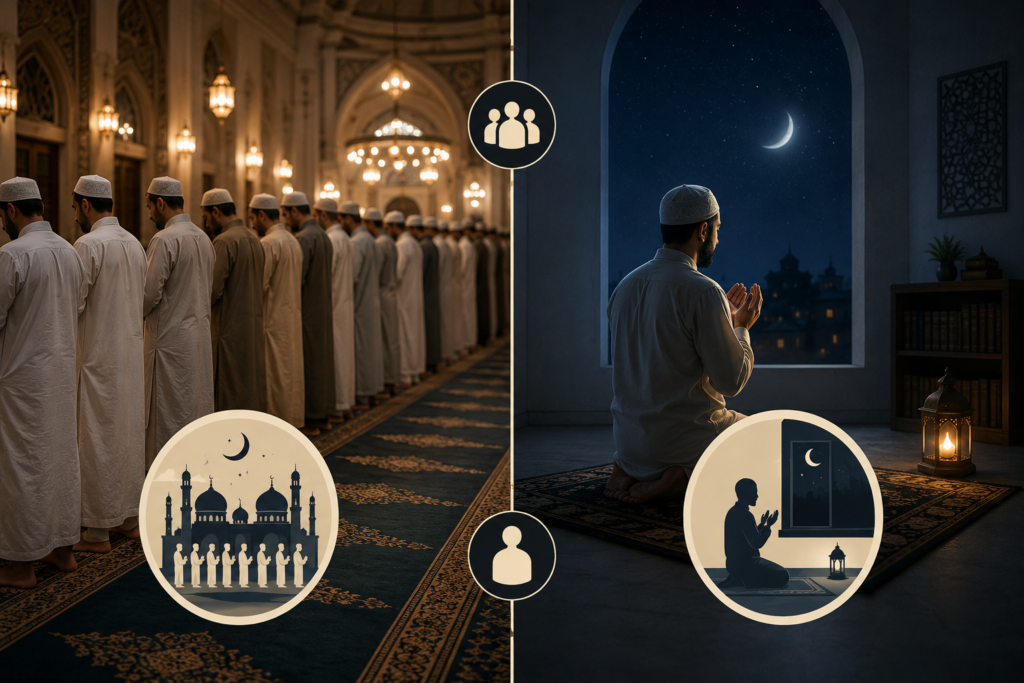
Great question and one that confuses a lot of people, including lifelong Muslims.
| Feature | Taraweeh | Tahajjud |
| When prayed | Ramadan only | Any night of the year |
| Timing | After Isha, before sleep | Last third of the night (after sleep) |
| Status | Strongly recommended Sunnah | Highly virtuous voluntary prayer |
| Where | Mosque or home | Usually home |
The simplest way to remember it: taraweeh is the Ramadan night prayer; tahajjud is the year-round night prayer. They’re cousins, not the same prayer. Some scholars say that taraweeh prayed in the last third of the night takes on the additional merit of tahajjud so if you’re an early riser, consider praying it late.
Can You Pray Taraweeh at Home? Everything You Need to Know
Yes absolutely, completely, and without question.
In fact, the Prophet Muhammad (peace be upon him) performed the majority of his taraweeh prayers at home. He led the community for a few nights and then deliberately stopped, explaining that he feared people might begin to consider it obligatory. So praying at home is not a compromise it’s actually the prophetic way.
Here’s what home taraweeh looks like in practice:
- Solo prayer: Follow the same steps outlined above. You are your own imam. Recite aloud it enhances focus and mirrors the mosque experience.
- Praying with family: One person leads, others follow. The leader stands slightly ahead of the group. Everyone benefits from the reward of congregational prayer.
- Female-led congregation: A woman can lead other women in taraweeh. She stands in the middle of the first row not in front of it and recites aloud. This is a legitimate and honoured tradition in Islamic scholarship.
How to set up a taraweeh space at home
You don’t need much. A clean prayer mat, a quiet corner, and your phone on silent. If you’re following along with Quran recitation, apps like Muslim Pro or Quran.com have audio recitation you can use to keep pace. Dim the lights. Let the atmosphere settle. Treat it like the sacred act it is because it is.
Praying taraweeh with family: congregation at home
There’s something quietly beautiful about standing in a row with the people you love, all facing the same direction, listening to the same words. Even if your household consists of just two people, that’s a congregation. And the Prophet said the reward of congregational prayer exceeds solo prayer by 27 degrees.
You can also split the night pray some rakats at the mosque and complete the rest at home. That’s completely fine. Night worship isn’t all-or-nothing.
Taraweeh Dua: What to Recite Between Sets
After every four rakats, sit, rest, and recite this well-known supplication:
Subhana zil mulki wal malakoot, subhana zil izzati wal azamati wal haibati wal qudrati wal kibriyaa’i wal jabarut. Subhanal malikil hayyil lazi la yanamu wa la yamootu. Subboohun quddoosun rabbuna wa rabbul malaa’ikati war rooh. Allahumma ajirna minan naar, ya mujeeru ya mujeeru ya mujeer.
English meaning: “Exalted is the Possessor of all dominion and sovereignty. Exalted is the Possessor of might, greatness, majesty, power, and pride. Exalted is the Living King who neither sleeps nor dies. All-perfect, all-holy is our Lord, Lord of the angels and the spirit. O Allah, save us from the Fire. O Granter of refuge, O Granter of refuge, O Granter of refuge.”
You don’t have to memorise this immediately. During your first Ramadan, even a simple “O Allah, forgive me” whispered sincerely in English is a dua worth making. Allah hears every language. He created them all.
Finding Taraweeh Prayers Near You in the United States
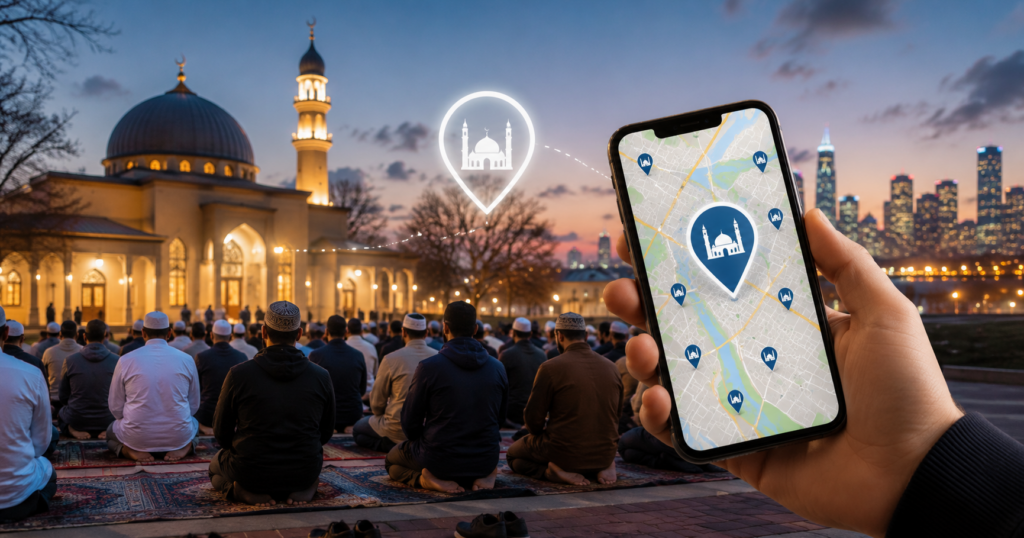
If you’re in the US, you have more options than you might think even in smaller cities.
- IslamicFinder.org search by zip code for mosques near you with Ramadan schedules, including taraweeh times and rakat counts (8 or 20).
- Muslim Pro app one of the most downloaded Islamic apps globally, with a mosque finder and prayer time alerts built in. Free on iOS and Android.
- Masjid Al-Noor, ISNA-affiliated mosques the Islamic Society of North America lists member mosques across all 50 states. Many follow the 20-rakat tradition.
- Call ahead mosque schedules vary. Some start taraweeh immediately after Isha; others begin 15–20 minutes later. A quick call saves a wasted trip.
One practical tip: if you want the longer Quran-completion experience, look for mosques that announce “khatm al-Quran” taraweeh they’re aiming to complete the entire Quran by the 27th night of Ramadan, often with a special emotional closing ceremony. It’s one of the most powerful religious experiences American Muslims describe.
Expert Insight: What 10 Years of Praying Taraweeh Taught Me
The first time I prayed taraweeh, I lasted four rakats and nearly fell asleep standing up. I’d eaten too much at iftar, my feet hurt, and I couldn’t stop thinking about the drive home.
By year three, I was staying for all 20.
What changed wasn’t my stamina it was my understanding of what I was actually doing. Once I understood that each pair of rakats was a private conversation with the Creator of everything, the length stopped mattering. The exhaustion became part of the experience. There’s something about praying at 11 PM, half-tired, half-hungry, surrounded by people doing the exact same thing it cracks something open in you.
The scholars have a word for that softening: khushu deep presence and humility in prayer. You can’t force it. But taraweeh, night after night for a full month, tends to find it for you.
The one piece of advice I’d offer anyone starting out: don’t compare your taraweeh to anyone else’s. Two rakats prayed slowly and sincerely will always outweigh twenty prayed on autopilot. Begin where you are. Come back tomorrow.
Conclusion
Taraweeh prayer is a meaningful part of Ramadan that helps Muslims deepen their faith, increase their devotion, and gain spiritual rewards. While it is not obligatory, participating in Taraweeh offers a unique opportunity to engage in extra worship and experience the blessings of the holy month.
FAQs
Is taraweeh prayer obligatory?
No. Taraweeh is classified as Sunnah Mu’akkadah a strongly recommended voluntary prayer, not a religious obligation. You will not sin by missing it, but scholars across all major schools of Islamic law agree that regularly abandoning it without reason is a significant spiritual loss.
Can I pray taraweeh if I don’t know the whole Quran?
Absolutely. You only need to know Surah Al-Fatiha plus any other short chapter or verses you’ve memorised even a single short surah repeated throughout is valid. The Prophet encouraged everyone to pray according to their ability. Learning more Quran is a lifelong journey, not a prerequisite for worship.
What time does taraweeh prayer start and end?
Taraweeh begins immediately after the obligatory Isha prayer typically between 9:00 PM and 10:30 PM depending on your US city and the time of year. It can technically be prayed any time before the Fajr (dawn) prayer begins. Those who prefer tahajjud-style worship sometimes delay it to the last third of the night.
Can I pray only 2 rakats of taraweeh?
Yes, and you’ll be rewarded for it. Two rakats of taraweeh is better than none, and Allah does not let any sincere act of worship go unrewarded. However, two rakats alone would not constitute a full taraweeh it’s the beginning of one. Think of it as the start, not the finish.
Does taraweeh have to be prayed every night of Ramadan?
No. There is no penalty for missing nights, and taraweeh is not a commitment that invalidates if broken. Pray as many nights as you can, with as much focus as you can bring. Consistency matters more than perfection showing up 20 nights sincerely is worth more than 30 nights on autopilot.