
Why Do We Pray in Islam? Muslims pray because worship is considered the core purpose of human life. Prayer, called Salah, was commanded by Allah and taught to Prophet Muhammad ﷺ during a night journey known as Isra and Mi’raj. It’s performed five times daily to keep believers connected to God, purify the heart from sin, and build discipline, gratitude, and community.
What Is Salah (Islamic Prayer)?
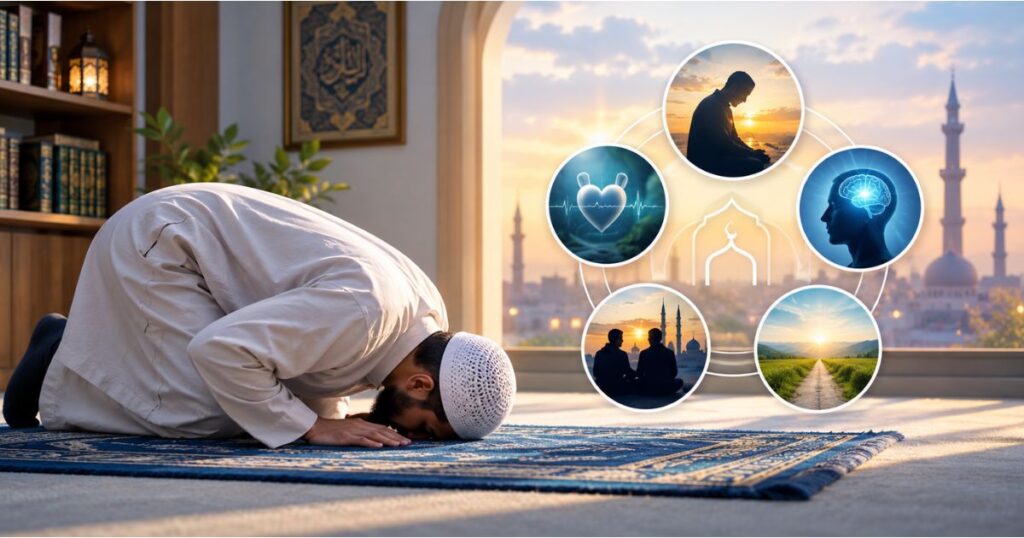
Salah is the second pillar of Islam, right after the Shahada (the declaration of faith). It’s a structured, obligatory act of worship performed five times a day, combining physical movement standing, bowing, prostrating, sitting with recitation from the Qur’an and personal supplication.
Every prayer follows the same basic shape wherever it’s performed. Muslims face the Kaaba in Mecca, recite verses in Arabic, and move through a fixed sequence of postures that together express humility and submission to God. It’s this combination of body, voice, and intention moving together that makes Salah distinct from casual or spontaneous prayer.
Why Do Muslims Pray? The Core Purpose
The simplest answer sits in the Qur’an itself. Allah states that humanity’s entire reason for existing is to worship Him:
“And I did not create the jinn and mankind except to worship Me.” Qur’an 51:56
That single verse reframes prayer from a chore into a purpose. In Islamic theology, worship isn’t one item on a checklist of good behavior, it’s the reason a person exists at all. Salah is simply the most concrete, repeated expression of that purpose.
This is also why prayer was one of the very first things Allah commanded once Muhammad ﷺ became a prophet. Before laws about business, marriage, or justice were revealed, prayer came first. It set the tone for everything that followed: a relationship with God has to be established before anything else in life can be properly ordered.
There’s a practical distinction here too. The Prophet ﷺ described neglecting prayer as one of the clearest lines between faith and its absence not as a threat, but as a description of how central prayer is to Muslim identity. Believers and non-believers may be indistinguishable in daily life, but at the time of prayer, the difference becomes visible.
Why Do Muslims Pray 5 Times a Day?
This is one of the most common follow-up questions and the answer traces back to a specific event in Islamic history, not an arbitrary number.
The Story of Isra and Mi’raj
About eleven years after Muhammad ﷺ began receiving revelation, he experienced a miraculous night journey known as Isra and Mi’raj. The angel Gabriel (Jibreel) took him from Mecca to Jerusalem, and from there through the seven heavens, where he met earlier prophets including Abraham, Moses, and Jesus.
At the highest point of this journey, Allah commanded fifty daily prayers. On his way back down, the Prophet ﷺ passed Moses, who knowing how difficult sustained obligations can be for people urged him to ask for a reduction. Muhammad ﷺ returned to Allah repeatedly, and the number was lowered each time: from fifty, to forty, to thirty, to twenty, to ten, and finally to five. Allah kept the reward of fifty prayers while reducing the daily burden to five, a detail preserved in Sahih al-Bukhari (Hadith 429, graded sahih, or authentically sound).
Fact block: The five daily prayers were reduced from an original fifty during the Prophet’s ﷺ ascension (Isra and Mi’raj), while the spiritual reward of fifty was retained. Source: Sahih al-Bukhari 3887 / 349, narrated by Anas ibn Malik.
That negotiation is often overlooked, but it matters: the five-times structure isn’t presented as an arbitrary rule. It’s framed as Allah’s mercy, a workable rhythm for real human life rather than an impossible demand.
For a full breakdown of each prayer’s name, Arabic term, and time window, here’s the basic structure:
| Prayer | Arabic Name | Approximate Time Window |
| Dawn | Fajr | Before sunrise |
| Midday | Dhuhr | After the sun passes its peak |
| Afternoon | Asr | Mid-to-late afternoon |
| Sunset | Maghrib | Just after sunset |
| Night | Isha | After twilight fades |
(Exact clock times shift daily based on the sun’s position and vary by location; most Muslims use a local prayer-time app or mosque schedule rather than fixed hours.)
What Are the Benefits of Prayer in Islam?

Salah isn’t only a spiritual obligation Islamic teaching describes it as something that actively shapes character and daily wellbeing.
- It expiates minor sins. The Prophet ﷺ compared the five daily prayers to bathing in a river outside your door five times a day nothing of the “dirt” of minor sin would remain. (Sahih al-Bukhari 528, Sahih Muslim 667, graded muttafaqun alayhi agreed upon by both Bukhari and Muslim)
- It provides structure and discipline. Five fixed prayer times each day naturally build a rhythm, a built-in reset point that resists the drift of an unstructured schedule.
- It offers a form of remembrance and calm. The Qur’an states, “Verily, in the remembrance of Allah do hearts find rest” (13:28) prayer is framed less as a task to complete and more as a return to steadiness.
- It builds community. Congregational prayer at a mosque, especially the Friday prayer, connects Muslims to one another and reinforces a shared identity that crosses ethnicity, language, and nationality.
- It creates accountability. Islamic tradition holds that prayer will be the very first matter examined on the Day of Judgment, a reminder that consistency in prayer is treated as a marker of one’s overall spiritual condition.
For a Muslim balancing work, school, or family responsibilities in 2026, this rhythm functions less like an interruption and more like a checkpoint five built-in moments a day to step back from screens, deadlines, and noise before returning to them with a clearer head.
What Happens If a Muslim Misses a Prayer?
Missing a prayer occasionally through oversight, illness, or unavoidable circumstance is treated with practicality, not condemnation. Islamic teaching instructs that a missed prayer should simply be performed as soon as it’s remembered, rather than abandoned. There’s flexibility, too: travelers and those in difficult circumstances are permitted to shorten or combine certain prayers.
What Islamic teaching does caution against is habitual, intentional neglect of prayer altogether not an isolated missed prayer due to human circumstance. The distinction matters: this is a faith built around consistent return and repair, not perfection.
An Honest Reflection on Prayer
Prayer only fully serves its purpose when it’s more than a physical routine. Scholars have long emphasized that a prayer performed quickly, without reflection or presence of heart, falls short of its intent even if every movement is technically correct. The goal isn’t just to complete five prayers a day, but to genuinely arrive at each one with attention. This is a section where your own community’s voice belongs to a first-hand reflection from an imam, a convert’s experience of learning to pray, or your organization’s own observations about what prayer looks like in practice would strengthen this section considerably. We’ve flagged this space for your input rather than inventing an anecdote.
How Islamic Prayer Connects to Daily Life

Salah isn’t designed to exist apart from ordinary life; it’s built to run alongside it. Because prayer times shift with the sun rather than the clock, they naturally reorganize a Muslim’s day around moments of pause rather than around a rigid Western nine-to-five structure. Many workplaces, schools, and mosques in Muslim-majority regions and increasingly in Western cities with sizable Muslim populations accommodate short prayer breaks for exactly this reason. The five prayers act less like a disruption to modern scheduling and more like built-in checkpoints that punctuate the day.
If you’re just starting to learn how to pray, The Revert’s step-by-step prayer guide walks through each movement and recitation in a beginner-friendly way.
FAQs
Why do Muslims pray facing Mecca?
Facing the Kaaba in Mecca (the Qibla) unifies Muslims worldwide in a single physical direction during prayer, symbolizing one shared focus of worship regardless of location.
Do women pray the same way as men in Islam?
Yes, the core structure of Salah, the postures, recitations, and timing is the same for men and women. Women are commonly encouraged to pray at home but are permitted to pray at the mosque as well.
Is Salah the same as making a personal dua (supplication)?
No. Salah is the structured, obligatory five-times-daily prayer, while dua is informal, personal supplication that can be made anytime, in any language, for any need.
What language is Salah performed in?
The core recitations of Salah are performed in Arabic, the language of the Qur’an, regardless of a worshipper’s native language. Personal supplications outside the formal prayer can be made in any language.
Can Salah be shortened or combined?
Yes. Travelers and those facing illness or hardship are permitted, under specific conditions, to shorten certain prayers or combine two prayer times with built-in accommodation for difficult circumstances.
How long does each prayer take?
A single prayer typically takes 5–15 minutes depending on how much is recited, though this varies by individual and by prayer (Friday congregational prayer runs longer due to the sermon).