
Dhuhr prayer is the second of the five daily obligatory prayers in Islam. It is performed after the sun passes its zenith and consists of four rakats. This prayer helps Muslims pause their daily work and connect with Allah through worship and remembrance.
What Is Dhuhr Salah and Why Is It Important?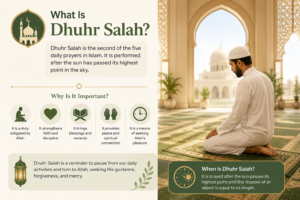
Dhuhr Salah is the second of the five daily obligatory prayers in Islam. It happens right in the middle of the day.
When the sun begins its descent from its highest point, the window for Dhuhr opens. This specific timing is no accident. It forces you to step away from worldly distractions and remember what truly matters.
Think of it as a divine coffee break. Instead of scrolling through social media, you are feeding your soul.
Regularly performing this prayer keeps your spiritual compass calibrated. It washes away minor sins committed since the morning and reinforces your discipline. While Fajr wakes you up and Asr closes your afternoon, Dhuhr grounds you when the world is chaotic.
Quick Checklist Before Praying Dhuhr
Before you even raise your hands to start, you need to check a few boxes. Preparation is half the battle.
Prerequisites for Dhuhr Salah
You cannot just jump onto the prayer mat without getting ready. Make sure you have the following sorted:
- Wudu (Ablution): You must be in a state of physical and spiritual purity. Wash your face, arms, head, and feet.
- Cleanliness: Your clothes, body, and the spot you are praying on must be free from impurities.
- Modesty: Cover your awrah. For men, this is from the navel to the knee. For women, it is the entire body except for the face and hands.
- The Qibla: You must face the Kaaba in Makkah. Use a compass app on your phone if you are unsure.
- Niyyah (Intention): Silently make the intention in your heart for the specific prayer you are about to perform.
Best Time to Pray Dhuhr
The time for Dhuhr starts immediately after the sun passes its absolute peak in the sky.
It ends when the shadow of an object becomes equal to its height, which marks the start of the Asr prayer.
Do not guess the time. Use a reliable local mosque timetable or a prayer app. Praying early in the window is always better, bringing a massive sense of relief and accomplishment to your afternoon.
Step-by-Step Guide to Praying Dhuhr Salah
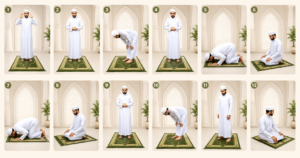
Now, let us get into the core of the practice. Knowing the mechanics inside out removes anxiety and lets you focus on the meaning.
How Many Rak’ahs Are in Dhuhr Salah?
A “rak’ah” is a single unit of prayer. Dhuhr has a total of 10 to 12 rak’ahs, split into obligatory and optional parts:
- 4 Sunnah Rak’ahs: Highly recommended before the main prayer.
- 4 Fard Rak’ahs: This is the absolute obligatory core of Dhuhr.
- 2 Sunnah Rak’ahs: Highly recommended after the main prayer.
- (Optional) 2 Nafl Rak’ahs: Extra voluntary prayers for added reward.
For a complete breakdown of every prayer’s rak’ah count — Fajr, Dhuhr, Asr, Maghrib, and Isha — our dedicated guide on rakaats in Salaah gives you the full picture in one place.
Step-by-Step Instructions
Let us focus on the 4 Fard (obligatory) rak’ahs. Follow these exact steps:
- Make your Niyyah: Stand facing the Qibla and silently intend to pray the 4 Fard rak’ahs of Dhuhr.
- The Opening Takbeer: Raise your hands to your ears and say “Allahu Akbar” (God is the Greatest). Fold your hands over your chest (right over left).
- Recite Al-Fatihah: Silently recite Surah Al-Fatihah. In the first two rak’ahs, follow it with another short Surah, like Al-Ikhlas. If you want to know exactly what Muslims say during every step of prayer — with full Arabic phrases, transliterations, and English meanings — that guide explains each recitation from Takbir to Salam.
- Bowing (Rukoo): Say “Allahu Akbar” and bow. Your back should be straight. Say “Subhaana Rabbiy-al-‘Adheem” three times.
- Stand Back Up: Rise while saying “Sami’ Allahu liman hamidah” and then “Rabbana lakal hamd”.
- First Prostration (Sujood): Say “Allahu Akbar” and go down. Your forehead, nose, palms, knees, and toes must touch the ground. Say “Subhaana Rabbiy-al-A’laa” three times.
- Sit Up: Say “Allahu Akbar” and sit on your knees for a brief moment.
- Second Prostration: Say “Allahu Akbar” and prostrate again, repeating the same phrase three times.
- Stand for the Next Rak’ah: Say “Allahu Akbar” and stand up. You have now completed one full rak’ah.
- The Sitting (Tashahhud): After your second rak’ah, sit and recite the Tashahhud. Then, stand up for the third rak’ah.
- Finish the Prayer: In the third and fourth rak’ahs, only recite Surah Al-Fatihah. After the fourth rak’ah, sit to recite the full Tashahhud, send blessings upon the Prophet (Salawat), and turn your head right, then left, saying “Assalamu alaikum wa rahmatullah”.
Common Mistakes to Avoid During Dhuhr Salah
Even seasoned practitioners slip up sometimes. Here are a few traps to watch out for.
Rushing the Movements
Your prayer is a conversation, not a race. Moving too fast between bowing and prostrating invalidates the prayer. Pause for at least a full second in every posture.
Forgetting the Niyyah
Intention is everything. If you just go through the physical motions without consciously intending to pray Dhuhr, it is just exercise, not worship.
Looking Around
Keep your eyes fixed on the spot where your forehead will rest during prostration. Looking up at the ceiling or glancing around the room breaks your spiritual focus.
Reciting Too Loudly
Unlike Fajr, Maghrib, and Isha, the Dhuhr prayer is silent. You should move your lips, but your recitation should only be audible to yourself. This is one of the most commonly misunderstood rules for beginners — our guide on how to pray in Islam explains the silent versus audible distinction for every prayer clearly.
Expert Insight How to Deepen Your Connection During Dhuhr Salah
It is easy to let your mind wander to your grocery list or that pending email.
Islamic scholars advise treating every prayer as if it is your last. This instantly shifts your perspective.
Before you raise your hands for the Takbeer, take three deep breaths. Visualize yourself standing directly before your Creator. Remember that the world and all its problems will still be there in ten minutes.
Real-world application: If you pray at the office, leave your phone at your desk. Walking to a quiet room without a device in your pocket physically separates you from your worldly anxieties, making your spiritual connection far stronger.
How to Teach Dhuhr Salah to Kids
If you are a parent, you know that teaching children requires patience. Figuring out exactly how to pray dhuhr together can be a beautiful bonding experience.
Do not overwhelm them with all 10 rak’ahs at once. Start small.
- Lead by Example: Kids copy what they see. Let them stand next to you on their own small prayer mat.
- Focus on the Fard First: Teach them the 4 obligatory rak’ahs before introducing the Sunnah prayers.
- Make it Positive: Never use prayer as a punishment. Reward them with praise and small treats when they complete it.
- Explain the “Why”: Tell them that Dhuhr is our way of saying “Thank You” to God for the beautiful day we are having.
Bonus How to Pray Dhuhr Salah While Traveling
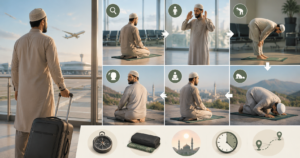
Islam is a practical and highly accommodating faith. If you are on a long journey, the rules change to make your life easier.
When you travel a certain distance (usually over 48 miles), you become a “Musafir” (traveler).
In this state, you are permitted to shorten your 4 Fard rak’ahs to just 2 rak’ahs.
Additionally, you can combine Dhuhr with Asr. You can either pray them both during the Dhuhr time slot, or delay Dhuhr and pray it together with Asr later in the afternoon. This flexibility ensures you never have to choose between your faith and your travel schedule.
Conclusion
Performing Dhuhr prayer regularly brings discipline, peace, and spiritual strength into a Muslim’s daily life. It helps a person stay connected with Allah in the middle of a busy day. By praying with focus and sincerity, one fulfills an important religious duty. It also encourages self-reflection and gratitude in daily life. Overall, it brings blessings and rewards from Allah.
FAQs
What is the correct time to pray Dhuhr?
The time for Dhuhr begins right after the sun passes its highest point in the sky. It ends when the shadow of an object becomes equal to the object’s height, marking the start of Asr.
Can I skip the Sunnah rak’ahs of Dhuhr?
While the 4 Fard rak’ahs are strictly mandatory, the Sunnah rak’ahs are highly recommended but not obligatory. However, praying them brings immense rewards and follows the tradition of the Prophet.
What do I do if I forget exactly how to pray dhuhr in the middle of it?
If you lose count of your rak’ahs or forget a step, do your best to estimate where you are. At the end of the prayer, perform two extra prostrations of forgetfulness (Sujood as-Sahw) to make up for the error.
Is Dhuhr recited silently or aloud?
Dhuhr is a silent prayer. You must move your lips and tongue to form the words of Surah Al-Fatihah and other recitations, but your voice should be no louder than a whisper.