
Asar (Asr) prayer is the third of the five daily obligatory prayers in Islam. It is performed in the afternoon and consists of four rakats. It helps Muslims take a break from daily activities and remember Allah through worship and reflection.
What Are the Prerequisites for Asr?
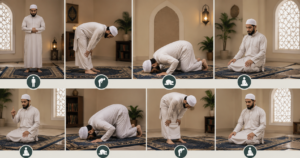
You cannot just jump right into prayer. You must prepare your body and your space. Think of this as getting ready for a highly important meeting.
Here is your quick checklist to complete before starting:
- Wudu (Ablution): You must wash your hands, mouth, nose, face, arms, head, and feet. If you are in a state of major impurity, you need Ghusl (a full shower). The exact order of steps for performing Wudu before Salah is something every Muslim — beginner or returning — should memorize correctly.
- Clean Clothes: Your clothes and your prayer spot must be free from impurities.
- Cover Your Body: Men must cover from the navel to the knee. Women must cover their entire body, leaving only the face and hands showing.
- Face the Qibla: You must face the Kaaba in Mecca. Use a phone app to find the exact direction from your USA location.
- Check the Time: Asr has a specific window. You cannot pray it too early.
Asr Salah Step by Step: The 4 Fard Rakats
The Asr prayer consists of 4 Fard (obligatory) Rakats. A Rakat is one complete cycle of standing, bowing, and prostrating. Understanding the number of rakats in every Salah helps you keep track of where you are in each prayer without losing count.
Because Asr is a daytime prayer, you recite the Quran silently in your head. You only say the “Allahu Akbar” (God is Great) out loud to transition between steps.
Here is your complete, step-by-step breakdown.
Rakat 1: The Beginning
Step 1: Make your Intention (Niyyah).
Focus your mind. Silently tell yourself, “I intend to pray the 4 Fard Rakats of Asr.” You do not need to say this out loud.
Step 2: The Opening Takbeer.
Raise your hands to your ears (or shoulders for women). Say “Allahu Akbar”. Place your right hand over your left hand on your chest or below your navel.
Step 3: Read Surah Al-Fatiha.
Recite the opening chapter of the Quran silently.
Step 4: Read a Short Surah.
Pick another short chapter, like Surah Al-Ikhlas, and recite it silently.
Step 5: Bow Down (Ruku).
Say “Allahu Akbar” and bend at the waist. Keep your back straight. Rest your hands on your knees. Say “Subhana Rabbiyal Adheem” (Glory to my Lord the Great) three times silently.
Step 6: Stand Back Up.
Rise and say, “Sami Allahu liman hamidah” (Allah hears those who praise Him). Then say, “Rabbana walakal hamd” (Our Lord, to You be praise).
Step 7: Prostrate (Sujood).
Say “Allahu Akbar” and go down to the floor. Your forehead, nose, both palms, knees, and toes must touch the ground. Say “Subhana Rabbiyal A’la” (Glory to my Lord the Most High) three times silently.
Step 8: Sit and Prostrate Again.
Say “Allahu Akbar” and sit up on your knees for a brief second. Say “Allahu Akbar” again and do a second Sujood. Say the praise three times again. If you want to understand what Muslims say during each step of prayer — with full Arabic phrases, transliterations, and English meanings — that guide covers every recitation from Takbir to Salam.
Rakat 2: The First Sitting
Step 9: Stand Up for Rakat 2.
Say “Allahu Akbar” and stand all the way back up.
Step 10: Repeat the Recitations and Movements.
Silently read Surah Al-Fatiha. Read another short Surah. Perform your Ruku (bowing) and your two Sujoods (prostrations) exactly as you did in the first Rakat.
Step 11: The First Sitting (Tashahhud).
After your second Sujood, do not stand up. Sit on your legs. Rest your hands on your thighs. Silently recite the Tashahhud. When you reach the part saying “Ash-hadu an la ilaha illallah”, raise your right index finger.
Rakat 3: Fatiha Only
Step 12: Stand for Rakat 3.
Say “Allahu Akbar” and stand up.
Step 13: Recite Al-Fatiha.
In the third Rakat, you only recite Surah Al-Fatiha. Do not add a second Surah.
Step 14: Bow and Prostrate.
Perform your Ruku and your two Sujoods just like before.
Rakat 4: The Final Conclusion
Step 15: Stand for Rakat 4.
Say “Allahu Akbar” and stand up for the final time.
Step 16: Recite Al-Fatiha.
Again, silently read Surah Al-Fatiha only.
Step 17: Bow and Prostrate.
Do your final Ruku and your final two Sujoods.
Step 18: The Final Sitting.
Sit back down. Recite the full Tashahhud. Then, recite the Durood (sending blessings upon Prophet Muhammad and Prophet Ibrahim). Finally, recite a short du’a (supplication).
Step 19: The Salam (Closing).
Turn your head to look over your right shoulder. Say “Assalamu alaikum wa rahmatullah” (Peace and mercy of Allah be upon you). Turn your head to look over your left shoulder and repeat the phrase.
You are done! You successfully completed your Asr prayer.
Asr Prayer Timing USA When Does It Start?

Figuring out prayer times in the USA can be frustrating. You have multiple time zones. You have Daylight Saving Time shifting the clocks forward and backward.
Asr time begins when the length of an object’s shadow equals the length of the object itself (plus its shadow at noon). It ends right as the sun begins to set and turn red.
During the winter in places like New York or Chicago, Asr might come in as early as 2:30 PM. In the summer, it might not start until 5:30 PM.
How to stay on track: Stop guessing. Download a reliable Islamic prayer app on your phone. Good options include Athan, Muslim Pro, or Pillars. Set an alarm. When the alert goes off, you know it is time to wrap up your work and pray.
The Importance of Asr Prayer in Islam
Why is Asr so special? It breaks up the busiest part of your day. It forces you to stop chasing money, grades, or success, and remember your Creator.
The Quran specifically highlights this prayer. Surah Al-Baqarah (2:238) says:
“Guard strictly (five obligatory) As-Salawat (the prayers) especially the middle Salat (i.e., the best prayer – Asr).” Among the five daily prayers in Islam, Asr carries a uniquely emphasized status that no other prayer shares.
Guarding the “middle prayer” brings massive spiritual rewards. It proves your dedication. Taking ten minutes away from a busy shift or a difficult study session shows Allah that He is your top priority.
Content Gaps Navigating Nuances
Islam is practical. It adapts to different situations and scholarly understandings. Here are a few common scenarios you might encounter.
Hanafi vs Shafi’i Timings
If you use a prayer app, you might see an option to choose “Hanafi” or “Shafi’i/Standard” for Asr time.
What does this mean? It comes down to shadow lengths. The Shafi’i, Maliki, and Hanbali schools say Asr starts when a shadow matches the object’s exact height. The Hanafi school says it starts when the shadow is double the object’s height.
This means the Hanafi Asr time starts about an hour later. Both opinions are valid. Pick the one your local community or family follows and stick with it.
Praying While Traveling

Road trips across the USA are long. Flights get delayed. If you are traveling a far distance (usually over 48 miles), Islam gives you a gift called Qasr (shortening).
Instead of praying 4 Rakats for Asr, you only pray 2 Rakats. You can also combine Asr with your Zuhr (midday) prayer. You can pray them both together at Zuhr time, or both together at Asr time. This makes traveling so much easier. To understand how to pray as a Muslim in special circumstances — including travel, illness, and combining prayers — that guide gives you everything you need.
Teaching Children
Getting kids to pray after school is a battle. They are tired. They want snacks. They want video games. Try these three simple tips:
- Lead by Example: Do not just tell them to pray. Say, “Let’s go pray together.”
- Create a Routine: Make a rule. Snacks and screens only happen after Asr is done.
- Keep it Positive: Do not yell or threaten. Celebrate their effort. Give high-fives when they finish their prayer.
Expert Insight: Elevating Your Asr
Praying Asr is one thing. Praying it with focus (Khushu) is another. Shaykh Yasir Qadhi, a prominent US-based Islamic scholar, often emphasizes the power of intention during the afternoon slump.
He notes that the Asr prayer acts as a spiritual anchor. When your energy dips in the late afternoon, your focus drifts. Standing for Asr forces you to physically and mentally reboot. To elevate your prayer, pause for thirty seconds after making wudu. Take a deep breath. Remind yourself that you are leaving the stress of your workday behind to speak directly to Allah.
Conclusion
Praying Asar regularly strengthens faith, brings peace to the heart, and keeps a Muslim connected to Allah throughout the day. By following the correct steps with sincerity and focus, one can perform the prayer properly and gain spiritual rewards.
FAQs
Is there a Sunnah before Asr?
Yes! You can pray 4 optional Rakats (Sunnah) before the 4 obligatory Fard Rakats. Prophet Muhammad (PBUH) highly encouraged this, saying Allah shows mercy to those who pray these 4 units. However, they are not strictly mandatory.
Can I pray Asr right before Maghrib?
You should pray Asr as soon as the time enters. Delaying Asr until the sun turns pale yellow or red right before sunset is considered Makruh (disliked). However, if you accidentally forget or oversleep, you must still pray it before Maghrib starts.
How do I pray Asr silently?
During Asr, you do not recite the Quran out loud. You move your lips and tongue to form the words, but you keep your voice down to a quiet whisper. Only you should be able to hear your own recitation. For a complete breakdown of what Muslims say during prayer — including which parts are silent and which are spoken aloud — that guide explains every detail clearly.