
The Islamic calendar consists of 12 lunar months based on moon sightings, totaling 354–355 days per year. Unlike the Gregorian calendar, Islamic months rotate through all seasons every ~32.5 years because the lunar year is shorter than the solar year. The calendar is dated from the Hijrah (Prophet Muhammad’s migration to Medina in 622 CE), marked as “AH” (Anno Hegirae, “in the year of the Hijrah”). Each month carries unique religious and cultural significance, with Ramadan dedicated to fasting, Dhul-Hijjah reserved for the Hajj pilgrimage, and Muharram marking the Islamic New Year.
What Is the Islamic Calendar?
The Islamic calendar, also called the Hijri calendar or lunar calendar, is the dating system Muslims use for religious purposes worldwide. It’s based on the cycles of the moon rather than the sun’s position in the sky, making it fundamentally different from the Gregorian calendar most of the world uses for civil matters.
Here’s the core definition: The Islamic calendar tracks 12 lunar months, where each new month begins when a crescent moon becomes visible in the sky. This means Islamic months are determined by actual observation not fixed rules on paper. A new month doesn’t start at midnight on a predetermined date; it begins when the lunar crescent is sighted by reliable observers, usually early evening at sunset.
The year numbering system starts from the Hijrah, the migration of the Prophet Muhammad from Mecca to Medina in 622 CE. This event marks Year 1 AH (Anno Hegirae). So when you see “1447 AH,” you’re looking at a year that began around 1,425 years after the Prophet’s migration. This is why Islamic years are often ahead of the Common Era (CE) numbering the Islamic calendar has fit more years into the same time span because lunar years are shorter. If you’re new to Islam and still getting oriented to concepts like this, our 7-Day Learning Plan for new Muslims is a helpful place to start.
How Does the Lunar Calendar Work?
Understanding why the Islamic calendar behaves differently from what you might expect requires a basic look at lunar cycles.
The Moon’s Role: Every 29.5 days, the moon completes its full cycle from new moon (invisible) to full moon and back to new moon. Islamic months follow this pattern:
- Odd-numbered months (1st, 3rd, 5th, etc.) have 30 days
- Even-numbered months (2nd, 4th, 6th, etc.) have 29 days
- Exception: The 12th month (Dhul-Hijjah) varies between 29 and 30 days on a 30-year cycle to stay synchronized with actual moon phases
This gives the Islamic year 354 or 355 days depending on how many months have 30 days in that particular year.
Why the Calendar “Drifts”: Here’s where things get interesting. The Gregorian solar year is about 365.25 days long. The Islamic lunar year is about 354 days long. That means every Islamic year is roughly 10–11 days shorter than a solar year.
What does this mean in practice? Let’s say Ramadan (the 9th month) begins on February 18 one year. The next Islamic year, Ramadan will start around February 8 roughly 10 days earlier. The year after that, it’ll be around January 29. Over time, Islamic months rotate through all four seasons. Ramadan might fall in spring one decade, summer the next, autumn after that, and winter after that. This cycle completes approximately every 32.5 solar years.
The 30-Year Cycle: To keep the lunar calendar aligned with actual moon phases, Islamic scholars established a 30-year pattern for the 12th month (Dhul-Hijjah):
- In 11 years of the cycle, Dhul-Hijjah has 30 days
- In the other 19 years, it has 29 days
This system, refined over centuries, keeps the Islamic calendar from drifting away from the actual lunar phases a small but crucial detail for precision.
The 12 Islamic Months: Names, Meanings & Significance
Here are all 12 months of the Islamic calendar, with their traditional meanings and the key events or spiritual significance associated with each:
1. Muharram “The Sacred” (30 days)
Muharram marks the Islamic New Year and is the first month of the Islamic calendar. It’s one of the four sacred months in which warfare and fighting were prohibited even before Islam, Arab societies honored this tradition.
Key Dates & Events:
- 1st of Muharram: Islamic New Year (Hijri New Year)
- 10th of Muharram: Day of Ashura, a significant day in Islamic history commemorating various events depending on Islamic tradition and sect
The name “Muharram” comes from the Arabic root meaning “to forbid” or “make sacred,” reflecting its protected status. Many Muslims observe this month with increased spiritual reflection, prayer, and fasting.
2. Safar “The Void” (29 days)
Safar is the second month, and its name literally means “empty” or “void” reflecting the month’s position as secondary in religious significance. Pre-Islamic Arabs considered this month inauspicious, believing misfortunes occurred during it. In Islamic practice, Safar holds no major religious observances or holidays.
However, some Islamic traditions emphasize spiritual discipline during Safar, viewing it as a bridge month between Muharram and the upcoming Rabi al-Awwal.
3. Rabi al-Awwal “First Spring” (30 days)
Rabi al-Awwal is historically significant for Muslims worldwide because it marks the birth of the Prophet Muhammad (12th of Rabi al-Awwal). Many Muslim-majority countries and communities observe this date as a holiday, sometimes called Mawlid al-Nabi.
This month also commemorates the Hijrah the Prophet’s migration from Mecca to Medina, which is the foundational event for the Islamic calendar itself. Both the birth and the migration make Rabi al-Awwal deeply meaningful in Islamic tradition.
4. Rabi al-Thani “Second Spring” (29 days)
Rabi al-Thani, meaning “the second spring,” follows Rabi al-Awwal. Like Safar, it carries less significant religious meaning in mainstream Islamic practice. However, it represents the continuation of the spring season (in the Northern Hemisphere’s solar calendar, not the Islamic calendar’s rotation).
5. Jumada al-Awwal “First Freeze” (30 days)
Jumada al-Awwal, meaning “the first freeze,” was named by pre-Islamic Arabs for the winter season. In the Islamic tradition, this month has no major holidays or observances, though it serves as a calendar marker for the year’s progression.
6. Jumada al-Thani “Second Freeze” (29 days)
The sixth month, Jumada al-Thani, completes the “freeze” pair named for winter conditions (in Arabia). Like its preceding month, it’s marked primarily as a passage of time rather than a month of major spiritual significance.
7. Rajab “The Inviolable” (30 days)
Rajab is one of the four sacred months and holds profound spiritual weight in Islamic tradition. The name means “to respect” or “to revere,” emphasizing its protected status. Warfare and violence were forbidden during this month even in pre-Islamic Arabia.
Key Events:
- 27th of Rajab: Commemorates Al-Isra wal-Mi’raj (The Night Journey and Ascension), when Muslims believe the Prophet Muhammad was miraculously transported from Mecca to Jerusalem and then to heaven
Many Muslims fast or increase their worship during Rajab, viewing it as a month of preparation and spiritual elevation before the arrival of Ramadan two months later. Some also use this period to build up their Tahajjud (night prayer) practice, since the extra devotion of Rajab and Sha’ban is widely seen as training for Ramadan’s intensity.
8. Sha’ban “The Disperser” (29 days)
Sha’ban serves as the preparation month before Ramadan. Its name means “to disperse” or “to scatter,” possibly referring to the Arabs’ scattering to seek water during this summer month. In Islamic practice, Sha’ban is when many Muslims practice optional fasting (called Sunna fasts) to prepare spiritually for the rigorous fasting ahead.
Key Dates:
- 15th of Sha’ban: Shab-e-Barat (Night of Forgiveness), observed by many Muslim communities as a night of prayer and seeking forgiveness
9. Ramadan “The Hot” (30 days)
Ramadan is the holiest month in the Islamic calendar. Named for the intense heat of the Arabian summer, it holds unparalleled spiritual significance for Muslims worldwide.
Why Ramadan is sacred:
- The Quran was revealed during this month specifically, the revelation began on the Night of Power (Laylatul Qadr)
- Muslims fast (sawm) from dawn until sunset for the entire month as one of the Five Pillars of Islam
- Spiritual reflection & prayer intensify; many Muslims recite the entire Quran during Ramadan in special nightly prayers (Taraweeh)
- Community comes together families break fasts together, and mosques overflow with worshippers
Key Dates:
- 27th Night of Ramadan (estimated): Laylatul Qadr (Night of Power), believed to be the holiest night of the year when the Quran’s revelation began
Ramadan is also when many Muslims lean most heavily on dua (supplication), especially in the last ten nights, and increase their voluntary night prayers alongside the obligatory five see our guide on the five daily prayers and their names if you want the full structure behind each one.
10. Shawwal “The Elevator” (29 days)
Shawwal marks the end of Ramadan and the arrival of one of Islam’s two major festivals: Eid al-Fitr (Festival of Breaking the Fast).
Key Date:
- 1st of Shawwal: Eid al-Fitr, when Muslims celebrate the end of Ramadan with prayers, feasts, new clothes, gifts, and family gatherings. This day is a public holiday in Muslim-majority countries and celebrated by Muslim communities worldwide.
11. Dhul-Qadah “The One Who Sits” (30 days)
Dhul-Qadah is the third of the four sacred months. Its name reflects a time of rest after the intensity of Ramadan and preparation for the pilgrimage season ahead. Warfare and hunting were traditionally prohibited during this month.
This month marks the beginning of the pilgrimage season (Hajj season), though the peak pilgrimage occurs in the next month.
12. Dhul-Hijjah “The One of Pilgrimage” (29 or 30 days)
Dhul-Hijjah is the holiest month after Ramadan and the final sacred month. It’s named for the Hajj (pilgrimage to Mecca), one of the Five Pillars of Islam. Every Muslim who is physically and financially able is required to perform Hajj at least once in their lifetime.
Key Dates & Events:
- 8th of Dhul-Hijjah: Hajj season begins; pilgrims enter the sacred state (Ihram) and begin rituals
- 9th of Dhul-Hijjah: Day of Arafah, the spiritual climax of Hajj when pilgrims stand on the Plain of Arafah near Mecca, praying and seeking forgiveness
- 10th of Dhul-Hijjah: Eid al-Adha (Festival of Sacrifice), the second major Islamic holiday, commemorating the Prophet Abraham’s willingness to sacrifice his son in obedience to God. Muslims worldwide celebrate with prayers, feasts, and the ritual sacrifice of animals
For a deeper look at how acts like fasting and Hajj connect to eternal reward in Islamic teaching, our piece on the Doors of Jannah walks through how these seasonal acts of worship are believed to open specific gates of Paradise.
The Four Sacred Months of Islam
In Islamic tradition, four months are designated as sacred (Ash-Hur al-Haram): Muharram, Rajab, Dhul-Qadah, and Dhul-Hijjah. This concept predates Islam even in pre-Islamic Arabia, these months were recognized as times when violence and warfare were forbidden.
Historical Significance: Arab societies before Islam honored these months to allow for trade and pilgrimage without fear of conflict. When Prophet Muhammad established Islam, this sacred tradition was preserved and sanctified within Islamic law and custom.
What “Sacred” Means in Practice:
- Warfare, fighting, and violence are forbidden
- Hunting (in some interpretations) is prohibited or discouraged
- Increased spiritual reflection and worship are encouraged
- The sanctity extends beyond the month to sacred territories (like Mecca) and sacred states (like Ihram during Hajj)
Today, Muslims recognize these months as spiritually elevated periods deserving heightened mindfulness, prayer, and peace a good time to revisit the basics of how to pray as a Muslim if your regular Salah routine has slipped.
Why Islamic Dates Change Every Year The Lunar-Solar Difference
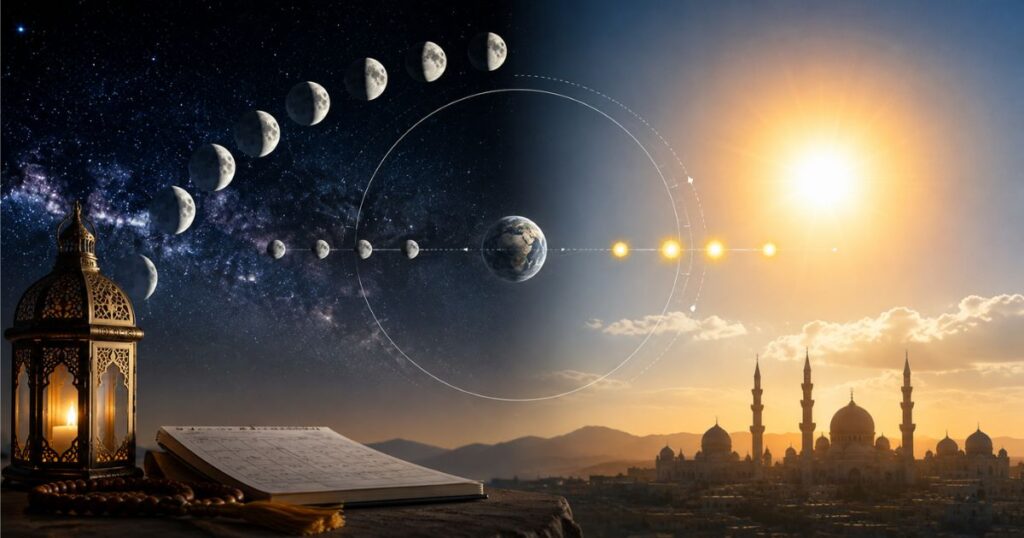
If you’ve ever wondered why Ramadan or Hajj falls on a different Gregorian date each year, the answer lies in the fundamental difference between how lunar and solar calendars track time.
The Math Behind the Shift:
| Year | Islamic Year (AH) | Ramadan Starts (Gregorian) | Shift from Prior Year |
| 2024 | 1445/1446 | March 12, 2024 | |
| 2025 | 1446/1447 | ~March 1, 2025 | ~11 days earlier |
| 2026 | 1447/1448 | ~February 18, 2026 | ~11 days earlier |
| 2027 | 1448/1449 | ~February 8, 2027 | ~10 days earlier |
See the pattern? Each year, Ramadan (and every other Islamic month) shifts roughly 10–11 days earlier in the Gregorian calendar.
Why This Happens:
- Islamic year = 354–355 days
- Gregorian year = 365.25 days
- Difference = ~10–11 days per year
Over 32.5 years, Ramadan will have cycled through all four seasons of the Gregorian calendar, moving from winter to spring to summer to autumn and back to winter.
Practical Impact: If you’re planning around Ramadan, Hajj, or Eid dates, you need to check the current Islamic calendar each year. These aren’t fixed Gregorian dates they’re anchored to the Islamic calendar’s lunar rhythm, the same rhythm that determines daily prayer times, which shift with the sun rather than the clock.
Understanding Moon Sighting & Calendar Calculations
The Islamic calendar’s month beginnings are determined by actual moon sighting, not astronomical prediction. While modern science can calculate exactly when the new moon will occur, Islamic tradition requires that a crescent moon be visibly sighted by reliable observers before the month officially begins.
How It Works:
- As the current month nears its end (typically on the 29th day), moon-sighting committees gather at designated locations
- They attempt to observe the crescent moon at sunset
- If the crescent is sighted, the new month officially begins that evening
- If the crescent cannot be seen (due to weather or other factors), the current month is extended to 30 days, and the new month begins the next evening
Why Moon Sighting Matters: In Islam, the Quran explicitly mentions moon sighting as the method for determining months: “They ask you about the crescent moons. Say, ‘They are signs to mark fixed times for people and for Hajj'” (Quran 2:189). This practice connects the calendar to observable natural phenomena rather than abstract calculation alone.
The 30-Year Cycle for Precision: To maintain alignment between the Islamic calendar and actual lunar phases, Islamic scholars developed a 30-year intercalation cycle. This system adjusts the length of the 12th month (Dhul-Hijjah) to ensure the calendar stays synchronized with the moon’s actual phases, preventing the calendar from drifting over centuries.
The Hijrah Why the Islamic Calendar Starts at 622 CE
The foundation of the Islamic calendar is the Hijrah the migration of Prophet Muhammad and the early Muslim community from Mecca to Medina in 622 CE.
What Was the Hijrah?
In the early days of Islam, the Prophet Muhammad and his followers faced intense persecution in Mecca. After 13 years of preaching Islam and enduring hostility, the Prophet and his companions made the decision to migrate to Yathrib (later called Medina), a city to the north. This migration, completed in 622 CE, marked a turning point in Islamic history.
Why It’s Significant: The Hijrah wasn’t simply a change of location it represented the establishment of the first Islamic state and community. In Medina, Muslims were able to practice their faith freely, establish laws, and build a society based on Islamic principles. This is why Muslim historians consider the Hijrah the true beginning of Islamic civilization. If you’re exploring what that founding community’s daily worship looked like, our guide on the origins and structure of the five daily prayers is a natural next read.
The Calendar Connection:
In 639 CE, Caliph Omar I, the second leader (Caliph) of the Muslim world after the Prophet’s death, officially established the Islamic era (AH) dating system, counting backward to the year of the Hijrah. He designated the first day of Muharram in the year of the Hijrah as Year 1 AH, which corresponds to July 16, 622 CE in the Julian calendar.
The acronym AH stands for “Anno Hegirae,” Latin for “in the year of the Hijrah.” This is why Islamic years are often written as “AH” for example, “1447 AH” means the 1,447th year since the Hijrah.
A Note on AH vs. CE Years: Because the Islamic year is shorter than the solar year, Islamic years accumulate faster. The year 1447 AH corresponds to around 2025–2026 CE. The Islamic calendar “runs ahead” in terms of year count, though it started later historically (622 CE vs. 1 CE).
Islamic Calendar vs. Gregorian Calendar Key Differences
Understanding how the Islamic calendar differs from the Gregorian calendar helps explain why Islamic holidays shift dates and why Muslims worldwide use both calendars for different purposes.
| Feature | Islamic (Hijri) Calendar | Gregorian Calendar |
| Basis | Lunar cycles (moon phases) | Solar cycles (Earth’s orbit around sun) |
| Months per Year | 12 months | 12 months |
| Days per Year | 354–355 days | 365–366 days |
| Month Length | 29 or 30 days (alternating); determined by moon sighting | 28, 29, 30, or 31 days (fixed) |
| Leap System | No leap months; months drift through seasons | Leap years every 4 years (with exceptions); seasons stay fixed |
| Month Naming | Each name has historical or seasonal meaning (in Arabic context) | Sequential numbering (January–December) in most Western languages |
| Starting Point | Year 1 = Hijrah (622 CE) | Year 1 = Approximate birth of Jesus Christ |
| Use Today | Religious observances; some Muslim-majority countries use it officially | International standard; used for civil purposes worldwide |
| Holiday Dates | Shift ~10 days earlier each Gregorian year | Fixed dates (e.g., Christmas is always Dec 25) |
| Region of Origin | Arabia (Islamic tradition) | Rome (Christian tradition, later reformed) |
Major Islamic Holidays & Religious Observances
Here’s when the major Islamic holidays fall and what each celebrates:
Ramadan (9th Month) The Month of Fasting
Spiritual Significance: Ramadan is the holiest month, commemorating when the Quran was revealed. Muslims fast from dawn to sunset, pray intensively, and increase charitable giving. Duration: 29–30 days 2026 Dates (Gregorian): Approximately February 18 March 20, 2026
Laylatul Qadr (Night of Power) Within Ramadan
Spiritual Significance: Believed to be the night the Quran’s revelation began. Muslims traditionally observe the last 10 nights of Ramadan with extra prayer and devotion, as Laylatul Qadr’s exact date isn’t publicly announced (though scholars estimate the 27th night). 2026 Dates: Approximately March 15–16, 2026 (estimated)
Eid al-Fitr (1st of Shawwal, 10th Month) Festival of Breaking the Fast
Spiritual Significance: Marks the end of Ramadan. Muslims celebrate with prayers, feasts, gifts, and family gatherings. 2026 Date: Approximately March 20–21, 2026
Hajj & Related Observances (8–10 Dhul-Hijjah, 12th Month)
Hajj Begins (8th of Dhul-Hijjah): Pilgrims enter the sacred state and begin rituals. Day of Arafah (9th of Dhul-Hijjah): The spiritual peak of Hajj; pilgrims gather on the Plain of Arafah. Eid al-Adha (10th of Dhul-Hijjah): Festival of Sacrifice, celebrating Abraham’s obedience and faith. Muslims offer special prayers and sacrifice animals. 2026 Dates: Approximately May 25–27, 2026
Islamic New Year (1st of Muharram, 1st Month)
Spiritual Significance: Marks the start of a new Islamic year. Muslims reflect on the past year and set intentions for spiritual growth. 2026 Date: Approximately June 16, 2026
Day of Ashura (10th of Muharram)
Spiritual Significance: Varies by tradition; commemorates various events in Islamic history. Some communities fast on this day; others engage in special remembrances. 2026 Date: Approximately June 25, 2026
Shab-e-Barat (15th of Sha’ban, 8th Month)
Spiritual Significance: The Night of Forgiveness, observed by many Muslim communities with prayer and seeking divine pardon. 2026 Dates: Approximately February 3–4, 2026
Al-Isra wal-Mi’raj (27th of Rajab, 7th Month)
Spiritual Significance: Commemorates the Prophet Muhammad’s Night Journey and Ascension. Muslims engage in special prayers and reflections. 2026 Date: Approximately January 16, 2026
How the Islamic Calendar Connects Faith to Global Community
One unique aspect of the Islamic calendar often overlooked is how it creates a shared rhythm of spiritual experience across the entire Muslim world despite geographical, cultural, and seasonal differences.
What Makes This Remarkable: When Ramadan begins, the same month starts simultaneously for Muslims everywhere, regardless of where they live. A Muslim in New York and a Muslim in Dubai are fasting the same Islamic month, even though it might be winter in one place and summer in the other. A Muslim in Australia experiences Hajj during their summer while Muslims in Saudi Arabia perform it during their winter.
This means Islamic holidays aren’t tied to seasons (spring Easter, winter Christmas) but to the lunar cycle a truly universal, borderless marker of time. It reinforces the Islamic concept of a global Muslim community (Ummah) united by shared religious calendars and practices, even across vastly different climates and cultures the same spirit of unity reflected in the shared structure of the five daily prayers performed everywhere, at every latitude, on the same lunar clock.
Over a 32.5-year cycle, every Muslim community eventually celebrates all Islamic holidays in every season. A holiday that falls in winter now will eventually cycle through spring, summer, fall, and back to winter again. This creates a unique form of collective experience every generation of Muslims will eventually celebrate the same holiday under radically different seasonal conditions.
This is one reason the Islamic calendar remains deeply meaningful in Islamic practice despite the Gregorian calendar’s dominance in civil affairs.
Conclusion
The Islamic calendar is a sophisticated lunar timekeeping system that has remained virtually unchanged for over 1,400 years. Its 12 months rotate through the Gregorian seasons approximately every 32.5 years, creating a unique rhythm of spiritual practice where Muslims worldwide celebrate the same holidays under different seasonal conditions. Understanding the Islamic calendar’s mechanics from moon sighting to the 30-year cycle reveals not just a system of dates, but a window into Islamic faith, history, and the global Muslim community’s shared experience.
If you’re exploring Islam for the first time, or thinking about converting to Islam, understanding this calendar is a natural companion to learning how to pray as a beginner both are part of building the same lifelong rhythm of worship.
FAQs
What are the 12 Islamic months in English?
The 12 Islamic months are Muharram, Safar, Rabi al-Awwal, Rabi al-Thani, Jumada al-Awwal, Jumada al-Thani, Rajab, Sha’ban, Ramadan, Shawwal, Dhul-Qadah, and Dhul-Hijjah. Each month follows a lunar cycle of 29 or 30 days.
How many days are in each Islamic month?
Islamic months alternate between 29 and 30 days. Odd-numbered months typically have 30 days, and even-numbered months have 29 days. The exception is the 12th month (Dhul-Hijjah), which varies between 29 and 30 days on a 30-year cycle. Most years have either 354 or 355 days total.
Why does Ramadan fall on different Gregorian dates each year?
The Islamic calendar is lunar-based (354–355 days), while the Gregorian calendar is solar-based (~365.25 days). This ~10–11 day difference means Islamic dates shift earlier each Gregorian year. Over 32.5 years, Islamic months rotate through all four seasons.
What month is Hajj in?
Hajj occurs in Dhul-Hijjah, the 12th and final Islamic month. The pilgrimage peaks on the 8–10th days, with Eid al-Adha celebrated on the 10th. In 2026, Hajj is expected around May 25–27.
Are there sacred months in Islam?
Yes. Four months are designated as sacred (Ash-Hur al-Haram): Muharram (1st), Rajab (7th), Dhul-Qadah (11th), and Dhul-Hijjah (12th). During these months, warfare and violence are prohibited. This tradition predates Islam but is preserved in Islamic practice.
What is the Islamic New Year, and when does it fall?
The Islamic New Year falls on the 1st of Muharram (the first month). It marks the start of a new Islamic year and commemorates the Hijrah. In 2026, the Islamic New Year is expected around June 16.
How do I convert Islamic dates to Gregorian dates?
Islamic years accumulate faster than solar years. A rough approximation: Multiply the Islamic year by 0.97, then add 622 to estimate the corresponding Gregorian year. For example, 1447 AH × 0.97 + 622 ≈ 2025 CE. However, for exact dates of specific months or holidays, use an Islamic calendar converter online, as precise conversions depend on moon sightings.
Is the Islamic calendar used in modern Muslim-majority countries?
Officially, most Muslim-majority countries use the Gregorian calendar for civil and governmental purposes. However, the Islamic calendar is used for determining religious observances, holidays, and in personal/family matters. Saudi Arabia and a few other nations use the Islamic calendar for some official purposes alongside the Gregorian calendar.