
The five daily Names of Prayers in Islam, known collectively as Salah, are Fajr (dawn), Dhuhr (midday), Asr (afternoon), Maghrib (sunset), and Isha (night). Each has a set number of rakats 2, 4, 4, 3, and 4 respectively and must be performed within its own prescribed time window. Beyond these five, Islam also recognizes other prayer categories such as Wajib, Sunnah, and Nafl.
What Are the 5 Daily Prayers Called in Islam?

Salah (also written Salat) is the Arabic term for the formal, structured prayer every Muslim is required to perform five times a day. It’s the second of the Five Pillars of Islam. It’s the second of the Five Pillars of Islam, and our overview of the 5 prayers of Islam and their spiritual benefits covers how each pillar supports the others.
The five prayers, in order, are:
- Fajr before sunrise
- Dhuhr (also spelled Zuhr) midday
- Asr late afternoon
- Maghrib just after sunset
- Isha night
Each name isn’t random; it’s literally the Arabic word for that segment of the day. That’s the first thing worth understanding before anything else. For a deeper look at what each name actually translates to and why, see our full breakdown of 5 Muslim prayers in English meaning and daily guide.
Salah, Namaz, or Salat Are They the Same Prayer?
Yes. These are three names for the exact same act of prayer, and the difference is purely linguistic, not religious.
- Salah / Salat the Arabic term, used across the Middle East and in most classical Islamic texts.
- Namaz is the Persian-origin term, commonly used in Pakistan, India, Bangladesh, Iran, Afghanistan, and Turkey.
If you grew up in a South Asian Muslim household, you likely heard “Namaz” your whole life and only encountered “Salah” in an Arabic class or a Quran study circle. Both words point to the same five prayers; there’s no theological distinction, only a regional one. This matters for a US audience specifically: American mosques serve worshippers from Arab, South Asian, African, and convert communities, so you’ll hear all three terms used interchangeably in the same community. If you’re new to the vocabulary in general, our basic Islamic phrases guide explains several other terms you’ll hear at the mosque alongside these.
The Meaning Behind Each Prayer’s Name
This is where most guides stop short; they’ll tell you when to pray Fajr, but not why it’s called Fajr. The names come directly from classical Arabic vocabulary describing that stretch of the day:
- Fajr means “dawn” or “daybreak” literally the burst of light that splits the darkness.
- Dhuhr comes from a root meaning “midday” or “the time the sun becomes visible at its peak,” referring to the moment just after the sun crosses its highest point.
- Asr means “the later part” or “a limited time” , a nod to the fact that daylight is now running out.
- Maghrib means “the place or time of sunset” ; the same root gives Arabic its word for “the West.”
- Isha means “night” or “evening,” and carries a secondary sense of “being full of life” fitting, since it’s often prayed after the day’s activities have wound down.
So the five prayer names essentially map onto a five-part division of the day: dawn, midday, afternoon, sunset, and night. Once you see that pattern, the names stop feeling arbitrary and start feeling like a built-in clock. Our English meaning and daily guide to the 5 Muslim prayers goes word-by-word through each name’s root if you want to go even deeper.
Names, Timings, and Rakats at a Glance
| Prayer | Arabic Meaning | Approximate Time | Rakats (Fard) | Recitation Style |
| Fajr | Dawn | Before sunrise | 2 | Recited aloud |
| Dhuhr / Zuhr | Midday | After the sun passes its peak | 4 | Recited silently |
| Asr | Later afternoon | Mid-afternoon to just before sunset | 4 | Recited silently |
| Maghrib | Sunset | Just after sunset | 3 | First 2 rakats aloud, last silent |
| Isha | Night | After Maghrib until midnight | 4 | First 2 rakats aloud, last silent |
Total: 17 obligatory rakats per day. These figures reflect the Fard (obligatory) portion only most Muslims also pray optional Sunnah rakats attached before or after several of these, which is covered below. For the complete fard-plus-sunnah rakat count for every prayer, see our full rakaats in Salah guide.
How Each Prayer Is Recited: Loud vs. Silent Rak’ahs
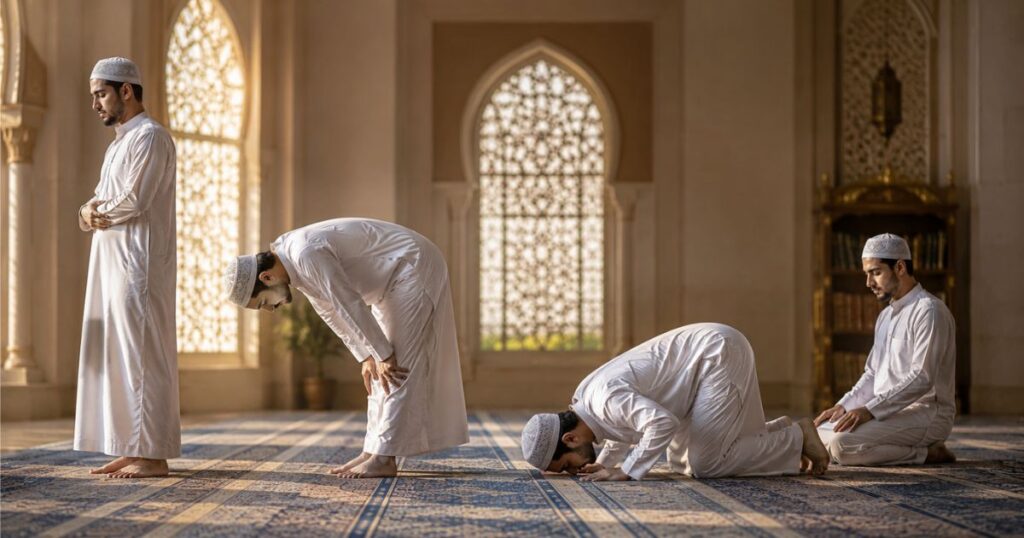
One detail beginners often miss: not every prayer is recited the same way.
- Fajr is recited aloud in full, whether you’re praying alone or leading a congregation.
- Dhuhr and Asr are recited silently throughout even in congregation, the imam’s recitation is inward.
- Maghrib and Isha are a mix: the first two rakats are recited aloud, and the remaining rakats are silent.
This pattern isn’t arbitrary either; it roughly follows daylight. The two prayers bookending darkness (Fajr, and the aloud portions of Maghrib/Isha) are voiced; the prayers performed in full daylight (Dhuhr, Asr) are silent. Our step-by-step Isha prayer guide walks through exactly which rakats are loud and which are silent, since this is the prayer beginners mix up most often.
Beyond the 5 Daily Prayers: Other Types You Should Know
The five daily prayers are obligatory (Fard), but Islam recognizes several other categories:
- Wajib (necessary): Includes the three-rakat Witr prayer (offered after Isha), and the two-rakat Eid prayers for Eid al-Fitr and Eid al-Adha.
- Sunnah (recommended, following the Prophet’s practice): Extra rakats prayed before or after several of the Fard prayers for example, two rakats before Fajr, and rakats before and after Dhuhr. Our guide on how many Sunnah rakats belong to Asr prayer breaks down the difference between Sunnah and Nafl in more detail.
- Nafl (voluntary): Optional prayers offered purely for extra spiritual reward. The best-known is Tahajjud, a late-night prayer, along with others like Ishraq (shortly after sunrise) and Salat-i-Hajjat (a prayer said when seeking something specific from God).
- Jumu’ah (Friday prayer): A congregational prayer that replaces the Dhuhr prayer specifically on Fridays; it’s not a sixth daily prayer, but a special version of Dhuhr. Our basic Islamic phrases guide has a plain-English explanation of Jumu’ah and the khutbah that goes with it.
- Istikhara: A short prayer for guidance, typically performed before making an important decision.
Note on differences between schools of thought: Exact rakat counts for Sunnah and Nafl prayers can vary slightly between Islamic schools (madhabs) for instance, some traditions pray four Sunnah rakats before Dhuhr and two after, while others differ. The Fard rakat counts in the table above are consistent across all major schools. And Witr specifically has its own recitation quirks worth knowing our Isha prayer guide covers Witr’s Dua al-Qunut step, since it’s prayed right after Isha.
How These Five Names Shape a Muslim’s Day in the US
For many American Muslims, the five prayer names aren’t just religious vocabulary they’re a literal daily schedule that has to be worked around a 9-to-5 job. Dhuhr typically falls in the middle of a workday, and Asr often lands during the commute home or a late-afternoon meeting. This is why US mosques and Islamic organizations frequently publish guidance for employers: a Muslim employee may need one or two short breaks during a standard shift, most often around midday for Dhuhr and again in the afternoon for Asr, with the exact timing shifting throughout the year as sunrise and sunset shift.
Fajr and Isha, by contrast, rarely conflict with work Fajr is before most people are awake, and Isha typically falls well after the workday ends. That leaves Dhuhr and Asr as the two prayers most likely to require a genuine accommodation conversation, which is a useful thing for both employees and managers to understand going in. Before any of these prayers, remember wudu is required our step-by-step wudu guide is a helpful refresher if you need to re-do it between prayers during a busy day.
Why Are the Prayers Named After Times of Day?
The names come from classical Arabic words for divisions of the day dawn, midday, afternoon, sunset, and night because the prayers themselves are timed to the sun’s position, not the clock. This tradition predates modern timekeeping: for centuries, Muslims determined prayer times by observing the sky directly rather than checking a schedule.
What Happens If You Miss a Prayer?
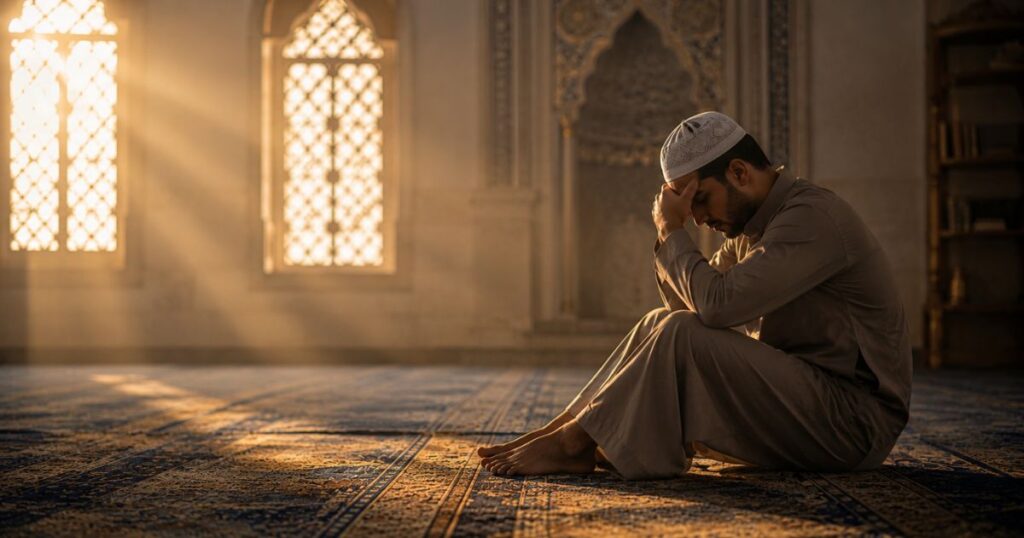
If a prayer is missed accidentally through oversight or unavoidable circumstances it should be performed as a “Qada” prayer as soon as it’s remembered. Intentionally skipping a Fard prayer is considered a serious matter in Islamic teaching, but accidental misses are treated as correctable rather than unforgivable.
Conclusion
Prayer (Salah) is one of the Five Pillars of Islam and serves as a daily act of worship that strengthens a Muslim’s relationship with Allah. Understanding the names of prayers in Islam, their meanings, rakats, and different types helps Muslims perform their worship with greater knowledge and sincerity. Whether it’s the five obligatory daily prayers or voluntary prayers such as Tahajjud, Duha, and Witr, each prayer carries unique spiritual benefits and rewards. Learning and practicing them consistently is an important step toward a stronger faith and a more disciplined Islamic lifestyle. If you’re just starting out on this journey, our guide on what to say to convert to Islam is a good place to begin before working through the prayers themselves.
FAQs
Is Namaz different from Salah?
No. Namaz is the Persian/Urdu word and Salah (or Salat) is the Arabic word both describe the exact same five daily prayers.
How many rakats do Muslims pray in total each day?
17 obligatory (Fard) rakats across the five prayers, plus additional optional Sunnah and Nafl rakats many Muslims choose to add.
Is Friday prayer a sixth daily prayer?
No. Jumu’ah replaces the Dhuhr prayer on Fridays; specifically it’s not an additional prayer added to the usual five.
What is Witr prayer?
Witr is a Wajib (necessary) prayer of an odd number of rakats, most commonly three offered after the Isha prayer.
Can two prayers be combined?
Some circumstances, such as travel or illness, permit combining certain prayers (for example, Dhuhr with Asr, or Maghrib with Isha), according to established Islamic rulings though the specific conditions can vary by school of thought.
What is Tahajjud?
Tahajjud is a voluntary (Nafl) night prayer performed after Isha and before Fajr, often associated with extra spiritual reward.