
The 6 pillars of iman are: belief in Allah, belief in the angels, belief in the revealed books, belief in the messengers, belief in the Last Day, and belief in divine decree (Qadar). Together, they form the aqeedah, the core creed that defines what a Muslim believes in their heart, as distinct from the 5 Pillars of Islam, which are the outward acts of worship.
What Is Iman? (And How It Differs From Islam)
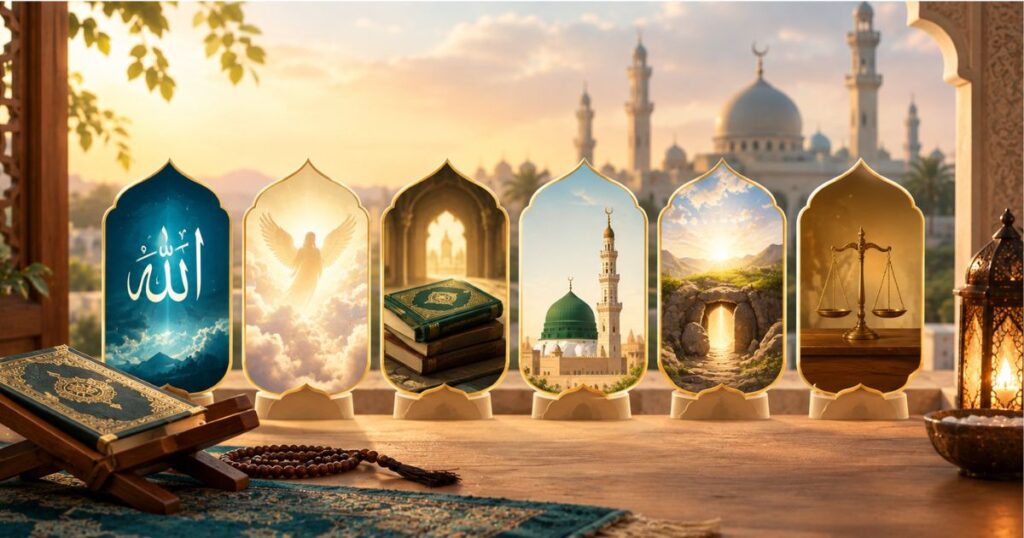
Iman is an Arabic word usually translated as “faith” or “belief.” It comes from the root man, meaning safety or security, the idea being that true belief settles the heart.
Iman is inward. Islam is outward. Scholars often describe them as two sides of the same coin, alongside a third dimension: Ihsan, or spiritual excellence worshipping Allah as though you can see Him.
- Islam = the 5 acts you do (Shahadah, Salah, Zakat, Sawm, Hajj)
- Iman = the 6 things you believe
- Ihsan = the sincerity you bring to both
You can memorize the 5 Pillars of Islam by watching someone pray. You can’t see iman it lives in the heart, which is exactly why the Prophet ﷺ laid it out so clearly for his followers.
Related read: Fundamentals of Islam: 5 Pillars & 6 Articles of Faith Explained
Where Do the 6 Pillars of Iman Come From?
The 6 pillars of iman come from a specific, well-documented moment: the Hadith of Jibril (the Angel Gabriel).
According to the hadith, a man in unusually white clothing sat before the Prophet ﷺ and his companions and asked him to define faith. None of them recognized the visitor. It was later revealed to be the angel Jibreel, testing the Prophet’s knowledge in front of his followers.
The Prophet ﷺ answered:
“Iman is to believe in Allah, His angels, His Books, His Messengers, the Last Day, and to believe in divine decree, its good and its bad.”
This single narration recorded in both Sahih al-Bukhari and Sahih Muslim, the two most authenticated hadith collections in Islam is the direct source of all six pillars. It’s also why scholars treat this list as fixed: it isn’t a summary someone assembled later, it’s a direct quote.
The 6 Pillars of Iman, In Order
1. Belief in Allah (Tawheed)
Belief in Allah is the foundation every other pillar rests on. It means accepting Allah as the one Creator, Sustainer, and Ruler of everything that exists with no partners, no equals, and no one else worthy of worship.
This concept is called Tawheed, and it has three parts scholars typically break it into:
- Lordship (Rububiyah): Allah alone creates, provides, and controls.
- Divinity (Uluhiyah): Allah alone deserves worship, prayer, fasting, sacrifice, all of it.
- Names and Attributes: Allah’s qualities (mercy, knowledge, power) are unique to Him and described only as the Quran and Sunnah describe them.
The Quran states it plainly: “He is Allah, the One.” (Surah Al-Ikhlas 112:1)
Denying this pillar, or attributing divine qualities to something else, is called shirk, considered the gravest sin in Islam.
2. Belief in the Angels
The second pillar is belief in angels beings created from light who exist to carry out Allah’s commands, without free will and without ever disobeying.
You don’t need to see angels to believe in them, the same way you don’t see the wind but trust it’s real. Islamic tradition names several by their specific roles:
| Angel | Role |
| Jibreel (Gabriel) | Delivers revelation to the prophets |
| Mikail (Michael) | Oversees rain and provision |
| Israfeel | Will blow the trumpet on Judgment Day |
| Malak al-Mawt | Takes souls at the time of death |
| Kiraman Katibin | Two recording angels assigned to every person, logging every deed |
That last one matters more than people expect. Believing two angels record your actions good and bad, whether anyone else is watching changes behavior in a way theology alone rarely does.
3. Belief in the Revealed Books
Muslims believe Allah sent guidance to humanity through written revelation, given to specific prophets across history. This isn’t a Quran-only belief; it includes the scriptures that came before it.
The major revealed books, in order:
- Suhuf — scrolls given to Ibrahim (Abraham)
- Tawrat (Torah) — given to Musa (Moses)
- Zabur (Psalms) — given to Dawud (David)
- Injil (Gospel) — given to Isa (Jesus)
- Quran — given to Muhammad ﷺ, believed to be the final and unaltered word of Allah
Muslims are required to believe in the divine origin of all of these not just the Quran while holding that the Quran confirms and completes the message.
4. Belief in the Messengers
This pillar means believing every prophet Allah sent was telling the truth, and that they were chosen specifically to guide their communities toward worshipping Allah alone.
The Quran names 25 prophets, from Adam to Muhammad ﷺ. Among them, five are given a distinct title the Ulul Azm, or “Messengers of Strong Will”: Nuh, Ibrahim, Musa, Isa, and Muhammad ﷺ, considered the most steadfast in the face of hardship. (Islamic history also preserves accounts of earlier, lesser-known prophetic figures see the story of Sheath (AS), son of Adam, for one example.)
Muhammad ﷺ holds a unique place: Muslims believe he is the final prophet, sent not to one nation but to all of humanity, and that no prophet will come after him.
5. Belief in the Last Day
Belief in the Last Day means accepting that this world will end, and every person will be raised again to answer for their life.
This pillar includes several connected beliefs:
- Resurrection every soul brought back to life
- The Reckoning being held accountable for every deed
- Al-Mizan (the Scale) deeds weighed, good against bad
- Jannah and Jahannam Paradise and Hellfire as final, eternal outcomes
For many Muslims, this is the pillar that shapes daily conduct the most directly. It reframes small, unseen choices, honesty in a conversation nobody’s tracking, patience in a moment nobody will remember as things that are, in fact, being recorded and will eventually matter.
6. Belief in Divine Decree (Qadar)
The sixth pillar is belief that nothing happens good or bad outside of Allah’s knowledge and will.
This is often the hardest pillar for new learners to sit with, because it raises an old question: if everything is decreed, do choices matter?
Islamic theology answers this with a both/and, not an either/or. Major, uncontrollable circumstances where you’re born, when you’ll die, who your parents are are fixed. But your responses, your effort, and your choices within those circumstances are genuinely yours, and you’re accountable for them.
Scholars describe Allah’s knowledge as recorded in Al-Lawh Al-Mahfuz the Preserved Tablet before creation itself began. Believing in Qadar isn’t meant to produce passivity; in practice, most Muslims describe it as producing a calm release of anxiety over outcomes paired with full effort in the moment.
6 Pillars of Imam vs. 5 Pillars of Islam What’s the Difference?
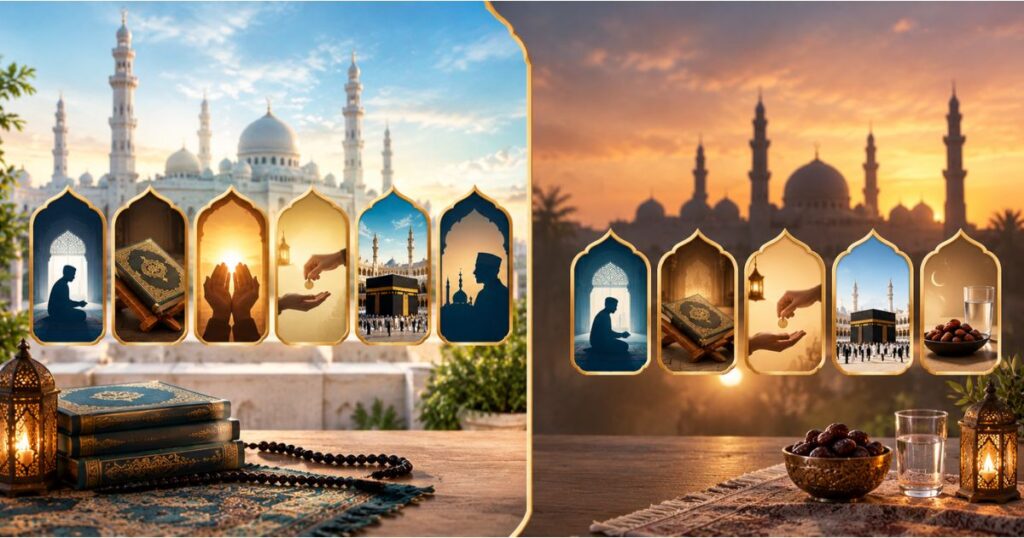
People often confuse these two lists because they’re taught close together. Here’s the clean breakdown:
| 6 Pillars of Iman | 5 Pillars of Islam | |
| What they are | Core beliefs | Core actions |
| Where they live | In the heart | In daily practice |
| List | Allah, angels, books, messengers, Last Day, Qadar | Shahadah, Salah, Zakat, Sawm, Hajj |
| Source | Hadith of Jibril | Hadith of Jibril (same narration) |
| Can others observe it? | No it’s internal conviction | Yes prayer, fasting, etc. are visible |
| Analogy | The roots of a tree | The visible tree itself |
Both lists come from the same hadith the man in white asked the Prophet ﷺ three separate questions that day: what is Islam, what is Iman, and what is Ihsan. The answers became three of the most-cited teachings in Islamic scholarship.
If you want to go deeper into the practice side specifically including how Salah fits into daily life that’s covered separately.
Why Do the 6 Pillars of Iman Matter?
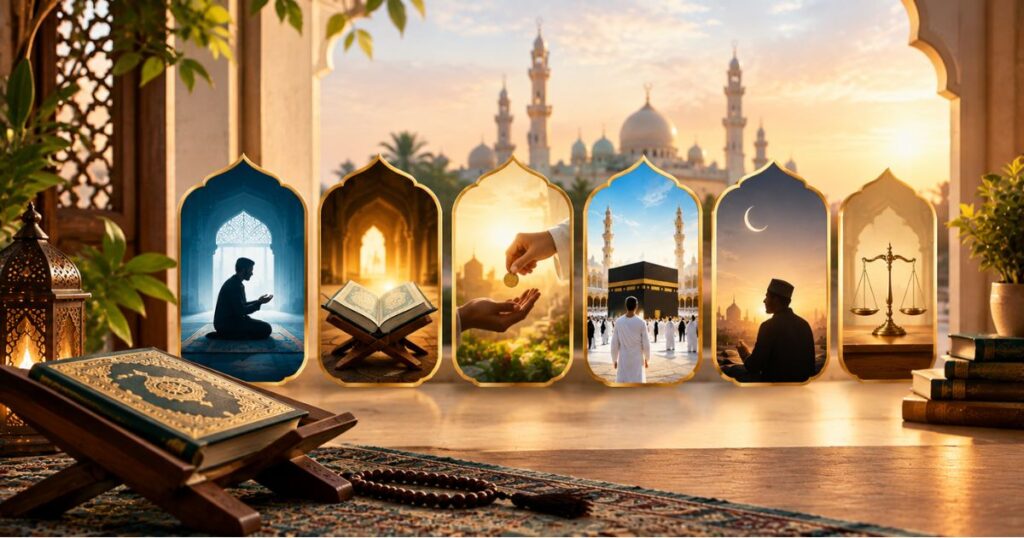
Each pillar isn’t just a theological checkbox it changes something practical:
- Belief in Allah removes the anxiety of feeling like life is random or meaningless.
- Belief in angels builds a quiet sense of accountability, even in private.
- Belief in the books connects a Muslim to a much longer story of guidance, not an isolated one.
- Belief in the messengers provides real, human examples of how to live the faith not abstract theory.
- Belief in the Last Day turns “no one’s watching” into “everything’s recorded.”
- Belief in Qadar offers something close to peace: trying your best, then releasing the outcome.
These beliefs are also part of what sets Islam apart from other worldviews see What Makes Islam Different From Other Religions? and The Benefits of Islam: What They Are and Why They Matter for more on that.
If you’re teaching these to a child or a new Muslim, a simple way to hold the order in memory is the phrase “A-A-B-M-L-Q” Allah, Angels, Books, Messengers, Last Day, Qadar said aloud a few times until it sticks, then paired with one real-life example per pillar rather than a definition alone.
Conclusion
The 6 pillars of iman Allah, angels, books, messengers, the Last Day, and Qadar come from a single, well-documented hadith and form the belief system underneath every act of Muslim worship. Where the 5 Pillars of Islam show what a Muslim does, the 6 pillars of iman explain what a Muslim believes and each one carries a direct, practical effect on how that belief plays out day to day. If you’re just starting to explore these ideas, anyone can begin this journey see our full guide on Islam to go further.
FAQs
What are the 6 pillars of iman?
They are belief in Allah, His angels, His revealed books, His messengers, the Last Day, and divine decree (Qadar). Together they form the core creed of Islamic faith, as taught in the Hadith of Jibril.
What’s the difference between iman and Islam?
Islam refers to the five outward acts of worship a Muslim performs. Iman refers to the six inward beliefs a Muslim holds. Scholars describe them as connected but distinct: action and conviction.
Where do the 6 pillars of iman come from?
They come from the Hadith of Jibril, recorded in Sahih al-Bukhari and Sahih Muslim, where the angel Gabriel, appearing as a stranger, asked the Prophet ﷺ to define faith.
How many prophets are mentioned in the Quran?
Twenty-five prophets are named in the Quran, from Adam to Muhammad ﷺ. Five of them Nuh, Ibrahim, Musa, Isa, and Muhammad ﷺ are known as the Ulul Azm, or Messengers of Strong Will.
What is Qadar in Islam?
Qadar is belief in Allah’s divine decree that everything occurring, good or bad, happens within His knowledge and will, while humans remain accountable for the choices they make within it.