
The benefits of Islam fall into four areas: spiritual (inner peace, forgiveness, purpose), mental and physical health (lower stress, healthier habits, community support), social (charity, family stability, belonging), and historical (contributions to science and medicine). These benefits come from Islam’s core practices prayer, fasting, charity, and belief in one God not from any single ritual alone.
What Does “Benefits of Islam” Actually Mean?
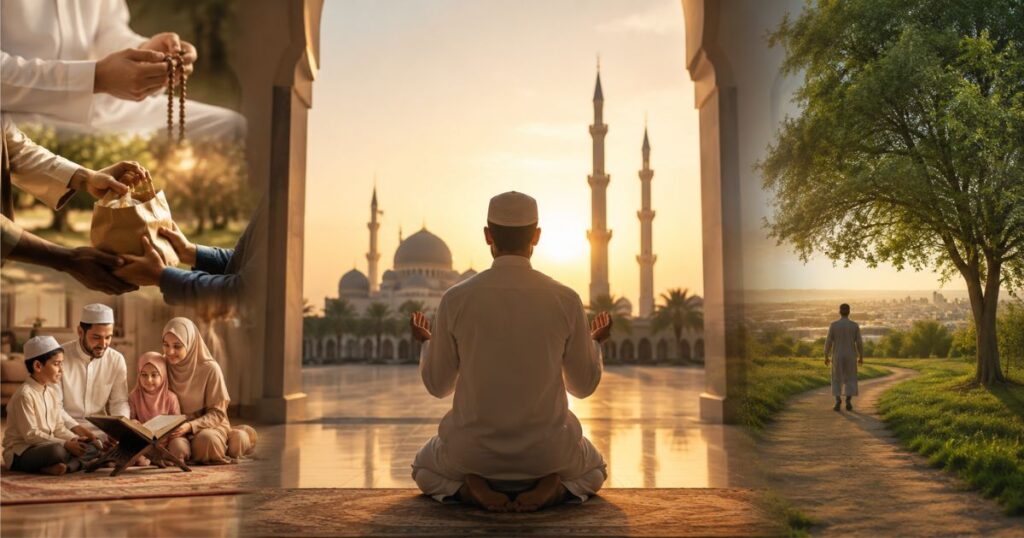
“Benefits of Islam” refers to the spiritual, psychological, social, and historical advantages that come from practicing the Islamic faith. These include a structured relationship with God, daily practices linked to lower stress and stronger community bonds, and a moral framework that shapes family and social life.
The word Islam itself means “submission” specifically, submission to God (Allah). Everything else, from the five daily prayers to fasting during Ramadan, flows from that single idea: a person’s life works better when it’s oriented around something bigger than themselves. If you’re just starting to explore what Islam actually is, this idea is the foundation everything else builds on.
The Five Pillars Where the Benefits Come From
Almost every benefit tied to Islam traces back to five core practices, known as the Five Pillars of Islam. Think of them as the operating system the rest of the religion runs on.
| Pillar | What It Involves | Benefit Linked to It |
| Shahada (Faith) | Declaring belief in one God and Muhammad as His messenger | Gives life a clear, unifying purpose |
| Salah (Prayer) | Five structured prayers a day | Built-in moments of mindfulness and stress relief |
| Zakat (Charity) | Giving a portion of wealth to those in need | Linked to higher reported happiness and reduced materialism |
| Sawm (Fasting) | Fasting during Ramadan | Builds self-discipline; associated with mental clarity |
| Hajj (Pilgrimage) | A pilgrimage to Mecca, once in a lifetime if able | Reinforces humility and global Muslim solidarity |
No single pillar does all the work. It’s the combination of a daily rhythm of prayer, a yearly reset through fasting, and consistent giving that produces the effects people describe when they talk about Islam changing their lives.
Spiritual and Emotional Benefits of Islam
Inner peace and surrender (tawakkul)
Islam teaches a concept called tawakkul trusting God with outcomes you can’t control. Rather than white-knuckling every uncertainty in life, a practicing Muslim is taught to do their best and then let go of the anxiety about results. Many converts and lifelong Muslims describe this as one of the most immediate emotional shifts they notice.
This isn’t passive resignation. It’s closer to what modern psychology calls an “internal locus of control paired with acceptance” you control your effort, not the outcome, and that combination is consistently linked to lower anxiety in general wellbeing research.
Forgiveness and a fresh start
Islam holds that sincere repentance wipes the slate clean. There’s no requirement to carry guilt indefinitely or perform an elaborate confession ritual a person turns back to God directly, without an intermediary, and is taught to trust that mercy is available every time.
For people carrying shame from their past, this is frequently cited as the single most relieving part of the faith: forgiveness isn’t earned through years of penance, it’s available the moment it’s sincerely sought. This is a theme that comes up again and again in real stories from people who found Islam.
What Science Says About Islam and Mental Health
This is the part most religious content skips but it’s exactly what people are searching for, and it’s where the real information gain is.
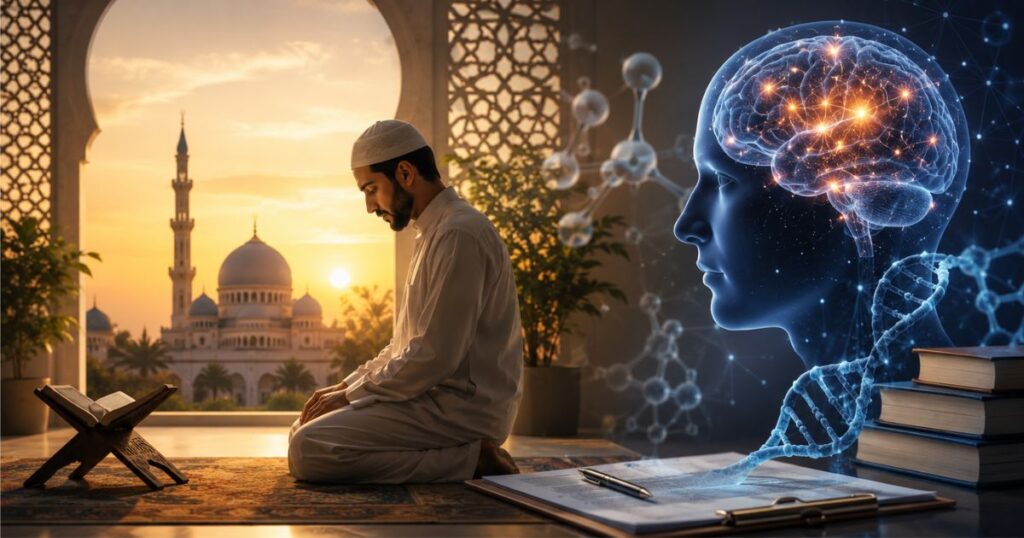
Dr. Muhammad Al-Ninowy, a physician and Islamic studies scholar who spoke at the Milwaukee Muslim Women’s Coalition’s first mental health and Islam conference, has connected specific Islamic practices to measurable mental health outcomes. He explained that Islam’s teachings address happiness, life satisfaction, purpose, and hope and that this nurtures a positive mental outlook.
According to his conference talk, practicing Muslims showed patterns including:
- Higher self-esteem
- Lower rates of, and faster recovery from, depression
- Less anxiety and fewer psychotic tendencies
- Lower rates of alcohol and drug abuse, lower rates of suicide, less delinquency, more marital stability, and better adaptation to bereavement
He also pointed to a mechanism: meditative prayer appears to stimulate areas of the brain involved in regulating emotional responses, which may help people react less reactively to stress over time. This is part of why practices like the night prayer, Tahajjud, are so consistently linked to inner calm and mental clarity.
Separately, mental health researchers writing for whyislam.org note that almsgiving has been linked in some studies to a happiness boost comparable to doubling one’s income, and that fasting during Ramadan is associated with increased discipline and goal-directed thinking, alongside its documented physical effects.
Self-contained answer: Islamic practices are linked to better mental health outcomes because they build structure (five daily prayers), regular emotional reset points (fasting, holidays), and consistent social connection (community worship, charity) three factors that mental health research independently associates with lower stress and higher life satisfaction, regardless of religion.
(Source note: these findings come from conference remarks by a credentialed physician/Islamic scholar and secondary summaries of psychological research; they represent Islamic community and practitioner-reported research, not a single peer-reviewed meta-analysis worth noting for readers who want to dig into the primary studies themselves.)
Social and Family Benefits The Power of Community (Ummah)
Islam is built to be practiced in community, not just privately. The concept of ummah, the global Muslim community, means a Muslim in Karachi and a Muslim in Chicago are taught to see each other as family, sharing obligations of support and charity.
Practically, this shows up as:
- Congregational prayer, which builds a habit of physical, in-person community five times a day even special occasions like Eid prayer are built around gathering together
- Zakat, a structural expectation that wealth flows toward people in need, not just optional charity
- Family emphasis Islamic teaching places heavy weight on obligations to parents, spouses, and children (you can see this reflected in guidance on raising children within the faith), which researchers studying religion and family stability generally link to lower isolation and stronger long-term relationships
For anyone who’s felt disconnected in an increasingly isolated, screen-first world, this built-in structure for belonging is one of the more concrete, measurable benefits, not just a feel-good claim.
Historical Benefits Islam’s Contribution to Science and Civilization
Islam’s benefits aren’t only personal, they’re historical. During the Islamic Golden Age (roughly the 8th to 14th centuries), scholars working within an Islamic intellectual framework made major advances in:
- Medicine figures like Ibn Sina (Avicenna) wrote medical texts used in European universities for centuries
- Mathematics the development of algebra, and the spread of the numeral system still used worldwide today
- Astronomy and optics advances that later fed into the European Renaissance
This wasn’t accidental. Islamic teaching explicitly frames the pursuit of knowledge as a form of worship a detail that’s easy to miss if you only think of religion and science as opposing forces.
Honest Answers to Hard Questions
A strategy guide about the benefits of Islam that skips the hard questions isn’t trustworthy. Here’s a straight answer to two of the most common ones.
Is Islam good for women?
This is genuinely contested, and a fair answer has two parts.
What Islamic teaching states: Islamic law, as laid out in the 7th century, guaranteed women rights to own property, to keep their own wealth, to consent to marriage, and to inherit at a time when women in much of Europe had none of those legal protections. Advocates point to this as evidence Islam was, relative to its era, a significant improvement for women’s legal standing.
What critics raise: Interpretation and practice vary enormously across Muslim-majority countries and communities, and issues like unequal inheritance shares, guardianship laws, and restrictions on dress or mobility are cited by critics including many Muslim women themselves as ongoing points of tension between religious text and lived practice.
The honest summary: the textual claims Islam makes about women’s rights are more progressive, for their historical era, than many people assume but how those rights are applied varies by country, culture, and interpretation, and that gap is a legitimate, ongoing debate within the Muslim world itself, not just an outside criticism.
What does “jihad” actually mean?
“Jihad” literally means “struggle” or “striving,” and its primary meaning in Islamic teaching is the internal effort to live a moral, disciplined life resisting anger, greed, or laziness, for example. This is sometimes called the “greater jihad.”
There is also a secondary, narrower meaning tied to armed defense under specific historical and legal conditions that scholars call the “lesser jihad.” The word has been misused, by extremists and by media shorthand alike, to mean “holy war” as a default definition, which is not how the majority of Islamic scholarship defines the term or how most Muslims use it day to day.
What Long-Time Practicing Muslims Report Noticing First
(Note: this section is written as an illustrative composite based on common, widely reported experiences described in Muslim community writing and conveying testimonials, not a single verified case study. If you have a real first-party quote, interview, or survey data from your own community, swap it in here; it will strengthen this section significantly.)
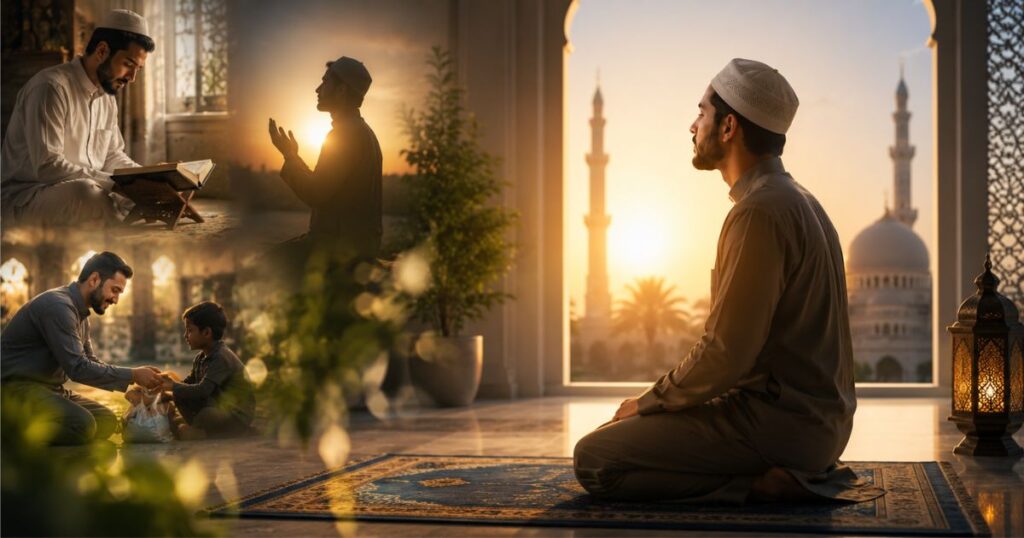
People who commit to daily prayer often report the same pattern in the first few months: the biggest shift isn’t dramatic, it’s structural. Five fixed points in the day: dawn, midday, afternoon, sunset, and night force a pause that didn’t exist before. That pause, repeated daily, is frequently described less as a religious obligation and more as an anchor: a forced stop that interrupts stress before it compounds.
This matches what Dr. Al-Ninowy described in clinical terms structure and predictability reducing psychological load but from the inside, most people describe it much more simply: “I stopped feeling like every day was running away from me.”
Conclusion
The benefits of Islam aren’t a single feature, they’re a system. Five daily prayers build structure. Fasting builds discipline and reflection. Charity builds connection and reduces materialism. Community (ummah) builds belonging. And a straightforward path to forgiveness removes the weight of carrying guilt alone.
If you’re curious to explore further, The Revert’s Learning Library and 7-Day Learning Plan are good next steps, or browse more articles on The Revert Blog.
FAQs
What are the benefits of Islam?
The core benefits are spiritual (inner peace, forgiveness, purpose), mental and physical health (structure, stress reduction, healthier habits), social (community and family stability), and historical (contributions to science and medicine).
Does Islam offer forgiveness for previous sins?
Yes. Islamic teaching holds that sincere repentance directly to God is enough to be forgiven, with no requirement for an intermediary or extended penance process.
Can Islam bring inner peace?
Many practicing Muslims report this as one of the clearest effects, largely attributed to tawakkul (trusting God with outcomes) and the structure of five daily prayers.
What are the five pillars of Islam?
Shahada (faith), Salah (prayer), Zakat (charity), Sawm (fasting), and Hajj (pilgrimage) the five core practices that structure a Muslim’s life.
Is Islam good for women?
Islamic texts grant women legal rights that were historically ahead of their era, but how those rights are applied varies widely by country and culture, a debate that exists within Muslim communities, not just outside them.
How does Islam affect mental health?
Research and practitioner reporting link Islamic practices prayer, fasting, charity, community worship to lower rates of depression, anxiety, and substance abuse, largely through structure, regular emotional reset points, and social connection.