
Today’s Fajr Prayer time in Houston, TX is calculated using the ISNA (Islamic Society of North America) method, with the sun at 15 degrees below the horizon. Exact minutes shift daily, so always confirm against a live source before Fajr.
What Is Fajr Prayer?
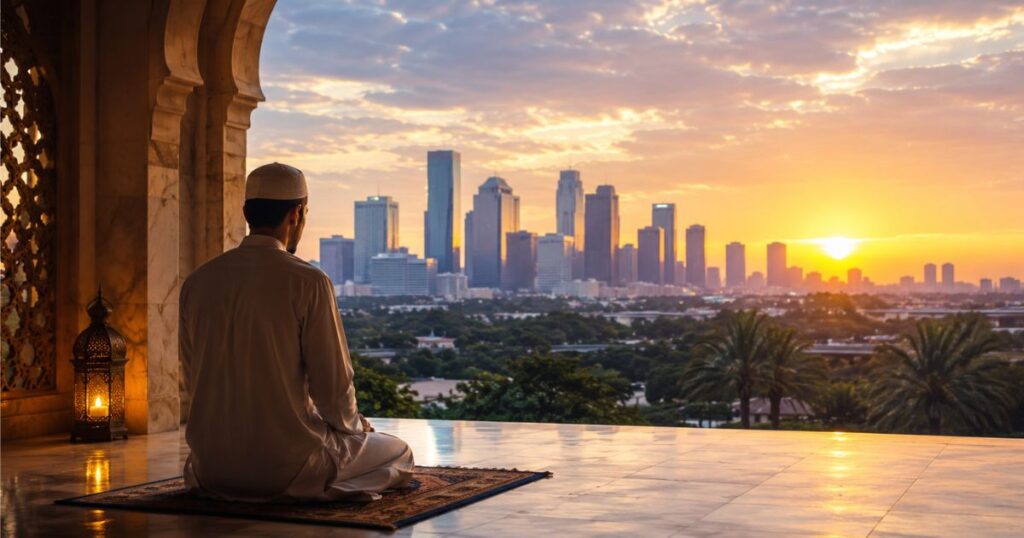
Fajr is the first of the five daily obligatory prayers in Islam, performed between true dawn (subh sadiq) and sunrise. It marks the start of the fasting day during Ramadan, which is why Fajr timing carries extra weight for Houston’s Muslim community every year. If you’re still learning the movements and recitations of this prayer, our step-by-step How to Pray Fajr guide walks through it from wudu to the final salam.
Today’s Fajr Time in Houston
In mid-July, Fajr in Houston falls around 5:15 AM under the ISNA calculation, roughly 76 minutes before sunrise. That gap between Fajr and sunrise the window in which the prayer must be completed stays fairly consistent year-round, even as the clock time itself shifts with the seasons. For a refresher on exactly how many units to pray once the time comes in, see How Many Rakats in Salat al Fajr.
Why Does Fajr Time Change Every Day?
Fajr isn’t a fixed clock time it’s tied to the sun’s position. Fajr begins when the sun reaches a specific angle below the horizon (commonly 15 to 19.5 degrees, depending on the calculation method), not at a set hour. As Houston’s daylight hours lengthen toward summer and shorten toward winter, that angle is reached earlier or later, so Fajr like sunrise and sunset creeps backward and forward across the calendar.
This is the single most common source of confusion for people switching between prayer apps: two apps rarely disagree because one is “wrong” they usually disagree because they’re using different sun angles.
How Is Fajr Time Calculated?
Prayer-time calculators use an assumed twilight angle for Fajr and Isha, set by different Islamic authorities based on their region’s astronomical conventions. Houston primarily uses the ISNA method, but you’ll see other methods referenced by apps built for other regions.
| Method | Fajr Angle | Region Typically Used |
| ISNA (Islamic Society of North America) | 15° | USA, Canada, parts of the UK |
| Muslim World League (MWL) | 18° | Europe, parts of the USA |
| Egyptian General Authority of Survey | 19.5° | Africa, parts of the Middle East |
| Umm Al-Qura | 18.5° | Saudi Arabia and the Gulf |
| University of Islamic Sciences, Karachi | 18° | Pakistan, India, Bangladesh |
A larger angle means the sky needs to be darker before Fajr starts, which pushes the time earlier. That’s why a Karachi-method app can show a Fajr time several minutes earlier than an ISNA-method app for the exact same Houston coordinates.
What Calculation Method Does Houston Use?
Most Houston mosques and prayer apps, including community-run schedules, default to the ISNA method at a 15-degree Fajr angle, paired with the Shafi/Hanbali/Maliki school for Asr timing, the same afternoon prayer covered in our How to Pray Asar guide. If your local masjid follows a different convention, its printed schedule takes precedence over any app.
Fajr’s Earliest and Latest Times in Houston (Seasonal Range)

Because Fajr tracks the sun, Houston’s Fajr time swings across a wide range over the year. Around the summer solstice (June), Fajr falls close to its earliest point of the year, near 5:04–5:06 AM. Around the winter solstice (December), it shifts to its latest point, closer to 6:00–6:10 AM. If you’re setting a recurring alarm, plan to adjust it at least monthly rather than relying on a single fixed time.
Houston isn’t the only Texas city where this seasonal drift matters for daily worship the same swing shows up for the evening prayer in our Maghrib Time Dallas guide, which covers the same sun-angle logic for a different point in the day.
Fajr During Ramadan & Suhoor Timing in Houston
During Ramadan, Fajr marks the end of Suhoor the pre-dawn meal making its exact timing more important than any other time of year. Because Ramadan follows the lunar calendar, it can fall in any season, which means Houston’s Ramadan Fajr time can range anywhere from the mid-5 AM hour (Ramadans that land in summer) to well past 6 AM (Ramadans that land in winter). Many Houston-area mosques publish a dedicated Ramadan schedule each year with a few minutes of built-in caution (ihtiyat) before the calculated time, so fasting Muslims aren’t caught eating past the true start of Fajr.Once Fajr is called, many also stay up for the special night prayer of the season see our Taraweeh Prayer guide for its significance during Ramadan.
Knowing what’s actually recited at the start of the day also helps our guide on what you say in the Fajr Adhan breaks down the call to prayer word by word.
Local Mosques and Community Prayer Schedules in Houston
Houston is home to one of the largest Muslim communities in the South, anchored by long-standing institutions like the Islamic Society of Greater Houston (ISGH), which has served the city since 1969 and now oversees more than 20 Islamic centers across the metro area. Community-run schedules like these carry an important advantage over generic prayer apps: they reflect the actual convention followed at the mosque where you’ll be praying in congregation, including any local adjustment minutes added for caution.
If you attend a specific Houston mosque, its printed or posted monthly schedule is the most reliable source it’s the version your local community actually prays by.
Fajr vs. Sunrise Prayer Is There a Difference?
Fajr and sunrise are two separate points, not the same event. Fajr prayer must be completed before sunrise begins once the sun starts to rise, the window for Fajr closes, and any prayer performed after that point falls outside the accepted time for Fajr. That’s why the gap between the two times (roughly 70–90 minutes in Houston, depending on the season) matters just as much as the Fajr time itself. Fajr is just the first of the five daily prayers see our overview of how many times a day Muslims pray for how it fits alongside Dhuhr, Asr, Maghrib, and Isha.
Daylight Saving Time and Houston Prayer Times

Houston observes daylight saving time, which shifts local clock time forward an hour each spring and back an hour each fall. Prayer-time calculators account for this automatically by using Houston’s time zone settings (America/Chicago), so the underlying sun-angle calculation doesn’t change only the clock number displayed does. If a schedule looks “off” by exactly an hour, a DST mismatch in the app’s settings is almost always the cause.
Conclusion
Fajr prayer time in Houston, Texas changes daily based on the sun’s position and the chosen prayer time calculation method. To ensure you pray on time, always check an accurate daily prayer timetable from a trusted Islamic organization or mosque. Observing Fajr consistently is a blessed way to begin your day with worship, spiritual reflection, and closeness to Allah. If you’re new to Salah altogether, our full How to Pray in Islam guide is a good starting point for every prayer, not just Fajr.
FAQs
What time is Fajr in Houston today?
Fajr in Houston shifts daily with the sun; in mid-July it falls around 5:15 AM under the ISNA method. Check a live source or your local mosque’s schedule for the precise time on any given day.
Why do different apps show different Fajr times for Houston?
Apps use different calculation methods with different sun angles ISNA uses 15 degrees, while others use 18 to 19.5 degrees, producing times that can differ by several minutes.
What calculation method is standard for Houston?
Most Houston mosques and prayer schedules use the ISNA (Islamic Society of North America) method at a 15-degree Fajr angle.
Does daylight saving time affect Fajr timing in Houston?
It affects the clock number shown, not the actual sun-based moment Fajr begins properly configured apps adjust automatically for Houston’s DST schedule.
How much earlier is Fajr in summer than in winter in Houston?
Fajr can shift by roughly an hour across the year, from around 5:04–5:06 AM near the summer solstice to around 6:00–6:10 AM near the winter solstice.