
Isha prayer is the fifth and final daily obligatory prayer in Islam. It is performed at night and consists of four rakats fard, along with additional sunnah and witr prayers. This prayer helps Muslims end their day with remembrance of Allah and spiritual peace.
What Is Isha Prayer and Why Is It Important?
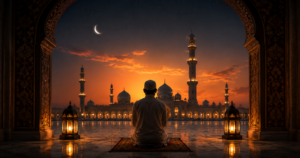
The night prayer is the fifth and final mandatory prayer of the day. It takes place after twilight fades and can be performed up until midnight.
Performing this prayer holds immense weight. It is a time of quiet reflection. The world is asleep, making your connection to the Divine even stronger. To understand where Isha fits within the full worship structure, read our complete guide on the 5 Muslim prayers in English — covering all five daily prayers with their meanings and times.
Here are the primary benefits of offering the night prayer:
- Erases daily mistakes: It acts as a spiritual cleanse for the minor errors you made during the day.
- Guarantees a peaceful sleep: Ending your day with prayer calms the nervous system and the mind.
- Builds discipline: Staying awake to fulfill this duty builds incredible self-control and focus.
- Offers protection: Tradition states that whoever performs the night prayer is under Divine protection until morning.
Preparing for Isha Prayer
You cannot just jump into the prayer. You need to prepare your body, mind, and environment.
Preparation is half the work. It transitions your brain from the chaos of daily life into a state of deep focus.
Here is exactly what you need to do before you begin:
| Preparation Step | What It Means | Why It Matters |
| Physical Washing | Washing your face, hands, head, and feet. | Ensures physical purity before standing in front of the Divine. |
| Clean Clothing | Wearing clean clothes that cover the required parts of the body. | Shows respect and readiness for the spiritual meeting. |
| Clean Environment | Finding a quiet, clean spot to pray, often using a prayer rug. | Removes physical distractions and ensures a pure prayer space. |
| Facing the Right Direction | Turning toward the designated direction of prayer (Mecca). | Unifies the physical focus of everyone praying around the world. |
The physical washing step — known as Wudu — is essential before every prayer. If you are unsure how to perform it correctly, our step-by-step guide on how to pray in Islam walks you through the full Wudu process before Salah.
Step-by-Step Guide to Praying Isha
Many people wonder exactly how to pray Isha without making mistakes. The process requires focus, but the physical steps are quite simple.
The night prayer consists of four mandatory cycles. A cycle is a set of standing, bowing, and prostrating.
Here is the exact breakdown of how to complete these four cycles from start to finish.
Step 1: Make Your Intention (Niyyah)
Every action starts with a clear goal. Before you make any physical movements, you must form the intention in your heart.
You do not need to say this out loud. You simply need to know within yourself that you are about to perform the four obligatory cycles of the night prayer.
Focus your mind on the present moment. Let go of your workday, your bills, and your stress.
Step 2: Begin with Takbir (Allahu Akbar)
Raise your hands up to your earlobes. Keep your palms facing forward.
Say the opening phrase, which translates to “God is the greatest.” This statement marks the official start of your prayer.
Once you say this, you are in a state of prayer. You cannot talk, eat, or look around. Fold your right hand over your left across your chest.
Step 3: Recite Surah Al-Fatihah and Another Surah
While standing, you will recite the opening chapter of the Quran. This chapter is mandatory in every single cycle of the prayer.
In the first two cycles of the night prayer, you will also recite another short chapter or a few verses after the opening chapter. Wondering exactly what Muslims say when they pray? Our dedicated guide explains every phrase and its meaning from opening Takbir to the closing Salam.
During the night prayer, you can recite these verses aloud during the first two cycles. This helps you focus on the rhythm and meaning of the words.
Step 4: Perform Ruku (Bowing)
After completing your recitation, say the opening phrase again and bend forward. Keep your back straight and rest your hands on your knees.
While bowing, you repeat a short phrase praising the Divine three times. This position represents deep respect and humility.
After bowing, stand back up completely straight. Pause for a moment and say the phrase of gratitude. Do not rush this transition.
Step 5: Complete Sujood (Prostration)
Next, you will lower yourself to the ground. Your forehead, nose, both palms, both knees, and all your toes must touch the floor.
This is the most submissive position in the prayer. You repeat a phrase of praise three times while your forehead is on the ground.
Sit up briefly, then perform a second prostration exactly like the first. Once the second prostration is done, you have completed one full cycle.
Note: You will repeat this entire process. After the second cycle, you sit to recite a declaration of faith. Then you stand up to complete the final two cycles (which only require the opening chapter). Finally, you sit again to complete the closing prayers and turn your head right and left to offer greetings of peace. For a broader understanding of how all four-rakat prayers follow this same structure, see our guide on how to pray as a Muslim.
Common Mistakes to Avoid During Isha Prayer
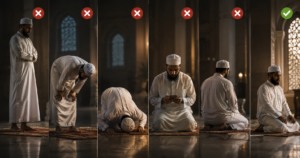
Even experienced people make errors. Knowing what to avoid is just as important as knowing what to do.
Keep an eye out for these frequent mistakes:
- Rushing the movements: Moving too fast breaks the spiritual focus and invalidates the physical postures.
- Looking around: Your eyes should remain fixed on the spot where your forehead will touch the ground.
- Praying too late: While you have until midnight, delaying the prayer unnecessarily is heavily discouraged.
- Forgetting the sitting phase: Many people forget to sit after the second cycle and accidentally stand straight up for the third.
If you ever miss Isha or have questions about combining it with Maghrib while traveling, Islam provides clear guidance. Our article on how to pray in Islam covers special circumstances including travel, illness, and shortened prayers.
Expert Insight The Spiritual Benefits of Praying Isha Regularly
As an SEO Content Strategist and someone who closely observes daily habits, I notice the profound impact of the night prayer.
I spoke with a community leader who has not missed a night prayer in twenty years. They shared a fascinating perspective.
“The night prayer is the anchor of the day,” they told me. “When you learn how to pray Isha with true focus, your sleep completely transforms. You drop the anxiety of the day on the prayer mat.”
This first-hand experience highlights a core truth. The physical movements are just the vehicle. The real benefit is the mental clarity and emotional release that happens right before you sleep. Many Muslims also follow Isha with a personal supplication. If you want to deepen that habit, explore what Dua means in Islam and how to incorporate it meaningfully after your prayer.
Conclusion
Performing Isha prayer regularly helps strengthen faith, brings inner calm, and completes the daily cycle of worship in Islam. By following the correct steps with sincerity and focus, a Muslim fulfills an important obligation and earns great rewards from Allah.
FAQs
What is the exact time frame for the night prayer?
It begins when the red twilight disappears from the sky. It ends at the midpoint of the night, which is calculated exactly halfway between sunset and dawn.
Can I pray the night prayer right before going to sleep?
Yes, as long as it is still within the acceptable time limit. Many experts actually recommend making it the very last action you take before getting into bed.
Do I have to read the chapters out loud?
In the first two cycles, you can read out loud, but it is not mandatory if you are praying alone. In the third and fourth cycles, you must read silently.
What happens if I forget a step during the prayer?
If you forget a major mandatory action, you usually have to repeat the cycle. If you make a minor mistake, you can perform two extra prostrations at the very end of the prayer to make up for the error.
Is it acceptable to combine the evening and night prayers?
Under normal circumstances, no. However, if you are traveling, sick, or facing severe weather conditions, you are permitted to combine them for ease. Learn more about optional Sunnah prayers and how voluntary worship fits around your obligatory prayers.