
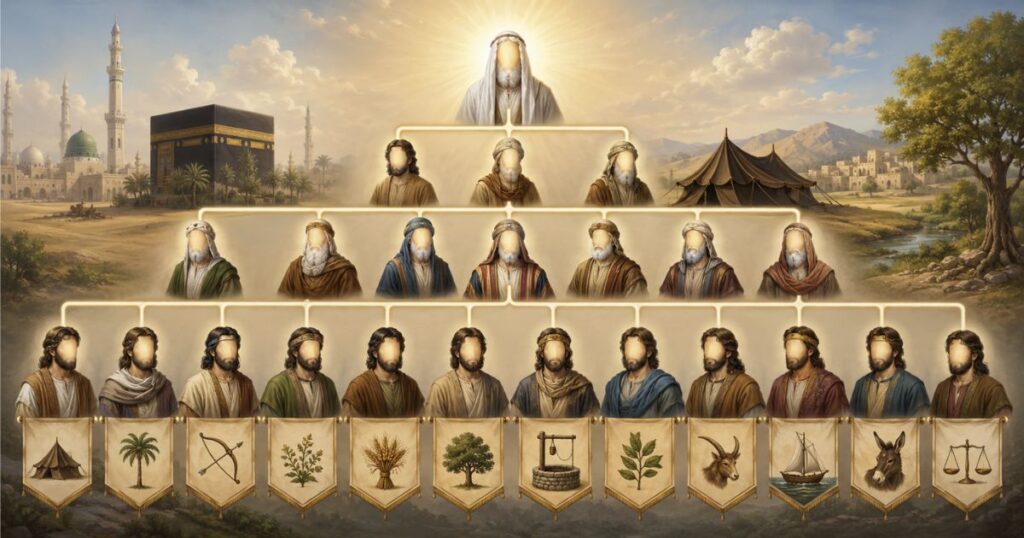
Prophet Yaqub (Jacob), whose lineage is explained in Prophet Yaqub’s Family Tree, was the son of Prophet Ishaq (Isaac) and the grandson of Prophet Ibrahim (Abraham). He had 12 sons, including Prophet Yusuf (Joseph), whose descendants became the twelve tribes of Bani Israel (the Children of Israel). Yaqub is also known as “Israel,” a name Islamic tradition links to an encounter with an angel.
Who Was Prophet Yaqub?
Yaqub (يعقوب), known as Jacob in English, is an Islamic prophet, the son of Prophet Ishaq, and the grandson of Prophet Ibrahim. The Quran names him directly 16 times and refers to him twice more by his other name, Israel. Like his father and grandfather before him, Yaqub preached one simple message: worship Allah alone.
He’s remembered for two things above everything else his deep, unshaken patience, and his role as the father of the man who would carry the family’s prophetic legacy into Egypt: Yusuf.
Prophet Yaqub’s Ancestors The Line From Ibrahim
Yaqub didn’t appear out of nowhere. He’s part of a deliberate, three-generation chain that the Quran treats as a single unit of prophethood.
Ibrahim (Abraham) Grandfather
Ibrahim is the patriarch of the whole Abrahamic line. He’s remembered for rejecting idol worship, for his willingness to submit fully to Allah’s command, and for being given two sons who each became founders of major prophetic branches: Ismail and Ishaq.
Ishaq (Isaac) Father
Ishaq was Ibrahim’s son and the direct link to Yaqub. According to Islamic tradition, Ishaq had twin sons Yaqub and his brother, known as Esau or Al-Eis. Yaqub was the one chosen to continue the line of prophethood, which is part of why tension grew between the brothers as they got older.
Yaqub’s full line of descent reads: Yaqub, son of Ishaq, son of Ibrahim. Three generations, three prophets, one unbroken chain.
Ibrahim’s Two Prophetic Branches
| Branch | Through | Leads To |
| Ismail’s line | Ismail (Ishmael), Ibrahim’s son through Hajar | Eventually leads to Prophet Muhammad |
| Ishaq’s line | Ishaq (Isaac), then Yaqub (Jacob) | Leads to Yusuf, Musa, Dawud, Sulayman, Isa, and the rest of the Bani Israel prophets |
Both branches trace back to the same man. That’s part of why Islam treats Judaism, Christianity, and Islam as connected through one shared ancestor. For a complete guide to prayer dress requirements and Salah preparation, read our guide on how to pray in Islam step by step.
Why Was Yaqub Also Called “Israel”?
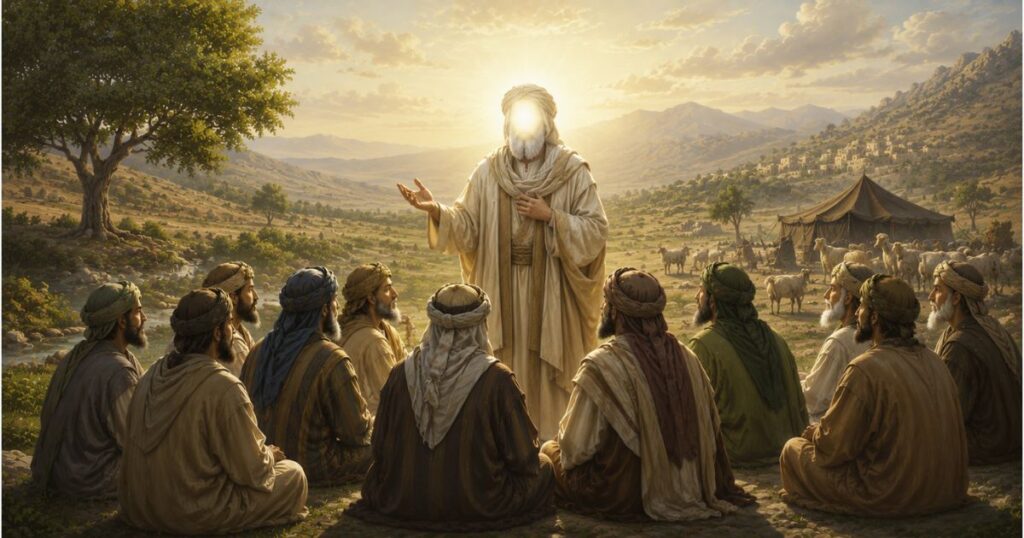
This is the detail most family-tree articles skip entirely and it’s one of the more interesting parts of his story.
Islamic commentary (drawing on accounts from the “People of the Book” alongside Quranic references) describes an episode where Yaqub wrestled through the night with a being later understood to be an angel. By the encounter’s end, Yaqub had been given a new name: Isra’il, meaning roughly “servant of Allah.” From that point forward, his descendants were known as Bani Israel the Children of Israel.
This single name change is the reason an entire nation, and three major world religions’ worth of history, traces back to one man’s family tree. It’s also why you’ll see Yaqub referred to as both “Yaqub” and “Israel” depending on the source they’re the same person.
Prophet Yaqub’s Wives and Children
Islamic tradition (again, largely drawn from accounts outside the Quran’s own text, since the Quran itself doesn’t detail this) holds that Yaqub married and had children with more than one wife. The two most consistently named are Leah and Raheel (Rachel), who were sisters.
| Son | Mother (per tradition) |
| Reuben (Rubeel) | Leah |
| Simeon (Sham’un) | Leah |
| Levi (Lawi) | Leah |
| Judah (Yahudha) | Leah |
| Issachar | Leah |
| Zebulun (Zabulun) | Leah |
| Dan | Bilhah |
| Naphtali | Bilhah |
| Gad | Zilpah |
| Asher | Zilpah |
| Yusuf (Joseph) | Raheel |
| Binyamin (Benjamin) | Raheel |
Yaqub also had at least one daughter, Dinah, though the Quran doesn’t go into detail about her.
A note on sourcing: the exact names of all four mothers, and the precise birth order of the sons, vary slightly between different scholarly and traditional accounts. What’s consistent across every source and confirmed in the Quran itself is the number: 12 sons, and their collective role as the ancestors of the twelve tribes.
The 12 Sons of Prophet Yaqub and the Tribes of Bani Israel
Here’s the lineage broken into a simple, scannable list:
- Reuben
- Simeon
- Levi ancestor of Musa (Moses) and Harun (Aaron), several generations later
- Judah
- Issachar
- Zebulun
- Dan
- Naphtali
- Gad
- Asher
- Yusuf (Joseph) became a prophet himself
- Binyamin (Benjamin) Yusuf’s full brother, and the youngest
The Quran refers to this group collectively as the Asbat, usually translated as “the tribes” or “the descendants.” Each of the twelve went on to found one of the twelve tribes of Bani Israel the nation that would later produce prophets like Musa, Dawud, Sulayman, and Isa. For new Muslims learning about Islamic prayer and its Quranic foundations, understanding this prophetic lineage helps make sense of why so many Quranic stories centre on Bani Israel.
Is Yusuf (Joseph) the Son of Prophet Yaqub?
Yes. Yusuf was Yaqub’s eleventh son, born to his wife Raheel. Yusuf is the only one of Yaqub’s twelve sons to also become a prophet. His story the dream of eleven stars bowing to him, his brothers’ jealousy, his years in Egypt, and his eventual reunion with his father is told in full in Surah Yusuf, the only chapter of the Quran devoted entirely to one person’s life.
Prophet Yaqub: Islam vs. the Bible What’s the Same, What’s Different
Because Yaqub/Jacob appears in both traditions, it’s worth being direct about where they line up and where they don’t, instead of assuming readers already know.
What’s shared: Both traditions agree Yaqub/Jacob was the son of Isaac and grandson of Abraham, that he had twelve sons who became the twelve tribes of Israel, and that he was given the name Israel after a significant encounter.
Where Islamic tradition differs in emphasis: The Quran doesn’t narrate the angel-wrestling event or the story of Yaqub disguising himself to receive his father’s blessing instead of his brother both come from outside Quranic text, drawn from Islamic commentary on earlier scriptural traditions. The Quran’s own focus is almost entirely on Yaqub’s role as a patient, grieving father in the story of Yusuf, and on his status as one of Allah’s chosen, “guided” prophets.
Bottom line: it’s the same historical figure, recognized by all three Abrahamic faiths but the Quran tells a tighter, more spiritually focused version of his story, centered on submission to Allah rather than family politics.
Where Is Prophet Yaqub Buried?
Islamic tradition holds that Yaqub is buried at the Cave of the Patriarchs in Hebron, in the same location as his father Ishaq and grandfather Ibrahim. The site known in Arabic as the Ibrahimi Mosque is considered sacred by Muslims, Jews, and Christians alike, making it one of the few places on Earth all three faiths recognize as holy for the same reason: it’s the resting place of their shared ancestors.
Prophets Descended From Yaqub’s Line
Yaqub’s twelve sons didn’t just found tribes they founded a family tree that kept producing prophets for generations. Through the line of Levi came Musa (Moses) and his brother Harun (Aaron). Later still came Dawud (David), Sulayman (Solomon), and eventually Isa (Jesus) all traditionally traced back to Bani Israel, the nation that began with Yaqub’s twelve sons.
That makes Yaqub one of the most “productive” points in the entire prophetic chain a single family tree that, over centuries, kept branching into some of the most significant figures in Islamic history.
If you’re learning about Islam for the first time, understanding the prophetic chain from Ibrahim to Yaqub to Yusuf is a powerful foundation. You can pair that with learning how to pray in Islam the five daily prayers that connect every Muslim to the same God these prophets worshipped.
Conclusion
Prophet Yaqub (AS) stands at the heart of prophetic history grandson of Ibrahim (AS), father of 12 sons who became the 12 tribes of Bani Israel, and the root from which Allah raised Musa, Dawud, Sulayman, and Isa (AS). His life was filled with tests, yet he remained patient and unshakeable in his trust in Allah. Understanding his family tree is not just history it is a reminder that Allah’s plan runs through generations, quietly and precisely, from one blessed man in Canaan to prophets who lit up the world.
For those beginning their journey in Islam, learn how to pray step by step and discover the five prayers that connect you to this prophetic tradition every single day.
FAQ
How many sons did Prophet Yaqub have?
Twelve. Ten were born to his wife Leah and her two handmaidens, Bilhah and Zilpah, while Yusuf and Binyamin were born to his wife Raheel.
Who was Prophet Yaqub’s father?
Prophet Ishaq (Isaac), who was himself the son of Prophet Ibrahim (Abraham).
Why is Prophet Yaqub also called Israel?
Tradition holds he was given the name Isra’il, meaning “servant of Allah,” following an encounter with an angel. His descendants became known as Bani Israel, the Children of Israel.
Is Prophet Yaqub the same person as the Bible’s Jacob?
Yes. Islam, Judaism, and Christianity all recognize the same historical figure son of Isaac, grandson of Abraham, father of twelve sons.