
What Is Halal and Haram in Islam? In Islam, halal means “permissible” anything Allah and the Prophet Muhammad ﷺ have allowed, from food to speech to business. Haram means “forbidden” anything they have explicitly prohibited, like pork, alcohol, or lying. But Islamic law actually recognizes five rulings, not two: obligatory, recommended, neutral, disliked, and forbidden. Halal and haram sit at the two ends of that scale.
Every choice a Muslim makes what to eat, how to earn money, what to say falls somewhere on a scale that Islam has already mapped out. Most people know the two end points: halal and haram. Fewer people know there are three categories in between, and that missing the middle ground is where most confusion about Islamic law starts.
This guide breaks down what halal and haram actually mean, where the rules come from, and how they apply to real, everyday decisions sourced directly from the Quran, authentic hadith, and Islamic scholarship.
What Does Halal Mean?
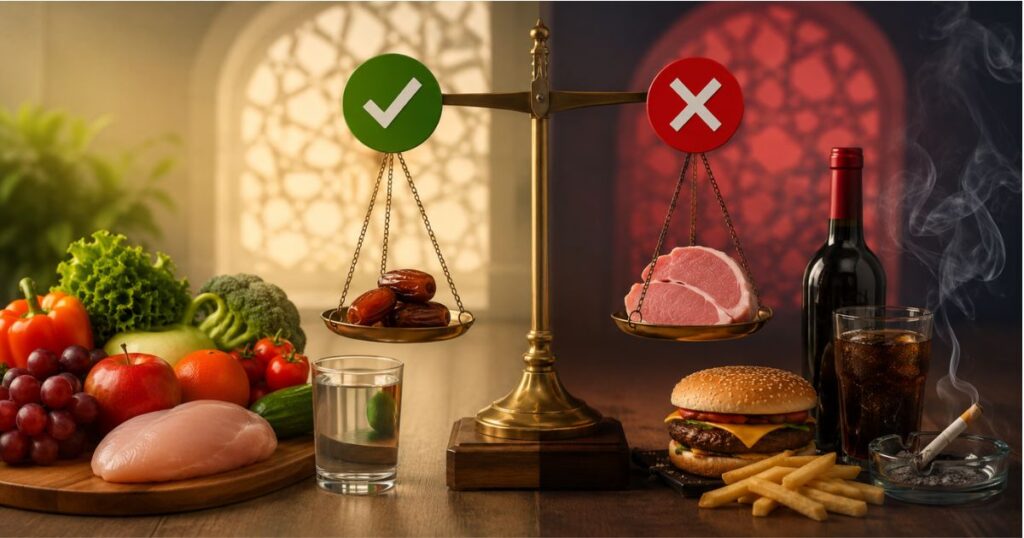
Halal (حلال) is an Arabic word meaning “permissible” or “lawful.” It describes anything an action, food, transaction, or behavior that Islamic law allows a Muslim to do or use, with no sin attached either way.
The Quran roots this permission directly in divine instruction. Believers are told, “eat from the good things which We have provided for you” (Quran 2:172), which frames halal not just as “allowed” but as something wholesome (tayyib) and beneficial.
Halal isn’t limited to food. It covers five broad areas of life: what you eat and drink, how you earn and spend money, what you say, how you dress, and how you treat other people. If Islamic law hasn’t prohibited it, and it doesn’t lead to something prohibited, it’s generally halal.
What Does Haram Mean?
Haram (حرام) is the direct opposite of halal it means “forbidden” or “unlawful.” Haram covers anything Allah and the Prophet ﷺ have explicitly prohibited, and doing it is considered a sin, while avoiding it is rewarded.
The clearest example comes from the Quran’s food laws: “Forbidden to you (for food) are: dead meat, blood, the flesh of swine” (Quran 5:3). That single verse anchors the haram status of pork, carrion, and unslaughtered blood across nearly every school of Islamic jurisprudence.
Haram isn’t only about food and drink. It extends to actions like lying, theft, adultery, and charging interest (riba) and Islamic scholars note an important principle here: if something is haram, anything that directly leads to it is generally treated as haram too.
Halal vs. Haram Quick Comparison
| Halal | Haram | |
| Meaning | Permissible, lawful | Forbidden, unlawful |
| Sin status | No sin doing or avoiding it | Sinful to do; rewarded to avoid |
| Food examples | Fruits, vegetables, grains, properly slaughtered meat, seafood | Pork, alcohol, blood, carrion, unslaughtered meat |
| Money examples | Honest trade, fair wages, paying zakat | Riba (interest), gambling, fraud |
| Behavior examples | Truthfulness, kindness, keeping promises | Lying, backbiting, slander |
| Authority to declare | Allah and His Messenger ﷺ alone | Allah and His Messenger ﷺ alone |
The 5 Categories of Islamic Rulings (Not Just 2)
Here’s what most halal/haram explainers leave out: Islamic jurisprudence (fiqh) doesn’t operate on a simple binary. It uses five classifications, and halal and haram are only the two extremes.
| Category | Arabic term | Meaning | Example |
| Obligatory | Wajib / Fard | Required; sin to skip, reward to do | The five daily prayers, fasting Ramadan |
| Recommended | Mustahabb / Sunnah | Encouraged, not required; extra reward if done | Voluntary charity, extra night prayers |
| Neutral | Mubah | Neither rewarded nor punished either way | Choosing what color shirt to wear |
| Disliked | Makruh | Discouraged, but not sinful | Excessive talking during a meal |
| Forbidden | Haram | Prohibited; sin to do, reward to avoid | Alcohol, theft, interest-based loans |
This five-tier system matters because it stops two common mistakes: treating something as forbidden when Islam only discourages it (makruh), and treating something as obligatory when Islam simply recommends it (mustahabb). Scholars often warn against elevating a neutral (mubah) act to the level of a religious rule that kind of overreach creates unnecessary hardship that Islam was never meant to impose.
Who Decides What Is Halal or Haram?
This is one of the most searched and most misunderstood questions on the topic, and Islamic scholarship is direct about the answer: only Allah and His Messenger ﷺ have the authority to declare something halal or haram. No individual, scholar, or institution can permit what Allah has forbidden, or forbid what Allah has permitted.
That authority flows through a clear hierarchy of sources:
- The Quran the primary and final word on what is permitted or prohibited.
- The Sunnah / Hadith the Prophet Muhammad’s ﷺ recorded teachings and practices, which explain and apply Quranic principles (collected in works like Sahih Bukhari and Sahih Muslim).
- Ijma (scholarly consensus) where the Quran and Sunnah don’t give an explicit ruling, and Islamic scholars agree on how principles apply.
- Qiyas (analogical reasoning) extending an existing ruling to a new situation based on shared underlying reasons, such as applying the prohibition on wine to other modern intoxicants.
Islamic teaching specifically warns against two opposite errors: people who invent religious obligations Allah never prescribed, and people who wrongly try to permit things Allah has clearly forbidden. Both distort the balance the ruling system is built to protect.
Halal and Haram in Everyday Life
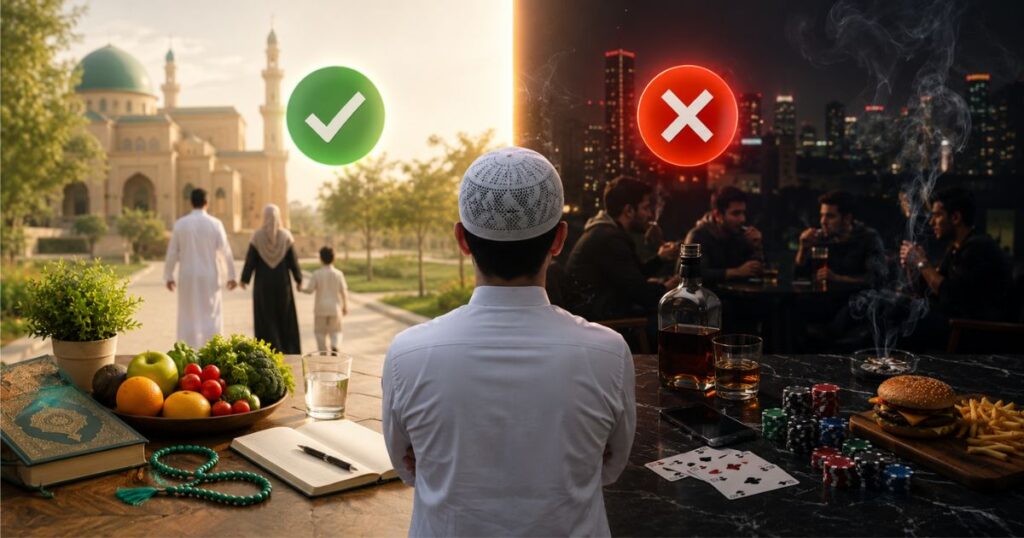
Food & Drink
This is the most commonly discussed application. Halal food includes fruits, vegetables, grains, dairy, seafood, and meat from animals slaughtered according to Islamic method (dhabihah) a swift cut to the throat, invoking Allah’s name, with the blood fully drained. Haram food includes pork, alcohol, carrion, blood, and any meat from an animal not slaughtered this way. Cross-contamination matters too: a halal meal prepared or stored alongside haram ingredients can lose its halal status.
Money & Business
Halal earning means honest trade, transparent contracts, fair wages, and paying zakat (obligatory charity). Haram earning includes riba (interest-based lending), gambling, and fraud the Quran directly contrasts trade and interest: “Allah has permitted trade and has forbidden interest” (Quran 2:275).
Speech & Behavior
Truthfulness, spreading beneficial knowledge, and reciting the Quran are halal speech. Lying, backbiting, and slander are haram the Prophet ﷺ defined backbiting plainly as “mentioning your brother in a manner which he dislikes,” even if what’s said is true.
Clothing
Halal clothing is modest and covers the body appropriately. Extravagant, overly revealing clothing, or clothing designed to imitate the opposite gender, falls into haram or heavily discouraged territory, along with specific prohibitions like gold and silk for men.
Relationships
Marriage, family bonds, and community ties built on mutual respect are halal. Adultery, fornication, and the unjust severing of family relationships are haram treated as serious violations with consequences described in both the Quran and hadith literature.
What Are “Doubtful Matters” (Shubuhat)?
Not everything in life falls cleanly into “clearly halal” or “clearly haram.” Islam has a name for that in-between zone: shubuhat, or doubtful matters.
The principle comes from a well-known hadith in Sahih Bukhari: “Halal is clear and haram is clear; between them are doubtful matters about which not many people know.” The guidance that follows is practical, not theoretical a person who avoids doubtful matters protects both their religious standing and their reputation, while someone who wades into them risks slipping into what’s actually forbidden without realizing it.
In modern life, shubuhat shows up constantly: an ingredient list with an unfamiliar additive, a financial product with an unclear fee structure, a job with ambiguous ethical implications. Everyday grooming questions like whether dyeing hair or plucking eyebrows changes their Islamic ruling are common real-life examples people ask about too. The safe approach Islamic scholarship recommends isn’t paranoia it’s caution paired with seeking knowledge, rather than assuming permissibility by default.
How Modern Science Verifies Halal Status
Halal compliance used to rely almost entirely on visible processes how an animal was slaughtered, what ingredients were listed. That’s changed. A 2024 systematic literature review published in the Journal of Halal Industry & Services documents how halal verification now draws on analytical, molecular, and instrumental testing methods to confirm the halal status of food, pharmaceutical, and cosmetic products catching things a label alone can’t, like trace animal-derived gelatin, cross-contamination residue, or alcohol content in flavorings.
This is where halal certification bodies (in the U.S., organizations like the American Halal Foundation; internationally, bodies like Malaysia’s JAKIM or Singapore’s MUIS) come in they combine documented process review with lab-level testing before a product carries a halal certification mark. For consumers, that certification mark is the most reliable shortcut to knowing a packaged or restaurant product meets halal standards without personally verifying every ingredient.
Is Halal Only About Food?
No. Food is the most visible application of halal, but the concept governs an entire way of living how you speak, earn, dress, worship, and treat others. Reducing halal to “what’s on the plate” is one of the most common misunderstandings of the term, even among people who follow it daily.
Can Non-Muslims Practice Halal?

Yes. Halal food, in particular, has drawn interest from non-Muslim consumers for reasons unrelated to religious obligation the emphasis on humane slaughter, blood drainage, and traceable sourcing appeals to people focused on animal welfare and food transparency. For Muslims, however, following halal isn’t an optional lifestyle preference; it’s a religious obligation tied to worship and obedience to Allah.
Conclusion
Halal and haram are the two clearest points on a five-part Islamic ruling scale obligatory, recommended, neutral, disliked, and forbidden that governs food, money, speech, dress, and relationships alike. Only the Quran and the Prophet’s ﷺ teachings carry the authority to set these rulings, interpreted through scholarly consensus and analogy. When something falls into a gray area, Islamic tradition favors caution over assumption a principle as relevant to reading a modern ingredient label as it was 1,400 years ago.
FAQs
What is the main difference between halal and haram?
Halal means permissible there’s no sin in doing it or avoiding it. Haram means forbidden doing it is sinful, and avoiding it is rewarded. They sit at opposite ends of Islam’s five-category ruling system.
What are common examples of haram in Islam?
Pork, alcohol, blood, carrion, gambling, interest-based lending (riba), theft, and adultery are among the clearest examples explicitly prohibited in the Quran and hadith.
Who has the authority to declare something halal or haram?
Only Allah and the Prophet Muhammad ﷺ. Scholars interpret and apply these rulings through the Quran, Sunnah, consensus (ijma), and analogy (qiyas) but no individual can independently create or cancel a ruling.
Is everything that isn’t haram automatically halal?
Not exactly Islamic law also recognizes recommended (mustahabb), neutral (mubah), and disliked (makruh) categories in between. Something can be “not haram” without being actively encouraged.
Can non-Muslims eat halal food?
Yes. Halal food is open to anyone, and some non-Muslim consumers choose it specifically for its animal-welfare and food-safety standards, even though the religious obligation applies only to Muslims.
What should I do about “doubtful matters” (shubuhat)?
Islamic guidance recommends caution avoiding an action or product when its halal status is genuinely unclear protects against unintentionally crossing into haram, while still encouraging seeking knowledge rather than assuming the worst by default.