
If you’re Muslim whether born into the faith or new to Islam navigating food in America can feel like decoding a language nobody else speaks. The supermarket aisles are full of products that look edible, but you’re left wondering: Is this halal? What’s in this sauce? Did they slaughter this animal the right way?
Here’s the reality: 83% of U.S. Muslims actively keep a halal diet, and they face the same questions every single day. The vast majority (83%) of Muslims say they either only purchase products that are halal-certified (37%) or prefer these products but will purchase those not certified as long as they are not clearly religiously forbidden. This Muslim food and Drink Guide helps make those everyday food choices easier to understand.
The good news? You’re not alone, resources exist, and this guide will show you exactly what you need to know. If you’re new to Islam and still getting oriented on the fundamentals, our New Muslim Guide is a good companion starting point.
What Is Halal? The Direct Answer
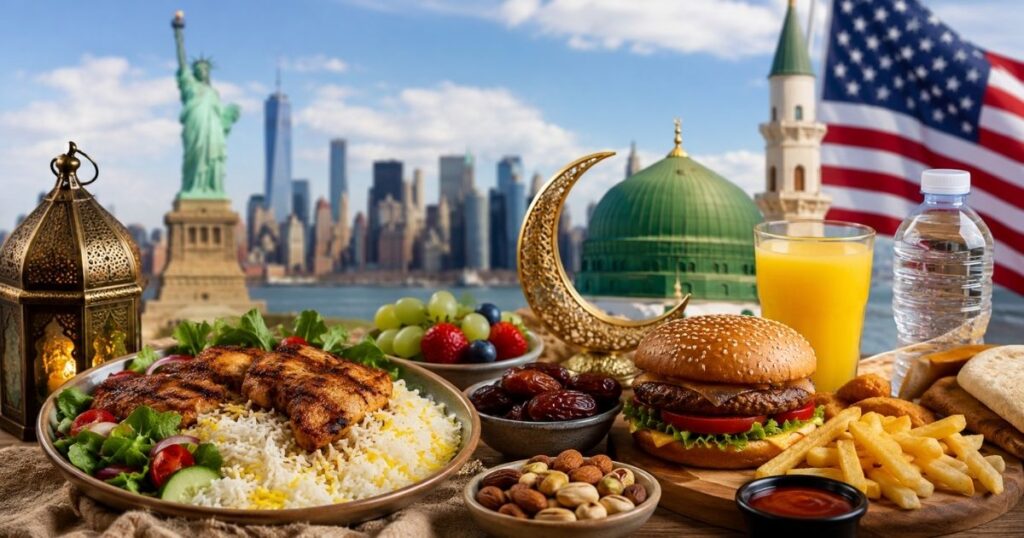
Halal refers to what is permissible under Islamic law. This includes most foods and drinks, except those specifically prohibited by the Qur’an or Hadith. For food to be considered halal, it must be free from any haram substances and must be handled and processed according to Islamic guidelines. The opposite, haram, includes pork, blood, alcohol, and animals not slaughtered according to Islamic law. This guide builds on the broader framework covered in our overview of What Is Halal and Haram in Islam?, which looks at the concept beyond just food.
In the USA context, navigating halal requires three things: (1) reading labels carefully, (2) understanding what certification marks mean, and (3) recognizing that not all “vegetarian” or “natural” foods are automatically permissible.
Quick Reference: Halal at a Glance
| Category | What’s Included |
| Definitely Halal | Fruits, vegetables, grains, legumes, eggs, most seafood, meat slaughtered according to zabiha (Islamic method) |
| Definitely Haram | Pork and pork byproducts, blood, alcohol and intoxicants, carrion (dead animals), improperly slaughtered meat, animals of prey |
| Doubtful (Mashbooh) | Gelatin, enzymes, emulsifiers, certain natural flavors, rennet, L-cysteine requires label verification or halal certification |
| Certification Bodies (USA) | IFANCA, USA Halal Chamber of Commerce, Islamic Services of America, Muslim Consumer Group (database) |
What Does “Halal” Mean? The Foundation of Islamic Dietary Law
Halal is an Arabic word meaning “permissible” or “lawful.” It’s not just a food label it’s a principle grounded in Islamic belief.
Islamic dietary laws are governed by principles outlined in the Qur’an and Hadith, focusing on what is lawful (halal) and what is forbidden (haram). The Qur’an is clear: believers should eat what is good and pure, avoid haram substances, and be mindful of how their food is produced.
For Muslims, keeping halal is an act of obedience to God and a way of maintaining spiritual and physical purity. Islam recognizes the importance of nutrition in maintaining bodily health, growth, and well-being. It places special emphasis on eating and drinking because an unhealthy diet and poor manners and habits can potentially affect a person’s body and soul.
Haram, by contrast, means forbidden. It’s the opposite of halal and includes anything explicitly prohibited in Islamic teachings.
What Muslims CAN Eat: A Complete List
Meat & Poultry
For meat and poultry to be halal, they must be slaughtered according to Islamic principles, a process called zabiha (or dhabiha). This isn’t arbitrary it’s about ethics, nutrition, and spiritual intention.
The Zabiha Process:
Meats considered halal include beef, lamb, goat, and chicken, as long as they are raised and slaughtered by Islamic guidelines. This typically involves using a sharp knife to make a swift, deep cut to the animal’s throat, intended to minimise the animal’s suffering. Additionally, the animal must be alive and healthy at the time of slaughter, and the name of Allah must be invoked upon the animal before it is killed.
Each requirement serves a purpose:
- A sharp, swift cut → Minimizes suffering and ensures the animal doesn’t sense prolonged pain
- Animal alive and healthy → Ensures meat quality and safety
- Invoking Allah’s name → Acknowledges the spiritual dimension of taking a life for food
- Draining blood → Part of the process; blood is forbidden in Islam, and draining it makes the meat fresher and safer
In the USA: Zabiha/dhabiha refers to the slaughtering of an animal or bird by a Muslim according to Islamic requirements. In the USA and Canada, halal meat must also meet all federal and/or state meat inspection laws before it can be sold. So halal meat here is both religiously compliant and federally inspected.
What about supermarket meat? Regular supermarket beef, chicken, and lamb are not halal, even if they’re organic or “humanely raised.” They’re killed using industrial methods (stunning, mechanical slaughter) that don’t follow Islamic law. Always buy meat labeled halal-certified or from a halal butcher.
Seafood
Seafood is also considered halal, except for certain types of seafood that are not permissible for consumption, such as pork, shellfish, and eel.
A note on variation: Most Islamic scholars permit all seafood, though some traditional interpretations exclude shellfish (shrimp, crab, lobster). If you’re uncertain, check with your local imam or trusted scholar, as opinions differ by school of thought.
Seafood is a huge advantage if you’re navigating halal in America. Almost every restaurant has fish or shrimp, and they’re generally safe options.
Plant-Based Foods
Naturally halal: Fruits, vegetables, grains, legumes, nuts, seeds, oils, and plant-based proteins like tofu.
Caveat: Preparation matters. A vegetable might be halal, but if it’s fried in lard or cooked in alcohol-based sauce, it becomes questionable. Read labels on packaged plant foods; check preparation methods at restaurants.
Dairy, Eggs & Other Proteins
Eggs are halal there’s no killing involved in egg production, and Islam is clear: eggs are permitted.
Milk, yogurt, and butter are halal unless they contain haram additives. Always check the ingredients.
Cheese requires attention. Some cheese uses animal-derived rennet. If sourced from non-halal animals, scholars may consider it doubtful. Rennet is an enzyme from animal stomach linings used to make cheese. Non-halal rennet comes from pigs or improperly slaughtered animals. Look for halal-certified cheese brands (many Middle Eastern and specialty dairies label clearly).
Peanut butter and nuts are halal if they have no haram ingredients added.
What Muslims CANNOT Eat: Haram Foods & Drinks
Clearly Forbidden (Haram)
Pork & Pork Byproducts
Under the muslim dietary restrictions, Muslims are required to avoid pork, blood, intoxicants, improperly slaughtered animals, and foods made with prohibited ingredients. Pork includes obvious items (bacon, ham, sausage) and hidden sources (lard, certain gelatin, some broths).
Why? The Qur’an explicitly prohibits it. Many Muslims view it as a test of faith avoiding pork, even when tempted, is an act of obedience.
Alcohol & Intoxicants
Any beverage or food containing alcohol is haram. This includes wine, beer, liqueur, and products cooked in alcohol (though some argue cooking alcohol burns off). A Muslim can not eat nor drink anything that causes intoxication in any amounts.
Blood & Carrion
Blood and blood byproducts are forbidden. Dead animals (carrion) or animals not slaughtered according to Islamic law are also haram.
Animals of Prey & Scavengers
Eagles, hawks, lions, foxes, and other carnivorous or scavenging animals are not permissible. These animals are considered haram because of their nature (predatory or unclean feeding habits).
Improper Slaughter
Any meat killed without following Islamic guidelines is haram, no matter how “organic” or “humane” the farm claims to be. Industrial slaughter, stunning, mechanical killing none of these follow zabiha, so the meat is not permissible.
The Gray Area: “Mashbooh” Doubtful Items & Modern Ingredients
Mashbooh (Arabic for “doubtful”) describes foods or ingredients where you can’t confirm whether they’re halal or haram. In today’s global food system, mashbooh is everywhere.
Why? Because modern food is complex. A single product might contain 10+ ingredients sourced from different countries, and the origin or processing method isn’t always transparent.
Common Mashbooh Items
Gelatin
Gelatin appears in gummy candies, marshmallows, some yogurts, and desserts. Gelatin is permissible (halal) if any of the following is true: You do not know whether the gelatin is from a plant [substitute] or animal source. You know that it is from an animal that is halal. You know that it is from an animal and you procure the gelatin-containing product from a Muslim, a Muslim market, or a Muslim land.
In America, most gelatin is pork-derived (pigs are cheap and widely available). Rule: If you can’t verify the source, assume it’s not halal unless a halal mark says otherwise.
Enzymes
Enzymes are used in baking, cheese-making, and processed foods. Mashbooh is the category most consumers overlook. Many modern ingredients gelatin, enzymes, mono- and diglycerides, natural flavors, and others fall into a doubtful middle ground. When the source cannot be confirmed, Islamic guidance is to abstain or seek clarity through certification.
Natural Flavors
“Natural flavors” can be alcohol-based. Without specifics on the label, you can’t know.
Emulsifiers & Stabilizers
These often come from animal sources. Mono- and diglycerides, for example, might be beef-derived (halal if from halal animal) or soy-derived (always halal).
Rennet (in Cheese)
Already covered above verify the source or buy halal-certified cheese.
The Strategy: Halal certification removes the guesswork. With modern food supply chains spanning continents and ingredient lists running long, a credible halal certification mark gives Muslim consumers confidence that their food meets the standards their faith requires.
When in doubt: (1) Look for a halal mark, (2) Contact the manufacturer, (3) Check the Muslim Consumer Group database, or (4) Choose a different product.
How to Know If Food Is Halal: Reading Labels & Certification
Halal Certification Marks in the USA
Understanding certification marks is your biggest shortcut to confidence while shopping.
IFANCA (Islamic Food and Nutrition Council of America)
IFANCA is the most recognized halal certifier in the USA. IFANCA, the Islamic Food and Nutrition Council of America, a national organization that certifies over 2,000 brands of food that qualify as halal, serving both the Muslim consumer and companies seeking a place in the halal market.
The IFANCA mark (a green crescent and sun) appears on thousands of products across supermarkets. If you see it, you can shop with confidence.
USA Halal Chamber of Commerce
Newer and growing. Similar verification process to IFANCA.
Islamic Services of America
Regional credibility; focuses on meat and processed foods.
Muslim Consumer Group (MCG)
MCG doesn’t certify; instead, it maintains a database of halal-certified products and ingredients. MCG first established its website in 2000 to educate Muslims throughout the world about the Halal status of food ingredients, E-numbers and food products. MCG has written a book, titled A Comprehensive List of Halal Food Products in U.S. and Canadian Supermarkets that lists food products and ingredients that are certified as Halal. Use their database when shopping or checking ingredients.
Reading Food Labels Without Certification
Not every halal product is certified (especially from small producers). You can verify manually:
Red Flags to Look For:
- Pork, lard, bacon fat
- Gelatin (unless source is verified halal or plant-based)
- Alcohol, wine, beer, liqueur
- Rennet (in cheese; look for halal-certified alternative or microbial rennet)
- “Natural flavors” (call the manufacturer to ask if alcohol-based)
What to Do:
- Read the ingredients list carefully
- If you see a red flag and no halal mark, contact the manufacturer or skip the product
- Use the Muslim Consumer Group database to check specific ingredients
- Ask at the store (many supermarket managers can access ingredient sourcing info)
Real Example: You’re buying a box of cookies. The label lists “gelatin.” No halal mark. You have three choices: (a) Skip it, (b) Call the manufacturer to ask if gelatin is pork or plant-based, or (c) Buy a halal-certified alternative. Most Muslims choose (c) for peace of mind.
Cross-Contamination & Kitchen Separation
Halal isn’t just about what you eat it’s also about how it’s prepared.
If halal and haram foods are prepared together, share fryers, or use the same cutting boards, the halal food becomes questionable.
At Home:
- Use separate cutting boards for halal meat and other items
- Wash utensils separately (or wash immediately after haram use)
- Use clean fryers or oil for halal cooking
At Restaurants:
- Ask: “Is this prepared separately from pork or alcohol?”
- Ask about shared fryers (many Asian or Latin restaurants use one deep fryer for everything)
- When in doubt, order seafood or vegetables and ask about prep
Finding Halal Food in the USA: Supermarkets, Chains & Restaurants
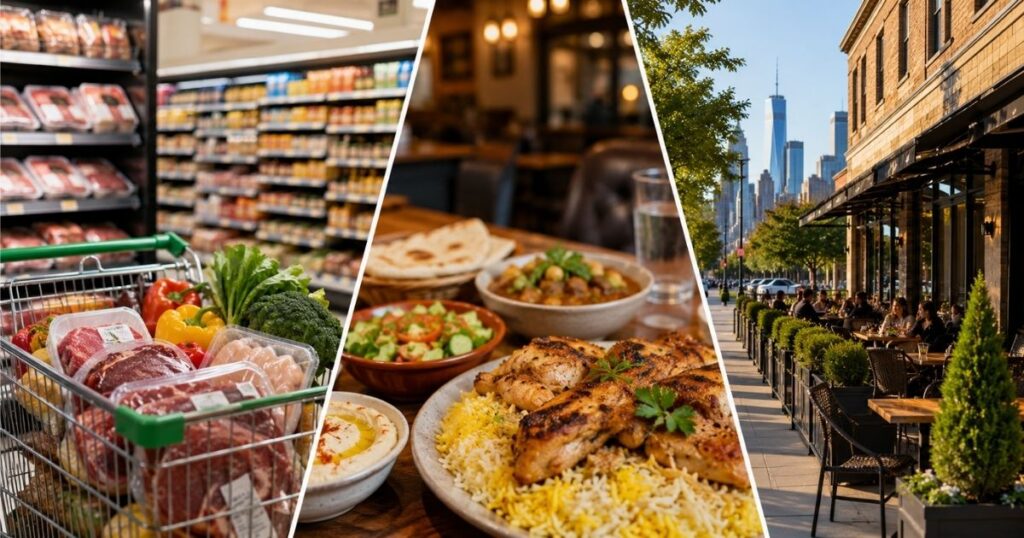
Supermarket Shopping Strategy
Where to Look First:
Start with produce everything’s halal. Then build out: grains, legumes, plant-based proteins. Finally, identify the halal meat section (many supermarkets now have one).
Best Supermarkets for Halal:
- Whole Foods: Strong halal section, clear labeling, higher prices
- Walmart: Growing halal offerings; check your regional store
- Specialty stores: Indian, Middle Eastern, Asian markets (most reliable for halal meat and products)
- Online: Halal grocery delivery services in major US cities
Pro Tip: Build a relationship with a local halal butcher. You’ll get fresher meat, direct sourcing transparency, and you’ll support the Muslim community.
What to Buy at Regular Supermarkets:
- All produce
- Grains and pasta (if no haram additives)
- Legumes and canned beans (check for pork lard)
- Halal-certified meat (look for the mark)
- Halal-certified dairy products
- Eggs
- Seafood (always halal)
What to Avoid:
- Regular supermarket meat (not halal-slaughtered)
- Pork section (obviously)
- Processed foods without halal certification (unless ingredients are obviously halal)
Fast-Food & Chain Restaurants: The Reality
Let’s be honest: Most chains don’t prioritize halal preparation. Cross-contamination is common. Meat is rarely halal-slaughtered. But some items are safer than others, and certain chains are improving.
The Safe Approach: “Simple & Verifiable”
- Grilled chicken (if you can confirm halal-certified or zabiha)
- Vegetable-based items (fries, rice, veggie wraps) but verify the oil and prep surface
- Seafood (generally halal) but avoid cross-contamination
- Avoid: Sauces (may contain alcohol or gelatin), shared fryers, mystery meat
Chain-by-Chain Reality Check:
| Chain | Best Item | Cautions | Strategy |
| Chipotle | Veggie/chicken bowl | Ask about chicken source; likely not halal-certified | Customize; ask questions; consider vegetarian |
| Panera Bread | Salads (check dressing) | Most dressings are vegetarian but check label | Stick to salads with oil/vinegar dressing |
| Subway | Veggie sub | Meat source unclear; deli counter | Go vegetarian or ask about meat sourcing |
| Taco Bell | Bean burrito | Meat from non-halal sources | Avoid meat; beans often halal if no lard |
| McDonald’s | Fries (verify oil) | High cross-contamination; beef not halal | Stick to sides; not ideal for halal |
| Chick-fil-A | Grilled chicken | Not halal-slaughtered (U.S. industrial standard) | Ask directly; many Muslims skip or choose sides |
The Reality: Chains vary by location and franchise owner. Always ask your local restaurant directly.
How to Ask a Restaurant About Halal
Do:
- “Is your chicken halal-certified or zabiha?”
- “Can you tell me where your meat comes from?”
- “How is this prepared? Are any haram ingredients used?”
- “Is this cooked in a shared fryer with pork or alcohol?”
Don’t:
- Assume the employee understands “halal” (many don’t)
- Demand or get frustrated (you’re educating them)
- Assume a “Muslim-sounding” restaurant is halal without asking
- Accept “probably halal” as an answer (you need confidence, not guesses)
If They Can’t Confirm: Order something else. Seafood, vegetables, or fruits are always safe. It’s better to miss a meal than eat something you’re uncertain about.
The Ingredients to Know: Common Halal Sticking Points
Gelatin: The #1 Confusion
Gelatin is in gummy candies, marshmallows, some yogurts, and desserts. Most gelatin in America is pork-derived.
How to Verify:
- Look for a halal certification mark
- Look for “plant-based gelatin” or “vegetable gelatin” on the label
- Contact the manufacturer
- Use Muslim Consumer Group database
Brands with Halal Gelatin: Many halal-certified candy and dessert brands exist; check IFANCA’s certified product list online.
Cheese & Rennet
Rennet (enzymes from animal stomach lining) is used to make most cheeses. Non-halal rennet comes from pigs or improperly slaughtered animals.
Halal Cheese Brands:
- Organic Valley (some products halal-certified)
- Many Middle Eastern dairies
- Brands labeled “vegetarian” or “microbial rennet”
Quick Check: Look for a halal mark or contact the brand.
Enzymes & Emulsifiers
These are in bread, baked goods, processed foods. Source is often unclear.
Strategy: Halal certification is your friend here. If no mark, consider an alternative brand or buy from halal-certified bakeries.
Alcohol in Unexpected Places
Vanilla extract is alcohol-based. Wine and beer appear in sauces and marinades. Some fermented breads contain trace alcohol.
Red Flag Words: “alcohol,” “wine,” “beer,” “distilled,” “extract” (if vanilla or almond), “liquor”
What to Do: Read labels; verify halal mark; contact manufacturer if unsure.
Halal vs. Kosher: Similarities & Key Differences
Both halal and kosher are religious dietary laws with deep roots and ethical principles. They overlap but aren’t interchangeable a good illustration of the wider point covered in our piece on What Makes Islam Different From Other Religions?: shared Abrahamic roots, distinct practice.
| Aspect | Halal | Kosher |
| Source | Qur’an, Hadith (Islamic teachings) | Torah, Talmud (Jewish law) |
| Forbidden Meat | Pork, blood, improper slaughter | Pork, blood, seafood, most birds of prey |
| Slaughter Method | Zabiha (Islamic method) | Shechita (Jewish method) |
| Invoking the Divine | Allah’s name at slaughter | Blessing over slaughter |
| Seafood | Generally permitted (some exclude shellfish) | NOT permitted (forbidden in Torah) |
| Certification | IFANCA, USA Halal Chamber, MCG | Orthodox Union, Star-K, others |
| Overlap | Both forbid pork; both require name invoked; both require minimal suffering | Same both prioritize ethics |
| Key Difference | Halal permits seafood | Kosher forbids seafood (& more animals overall) |
Real-World Note: Based on this, when halal options are limited, some American Muslims opt to eat kosher food, which is marked with a “K” on the packaging. Jewish dietary rules also forbid the consumption of pork and require that the name of God be said at the time of slaughter.
In some regions or situations, Muslims and Jews find shared grocery options. Both value ethical sourcing and religious compliance.
Ramadan, Fasting & Food: Iftar & Suhoor Guide
Ramadan is the Islamic holy month when adult Muslims fast from dawn to sunset. It’s a spiritual practice that includes discipline, prayer, and community. One of the Five Pillars of Islam, specifically the pillar of Sawm (fasting). Since Ramadan’s exact dates shift each year, our guide to the Islamic Calendar explains how the lunar months determine when it falls.
The Basics
Suhoor (Pre-Dawn Meal): Eaten before sunrise, usually 1–2 hours before fajr prayer. Purpose: energy for the day’s fast.
Iftar (Breaking the Fast): Eaten after sunset, usually just after maghrib prayer. Traditionally begins with dates and water, then a full meal. If you want the exact timing behind fajr and maghrib each day, our guide to the 5 Daily Prayers in Islam breaks down when each one falls.
The Rule: Everything eaten before sunrise, after sunset, or otherwise must still be halal.
Suhoor Ideas
Eat protein-rich, sustained-energy foods:
- Eggs and whole grain toast
- Oatmeal with nuts and honey
- Yogurt and granola
- Cheese and fruit
- Chicken with rice
Drink plenty of water. Avoid sugary foods (they cause energy crashes).
Iftar Ideas
Traditional opening: Dates and water (following Prophet Muhammad’s example)
Then a full meal:
- Halal meat or grilled chicken
- Rice or bread
- Vegetables (fresh or cooked)
- Soup (lentil, chicken, or vegetable)
- Fruit for dessert
Halal rules still apply. If buying prepared iftar foods, check for halal certification.
Navigating Iftar in America
Many US cities now have Ramadan specials at Muslim-owned restaurants. Some mainstream chains (Chipotle, Panera) offer discounts to Muslims during Ramadan. The same verification rules apply: ask about sources, check prep methods, confirm halal status.
Scholar Opinions & Variation: When Muslims Disagree on Halal

Islam is not monolithic. Islam is a mosaic, not a monolith Muslim people come from all over the world with varied food cultures and dietary preferences.
Different schools of Islamic jurisprudence (Hanafi, Shafi’i, Maliki, Hanbali) may have slightly different rulings on certain foods.
Common Areas of Disagreement
Seafood (Especially Shellfish)
Most scholars permit all seafood. Some traditional interpretations exclude shellfish (shrimp, crab, lobster), arguing only fish with scales are permitted. If you’re unsure, ask your local imam or trusted scholar.
Meat from “People of the Book”
Most adhere to the Islamic opinion that only meat certified halal or zabiha is permissible to eat. Shaykh Yusuf Weltch, a teacher of Arabic, Islamic law, and spirituality and a member of the Seekers Guidance faculty is one scholar who ascribes to this mindset. He writes, “In short, it is not permissible to eat any meat that was not slaughtered according to the Sacred Law of Islam; a person living in a Muslim minority country does not change that ruling as there still remains many options of permissible food, such as seafood and non-meat options.”
Some scholars argue that meat slaughtered by Christians or Jews (who also invoke God’s name at slaughter) is permissible. Others say this is only allowed in Muslim-majority countries and not applicable in the USA. When in doubt, stick to halal-certified meat.
Modern Ingredients
As new food additives emerge, scholars evolve their guidance. Some items classified as mashbooh (doubtful) 10 years ago now have clearer rulings as certifiers investigate them.
The Takeaway: No “one-size-fits-all” halal. If you encounter variation, consult your imam or trusted scholar.The important thing is your sincere intention to follow Islamic dietary principles the same spirit of sincerity over rigid checklist-worship covered in our piece on the Beauty of Islam.
Conclusion
Eating halal in America is entirely doable and increasingly mainstream. You have certification marks to guide you, a growing halal food industry, and an American Muslim community of nearly 4 million people navigating the same journey.
FAQs
Can Muslims eat food prepared by non-Muslims?
Yes, if the food itself is halal and prepared without haram ingredients or methods. Qur’an (5:5) permits food from “People of the Book” (Christians, Jews) under certain conditions, though this is debated among scholars. If you’re invited to a non-Muslim friend’s dinner, communicate your needs respectfully most people appreciate the effort to include you.
Are all vegetarian foods automatically halal?
Not always. Vegetarian foods can still contain haram ingredients (alcohol-based flavorings, certain additives, gelatin) or be cross-contaminated. Always check labels carefully, even on plant-based items.
What’s the difference between “halal-certified” and “just halal”?
Halal-certified means a third-party organization (IFANCA, etc.) has verified the product meets halal standards. Non-certified foods can still be halal if they genuinely meet Islamic guidelines, but certification removes guesswork and provides accountability.
Can Muslims drink energy drinks or soda?
Most are halal (no alcohol). However, check labels for non-halal ingredients (certain flavorings, gelatin). Energy drinks are also debated for health reasons during Ramadan fasting, but that’s a personal/health choice, not a halal issue.
Is meat from supermarkets halal?
Regular supermarket meat is NOT automatically halal. It’s killed by industrial methods (stunning, mechanical slaughter) and blood isn’t drained according to Islamic law. Only buy meat labeled halal-certified or from halal butchers.
How strict is the halal rule? What if I make a mistake?
Islam teaches that mistakes made in good faith are forgiven. If you know they dislike your consuming their food and drink, you may not do so. If you’re unsure and try to avoid haram, you’re following the spirit of the law. Intention (niyyah) matters deeply in Islam.