
How to Pray in Islam Step-by-Step Guide? Prayer (salah) is the second pillar of Islam the daily conversation between you and Allah. Whether you’re new to Islam, a convert, or simply curious about how Muslims pray, this guide breaks down the entire process without jargon or overwhelm. You’ll learn the exact steps, what each movement means, and how to bring both your body and heart into prayer.
By the end of this guide, you’ll understand not just how to pray, but why each step matters. If you’re brand new here, our Can Anyone Be Muslim? Yes Here’s Your Complete Guide is worth reading first for the bigger picture.
What You Need to Know
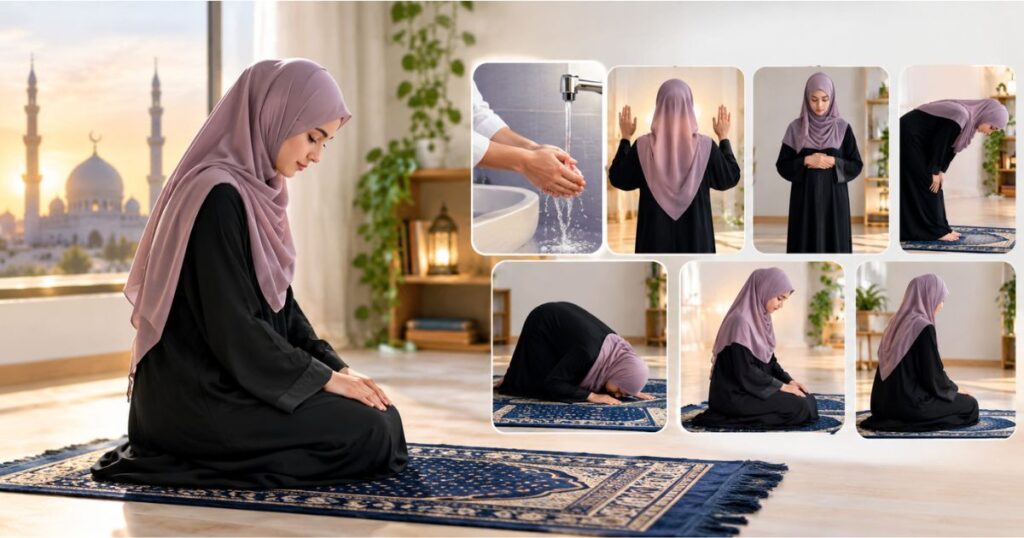
What is Salah? The five daily Islamic prayers are a structured form of worship performed at specific times throughout the day the second of the Five Pillars of Islam.
When do Muslims pray? Five times daily: Fajr (dawn), Dhuhr (midday), Asr (afternoon), Maghrib (sunset), and Isha (night).
How long does it take? Each prayer takes 5–10 minutes.
What do you need before prayer?
- Wudu (ritual ablution/washing)
- Modest clothing (covering body except face, hands, feet)
- Facing the qibla (direction of the Kaaba in Mecca)
- Clear intention (in your heart, not aloud)
Before You Pray: Essential Preparation
Understanding Wudu (Ritual Ablution)
Wudu is the ritual washing that prepares you spiritually and physically for prayer. It’s not just hygiene it’s a moment of intention-setting and mindfulness it’s a moment of intention-setting and mindfulness, part of the broader concept of Purity in Islam (Taharah).
The 5 Steps of Wudu:
- Wash your face Use water; wash from forehead to chin, ear to ear.
- Wash your arms From fingertips to elbows, right arm then left.
- Wipe your head, wet your hands and run them over your hair and ears.
- Wash your feet From toes to ankles, right foot then left.
Spiritual Tip: As you wash each part, think about purifying your heart. The Prophet Muhammad taught that wudu washes away minor spiritual impurities and prepares your heart for meeting your Lord.
What breaks wudu? Bathroom use, passing gas, loss of consciousness, or touching the opposite gender (in some Islamic schools). If your wudu is broken, you simply perform it again.
Choosing Your Prayer Space
You don’t need a mosque to pray. A clean corner at home, office, or outdoors works perfectly.
What to do:
- Find a clean space where you won’t be interrupted.
- Face the qibla (the direction of Mecca). Apps like Muslim Pro or a compass can help you find the direction.
- Wear modest clothing Covered from shoulders to knees (men should cover at least from navel to knees; women should cover everything except face, hands, and feet).
- Use a prayer mat (optional, but recommended for cleanliness and focus).
Making Your Intention (Niyyah)
Your intention is silent and from the heart you don’t say it aloud.
Simply think: “I intend to pray Fajr for Allah” (or whichever prayer it is).
That’s it. Your intention is between you and Allah.
The Five Daily Prayers: When & How Many Cycles
Each prayer consists of a certain number of rak’ahs (cycles). A cycle includes standing, reciting, bowing, prostrating, and sitting. For the exact time windows for each of these five prayers, see The 5 Daily Prayers in Islam: Namaz Times & Importance.
| Prayer | Time | Rak’ahs | Recitation |
| Fajr | Before sunrise | 2 | Aloud (audible) |
| Dhuhr | Midday | 4 | Silent (quiet, internal) |
| Asr | Afternoon | 4 | Silent |
| Maghrib | Just after sunset | 3 | First 2 aloud, 3rd silent |
| Isha | Night | 4 | First 2 aloud, last 2 silent |
What does this mean? If you’re praying Fajr (2 rak’ahs see How Many Rakats Are in Fajr Prayer? for the full breakdown), you’ll do the 13-step sequence twice. If you’re praying Dhuhr (4 rak’ahs), you’ll do it four times, but with variations in which verses you recite. For the complete rakah chart across all five prayers including Sunnah and Witr, see How Many Rakahs Are in Each Prayer? Complete Chart.
Don’t worry once you master one rak’ah, you can stack them. Let’s start with the foundation.
One Complete Prayer Cycle (Rak’ah): 13 Steps
Step 1: Stand and Raise Your Hands
Position:
- Stand upright with feet about shoulder-width apart.
- Raise both hands to ear level or shoulder level, palms facing forward.
What you say: “Allahu Akbar” (الله أكبر)
Pronunciation: Ah-lah-hoo Ack-bar
Meaning: Allah is Greater (greater than everything).
Spiritually: You’ve just announced that you’re entering a sacred space. Everything else your phone, your worries, your to-do list all fade away. You’re with Allah now.
Take a moment here. Don’t rush. Feel the transition.
Step 2: Place Your Hands on Your Chest
Position:
- Place your right hand over your left hand.
- Rest both on your chest, below your collarbone.
- Let your eyes gaze toward the ground in front of you (specifically, toward the place where you’ll prostrate).
Spiritually: This posture closes you off from fidgeting and distractions. You’re signaling: “I’m here. I’m fully present.”
Step 3: Recite the Opening Supplication (Optional but Recommended)
What you say:
“Subhanak Allahumma wa bi hamdika, wa tabarakasmuka, wa ta’ala jadduka, wa la ilaha ghairuk.”
Transliteration: سُبْحَانَكَ اللَّهُمَّ وَبِحَمْدِكَ وَتَبَارَكَ اسْمُكَ وَتَعَالَىٰ جَدُّكَ وَلَا إِلَهَ غَيْرُكَ
English Translation:
“How perfect You are, O Allah, and Yours is the praise. Blessed is Your name, exalted is Your majesty, and there is no god besides You.”
Why say this? It sets a humble, grateful tone. You’re essentially greeting Allah with respect and awe before asking for His guidance.
Step 4: Seek Refuge and Begin the Quran
Say:
“A’udhu billahi minash-Shaytanir-rajim”
Transliteration: أَعُوذُ بِاللَّهِ مِنَ الشَّيْطَانِ الرَّجِيمِ
Meaning: “I seek refuge in Allah from Satan, the rejected one.”
Then say:
“Bismillahir-Rahmanir-Rahim”
Transliteration: بِسْمِ اللَّهِ الرَّحْمَٰنِ الرَّحِيمِ
Meaning: “In the name of Allah, the Merciful, the Compassionate.”
Step 5: Recite Surah Al-Fatiha (The Opening)
This is the most essential chapter of the Quran. You must recite it in every rak’ah. Many new Muslims find it helpful to read the meaning alongside the Arabic.
Full text with English line-by-line:
بِسْمِ اللَّهِ الرَّحْمَٰنِ الرَّحِيمِ
“In the name of Allah, the Merciful, the Compassionate.”
الْحَمْدُ لِلَّهِ رَبِّ الْعَالَمِينَ
“All praise belongs to Allah, Lord of all that exists.”
الرَّحْمَٰنِ الرَّحِيمِ
“The Merciful, the Compassionate.”
مَالِكِ يَوْمِ الدِّينِ
“Master of the Day of Judgment.”
إِيَّاكَ نَعْبُدُ وَإِيَّاكَ نَسْتَعِينُ
“It is You we serve, and it is You from whom we seek help.”
اِهْدِنَا الصِّرَاطَ الْمُسْتَقِيمَ
“Guide us on the straight path.”
صِرَاطَ الَّذِينَ أَنْعَمْتَ عَلَيْهِمْ
“The path of those whom You have favored.”
غَيْرِ الْمَغْضُوبِ عَلَيْهِمْ وَلَا الضَّالِّينَ
“Not of those who have incurred Your anger, nor of those who are astray.”
Then say: “Ameen” (آمِين) “May it be so.”
What this means spiritually: You’ve just asked Allah for guidance. The entire chapter is you making a request, then accepting that only Allah can truly guide.
Step 6: Recite Additional Quranic Verses
After Al-Fatiha, recite any chapter or verses from the Quran. In the first two rak’ahs of most prayers, you can recite longer passages. In later rak’ahs, shorter verses are common.
Common example: Surah Al-Ikhlas (Chapter 112)
قُلْ هُوَ اللَّهُ أَحَدٌ
“Say: He is Allah, One.”
اللَّهُ الصَّمَدُ
“Allah, the Self-Sufficient.”
لَمْ يَلِدْ وَلَمْ يُولَدْ
“He has not begotten, nor was He begotten.”
وَلَمْ يَكُن لَّهُ كُفُوًا أَحَدٌ
“And there is none like unto Him.”
Why this step? You’ve asked for guidance; now you’re receiving it through the words of Allah (the Quran). It’s a beautiful exchange: request, then response.
Step 7: Transition to Bowing Say Takbir
Say: “Allahu Akbar” as you begin to bend forward.
Spiritually: You’re about to lower yourself in a sign of humility. Before you do, you declare His greatness.
Step 8: Bow (Ruku’)
Position:
- Bend at your hips until your back is parallel to the ground (like you’re folding at the waist).
- Keep your back straight, not curved.
- Place your hands on your knees; spread your fingers.
- Your eyes look toward the ground in front of you.
- Keep your arms away from your body, not hugged in.
What you say (3+ times):
“Subhana Rabbil-A’zim”
Transliteration: سُبْحَانَ رَبِّيَ الْعَظِيمِ
Meaning: “How perfect is my Lord, the Great.”
Spiritually: This is the paradox of prayer. You’re in a bent, unstable position (physically weak). Yet you’re declaring His greatness and perfection. It’s an acknowledgment: “I am small; You are mighty.”
Stay in this position for at least a few seconds. Don’t rush.
Step 9: Rise from Bowing
As you rise, say:
“Sami’Allahu liman Hamidah”
Transliteration: سَمِعَ اللَّهُ لِمَنْ حَمِدَهُ
Meaning: “Allah hears those who praise Him.”
Then stand upright and say:
“Rabbana wa lakal-Hamd” (or the full version: “Allahumma Rabbana wa lakal-Hamd”)
Transliteration: رَبَّنَا وَلَكَ الْحَمْدُ
Meaning: “Our Lord, to You alone belongs all praise.”
Spiritually: You’ve humbled yourself; now you’re lifted back up. The message is: “Allah hears my humility. He responds with mercy.” There’s relief and hope in this rising.
Make sure every joint returns to its place before moving forward.
Step 10: Transition to Prostration
Say: “Allahu Akbar” as you begin to lower yourself to the ground.
Spiritually: Again, before the action, you declare His greatness.
Step 11: Prostrate (Sujud)
This is the most iconic position in Islamic prayer and the closest you come to Allah.
Position (all seven body parts must touch the ground):
- Your forehead
- Your nose (forehead and nose together count as one point)
- Your two hands
- Your two knees
- Your toes (both feet)
How to get there:
- Kneel down on the ground.
- Place your hands in front of you, palms down.
- Lower your forehead and nose to the ground.
- Your toes curl under, touching the ground.
- Your arms are not limp; they have some tension, close to your body.
- Your eyes look down.
What you say (3+ times):
“Subhana Rabbil-A’la”
Transliteration: سُبْحَانَ رَبِّيَ الْأَعْلَىٰ
Meaning: “How perfect is my Lord, the Most High.”
Optional (and encouraged): Make personal du’a (supplication) here.
This is the most powerful moment of prayer. The Prophet taught that you’re closest to Allah in sujud. Ask Him for forgiveness, guidance, help, healing whatever you need. You can speak in Arabic or your native language.
Spiritually: You’re at your absolute lowest physically. Your forehead touches the earth. Yet you’re declaring His supremacy. There’s profound humility here and also profound intimacy. You’re vulnerable before your Lord, and that vulnerability opens the door to genuine connection.
Stay in sujud for a few seconds. Don’t rush.
Step 12: Sit Up Between Prostrations
Say: “Allahu Akbar” as you rise slightly.
Position:
- Sit up on your heels.
- Your hands rest on your thighs or lap.
- Your back is upright but relaxed.
Optional (and recommended):
“Rabbi ighfir li, Rabbi ighfir li” (2–3 times)
Transliteration: رَبِّ اغْفِرْ لِي
Meaning: “My Lord, forgive me.”
Spiritually: This is a moment of reflection and rest. You’ve just been in the deepest humility; now you’re acknowledging your need for forgiveness. It’s sincere, direct, and human.
Step 13: Second Prostration
Say: “Allahu Akbar” as you return to the ground.
Repeat the same position and words:
“Subhana Rabbil-A’la” (3+ times)
Why two prostrations? It emphasizes the importance of this act of ultimate submission. The first prostration is your recognition of His greatness; the second is your commitment to keep recognizing it.
Completing Multiple Rak’ahs
If you’re praying a prayer with more than one rak’ah (e.g., Dhuhr with 4 rak’ahs), here’s what happens:
After the 2nd Prostration of Rak’ah 1:
- Say “Allahu Akbar” and rise to standing position.
- Repeat Steps 3–13 (Fatiha, additional verses, bowing, prostrations).
After the final prostration of the 2nd rak’ah (or final rak’ah in a longer prayer):
- You now sit for the Tashahud (bearing witness), which we’ll cover below.
The Final Rak’ah Tashahud and Closing
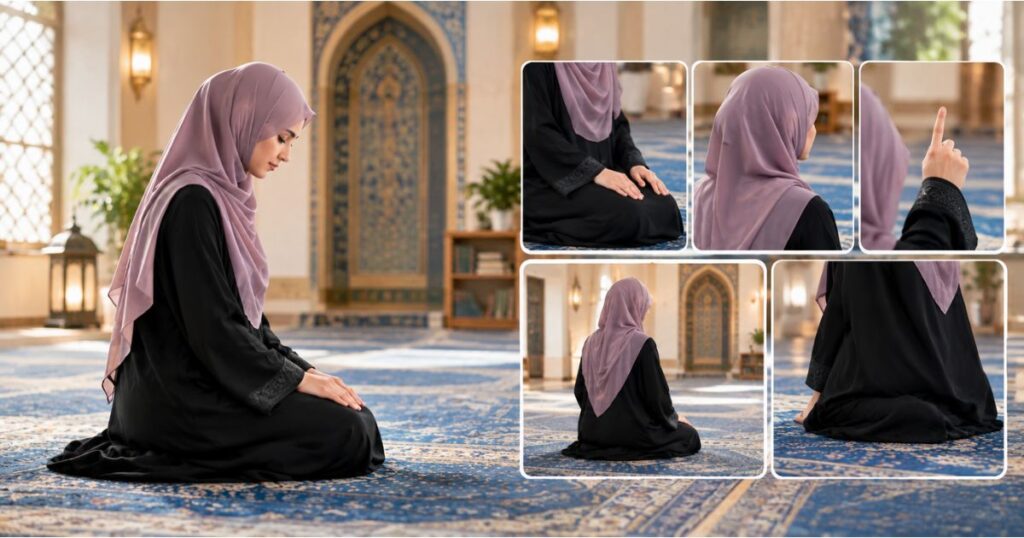
Sitting Position
After your final two prostrations, you sit on the ground.
Position:
- Sit on your left leg (your right leg is either upright or folded to the side, depending on your school of Islamic law).
- Your hands rest on your thighs, palms down or up.
- Your back is upright; your eyes gaze toward your lap.
Recite the Tashahud (The Testimony)
What you say:
“At-Tahiyyatu lillahi was-Salawatu wat-Tayyibat,
As-Salamu ‘Alayka Ayyuhan-Nabiyyu wa Rahmatullahi wa Barakatuh,
As-Salamu ‘Alayna wa ‘Ala ‘Ibadillahi As-Salihin,
Ash-Hadu an La Ilaha Illallah,
wa Ash-Hadu anna Muhammadan ‘Abduhu wa Rasuluh.”
English Translation:
“All compliments, prayers, and pure deeds are for Allah.
Peace be upon you, O Prophet, and the mercy of Allah and His blessings.
Peace be upon us and upon the righteous servants of Allah.
I bear witness that there is no god but Allah,
and I bear witness that Muhammad is His servant and Messenger.”
When you reach the Shahada (testimony):
Raise your right index finger toward the sky. This is a gesture of swearing an oath you’re bearing witness before Allah and the angels.
Spiritually: This is your reaffirmation. In every prayer, you’re renewing your faith: “There is none worthy of worship but Allah, and Muhammad is His messenger.” It’s not just words; it’s a declaration of your deepest conviction.
When you reach this testimony the same core declaration as the Shahada raise your right index finger toward the sky as a gesture of swearing an oath. In every prayer, you’re renewing your faith.
Send Blessings on the Prophet (Salawat)
What you say:
“Allahumma Salli ‘Ala Muhammadin wa ‘Ala Ali Muhammadin,
Kama Sallayta ‘Ala Ibrahima wa ‘Ala Ali Ibrahima,
Wa Barik ‘Ala Muhammadin wa ‘Ala Ali Muhammadin,
Kama Barakta ‘Ala Ibrahima wa ‘Ala Ali Ibrahima,
Innaka Hamidun Majid.”
English Translation:
“O Allah, send prayers upon Muhammad and upon the family of Muhammad,
just as You sent prayers upon Ibrahim and the family of Ibrahim.
And bless Muhammad and the family of Muhammad,
just as You blessed Ibrahim and the family of Ibrahim.
Indeed, You are Worthy of Praise and Majesty.”
Spiritually: You’re asking for the legacy of the Prophet to flourish. By extension, you’re asking: “Make his way of life, his message, successful in our time.” You’re part of a chain of believers keeping this tradition alive.
Personal Supplication (Du’a)
Before you end the prayer, this is your moment to ask Allah for what you need.
You can:
- Ask for help, healing, guidance, forgiveness.
- Speak in Arabic or your native language.
- Be sincere and honest.
- Ask for your own needs or those of others.
Example:
“Allahumma inni adhaltu nafsi dhulman kathira, wa la yaghfirudh-dhunuba illa anta, faghfir li maghfiratam-min ‘indika warhamni, innaka antal-Ghafurur-Rahim.”
Translation: “O Allah, I have wronged myself greatly, and none forgives sins except You. So forgive me a complete forgiveness from You and have mercy upon me. Indeed, You are the Forgiving, the Merciful.”
Spiritually: This is your direct conversation with your Lord. No intermediary. No formality. Just you and Allah.
End with Taslim (The Greeting of Peace)
Turn your face to the right:
Say: “As-Salamu ‘Alaykum wa Rahmatullahi wa Barakatuh”
Transliteration: السَّلَامُ عَلَيْكُمْ وَرَحْمَةُ اللَّهِ وَبَرَكَاتُهُ
Meaning: “Peace and the mercy and blessings of Allah be upon you.”
Then turn your face to the left and say the same.
Spiritually: You’re greeting the angels on your right and left. You’re also acknowledging all believers past, present, and future. The prayer is complete.
What Breaks Your Prayer? Common Mistakes
If any of these happen, you need to restart your prayer:
- Talking or making unnecessary sounds (including laughing out loud)
- Exposing your awrah (private areas)
- Facing away from the qibla
- Leaving out Surah Al-Fatiha (the most essential step)
- Not being still or settled in each position
- Eating or drinking deliberately
- Incomplete wudu before starting
Minor distractions (a car honks, someone coughs nearby, your mind wanders) don’t break the prayer, just gently refocus.
For Women: Key Differences
Women and men follow the same basic steps for prayer. However, there are some important variations:
| Aspect | Women | Men |
| Clothing | Full hijab and body coverage required | Head and neck covered (some schools); modesty required |
| Foot Position in Prostration | Can be flexible (feet to side or under); priority is modesty | Toes point toward qibla (specific position) |
| Sitting Position | Tawarruk (both legs to one side for modesty) | Upright sitting position |
| Aloud Recitation | Silent throughout (even when imam recites aloud) | Aloud in first rak’ahs |
| Menstruation | Prayer is paused during menstruation and postpartum recovery | N/A |
Important note: These variations aren’t about women being “less,” but about respecting modesty in Islamic law. Women’s prayer is just as valid and rewarded as men’s.
Spiritual Tips for Deepening Your Focus (Khushu)
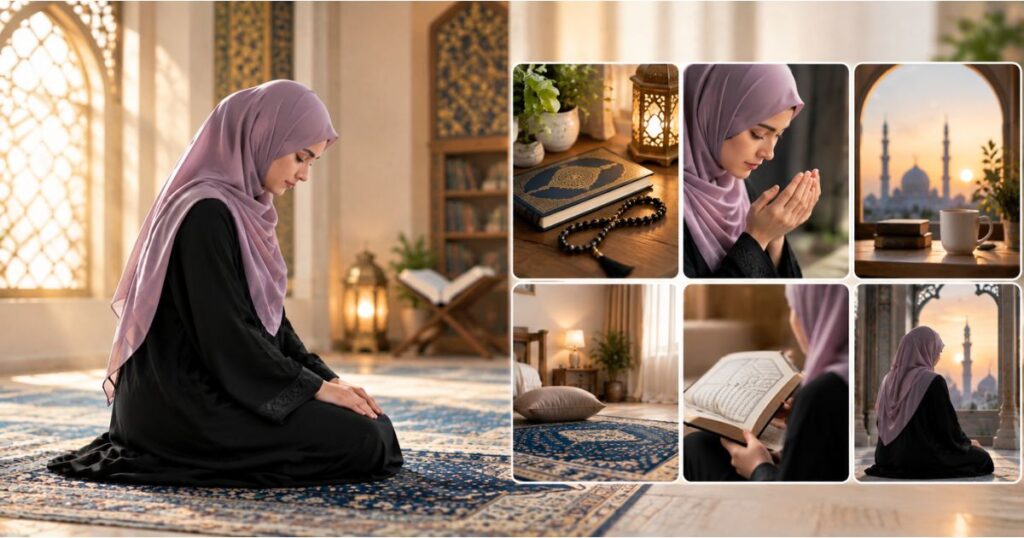
Khushu means the presence of the heart being mentally and emotionally engaged in prayer, not just going through the motions.
Practical tips:
- Understand what you’re saying: Before prayer, read the English meaning of Surah Al-Fatiha and other verses you’ll recite.
- Remove distractions: Turn off your phone. Find a quiet space.
- Pray at the beginning of the prayer time: The further into the prayer window you go, the harder it is to focus.
- Take your time: Don’t rush through positions. Spend a few seconds on each one.
- Visualize the qibla: Before you begin, picture the Kaaba in Mecca. It connects you to millions of Muslims praying in the same direction.
- Make sincere du’a in sujud: Pour out your heart during prostration; it’s the most powerful moment.
- Reflect between sujuds: Use the sitting time to genuinely think about what you’ve just said.
Conclusion
Learning how to pray in Islam may feel challenging at first, but with regular practice, the steps, movements, and recitations become easier to remember. Salah is an important act of worship that connects Muslims with Allah throughout the day. Beginners can start by learning the basic prayer steps, required recitations, prayer times, and rakats, then build confidence through consistent practice. If you are unsure about any part of Salah, seek guidance from a trusted and knowledgeable Islamic teacher or scholar. If you are unsure about any part of Salah, seek guidance from a trusted and knowledgeable Islamic teacher or scholar. For a structured week-by-week ramp-up, see our 7-Day Learning Plan, or explore the full Prayer Guide.
New to Islam and taking your first steps? Start with What to Say to Convert to Islam: A Simple Guide or browse more on The Revert Blog.
FAQs
What if I forget a verse or say something wrong?
Don’t worry. Simply continue. Islam is merciful; minor mistakes don’t invalidate your prayer. If you forget a major pillar (like sujud), you make it up when you remember.
How do I know if my prayer is accepted?
The sign of an accepted prayer is that it makes you want to avoid sin and do good. The Prophet taught that prayer should draw you closer to Allah and make you a better person.
What if I’m distracted during prayer?
Distraction is human. When your mind wanders, gently bring it back to prayer. Don’t be hard on yourself. Each time you refocus, you’re strengthening your spiritual muscle.
Can I pray in English instead of Arabic?
The recitation (Fatiha and other Quranic verses) must be in Arabic that’s the language of the Quran. However, your personal du’a and inner focus can be in any language. Many new Muslims learn the transliteration first, then gradually learn Arabic.
What should I do if I’ve missed prayers in the past?
If you’ve missed prayers, you can make them up (Qada) anytime. There’s no limit to how far back you can make up prayers. The Prophet taught that it’s never too late to return to prayer.
How long should each prayer take?
Each prayer typically takes 5–10 minutes, depending on how many rak’ahs and how slowly you recite. There’s no strict time limit; what matters is that you’re present and not rushing.
Can I pray alone, or do I need a congregation?
Men are encouraged to pray in congregation (though not required), which deepens community and focus. Women can pray alone or in congregation. Prayer at home is perfectly valid.
What is the reward for prayer in Islam?
The Quran says prayer prevents indecency and wrongdoing. Many believers report greater peace, better decision-making, and increased resilience through consistent prayer. The ultimate reward is closeness to Allah and paradise in the afterlife.
How often should I pray if I’m a beginner?
Start with praying once a day if that’s realistic for you. Then gradually add more prayers as you become comfortable. Consistency matters more than perfection. Even one sincere prayer is meaningful.
Can I pray while sitting or lying down if I’m sick or injured?
Yes. If you can’t stand, you can bow or prostrate from a sitting or lying position. If you can’t move at all, you can pray with your eyes or by intention. Islam makes allowances for illness and disability.