
Purity (taharah) in Islam is an essential aspect of the faith that encompasses three interconnected dimensions: physical cleanliness (washing the body), ritual ablution (wudu for prayer, ghusl after major impurity), and spiritual purification (freeing your heart from sin and polytheism). It is foundational to worship and daily Muslim life so central that the Prophet Muhammad said, “Cleanliness is half of faith,” meaning outer purity and inner belief are inseparable. If you’re new to these concepts, our New Muslim Guide is a good place to build the wider foundation this article builds on.
What Is Purity in Islam? Definition & Concept
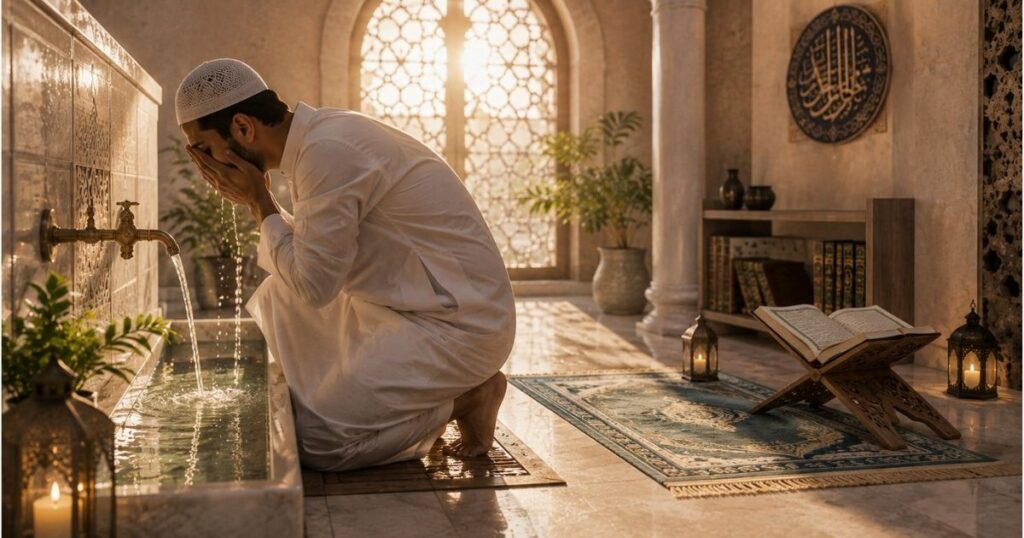
The Arabic word taharah (طهارة) literally means cleanliness and purity. But in Islamic teaching, it’s far more than washing your hands before eating. Purity represents a state of being physically clean, ritually prepared, and spiritually aligned with Allah.
From an Islamic perspective, purity has a general meaning: on one hand, physical cleanliness which is the purity of the body from perceptible filth or ritual purification; on the other hand, it may mean spiritual purity which is the purity of the self from vices, sins and abandoning disobedience, and getting used to good deeds and words.
Think of it like this: you wouldn’t invite an honored guest into a dirty home, nor would you greet them with an angry or dishonest heart. Purity is how Muslims prepare themselves to stand before Allah, the Most Pure and Most Honored.
The Three Dimensions of Purity
Purity operates on three levels that work together:
1. Physical Purity (Cleanliness)
Washing away dirt, filth, and physical impurities from your body. This is the most concrete form the one you can see and feel. Physical cleanliness and spiritual purity are not separate endeavours, but rather physical cleanliness is the first step to being spiritually pure.
2. Ritual Purity (Taharah)
Removing ritual impurity through specific Islamic practices. Ritual impurity is achieved by first removing physical impurities (for example, urine) from the body, and then removing ritual impurity through wudu (usually) or ghusl. This is where acts like wudu and ghusl come inthey’re not just practical hygiene; they’re prescribed religious practices.
3. Spiritual Purity (Intangible)
Purifying your heart and soul from spiritual filth: sin, hypocrisy, arrogance, envy, disbelief. Intangible purity is the purity of the believer, who is free of Shirk and disbelief. Intangible impurity is the impurity of disbelief, evildoing and sin.
Quranic Evidence for Purity
The Quran emphasizes purity repeatedly. The Quran says: “In it there are men who love to observe purity and Allah loves those who maintain purity” (Quran 9:108). This verse directly links your commitment to purity with Allah’s love for you.
Another powerful verse: The Qur’an 2:222 states unambiguously, ‘God loves those who turn to Him, and He loves those who keep themselves clean’. Here, cleanliness and spiritual turning toward Allah are mentioned together they reinforce each other.
The Hadith: “Cleanliness Is Half of Faith”
The Holy Prophet said that cleanliness is half of faith, meaning that physical purity is vital to maintain a good soul. (Sahih Muslim, Kitab al-Taharah, Hadith 223) This hadith is the backbone of Islamic purity teaching. It tells us that your outer cleanliness directly impacts your inner spiritual state. When you neglect physical purity, your faith weakens. When you prioritize it, your soul is strengthened.
Why did the Prophet emphasize this above all else? Because purity is visible, actionable, and daily. Every Muslim can practice it, regardless of wealth or status. It’s a daily reset button for your relationship with Allah.
Why Purity Matters in Islam: Theology & Importance
Purity isn’t optional in Islam. It’s a prerequisite for the most essential acts of worship.
Purity as the Gate to Prayer
The importance of wudu, having knowledge regarding it and performing it correctly, is proven by the fact that it is a precondition of salah (prayer), and without it our salah is invalid. You cannot pray the first pillar of Islam after belief without ritual purity. This teaches us that approaching Allah requires preparation, respect, and cleanliness. Our guide to the 5 Daily Prayers in Islam covers the timing and structure of the five prayers this purity requirement precedes.
The Prophet Muhammad emphasized this requirement, saying, “The key to Paradise is Salah, and the key to Salah is cleanliness.” Purity is literally the key to your spiritual journey.
The Connection Between Outer Cleanliness and Inner Faith
Islamic teaching doesn’t separate the body from the soul. The Promised Messiah explained regarding this matter, “Anyone who desires to develop an inner state of righteousness and purity must also be physically clean as well.”
When you wash your face in wudu, you’re also washing away arrogance. When you wash your hands, you’re letting go of greed. When you wash your feet, you’re stepping away from forbidden paths. The physical act becomes a spiritual meditation.
Purity in the Five Pillars
Purity interweaves through all Islamic practice, covered in full in our guide to the 5 Pillars of Islam. Performing Salat seeks to purify the soul, and it requires us to do ablution to clean ourselves physically. Ramadan helps us reflect and improve our spiritual purity, and Islamic teachings also tell us that we should especially refrain from impure deeds during fasting. The fourth pillar is Zakat, which literally means purity; giving out of our wealth helps us stay away from love of the world and avoid evil. Finally, Hajj, or pilgrimage, also seeks to purify pilgrims, who must stay in ablution and wear clean clothes.
Notice how purity isn’t one pillar it’s woven through all of them. Every pillar reinforces your commitment to cleanliness, both inside and out.
Types of Purity & Impurity in Islam
Islamic jurisprudence divides purity and impurity into two categories: tangible (physical, visible) and intangible (spiritual, internal).
Tangible (Ritual) Purity & Impurity
Tangible purity is the purity from ritual impurity and tangible impurity. Tangible impurity is things that the Lawgiver has deemed to be impure and filthy. This includes that of which the impurity is major, namely dogs, and that of which the impurity is minor, such as the urine of an infant boy. It also includes that of which the impurity is moderate, such as the impurity of urine, blood and dead animals.
In practical terms, tangible impurity refers to hadath (ritual impurity from bodily functions or states). There are two types:
Minor Impurity (Hadath Asghar): Caused by natural body functions. Minor Impurity (Hadath Asghar) includes situations such as passing gas, using the restroom, or deep sleep. Minor impurity requires wudu (partial ablution) to restore purity before prayer.
Major Impurity (Hadath Akbar): Caused by significant physical events. Major Impurity (Hadath Akbar) includes actions like marital relations, menstruation, and postpartum bleeding. Major impurity requires ghusl (full-body ablution).
Comparison Table: Major vs. Minor Impurity
| Aspect | Minor Impurity (Hadath Asghar) | Major Impurity (Hadath Akbar) |
| Causes | Urination, defecation, passing gas, sleep, bleeding gums | Sexual intercourse, ejaculation, menstruation, postpartum bleeding |
| Purification Method | Wudu (partial ablution) | Ghusl (full ablution) |
| What It Invalidates | Prayer (Salah) only | Prayer, Quran recitation, circumambulation of Kaaba |
| Recovery Time | Quick (5-10 minutes) | Takes longer, full-body wash |
Intangible (Spiritual) Purity & Impurity
Intangible purity is the purity of the believer, who is free of Shirk and disbelief. Intangible impurity is the impurity of disbelief, evildoing and sin.
Spiritual impurity is invisible but profound. It includes:
- Major Spiritual Impurity: Shirk (associating partners with Allah), disbelief (kufr)
- Minor Spiritual Impurity: Showing off (riya’), minor sins, hypocrisy, envy, malice
Within spiritual purification, there are two subcategories: major spiritual purification involves cleansing the heart from shirk (associating partners with Allah) and minor spiritual purification involves purifying the heart from moral vices such as malice, envy, hypocrisy, arrogance, and the love of worldly status and wealth.
The Prophet taught that ritual purity (wudu, ghusl) supports spiritual purity. When you wash before prayer, you’re literally preparing your heart to stand before Allah free from spiritual filth a theme explored further in our piece on the Beauty of Islam, where sincerity, not mechanical compliance, is what worship is really built on.
Purity Across Islamic Schools (Fiqh & Jurisprudence)
Islamic law, or fiqh, includes specific rulings on purity. Ayatollah Ali al-Sistani does not believe in the impurity of People of the Book (Jews, Christians, and Zoroastrians). This shows that even among Islamic scholars, there are nuanced differences in understanding ritual impurity.
The four major Sunni schools (Hanafi, Maliki, Shafi’i, Hanbali) have slightly different approaches to purity rulings. For instance, some schools have stricter rules about what invalidates wudu, while others are more lenient. All schools agree on the fundamentals but differ in secondary matters.
Sunni jurisprudence on personal grooming: Sunni Islam has its own hygienical jurisprudence. It is preferable for a Sunni Muslim to remove the hair directly below the navel and under the arms also as trimming the nails once a week. Leaving hair and nails is permissible after 15 days and disliked after 40 days. This shows how purity extends into personal grooming as part of the fitra (natural disposition in Islam).
Wudu (Minor Ablution): Steps & Spiritual Meaning
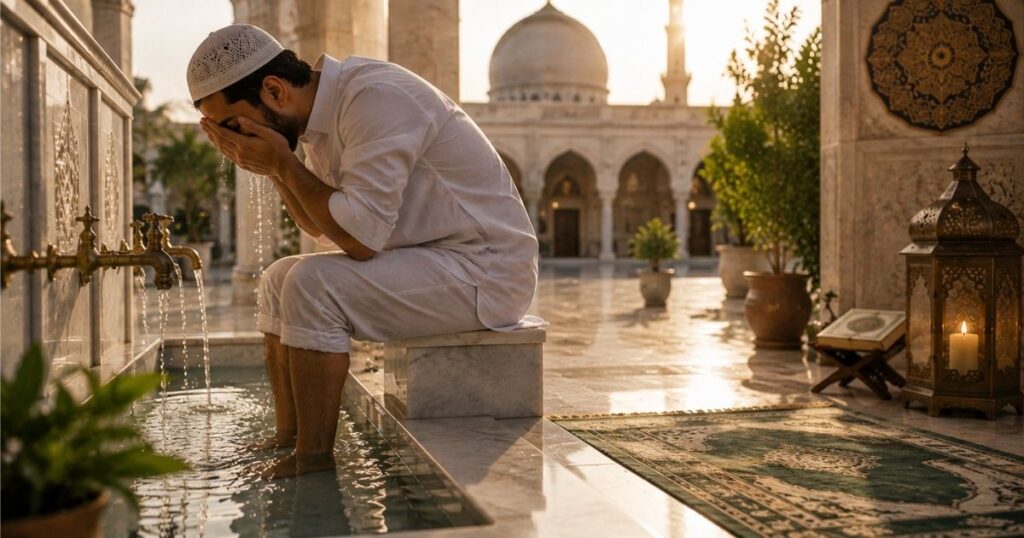
Wudu is the partial ablution you perform before prayer. It’s the most frequent act of purification in Muslim life performed at least five times daily for the five daily prayers.
What Is Wudu & When It’s Required
Wudu is a spiritual act of self-purification in Islam, cleansing both body and heart, renewing faith, and preparing the soul for sincere worship and closeness to Allah. Linguistically, wudhu means clean and beautiful, while in terms of terminology, wudhu is the act of purifying certain parts of the body with water in order to be clean from minor impurities.
You need wudu before:
- Praying (Salah)
- Touching the Quran
- Circumambulating the Kaaba during Hajj
- Some scholars add: making supplication (dua) with full intention
What Breaks Your Wudu?
You are in this state of ritual purity of wudu’ until you urinate or defecate, pass wind, sleep, or become unconscious. If you do any of these things before or during the Salah, you must repeat the wudu’.
Other acts that invalidate wudu include bleeding (from gums or wounds), vomiting, and loss of consciousness.
The Seven Steps of Wudu
Wudu has a specific procedure, rooted in Quranic guidance and Prophetic examples. Here’s the step-by-step guide:
Step 1: Intention (Niyyah)
Before touching water, make an intention in your heart (not aloud) that you’re performing wudu for the sake of Allah to become pure. When water touches the face for the first time, a Muslim makes an intention in their heart: “I intend to perform wudu to remove minor impurities for the sake of Allah Ta’ala.” Your intention transforms the physical act into an act of worship.
Step 2: Wash the Hands Three Times
Starting with the right hand, wash both hands up to the wrists three times. Wash the hands three times, starting with the right. This removes the filth of your daily work and prepares you to engage in pure worship.
Step 3: Rinse the Mouth Three Times
Swirl water in your mouth and spit it out three times. This purifies your speech, symbolizing that your words will be clean and truthful in prayer.
Step 4: Rinse the Nose Three Times
Rinsing the nose three times, blowing the water out and using the left hand to remove the water from your nose. Your sense of smell is cleansed; you prepare to focus only on the divine.
Step 5: Wash the Face Three Times
Wash the face three times, covering everything from the tip of the hairline to chin and from ear to ear. The beard is considered part of the face and should be washed as well. Your entire face where your identity shows is purified.
Step 6: Wash Both Arms to the Elbows Three Times
Wash both arms, starting with the right, from fingertips to just above the elbows. Starting with the right signifies beginning with good. Your arms which perform your deeds are cleaned.
Step 7: Wipe the Head and Wash the Feet
Wipe your head and ears once with fresh water, not the water left over from the previous step. The head is wiped by putting your hands at the front of the hairline and bringing them to the back of your head, then bringing them back to where you started. Then, wash both feet, starting with the right, three times, up to and including the ankles, making sure the water gets in between the toes and no part of the heel is left dry.
The Spiritual Meaning: Your entire body from intention (heart) to the ground you walk on (feet) is purified and aligned with Allah.
Wudu for Women
Women follow the same basic steps as men. However, a woman should wipe her hair, whether it is loose or tied up, by wiping from the front of the head to the back of the head. It is not necessary to wipe the entire length of her hair. This accommodates the diversity of women’s hair styles while maintaining the spirit of the ritual.
Ghusl (Major Ablution): Full Purification
Ghusl is a full-body ritual bath required after major ritual impurity. It’s more comprehensive than wudu and represents a complete spiritual reset.
When Ghusl Is Required
In Islamic laws, ghusl is considered an act of worship; it is an act of purifying oneself from the ritual impurity (najasat) caused by sexual intercourse, discharge of semen or blood, and by touching the dead body.
Specifically, ghusl is required after:
- Sexual intercourse (for both men and women)
- Ejaculation or female discharge (with desire or from intimate contact)
- Women also have to perform ghusl after their menstrual periods and postpartum bleeding.
- Touching a deceased person (Janazah)
How to Perform Ghusl
A Muslim performing complete ablution then washes every part of his or her body. The basic procedure:
- Intention: Make niyyah (intention) to purify yourself
- Wash the Private Area: Cleanse yourself with water
- Full Wudu: Perform wudu as normal
- Pour Water Over the Head: Three times, ensuring water reaches the roots of hair
- Wash the Entire Body: Right side first, then left side, making sure water touches every part
The key difference from wudu: every part of your body must be washed, and no part not even a hair’s width can remain dry.
Women, Menstruation & Purity: A Respectful Perspective
In Islamic teaching, menstruation is not shameful; it’s a natural biological state that requires specific ritual rulings. During menstruation, a woman is in a state of major ritual impurity and:
- Cannot pray Salah
- Cannot fast during Ramadan
- Cannot touch or recite the Quran (though some scholars allow recitation with a barrier)
- Cannot be in the mosque (though she can be nearby)
This is not punishment. The goal of purification, both for the wudu’ and the ghusl, is to remove all impurity (both physical and spiritual), so that the heart can absorb belief. During menstruation, Islamic law gives women a spiritual pause a time to rest and reflect rather than actively worship.
After menstruation ends, a woman performs ghusl and returns to full worship. Performing wudu’ in mindful devotion will expiate sin done between prayers (Sahih Muslim 2:437, 438, 444). Similarly, ghusl after menstruation is an act of spiritual renewal.
Postpartum bleeding (Nifas): After childbirth, a woman experiences postpartum bleeding for up to 40 days. The same purity rules apply during this time. Once bleeding stops, she performs ghusl and resumes prayer and fasting.
Intimate Relations (Marital Purity): After sexual intercourse, both spouses require ghusl before prayer, fasting, or Quran recitation. This ritual sanctifies the marital relationship and resets both partners spiritually.
Tayammum: Ablution Without Water
Not every situation allows for water. Islamic law, reflecting divine mercy, provides tayammum a dry ablution using earth or sand.
What Is Tayammum?
There is a symbolic or dry ablution referred to as tayammum that is used when no water is available or a person cannot use water because of health reasons of health. Every ritual act including ablution requires intention in one’s heart to perform the ritual for the sake of Allah.
When to Perform Tayammum
You can perform tayammum when:
- No water is available (travel in desert, emergency situations)
- Water would harm you (severe cold, injury, skin condition)
- You don’t have access to water in time for prayer
- You’re sick or disabled
How to Perform Tayammum
- Make intention (niyyah)
- Strike your hands on clean earth, sand, or dust
- Wipe your face with both hands
- Wipe your arms (forearms and hands) up to the elbows
The Spiritual Message: Purity is always accessible. Even without water, you can approach Allah with a pure heart and clean intention. The fiqh (Islamic jurisprudence) is based on admonitions in the Quran for Muslims to be ritually clean whenever possible, as well as in hadith literature (words, actions, or habits of the Islamic prophet Muhammad). The emphasis is on accessibility Islam removes barriers to worship.
Purity Across Islamic Schools: Jurisprudential Differences
While all schools of Islamic jurisprudence agree on the fundamentals of purity, they differ on secondary matters.
Sunni Schools (Hanafi, Maliki, Shafi’i, Hanbali)
Each school has slightly different rulings:
- Hanafi School: Often more lenient on what invalidates wudu; accepts tayammum more readily in certain situations
- Maliki School: Emphasizes the importance of dry ablution in flexibility; has specific rulings on water sources
- Shafi’i School: Detailed jurisprudence on every act of wudu; stricter on invalidators
- Hanbali School: Follows the literal hadith closely; detailed rulings on permissible and impermissible water
All agree: intention, proper water (or earth), and correct procedure are essential.
Shia Jurisprudence
Shia fiqh has some differences, particularly on ghusl and the state of major impurity (Janabah). Some scholars such as Mohsen Fayz Kashani (d. 1680) and Sulayman ibn Abdullah Mahuzi (d. 1708) did not believe in the impurity of non-believers, and particularly non-People of the Book. Kashani believes that the impurity of kuffar is spiritual and internal, so there is no need to wash after touching them.
This shows intellectual diversity within Islamic jurisprudence. All schools deeply respect purity, but they interpret and apply its rules with nuance.
Purity & Daily Muslim Life: Beyond the Prayer Mat

Purity isn’t confined to ritual moments. It’s woven into every aspect of Muslim life.
Purity and Quranic Recitation
Cleanliness is an important part of Islam, including Quranic verses that teach how to achieve ritual cleanliness. Out of respect for the Quran Allah’s direct words you must be in a state of wudu (or ghusl if in major impurity) to touch or recite it. This teaches reverence.
Purity in the Mosque
The mosque is a sacred space. The common Muslims practice of taking off shoes when entering mosques and homes is also based on ritual cleanliness. You enter purified, barefoot, on clean ground. The mosque becomes a sanctuary of purity where your soul can connect directly with Allah.
Purity in Fasting (Ramadan)
During Ramadan, Islamic teachings also tell us that we should especially refrain from impure deeds during fasting. Fasting is not just abstaining from food and drink; it’s about purifying your speech, thoughts, and actions. You guard your eyes, ears, tongue, and heart. Since Ramadan’s dates shift each year based on the lunar calendar, our guide to the Islamic Calendar explains how those dates are determined.
Purity in Hajj
Hajj, or pilgrimage, also seeks to purify pilgrims, who must stay in ablution and wear clean clothes. During Hajj, pilgrims are in a heightened state of ritual purity called ihram. This reflects the ultimate goal: standing before Allah in absolute purity.
Purity in Dietary Laws (Halal)
Islamic dietary laws provide a set of rules as to what Muslims eat in their diet. These rules specify the food that is halāl, meaning lawful. Eating halal is part of maintaining spiritual purity consuming only what Allah has permitted, avoiding the forbidden (haram). Our full breakdown of What Is Halal and Haram in Islam? covers this dimension of purity in much more depth.
Purity in Personal Grooming
Personal grooming is also a matter of focus in Islam, and comprises all the ritual purity practices of prophets known as fitra. Allowing a beard to grow while trimming the moustache is emphasized with it being seen as mandatory by some respected Sunni scholars from the 4 major Sunni schools of jurisprudence.
Grooming trimming nails, removing excess hair, maintaining cleanliness is part of the Islamic way. It shows respect for your body as a trust from Allah.
Purity in Daily Choices
Every day, you face choices about purity:
- Speech: Will you speak truthfully or lie?
- Work: Will you earn halal or haram?
- Relationships: Will you maintain modest, respectful interactions?
- Consumption: Will you eat and drink what Allah permits?
Each choice either purifies or pollutes your soul. Physical cleanliness and spiritual purity are not separate endeavours, but rather physical cleanliness is the first step to being spiritually pure.
Conclusion
Purity in Islam is the foundation of your relationship with Allah. It’s not a burden or a punishment it’s a gift of clarity and grace. Every time you wash for prayer, you’re not just preparing your body; you’re aligning your entire self physically, ritual, and spiritual toward the Divine. For this reason, a central teaching of Islam is that ‘cleanliness is half of faith’. The other half? Your sincere heart. Together, they make you whole. If you’re just beginning to build these habits into your life, our Start Your Journey page is a good next step.
FAQs
Is my wudu valid if I have nail polish on?
A: Most scholars say no. Nail polish creates a barrier that prevents water from reaching the nail. Remove it before wudu. Some scholars allow translucent polish that water can penetrate, but to be safe, it’s best to keep nails bare during prayer times.
What if I forget to wash one part during wudu?
Your wudu is incomplete. You must repeat the entire wudu, ensuring every required body part is washed. Precision and mindfulness are part of spiritual practice.
Can I do wudu once and pray multiple prayers with it?
Yes, one wudu is valid for multiple prayers until something breaks your wudu (urination, defecation, passing gas, sleep, etc.). Many Muslims perform wudu before Fajr (dawn prayer) and maintain it through multiple prayers if nothing breaks it.
Does a regular shower count as ghusl?
Not necessarily. Ghusl requires specific intention (niyyah) and procedure. A regular shower might wash your body, but ghusl is a ritual with spiritual significance. You should perform ghusl with the conscious intention of purifying yourself from major impurity.
What if I can’t do wudu because of a skin condition or allergy?
Use tayammum (dry ablution) instead. Use of water should not be harmful to the person who wants to perform ghusl. Islamic law accommodates disabilities and health conditions; purity is never a burden on your wellbeing.
Can I do wudu with cold water in winter?
Yes. Water is cold or warm. However, if cold water would genuinely harm your health, consult an Islamic scholar about alternatives or tayammum. Islam is merciful; it doesn’t require you to endure hardship.
Is purity broken if I accidentally swallow my saliva while in wudu?
No. Normal saliva does not break wudu. Only significant discharge (like vomit or bleeding from gums) invalidates it.
What does purity mean for non-Muslims?
Some scholars such as Mohsen Fayz Kashani did not believe in the impurity of non-believers, and particularly non-People of the Book. The concept of ritual impurity in Islam is specific to Muslims’ preparation for worship. Non-Muslims aren’t bound by these rulings, though cleanliness is universally valued in Islam.