
Growing up brings big changes not just physically, but spiritually too. If you’re a parent, educator, or young Muslim yourself wondering about the age of puberty for girls, you’ve probably noticed that different sources give different ages. Shia tradition says nine years. Sunni scholars often say fifteen. And biologically, most girls start puberty somewhere between eight and thirteen. So what’s really going on?
The truth is, Islam recognizes puberty through a combination of physical signs and age milestones, and different schools of Islamic thought have interpreted the evidence differently for over a thousand years. This isn’t confusion, it’s jurisprudence in action. By the end of this guide, you’ll understand not just what the ages are, but why scholars disagree, how to support your daughter through this transition, and what religious duties actually begin when. If you’re new to Islamic terminology in general, our New Muslim Guide is a helpful companion for the basics referenced throughout this piece.
Understanding Balugh: Definition & Core Concepts
Bulugh is an Arabic term commonly translated as “puberty” or “maturity,” but it’s more specific than English gives us. In Islamic law, bulugh represents the moment when a Muslim enters a new phase of life the moment they become duty-bound to follow Sharia and are held accountable for their actions.
This is crucial: biology is not just about biology. It’s about legal and spiritual responsibility. Islamic scholars distinguish between two things that often happen around the same time but aren’t identical:
- Biological puberty: When your body shows signs of physical maturation (menstruation, breast development, pubic hair)
- Legal puberty (bulugh): When Islamic law considers you a mature, responsible person
Sometimes these overlap perfectly. Sometimes they don’t and Islamic law has rules for those moments too.
The concept of bulugh is rooted in the Qur’an, which mentions maturity in relation to orphans and guardianship: “And test the orphans until they reach marriageable age; then, if you find sound judgment in them, deliver to them their wealth.” (Qur’an 4:6). Islamic scholars interpreted this and related Hadith traditions to develop detailed rules about when someone becomes mature enough to take on religious duties, a concept called taklif (placing obligation).
The Age of Puberty by Islamic School: A Comparison Table
Here’s where things get interesting. The five major schools of Islamic jurisprudence (four Sunni schools + Shia Imami tradition) don’t all agree on a single age for girls’ puberty. This isn’t a flaw; it reflects how carefully scholars weighed different evidence.
| School of Islamic Law | Age for Girls (Legal Puberty) | Additional Criteria | Primary Source |
| Shia Imami | 9 lunar years | OR any sign of puberty (menstruation, breast development, pubic hair) | Shia Hadith traditions; Shaykh al-Tusi (10th century) |
| Hanafi | 15 lunar years (or menstruation) | Menstruation before 15 counts as puberty; if no menstruation by 15, girl is considered mature | Abu Hanifah’s later rulings |
| Maliki | 18 solar years | More conservative approach; emphasizes emotional/mental readiness alongside age | Malik ibn Anas traditions |
| Shafi’i | 15 lunar years (or signs) | OR if any sign of puberty appears (menstruation, pubic hair, discharge) | Ash-Shafi’i’s synthesis of Hadith |
| Hanbali | 15 lunar years (or signs) | OR if any sign of puberty appears | Ahmad ibn Hanbal traditions |
Key takeaway: The Shia tradition uniquely recognizes 9 lunar years as puberty, while the four major Sunni schools recognize 15 lunar years (or physical signs, whichever comes first). Several Sunni schools also note that if physical signs appear before age 15, those signs establish puberty regardless of age.
Note on lunar vs. solar years: One lunar year is roughly 354 days (about 11 days shorter than a solar year). So 9 lunar years is approximately 8.6 solar years. This small distinction mattered in historical jurisprudential discussions but is less emphasized in modern practice. Our guide to the Islamic Calendar explains how the lunar year works and why it consistently runs shorter than the solar year Western readers are used to.
The Signs of Puberty in Islam
All Islamic schools agree on this: if a girl shows any one of the recognized signs of puberty, she is considered mature, regardless of age. She doesn’t need all signs to appear, one is sufficient.
The Four Primary Signs
1. Menstruation (Hayḍ)
Menstruation is the most widely recognized sign across all schools. When a girl experiences her first period, she has reached puberty according to Islamic law, even if she hasn’t reached the “age” that her school of law normally uses.
2. Pubic Hair Growth
Coarse, dark hair growing around the private area is a recognized sign of puberty. This appears early in development and is considered valid evidence of maturity across all schools.
3. Breast Development
The development of breasts is recognized by most schools as a sign of physical maturity and, by extension, legal puberty.
4. Reaching the Designated Age
If none of the above signs appear, reaching the age designated by your school of law (9 for Shia, 15 for most Sunni schools) automatically establishes puberty.
Why this matters: A girl might reach the age of puberty according to her school but show no physical signs. Islamic law still counts her as mature. Conversely, a girl might menstruate at age seven or eight and be considered mature in Islamic law, even though biologically she’s still very young. Islamic jurisprudence addresses this through the concept of qai’dat la darar (the rule of no hardship) if a young girl can’t reasonably be expected to perform certain duties (like full fasts during Ramadan), jurists provide exemptions based on her actual capability.
Biological Puberty vs. Islamic Legal Age Why They Differ
Here’s where the integration of modern medical science with Islamic tradition becomes important.
What biology tells us: Medical research is clear. Most girls enter puberty between ages 8 and 13, with the average age for a first period (menarche) around 12–13 years in developed nations. Some girls menstruate as early as age 8–9; others not until 15 or 16. This variation is completely normal and influenced by genetics, nutrition, ethnicity, geography, and individual biology.
What Islamic law traditionally said: Early Islamic scholars, working from Hadith traditions and their own observations, settled on fixed ages as legal thresholds. The Shia scholars of Iraq and Iran, observing girls in their communities, concluded that nine years was a reasonable marker for when puberty typically began. Sunni scholars, particularly those in different regions, felt that 15 years was a safer age. Some medieval scholars disagreed entirely and based puberty solely on physical signs.
Why the difference matters: Islamic law needed certainty. Legal systems require clear rules. Waiting for physical signs to appear is biologically accurate but legally ambiguous. Who decides if a girl has truly menstruated? How much testimony is needed? Fixed ages provided clarity and consistency, especially in contexts where medical knowledge wasn’t standardized and privacy around menstruation was culturally restricted.
The modern reality: Today, we know that puberty is not a fixed-age event. Research has also shown that the average age of menarche has shifted over time and varies by region. Girls living at high altitudes, for example, tend to menstruate later than girls at sea level. Ethnic background, nutrition, and health also influence timing. Islamic law, in theory, can accommodate this variation. In practice, most Muslim communities follow one of the traditional age-based systems while also recognizing that girls showing earlier physical signs are considered mature.
The takeaway: Islamic law set fixed ages for legal certainty in different eras. Today, those ages still serve as legal markers in most Muslim communities, but they’re understood alongside modern medical knowledge that puberty is a spectrum, not a single moment.
Why Shia and Sunni Scholars Differ The Jurisprudential Reasoning
This is the question that many parents and educators ask: Why do Shia and Sunni Islam give different ages? The answer isn’t that one tradition is “right” and the other “wrong” , it’s that they weighed the same evidence differently. This same pattern of shared roots and differing emphasis shows up across many areas of Islamic practice, something our piece on What Makes Islam Different From Other Religions? touches on from a broader angle.
The Shia Position: Nine Lunar Years
Shia Imam jurisprudence, developed primarily in Iraq and Iran, relies heavily on specific Hadith traditions from the Shia infallible Imams. One foundational narration states: “A girl of nine is not reckoned as a child, and all of them have formed a consensus upon that a girl of nine would not be reckoned as a child, except if there happens to be a weakness in her intellect.”
Shia scholars interpreted this tradition as establishing nine years as the age of bulugh. However, even within Shia jurisprudence, there’s nuance:
- The classic view (held by most Shia jurists): Nine lunar years = blugh for all religious duties
- The contemporary view (held by some modern Shia scholars): Physical signs should accompany age, or age thirteen is more realistic
- The contextual view (held by scholars like Ayatollah Sadiqi Tehrani): Different ages apply to different religious duties prayer obligations might begin at nine, while fasting obligations might begin at thirteen
The reasoning: Shia scholars were working from Hadith traditions specific to Shia sources and felt these traditions reflected biological reality in their context. The nine-year marker, they argued, corresponded to when girls actually began showing signs of puberty in pre-modern communities.
The Sunni Position: Age 15 (or Signs)
The four Sunni schools, drawing from different collections of Hadith and different scholarly interpretations, generally settled on 15 lunar years as the age of puberty for both boys and girls or earlier if physical signs appear.
The reasoning behind this is multifaceted:
- Different Hadith interpretation: Sunni scholars had access to different Hadith collections and weighted them differently. Many pointed to traditions mentioning fifteen years as a threshold, such as the story of Abdullah ibn Umar, who was not called upon for military duty at fourteen but was included at fifteen.
- Emphasis on physical signs: Sunni jurisprudence emphasizes that actual physical signs (menstruation, seminal emission, pubic hair) are the most reliable indicators of maturity, regardless of age. If a girl menstruates at twelve, she’s mature at twelve. If she hasn’t menstruated by fifteen, she’s considered mature at fifteen anyway.
- Regional differences: Sunni schools developed across the wider Islamic world from North Africa to Central Asia and their jurisprudents may have observed that in some regions, girls didn’t typically menstruate until later in their teens.
Abu Hanifah’s original view was even more conservative: He set the age at 17 or 18 for girls, believing that mental and emotional maturity should accompany physical maturity. Later Hanafi scholars adjusted this to 15, aligning more with other schools.
Why the Disagreement Doesn’t Mean Discord
The key insight: Islamic scholars didn’t disagree on whether puberty is real or important. They disagreed on how to mark it legally.
All Islamic schools recognize that:
- Physical signs (especially menstruation) establish puberty immediately
- Age is a fallback when signs haven’t appeared
- Context and individual capability matter (hence the rule of no hardship)
The difference in ages reflects different jurisprudential weighting of evidence, regional observation, and how to balance legal certainty with individual variation. It’s not that one tradition got it “right” it’s that different traditions made different reasonable choices about where to draw the legal line.
For modern Muslim families: You follow the tradition your community or scholar adheres to. If you’re Shia, nine years is the recognized age (though signs matter too). If you’re Sunni, fifteen years is the recognized age (though signs matter too). If your daughter shows physical signs earlier, most scholars across traditions will recognize her as mature.
What Religious Duties Begin After Puberty?
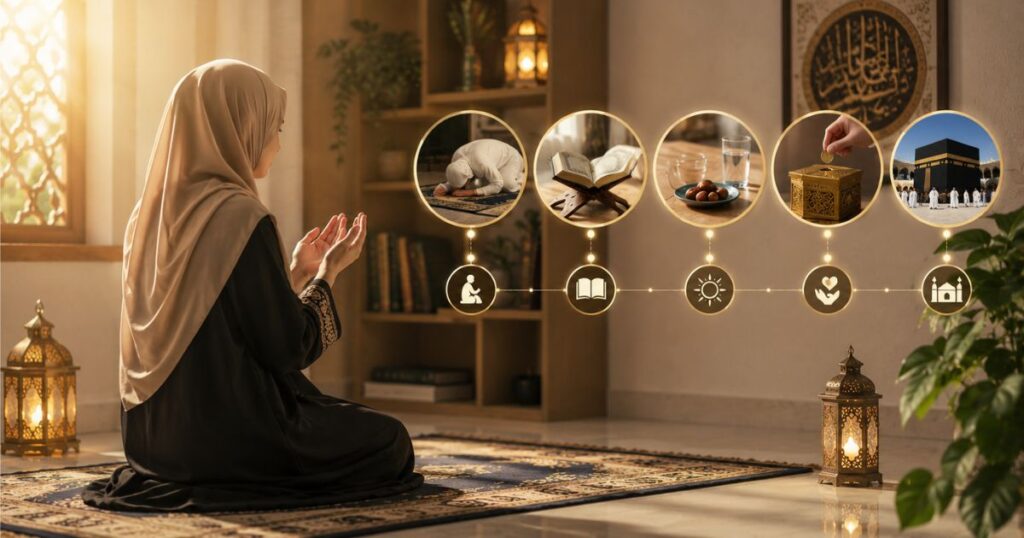
Reaching puberty isn’t just a biological milestone it’s a spiritual transition. Once a girl reaches bulugh, she enters a new phase of religious responsibility, formally taking on the Five Pillars of Islam as binding obligations rather than voluntary practice.
Prayer (Salat)
Prayer is the cornerstone of Islamic practice, and expectations shift after puberty.
Before puberty: A girl is encouraged to pray and develops the habit, but it’s not obligatory. Parents often teach children to pray by age seven as a foundational practice.
After puberty: Prayer becomes obligatory. She must perform all five daily prayers with proper ablution and attire. See our full breakdown of the 5 Daily Prayers in Islam for the timing and structure of each one.
What changes physically:
- She must cover her hair with a headscarf during prayer (the requirement to wear hijab specifically during prayer is emphasized in the Hadith about the Prophet’s instruction)
- Her ablution (wudu) must be complete and valid
- If she’s menstruating, she is exempt from prayer and doesn’t need to make up those prayers later (they’re waived as a mercy)
The broader principle: Islam recognizes that girls’ bodies undergo cyclical changes, and menstruation is a natural, normal part of that. During this time, she’s not considered “unclean” in a shaming sense; rather, Islamic law gives her a break from formal prayer obligations as a compassionate accommodation. She can still remember God, recite Qur’an, and engage spiritually without formal ritual prayer.
Fasting (Sawm) in Ramadan
Fasting is the second pillar directly affected by puberty.
Before puberty: A girl may practice fasting (many families have children fast partial days or certain fasts to build the habit), but it’s not required.
After puberty: Fasting during the entire month of Ramadan becomes obligatory (unless she’s menstruating or has another valid excuse). Since Ramadan’s dates move each year with the lunar calendar, our Islamic Calendar guide explains exactly how that timing is determined.
What changes:
- She must abstain from food, drink, and sexual relations from dawn to sunset
- If she menstruates during Ramadan, she breaks her fast and doesn’t need to fast that day
- Any fasts she misses due to menstruation, she makes up later in the year (called qada’)
- This is not a punishment or shameful thing it’s a mercy within Islamic law recognizing her body’s needs
Why menstruation affects fasting: Islamic jurisprudence is consistent on this point: menstruation is considered a state of natural bodily discharge that, in traditional Islamic understanding, temporarily exempts a woman from ritual worship. Rather than frame this as punishment, Islamic teaching emphasizes it as a mercy (rahma) God is making things easier during a time when a girl’s body is in flux. This spirit of mercy over rigid legalism is a theme we explore further in our piece on the Beauty of Islam.
Modesty & Hijab
One of the most visible changes after puberty is the expectation of modest dress.
Before puberty: Many Muslim families introduce modest clothing early, but formal hijab requirements don’t typically apply.
After puberty: She is expected to wear hijab the Islamic headscarf in public, especially around non-mahram men (men she could theoretically marry: strangers, male cousins on some sides, etc.). Modesty in Islam isn’t a women-only expectation, either our guide to the Islamic Dress Code for Men covers the parallel obligation that applies on the other side.
What this means:
- Head covering in public
- Loose, non-form-fitting clothing that covers arms, legs, chest
- The principle is modesty and setting a boundary between her private and public self
Important framing: Hijab is not about shame or hiding. In Islamic understanding, it’s about agency, respect, and defining how others perceive and interact with you. A girl who wears hijab is exercising control over her image and her space.
Other Religious Duties
After puberty, a girl is also responsible for:
- Hajj (pilgrimage): If she has the means and health, she should perform Hajj at least once in her lifetime
- Zakat (charity): If she owns wealth above a certain threshold, she must give a percentage to the poor
- Full accountability in Islamic law: She can be held responsible for her choices, both morally and (in some Islamic legal contexts) legally for example, her testimony may be relevant in certain court cases
The Parent’s Checklist: Supporting Your Daughter Through Puberty
Understanding the Islamic framework is one thing. Actually supporting your daughter through this transition is the real work. Here’s a practical approach:
1. Start the Conversation Early (Ages 8–9)
Don’t wait for puberty to knock on the door. By age eight or nine, begin introducing the concept gently.
- Use age-appropriate language: “Your body is going to start changing soon, and that’s normal.”
- Read children’s books about puberty together
- Answer questions casually and matter-of-factly this teaches your daughter that her body and its changes are not shameful topics
- Mention that her religion recognizes this transition too
Why it works: When puberty arrives, it won’t feel shocking if you’ve already laid the groundwork. It’ll feel like a continuation of an ongoing conversation.
2. Explain the “Why” Behind the Changes
Girls are more likely to embrace change when they understand its purpose.
- Explain hormones simply: “Your body is releasing special chemicals that tell it to grow up.”
- Connect to religion: “In Islam, when your body shows these signs, it means you’re becoming a woman and that brings new responsibilities, but also dignity and respect.”
- Frame it positively: “This isn’t something bad happening. It’s your body doing exactly what it’s supposed to do.”
3. Make the First Menstruation Less Scary
Menstruation is often what signals puberty has “officially” arrived.
- Before it happens, explain what to expect: “You might see blood anywhere from a little to quite a bit. It might be bright red or dark brown. This lasts for a few days, and then it stops. This happens about once a month.”
- Have supplies ready (pads, tampons, or other products she might want to try)
- Normalize it: “This is something most women and girls go through. It’s not an emergency. You’ll be fine.”
- When it happens, celebrate it quietly with her: “You’ve reached an important milestone. I’m here to support you.”
- Don’t make it a big public announcement if she doesn’t want that
4. Teach Practical Menstrual Care
Your daughter needs to know how to manage her period in daily life.
- Show her how to use different products (pads, tampons, cups, discs) and let her choose what’s comfortable
- Teach her about hygiene: changing products regularly, washing hands, managing odor
- Help her track her cycle using a calendar or app (knowing when to expect her period reduces anxiety)
- Normalize buying period products it’s not embarrassing, it’s practical
- Discuss eco-friendly and sustainable options that align with Islamic values of environmental stewardship
5. Address Hijab Gradually, Not Suddenly
One of the biggest shifts is the expectation of wearing hijab. Don’t spring this on her.
- Before puberty, introduce the concept: “When you become a young woman, you’ll wear a hijab like I do.”
- Let her see hijab as something adult women wear with pride, not as punishment
- When puberty comes, offer choices: “Which style would you like to try? What colors do you feel comfortable in?”
- Some girls embrace hijab immediately; others need time to adjust. Both are okay.
- Connect it to empowerment: “Hijab means you decide what you show the world. It’s your choice.”
6. Support Prayer & Fasting Without Pressure
Religious obligations shouldn’t feel like punishment.
- Make prayer attractive: pray together, create a beautiful prayer space, listen to Qur’an together
- When she starts fasting, begin with partial fasts (just the morning or afternoon) so it doesn’t feel impossible
- During menstruation, don’t make her feel excluded from religious community: she can still attend mosque (many mosques have spaces for menstruating women), listen to lectures, make dua, and recite Qur’an
- Emphasize that Islam is compassionate exemptions from fasting and prayer during menstruation are mercies, not punishments
7. Foster a Positive Relationship with Her Body
This is foundational to her well-being.
- Avoid negative language about periods, bodies, or development
- Teach her that her body is a trust from God (amanah)
- Encourage healthy habits: exercise, good nutrition, adequate sleep
- If she struggles with body image or anxiety, support her in finding a counselor or therapist (many Muslim communities now have culturally sensitive therapists)
8. Stay Connected & Available
Adolescence can feel isolating. Your presence matters.
- Check in regularly: “How are you feeling? Any questions?”
- Don’t assume she’ll come to you sometimes you need to create safe moments for conversation
- Listen without immediately trying to fix or minimize her concerns
- Share your own stories (age-appropriately): “When I was your age, I felt nervous about prayer too, and here’s what helped…”
Menstruation in Islamic Practice: Practical Guidance
Once your daughter begins menstruating, she’ll have questions about how her monthly cycle intersects with her religious duties. Here’s the Islamic framework and practical guidance:
Prayer & Fasting During Menstruation
The primary rulings are consistent across Islamic schools:
Prayer: A menstruating girl is exempt from obligatory prayer. She does not pray the five daily prayers, and she does not make up these prayers later (they’re waived entirely). However:
- She can recite Qur’an (though traditionally some schools discourage reciting directly from the Mushaf the physical Qur’an during menstruation; many modern Islamic scholars permit this)
- She can listen to Qur’an and Islamic lectures
- She can make dua (supplication) and remember God
- She can attend the mosque in most contemporary interpretations (though historically some spaces were restricted)
Fasting: A menstruating girl is exempt from fasting during those days and does not fast during her period. Later, she makes up the missed fasts typically within the same month or anytime before the next Ramadan. These “makeup fasts” are called qada’ and count fully toward her obligation.
The Islamic principle here is clear: menstruation is a mercy, not a punishment. God is acknowledging that your body is experiencing a natural discharge and giving you a break from fasting, which requires physical endurance and internal discipline.
Being Part of Religious Community During Menstruation
A girl should understand that menstruation doesn’t exclude her from Islam or Islamic community:
- She can attend mosque circles, classes, and lectures (her presence is not unwelcome)
- She can serve her community, help others, and contribute to Islamic work
- She can teach Islamic knowledge to others (menstruation doesn’t affect her knowledge or credibility)
- She remains fully Muslim and spiritually connected
The historical misconception that menstruation makes a woman “impure” in a spiritual sense is not Islamic teaching. Islamic jurisprudence treats menstrual blood as a natural bodily discharge that requires ritual purity (wudu) to be regained before prayer, but this is about ritual readiness, not spiritual worthiness.
Managing Menstrual Health Islamically
Your daughter should know that taking care of her menstrual health is an Islamic value.
Halal menstrual products: All standard products (pads, tampons, menstrual cups, discs) are halal as long as they’re used for hygiene. There’s no Islamic prohibition on any product type the same permissive, case-by-case framework covered in our guide to What Is Halal and Haram in Islam? applies here too. This means your daughter can choose whatever is comfortable for her.
Sustainable options: Islam teaches care for the earth (khalifah principle). If your daughter wants to use eco-friendly products (reusable pads, menstrual cups), this aligns beautifully with Islamic values of environmental stewardship.
Pain management: If she experiences menstrual pain or cramps, she can take over-the-counter pain relievers and use heat. There’s no Islamic restriction on managing period pain.
Hygiene: Changing products regularly, washing hands, and managing odor are all matters of good health and self-respect encouraged in Islam.
Addressing Menstrual Disorders
If a girl experiences unusually heavy bleeding, severe cramps, or irregular cycles, this should be discussed with a doctor. These can indicate:
- Hormonal imbalances
- Thyroid issues
- Polycystic ovary syndrome (PCOS)
- Other manageable conditions
Islam encourages seeking medical care (shifa’ the cure). There’s no shame in medical treatment, and a Muslim family should support a girl in getting proper healthcare.
FAQs
These questions come from real parents, educators, and young Muslims seeking guidance:
Can a girl reach puberty before age 9 in Islam?
Yes. If a girl shows physical signs (menstruation, pubic hair, or breast development) before age nine, she’s considered to have reached puberty across all Islamic schools even the Shia tradition, which sets nine as the baseline age. The physical signs override the age. However, very early puberty (before age eight) is medically rare and should be evaluated by a doctor.
What if my daughter hasn’t menstruated by age 15?
In Sunni jurisprudence, she’s considered mature at age 15 regardless. In Shia jurisprudence, she’s been considered mature since age nine. However, if menstruation hasn’t begun by age fifteen and there are no other signs of puberty, this should be evaluated medically. Absent periods can indicate hormonal imbalances or other health issues that a doctor should assess.
Is the age of puberty different for boys?
Yes. In Shia jurisprudence, boys reach puberty at 15 lunar years (or with physical signs like seminal emission). In Sunni schools, the age is also typically 15 lunar years or earlier with signs of seminal emission or pubic hair. So boys’ legal puberty comes later than girls’ in both traditions.
Do I have to follow Shia or Sunni rules? What if my family is mixed?
This is a real question many modern Muslim families face. The answer: Follow what you sincerely believe is correct, or follow the tradition of your local community/imam. If your family practices different schools of Islamic law, have an open conversation and decide together what your household will follow. Most scholars agree that acting upon any of the established schools of law with sincerity is valid.
Can a girl pray or fast before officially reaching puberty?
Yes and it’s encouraged. Many Muslim families have children pray and fast before puberty as training and habit-building. The difference is that before puberty, it’s voluntary (not obligatory), so if a child can’t complete a fast, there’s no “making up” required. After puberty, fasting becomes obligatory and makeup days are owed for missed fasts during Ramadan.
How do I know if my daughter is ready for the hijab?
A: Readiness is both legal and emotional. Legally, after puberty, hijab becomes obligatory in Islam. Emotionally, she may need time to adjust. The best approach: involve her in the decision. Show her different styles, let her pick colors and fabrics she likes, and frame it as empowerment, not obligation. Some girls embrace hijab immediately; others gradually increase their covering. Both processes are valid.
Is it normal for my daughter to feel anxious or embarrassed about puberty?
Absolutely. Puberty brings physical, emotional, and social changes all at once. Anxiety, embarrassment, and confusion are completely normal. What helps: open communication, reassurance that these feelings are shared by most girls, and normalizing her body and its changes. If anxiety is severe or persistent, talking to a school counselor or therapist can help.
My daughter got her period at school. How should I handle this?
First, reassure her that this is normal and she’s not alone (many girls menstruate unexpectedly at school). School nurses typically have pads available. At home, have a calm conversation: “This is a sign that your body is maturing. Here’s what to expect next time, and here’s how to manage it.” Some schools have better period education than others; if yours doesn’t, fill in the gaps at home. Make sure she knows she can always come to you with questions.
Can my daughter use tampons or menstrual cups as a Muslim?
Yes. There is no Islamic prohibition on any type of menstrual product. Some traditional scholars expressed caution about internal products out of concern for virginity, but modern Islamic scholars widely affirm that menstrual products don’t affect virginity. Your daughter should use whatever is comfortable and effective for her. For families thinking further ahead about how Islamic guidance shapes relationships and boundaries as daughters grow older, our guide to Islamic Relationship Rules is a useful next read. And if this is your family’s first time navigating any of these milestones as newer Muslims, our Start Your Journey page is there to help you build outward from here.