
Islam permits Muslim Hadith on Women & Perfume in Islam inside their homes and with their families freely. However, the Prophet Muhammad discouraged women from wearing noticeable fragrance in public or when leaving the house because it can attract unwanted attention and distract from spiritual purposes like prayer. The ruling emphasizes balance: cleanliness and self-care are encouraged; thoughtlessness about one’s impact on others is discouraged. If you’re new to how Islamic rulings like this one work, our New Muslim Guide is a good place to build the wider context.
The Core Hadiths on Women and Perfume
To understand the Islamic teaching, you need to know the actual hadith sources not summaries or interpretations, but the authenticated words themselves.
The Main Hadith: Men’s vs. Women’s Perfume
Abu Huraira (may Allah be pleased with him) reported that the Prophet said:
“The perfume of men is that which scent is apparent and color is hidden. The perfume of women is that which scent is hidden and color is apparent.”
Source: Sunan al-Tirmidhī (Hadith 2787)
Grade: Sahih (authentic) according to Al-Albani, and classified as authentic by Imam Tirmidhi himself
What this actually means: Men’s perfume should be visible in appearance but subtle in smell (the opposite of women’s). Women’s perfume should be invisible in color but noticeable only to those in close proximity, like family members. This distinction is part of a wider pattern in Islam where modesty applies to both genders, not just women. Our guide to the Islamic Dress Code for Men covers the parallel obligations placed on men.
This isn’t a blanket prohibition it’s a description of propriety based on context and who’s wearing it for whom.
Scholar Khalil Ahmad Saharanpuri, in his commentary Badhlul Majhud, explains: “Scent hidden means fragrance not deliberately worn to be perceived by strangers; scent apparent means for intimate family settings.”
The “Adulteress” Hadith: The Strongest Warning
Abu Musa Al-Ash’ari (may Allah be pleased with him) reported that the Prophet said:
“Any woman who applies perfume and passes by people so that they may smell her fragrance is like an adulteress.”
Sources (multiple authentic chains):
- Sunan Nasa’i (Al-Mujtaba), Hadith 5126
- Sunan Tirmidhi, Hadith 2786
- Sunan Abi Dawud, Hadith 4173
- Sahih Ibn Hibban, Hadith 4424
- Mustadrak Hakim, Vol. 2, p. 396
Grades: Classified as Sahih (authentic) by Imam Tirmidhi, Hakim, and Dhahabi
A crucial distinction: The Arabic word used is “زانية” (zaaniyah), which means adulteress—a woman who commits adultery not a prostitute. This word choice matters. Scholars explain the Prophet used it metaphorically to convey the seriousness of the action, not a literal equivalence.
The Mosque Hadith: Specific to Worship Spaces
Zaynab (the wife of Abdullah ibn Masood) reported that the Prophet said:
“If any of you (women) attend the mosque, do not wear perfume.”
Source: Sahih Muslim
The principle: This hadith is specifically about the mosque a sacred space for worship, one of the settings for the 5 Daily Prayers in Islam. The restriction here is about maintaining focus on prayer and not distracting others during a spiritual act. It’s not a general restriction on all public spaces; it’s contextual.
The “Three Things” Hadith: The Prophet’s Love of Perfume
The Prophet also said:
“Three things have been made dear to me in your world: women, perfume, and the delight of my eyes lies in prayer.”
Source: Sunan Nasa’i, reported in his Book of the Kind Treatment of Women
What this reveals: The Prophet loved perfume it was a personal practice and a Sunnah (his way). He encouraged cleanliness and fragrance as virtues, not vices. This hadith shows that perfume itself is honored in Islam; the restriction is about context and intention, not the substance itself.
Understanding the Wisdom: Why This Ruling?
The strength of the hadith language calling a woman who wears perfume in public an “adulteress” shocks many modern readers. The wisdom behind it, however, is profound.
The Concept of “Zina of the Eyes”
Islamic scholars explain that fragrance is a sensory trigger. When a woman deliberately wears noticeable perfume in public, she’s using a tool to draw attention to herself. This can:
- Encourage men to look at her Islamic teaching warns both men and women against “zina of the eyes” (adultery of the sight)
- Create unnecessary temptation by placing herself in a position where she’s causing others to struggle with their gaze
- Shift the focus from her dignity as a person to her physical appeal
Scholar commentary in Tuhfatul Ahwadhi explains: “She has incited the desires of men and caused them to cast gazes upon her, thus making her the cause of the adultery of the eyes. One who causes sin bears a portion of its weight.”
This is not about blaming women for men’s inability to lower their gaze. Rather, it’s about shared responsibility in a community. Both genders have a role: men must lower their gaze; women must not deliberately attract attention through perfume.
The Principle of Causation (Causality in Sin)
Islamic jurisprudence includes a principle: One who is the cause of sin also bears the brunt of that sin.
This doesn’t mean the one who actually commits the wrong is innocent he’s still sinful. But a person who creates unnecessary conditions for others to sin shares in the accountability.
When a woman wears strong perfume specifically to make people notice her fragrance, she’s creating a cause for others’ distraction. Hence the severe language in the hadith.
But here’s the key: The ruling applies to deliberate attraction, not accidental fragrance. There’s a difference between genuinely smelling nice and strategically using scent as a tool for attention.
Women’s Agency and the Real Teaching
A 2022 scholarly article from Al Hakam by Hazrat Mirza Bashiruddin Mahmud Ahmad clarified this profoundly:
“The Holy Prophet was proud that he liked three things and held them as dearest… He said he loved perfume, women, and prayer. If one reflects, the Holy Prophet possessed complete love for these three things and his love was so deep that no parallel can be found in any religion other than Islam.”
When the Prophet said he loved “women” (using the word nisa, not “wives”), he meant: “No other religion took care of the rights and spoke of the benefits of women in the way I did.”
The perfume teaching isn’t about restricting women’s freedom it’s about awareness and wisdom. Islamic law elevates women’s status while asking them to exercise discernment about how they present themselves.
When Women CAN Wear Perfume: Context Matters
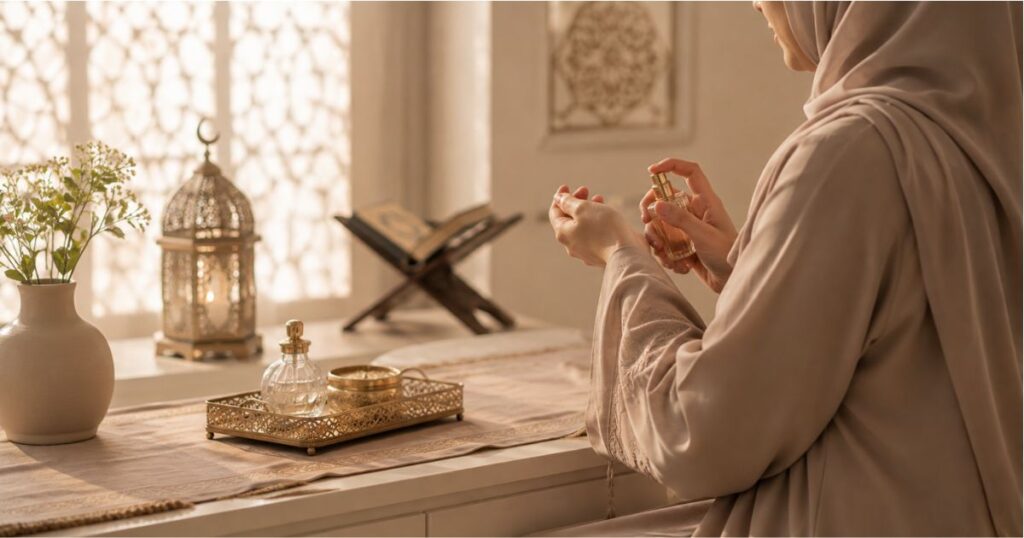
The hadiths are strict about public perfume. But inside the home? A completely different picture emerges.
Inside the Home: Always Permitted (Even Encouraged)
Scholar Sa’id, commenting on the hadith, clarified:
“The perfume of women (mentioned in the hadith) is when she intends to leave her house. If she is inside with her husband, then she may wear whatever fragrance she wishes.”
Source: Sharh al-Sunnah, Vol. 12, p. 81
This is explicit: At home, with family and especially for your husband, wear as much perfume as you like. There’s no restriction here. In fact, it’s encouraged as part of maintaining beauty and attraction within marriage a valued Islamic principle, and one of several practical themes covered in our guide to Islamic Relationship Rules.
Practical application: You can wear your strongest, most luxurious perfume at home. Perfume for your husband is Sunnah following the Prophet’s example of caring about appearance and cleanliness in intimate relationships.
Leaving the House: Be Mindful of Your Intention
This is where most women today have real questions. The hadith says don’t wear perfume “so that people may smell it.” The operative phrase is “so that” intention and deliberateness matter.
Three scenarios:
- Deliberately wearing strong perfume to be noticed: This falls directly under the hadith’s restriction. Don’t do this.
- Wearing perfume for yourself (because you like how it smells) or subtle fragrance: This is a gray area scholars debate. If the perfume is subtle detectable only to those close to you many scholars permit it.
- Wearing unscented lotion or deodorant: No restriction. These aren’t “perfume” in the Islamic sense; they’re hygiene.
At the Mosque: Strongly Discouraged
The mosque is a sacred space dedicated to worship the setting for the 5 Pillars of Islam‘s prayer obligation. The Prophet specifically prohibited fragrance here because:
- It distracts worshippers (men and women)
- It’s unnecessary in a space meant for devotion
- It conflicts with the spiritual focus required for prayer
This is the clearest context where perfume is restricted, and Islamic consensus is strong here.
Special Occasions & Celebrations: Scholars Differ
What about weddings, celebrations, or family gatherings?
Different Islamic schools (madhabs) have slightly different views:
- The stricter view: Avoid perfume even at celebrations if it’s to attract attention
- The contextual view: At a women-only gathering or family celebration, it’s permissible because the restriction applies to mixed public spaces
- The modern view: Contemporary scholars recognize that social contexts have changed and distinguish between intentional seduction and simply being well-groomed
Most scholars today lean toward the contextual approach: Perfume at women-only gatherings or celebrations is acceptable; perfume at mixed, public events where you’re deliberately drawing attention is discouraged.
Scholarly Interpretations Across Islamic Schools
Islamic jurisprudence isn’t monolithic. While all scholars agree on the core principle modesty in public they differ on application, a pattern that shows up across many areas of Islamic law and is part of what our piece on What Makes Islam Different From Other Religions? touches on more broadly.
The Strict Interpretation
Who holds it: Some traditional scholars emphasize the literal wording of the hadith
Their position: Avoid all noticeable perfume in any public setting. The margin of safety is better than the risk of causing distraction.
Strength: Prioritizes the hadith’s explicit warning and errs on the side of caution
The Contextual Interpretation
Who holds it: Most classical and contemporary scholars
Their position: The hadith applies to deliberate, noticeable fragrance worn specifically to attract attention. Subtle perfume, worn for personal cleanliness, is permissible.
Basis: The principle of niyyah (intention). If you’re not wearing perfume to be noticed, the restriction doesn’t apply.
Strength: Balances the hadith with Islamic principles of balance, women’s agency, and practical wisdom
The Modern Application View
Who holds it: Contemporary scholars addressing 21st-century contexts
Their position: The restriction was about a woman being conspicuously noticeable for her fragrance in a society where women were relatively secluded. Today, women work, study, and move freely in public. The principle modesty and awareness applies, but the application may differ:
- Light perfume worn for personal comfort: Acceptable
- Strong perfume worn specifically to draw male attention: Not acceptable
- Perfume at work or professional settings: Generally acceptable if subtle
Basis: The principle of maqasid al-shariah (the purposes of Islamic law) the intent is modesty, not oppression
The Perfume Teaching in Broader Islamic Context
Islamic teaching on perfume reveals something beautiful about how Islam views women, cleanliness, and community.
Perfume in Islamic Tradition
The Prophet Muhammad didn’t just permit perfume he emphasized it as a personal practice:
- He wore perfume regularly
- He perfumed his beard
- He recommended it to companions
- He made it a marker of the Sunnah (prophetic way)
The Islamic principle: Cleanliness is half of faith (al-tahara nisf al-iman). Perfume is part of this it’s not vanity; it’s hygiene and self-respect, in the same spirit covered in our guide to What Is Halal and Haram in Islam?, where permissibility is judged by intention and context rather than blanket prohibition.
The restriction on women’s perfume isn’t about denying women this good. It’s about where and how they wear it public restraint paired with private freedom.
A Comparison: Men’s Perfume vs. Women’s Perfume
The hadith teaching distinguishes:
Men’s perfume (apparent in sight, hidden in scent): Visible fragrance that’s subtle. Men are encouraged to wear perfume that shows but the scent should be understated. This reflects men’s public role in Islamic society and the expectation that they’ll be seen, but not for their fragrance.
Women’s perfume (hidden in sight, apparent in scent): Not visually decorated, but the scent is strong. This reflects women’s traditional role in the home perfume for intimate circles (husband, family), not strangers.
In modern context: This distinction is less about rigid gender roles and more about spheres of interaction. The principle remains: Don’t use fragrance as a tool for public attention.
Practical FAQs for Muslim Women Today
These questions come up repeatedly and deserve clear answers.
“Is perfume haram (forbidden) for women?”
No. Perfume is not haram (forbidden) in Islam. It’s halal (permissible). What’s discouraged is wearing strong perfume in public specifically to attract attention. The substance itself is honored; the context matters.
“Can I wear perfume to work or school?”
Generally, yes if it’s subtle. Most Islamic scholars today permit light perfume in professional and educational settings because:
- The purpose isn’t to attract attention; it’s hygiene and professionalism
- The setting is mixed but not recreational it’s functional
- Your presence is accepted regardless of perfume
The boundary: Don’t wear strong perfume with the intent of being noticed. Light fragrance worn for yourself? Acceptable to most scholars.
“What if I wear just a little bit?”
Subtlety changes everything. If your perfume is noticeable only to people in close proximity (like someone sitting next to you), scholars generally permit it. The hadith warns against fragrance strong enough to draw attention as you pass people.
Simple test: If someone a few feet away can smell you, it’s too strong. If they can only smell you up close, it’s subtle enough.
“Does wearing a hijab change the ruling?”
Hijab doesn’t eliminate the restriction, but it recontextualizes it. When you wear a full hijab, your physical appearance is already concealed. Some scholars argue this makes the perfume restriction less relevant because you’re already emphasizing modesty through clothing.
Majority view: Even with hijab, avoid strong fragrance in public spaces. The principle of not drawing attention through sensory appeal still applies.
“Is this rule the same for all Muslim women?”
Essentially yes, but scholars recognize different contexts and life circumstances. A working woman, a student, a mother, and a retiree might apply the ruling differently. The core principle modesty and awareness is universal; the application may vary.
Different Islamic schools: Hanafi, Maliki, Shafi’i, and Hanbali schools all agree on the core; they differ only on strictness of application in gray areas.
“What about deodorant or body spray?”
Deodorant: No restriction. It’s hygiene, not fragrance in the Islamic sense.
Body spray: Depends. Light body spray for personal freshness is generally acceptable. Heavy body spray with a strong scent is in the same category as perfume avoid in public.
“My perfume is invisible but shows up on my clothes is that okay?”
Yes. If the fragrance is incidental to your clothing and not deliberately applied to be noticed, it’s acceptable. The restriction targets intentional fragrance, not residue.
The Modern Question: How Does This Apply Today?
The Prophet lived 1,400 years ago. Society has changed. How should a Muslim woman apply this teaching in 2026?
The principle remains constant: Be aware of your impact, exercise modesty, and don’t deliberately use fragrance as a tool for attention.
The application differs:
- In the workplace: Light, professional fragrance is acceptable to most contemporary scholars because your role there isn’t about attraction; it’s professional presence.
- In educational settings: Similar to the workplace. Subtle fragrance is okay.
- At home: Wear whatever fragrance you love. No restriction.
- In social settings (mixed gatherings, parties): This is a gray area. If it’s a professional or family event, light fragrance is fine. If it’s explicitly social/recreational where attraction might be a factor, be more cautious.
- At the mosque: Avoid all fragrance. This is the only setting where Islamic consensus is strict.
The key shift in modern times: Women’s presence in public is now normal and necessary. Scholars have adapted the principle of modesty to fit current reality while keeping the core wisdom intact.
The Wisdom Beyond the Restriction
Here’s something many sources miss: The perfume restriction teaches women about their own power.
The hadith acknowledges that women have the ability to affect others through sensory appeal. Rather than denying this power, Islam asks women to exercise it wisely. This is different from other religious traditions that simply tell women to be invisible.
Islamic teaching says: You have power. Use it wisely. Exercise it at home with those who deserve it. Don’t waste it on strangers or mix it with your professional and public identity.
This is actually empowering when understood correctly it’s about agency and choice, not oppression. It’s the same underlying spirit of sincerity over rigid legalism that runs through our piece on the Beauty of Islam.
Conclusion
The Prophet Muhammad loved perfume and emphasized cleanliness as part of Islamic virtue. He also taught that women should be mindful about wearing strong fragrance in public not because perfume is forbidden, but because awareness of our impact on others is a sign of modesty and community consciousness. If you’re exploring how these everyday details fit into the bigger picture of Islamic practice, our Start Your Journey page is a good next stop.
FAQs
What is the main hadith about women and perfume?
The Prophet Muhammad said, “The perfume of men is that which scent is apparent and color is hidden. The perfume of women is that which scent is hidden and color is apparent.” This refers to the appropriateness of fragrance based on context men’s fragrance for public visibility, women’s fragrance for intimate settings. The hadith is graded as authentic (Sahih) by Islamic scholars.
Why does Islam restrict women from wearing perfume?
Islam doesn’t forbid perfume; it restricts noticeable fragrance in public. The reason is based on the principle of modesty and awareness. Strong fragrance in public can distract others and draw unwanted attention, potentially causing others to struggle with lowering their gaze. The restriction emphasizes responsibility and community awareness.
Can Muslim women wear perfume at home?
Yes, absolutely. Scholar commentary explicitly states that women may wear any fragrance they wish inside the home, especially for their husbands. Perfume at home is encouraged as part of self-care and marital beauty.
Is perfume forbidden in the mosque?
Yes, according to authentic hadith, women should not wear perfume when attending the mosque. This is specific to the mosque as a sacred space for worship. The restriction doesn’t apply to other public spaces in the same way.
What does “zaaniyah” in the perfume hadith mean?
Zaaniyah (زانية) means “adulteress”a woman who commits adultery. Scholars explain the Prophet used this term metaphorically to convey the seriousness of the action, not that the woman is literally committing adultery. The teaching is about her role in causing distraction and fitna (temptation) for others.
Do all Islamic schools agree on this ruling?
All major Islamic schools (Hanafi, Maliki, Shafi’i, Hanbali) agree on the core principle: women should avoid noticeable fragrance in public. They differ only on the strictness of application in gray areas, such as professional or educational settings.
Can Muslim women wear subtle perfume in public?
Most contemporary Islamic scholars permit subtle perfume in public light fragrance that’s noticeable only to those in close proximity. The restriction targets fragrance strong enough to draw attention as you pass people. Intention also matters: if you’re wearing perfume for yourself, not to attract others, it’s more acceptable.
How do Muslim women apply this teaching today?
Modern Islamic scholars recognize that women’s presence in public is now normal and necessary for work, education, and social life. They apply the core principle of modesty while allowing subtle fragrance in professional and educational settings. The strictest restriction remains for religious spaces (mosques) and recreational contexts where attraction might be a factor.