
How to Do Wudu (Ablution)? Wudu is the Islamic ritual of washing the hands, mouth, nose, face, arms, head, ears, and feet in a specific order before prayer. It involves 8 steps, most repeated three times, and must be done in sequence without long pauses. Wudu is required before every Salah unless your previous wudu is still intact.
What Is Wudu, and Why Does It Matter?
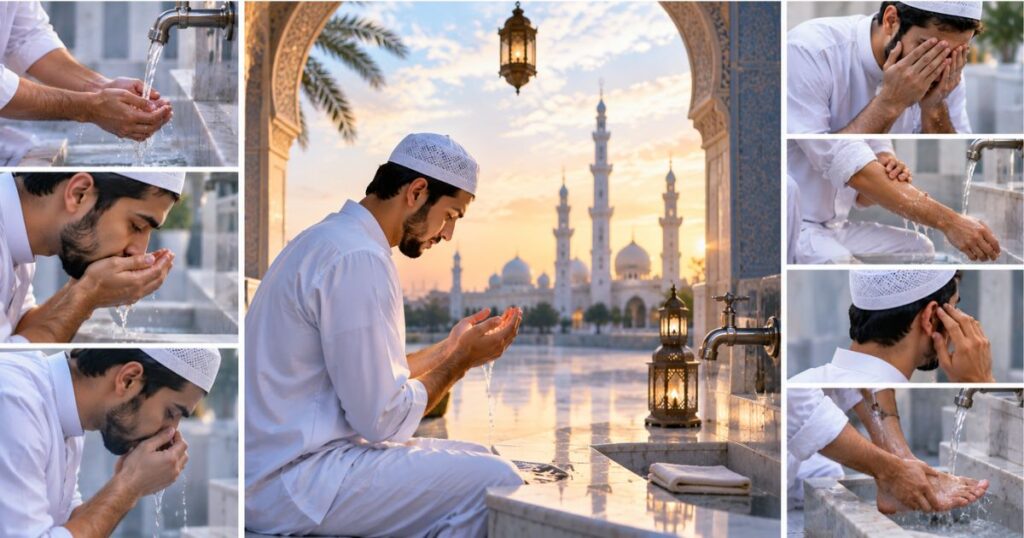
Wudu (also spelled wudhu or wuzu) is the ritual purification Muslims perform before prayer, using clean water to wash specific parts of the body in a fixed order.
It’s not just physical cleanliness. Wudu is described in Islamic teaching as a spiritual reset, a way of leaving behind the small sins of the hands, eyes, and feet before standing in prayer. It’s one part of the broader concept of Purity in Islam (Taharah). The Prophet Muhammad ﷺ is reported to have said that prayer without wudu is not accepted, which is why Muslims treat it as a non-negotiable first step, not an optional formality.
The steps come directly from the Quran: “O you who believe! When you intend to offer prayer, wash your faces and your hands up to the elbows, wipe your heads, and wash your feet up to the ankles” (Surah Al-Ma’idah 5:6). Everything else the three washes, the order, the dua comes from the Sunnah, the practice of the Prophet ﷺ.
Before You Begin: Niyyah and Bismillah
Two things happen before you touch water:
Niyyah (intention). You simply hold in your heart that you are doing wudu in order to pray. There’s no phrase to recite out loud. Intention is a matter of the heart and mind, not words.
Bismillah. Say “Bismillah” (“In the name of Allah”), either aloud or silently, right before you start washing. Most scholars consider this recommended (Sunnah); some hold it obligatory, so it’s best not to skip it.
How to Do Wudu, Step by Step
Do these in order, without long breaks between steps, and using clean water throughout.
Step 1: Wash Your Hands (3 times)
Wash both hands up to the wrist, starting with the right hand, three times each. Make sure water passes between every finger. This is the most commonly rushed step, so take a moment here.
Step 2: Rinse Your Mouth (3 times)
Cup water in your right hand, bring it to your mouth, and swirl it around thoroughly before spitting it out. Repeat three times. If you’re fasting, rinse gently rather than swishing vigorously.
Step 3: Rinse Your Nose (3 times)
Using your right hand, sniff a small amount of water into your nostrils, then use your left hand to blow it out. Repeat three times. Going gently inhaling too much water at once can be uncomfortable or even cause you to choke.
Step 4: Wash Your Face (3 times)
Wash your entire face from your natural hairline down to the bottom of your chin, and from ear to ear three times. If you have a beard, run your wet fingers through it; a thin beard should be washed through to the skin, while a thick beard just needs the surface and a finger-comb.
Step 5: Wash Your Arms (3 times)
Starting with the right arm, wash from your fingertips up to and including your elbow, three times. Then repeat with the left arm. Check that no dry patch is left, especially around the elbow and between fingers. Remove anything that could block water first with thick paint, dried dough, or wax, for example.
Step 6: Wipe Your Head and Ears (once)
This step is called masah. With wet hands, wipe from your forehead back to the nape of your neck, then bring your hands back to the forehead. Do this only once, not three times like the earlier steps. While your hands are still wet, use your index fingers to clean the inside grooves of your ears and your thumbs to wipe behind them.
Step 7: Wash Your Feet (3 times)
Wash your right foot from the toes up to and including the ankle, three times, making sure water reaches between each toe. Repeat with the left foot.
Step 8: Recite the Shahada
With your wudu complete, say: “Ashhadu an la ilaha illallah, wahdahu la sharika lah, wa ashhadu anna Muhammadan ‘abduhu wa rasuluh” “I bear witness that there is no god but Allah alone, with no partner, and that Muhammad is His servant and messenger.” For the full meaning behind this declaration, see What Is the Shahada in Islam?
Fard vs. Sunnah Parts of Wudu
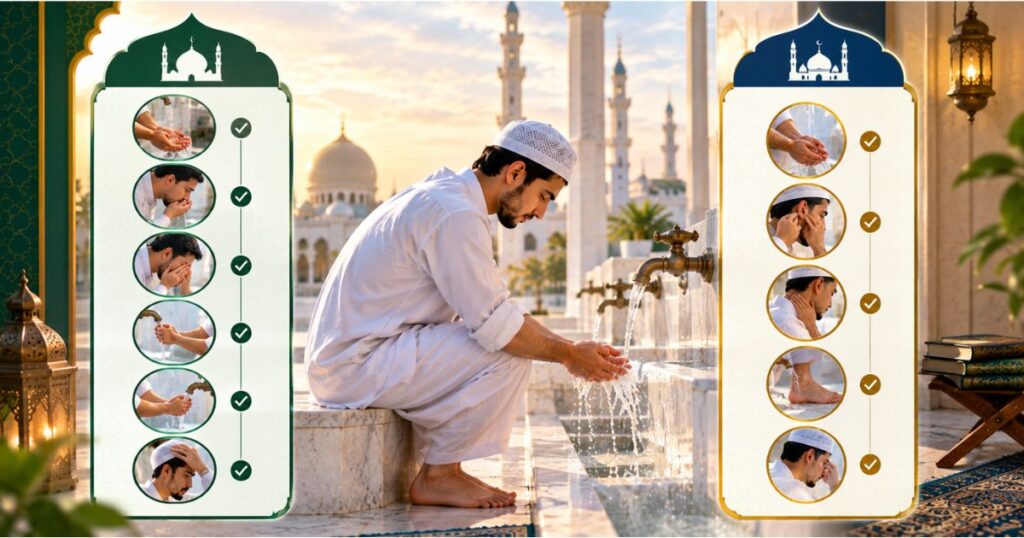
Not every part of wudu carries the same weight. The fard (obligatory) parts must be done for wudu to count at all; the Sunnah (recommended) parts were practiced by the Prophet ﷺ and add reward, but skipping one doesn’t invalidate your wudu.
| Action | Status | Repetitions |
| Washing the face (includes mouth & nose rinse) | Fard | Once (minimum) |
| Washing the arms to the elbows | Fard | Once (minimum) |
| Wiping the head | Fard | Once |
| Washing the feet to the ankles | Fard | Once (minimum) |
| Doing the above in order | Fard (most scholars) | — |
| Niyyah (intention) | Fard | — |
| Saying Bismillah | Sunnah (some hold obligatory) | — |
| Washing hands before starting | Sunnah | 3 times |
| Rinsing mouth and nose separately | Sunnah | 3 times |
| Repeating each wash three times | Sunnah | 3 times |
| Wiping the ears | Sunnah (some hold obligatory) | Once |
In short: you can perform a technically valid wudu washing each part just once but the three-times routine most guides teach is the fuller, Sunnah way, and it’s what’s recommended by default.
What to Say After Wudu
Once you finish, it’s recommended to say: “Ashhadu an la ilaha illallah, wahdahu la sharika lah, wa ashhadu anna Muhammadan ‘abduhu wa rasuluh. Allahumma-j’alni minat-tawwabina wa-j’alni minal-mutatahhirin” meaning, “I bear witness there is no god but Allah alone… O Allah, make me among those who repent and among those who purify themselves.” This dua is reported in hadith as opening extra reward for the person who recites it after a proper wudu.
What Breaks (Nullifies) Wudu?
Once you have wudu, it stays valid until one of the following happens:
- Using the toilet (urine, stool, or passing gas)
- Falling into a deep sleep (light dozing while seated is generally an exception)
- Losing consciousness
- Sexual discharge
If any of these occur, you’ll need to repeat your wudu before your next prayer.
Making Wudu With Socks, Shoes, or a Cast
If you already have wudu and then put on socks or shoes that cover the ankle, you don’t need to remove them the next time you need to renew your wudu. Instead of washing your feet again, simply wipe the top of each covered foot once with wet hands. This concession (called masah ‘ala al-khuffayn) typically lasts up to 24 hours for residents and 3 days for travelers, starting from the first time you wipe rather than when you put the socks on.
If you have a wound, cast, or bandage that can’t get wet, you’re not required to remove it or force water underneath. You can wipe over the covering instead of washing that body part — Islamic teaching consistently favors practicality over hardship in these situations.
Can You Do Wudu With Nail Polish or Makeup On?
This comes up constantly for modern, on-the-go Muslims and the underlying rule is simple: water has to physically reach the skin or nail.
Ordinary nail polish and most long-wear makeup form a sealed layer, which blocks water from reaching the nail or skin underneath meaning that part of your wudu isn’t complete. The same logic applies to thick, waterproof foundation, heavy lip products, or anything with a film-forming texture.
A tinted product with no separate layer, just color with no coating generally doesn’t block water and doesn’t need to be removed, since it doesn’t act as a physical barrier. Some “breathable” or water-permeable nail polishes marketed specifically for wudu claim to let water through, though scholars are divided on relying on manufacturer claims versus testing it yourself. If you’re unsure, removing polish or makeup before wudu is the safer route.
What Is Tayammum? Wudu Without Water
Tayammum is a dry substitute for wudu, used when water isn’t available, is harmful to use (due to illness or extreme cold, for example), or would take too long to reach in a way that risks missing prayer.
To perform tayammum: strike your palms on clean earth, sand, or a similar surface once, then wipe your face; strike again and wipe your hands (up to the wrist or elbow, depending on the school of thought you follow). It replaces the entire wudu, not just part of it, and the same things that break wudu also break tayammum plus tayammum is automatically cancelled once water becomes available again.
Wudu vs. Ghusl What’s the Difference?
| Wudu | Ghusl | |
| What it is | Partial washing of hands, mouth, nose, face, arms, head, ears, feet | Full-body wash, head to toe |
| When it’s needed | Before each prayer (unless still valid) | After major impurity e.g., sexual discharge, end of menstruation |
| Steps repeated? | Yes, most parts 3x | No fixed repetition — full coverage is what matters |
| Can tayammum replace it? | Yes, when water is unavailable/harmful | Yes, under the same conditions |
Both are forms of taharah (ritual purity), but ghusl is the “reset” for major impurity, while wudu is the routine, lighter purification before prayer. New Muslims often perform ghusl as a symbolic fresh start when they take the Shahada see What to Say to Convert to Islam: A Simple Guide for how that fits together.
Making Wudu in the USA Practical Tips for Work, School, and Gyms
Textbook wudu assumes you’re standing at a low tap with space to wash your feet comfortably which isn’t how most American offices, classrooms, or gyms are set up. A few practical adjustments that observant Muslims commonly rely on:
- Office and school bathrooms: Many sinks are too high to wash feet in comfortably. Wearing socks from a state of wudu at home (and wiping over them later, per the khuffs rule above) avoids the problem entirely on days you’re out all day.
- Gyms and public restrooms: A small squeeze bottle or portable wudu spray bottle carried in a bag makes rinsing hands, face, and feet over a sink far less messy than trying to use the sink basin directly.
- Shared or single-occupancy restrooms: If there’s no floor drain and you’re worried about water on the floor, doing your foot-wash last, over a small towel or bath mat you bring along, keeps things tidy for the next person.
- Time-pressed prayer breaks: Since wudu remains valid until it’s broken, many people renew wudu once earlier in the day (e.g., after using the restroom) and it can carry through multiple prayers without needing to repeat the whole process each time.
None of these are religious rulings they’re just common-sense workarounds people in the USA use to make a five-times-daily ritual fit into a modern workday.
Common Wudu Mistakes New Muslims Make
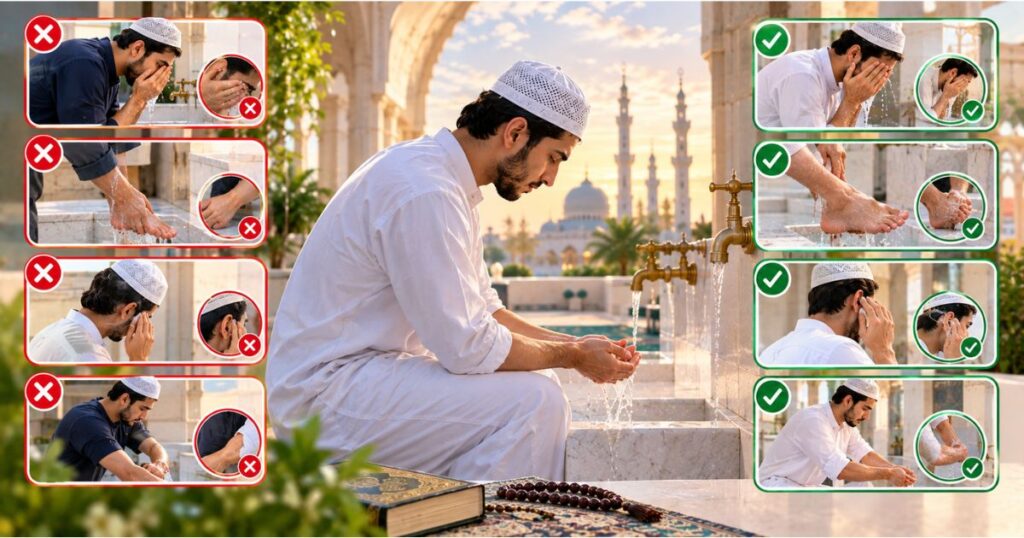
- Rushing the order washing feet before arms, for example, breaks the required sequence
- Missing between the toes and fingers water needs to reach every gap, not just the surface
- Confusing “wash” with “wipe” the head and ears are wiped once, not washed three times like the hands and face
- Forgetting the ankle bone the wash for feet and arms must include the ankle/elbow joint itself, not stop just before it
- Long pauses mid-window letting earlier-washed parts dry out before finishing can invalidate the sequence for some schools of thought
If wudu itself still feels unfamiliar, our full Learn How to Pray guide walks through wudu, standing position, and the full prayer sequence together, start to finish.
Conclusion
Wudu is 8 sequential steps: hands, mouth, nose, face, arms, head/ears, feet, then the shahada with most steps done three times. The core rule to remember: water must physically reach the skin, which is why things like nail polish, thick makeup, or wound coverings need special handling. When water isn’t available or would cause harm, tayammum steps in as a full substitute.Get the order and the “wash vs. wipe” distinction right, and the rest comes with practice. Once wudu feels natural, the next step is learning how to actually pray, step by step.
FAQs
Is wudu different for men and women?
No. The steps, order, and repetitions of wudu are the same for men and women. The only notable difference mentioned in Islamic teaching relates to how women with long or braided hair wipe their head during wudu; they don’t need to undo braids or wipe the full length of the hair.
How long does wudu last?
Wudu stays valid indefinitely until it’s broken by something like using the toilet, passing gas, deep sleep, or loss of consciousness; there’s no automatic time limit.
Can you make wudu with a cast or bandage on?
Yes. If water would harm the injury or can’t reach the skin, you wipe over the covering instead of washing that body part directly.
Do you need wudu to read the Quran?
Scholars differ: many hold that wudu is recommended (not obligatory) for reading Quran from memory or on a phone/app, but is required to touch a physical Arabic Mushaf according to the majority view.
What breaks wudu but not tayammum, or vice versa?
The same things break both, since tayammum is a substitute for wudu but tayammum has one extra condition: finding water afterward cancels it, even if nothing else has happened.
Can you make wudu sitting down?
Yes, wudu can be performed seated; there’s no requirement to stand, which is helpful for elderly worshippers or anyone with mobility limitations.
Is wudu required before every single prayer?
Only if your previous wudu has been broken. If it’s still intact from earlier, you can pray multiple prayers on the same wudu.