
Islamic prayer (salah) is performed five times daily facing the Kaaba in Mecca and involves standing, bowing, prostrating, and sitting while reciting Quranic verses. For anyone learning How to Pray as Muslim, the process begins with ritual ablution (wudhu), making your intention, and then following thirteen simple steps that take 5–15 minutes to complete. Most beginners learn the basics in their first session and refine their practice over weeks, and that’s perfectly normal.
Why Prayer Matters: More Than Just Ritual
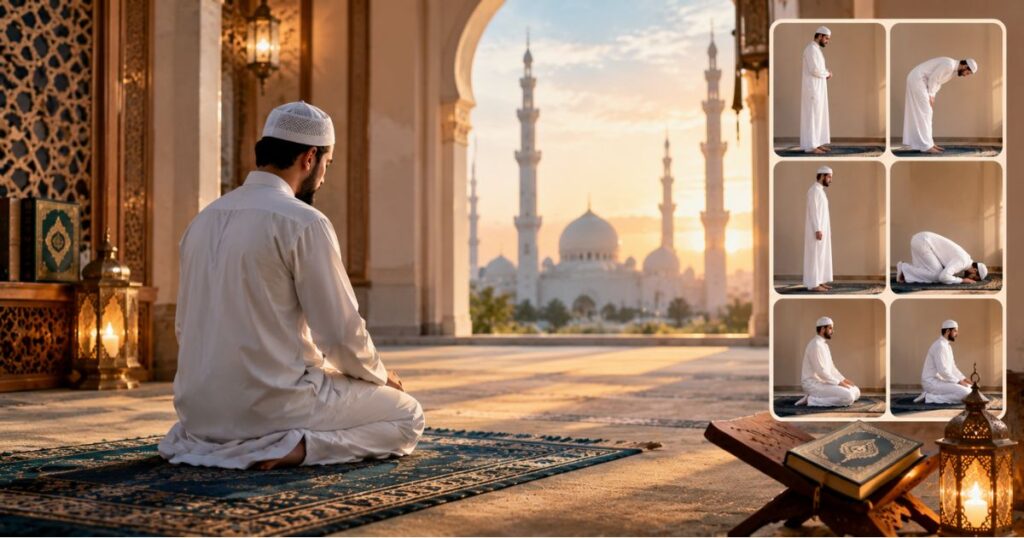
Prayer isn’t about checking a box. It’s the moment you step out of your day out of work stress, family drama, financial worry and stand before God with nothing between you except honesty.
The spiritual anchor. In Islam, prayer is one of the Five Pillars, the five core practices that hold the entire faith together. The Prophet Muhammad (peace be upon him) called prayer “the pillar of religion,” meaning everything else in Islam flows from this one practice. When you pray regularly, you’re not just performing movements; you’re building a relationship with God that sustains you through life’s hardest moments. For more on the deeper purpose behind these five daily check-ins, see Why Do We Pray in Islam? The Real Purpose of Salah Explained.
The practical gift. Prayer offers something modern life rarely gives: five guaranteed pauses to breathe, reset, and reconnect. Research shows that prayer and meditation reduce anxiety, lower stress hormones, and improve focus. When you prostrate your forehead touching the ground you’re in the neurological state closest to deep sleep and meditation combined. That’s why so many Muslims say prayer is their sanctuary.
A truth beginners need to know. If you’re nervous about praying for the first time, that’s normal and human. Every Muslim no matter how long they’ve been practicing felt uncertain at the beginning. You will forget steps. Your mind will wander. You might stumble over Arabic. None of that makes your prayer invalid or less worthy. What matters is that you’re showing up with sincere intention. If you’re brand new to Islam altogether, Can Anyone Be Muslim? Yes Here’s Your Complete Guide is a good place to start before diving into prayer specifically.
Before You Pray: Getting Ready (What You Actually Need)
Prayer isn’t complicated to prepare for. You don’t need special clothing or an expensive prayer mat (though many people use them). You need four things: cleanliness, a clean space, intention, and direction.
Ritual Ablution (Wudhu): The Cleansing Before Prayer
Wudhu means ritual purification. It’s not about being dirty in a literal sense; it’s about clearing away the dust of daily life and preparing your heart to stand before God one expression of the broader concept of Purity in Islam (Taharah).
Here’s the basic checklist:
- Wash your hands three times (up to the wrists)
- Rinse your mouth three times
- Rinse your nose three times (sniff water in gently)
- Wash your face three times (forehead to chin, ear to ear)
- Wash your arms three times (from wrist to elbow, right then left)
- Wipe the top of your head once (usually just a light touch)
- Wipe your ears once (inside and behind)
- Wash your feet three times (up to the ankle, right then left)
You need wudhu before every prayer. It becomes invalid if you use the bathroom, pass gas, sleep, eat, drink, bleed, or vomit. If you’re already in wudhu and it’s time for the next prayer, you can pray without repeating wudhu (unless one of the above happened).
Women’s note: During menstruation, you’re not required to pray or fast. This is Islamic compassion, not punishment your body is doing sacred work. After your period ends, perform a full bath (ghusl) and resume prayers.
What to Wear: Modesty, Not Complexity
For men: Cover from navel to knee. A t-shirt and pants work perfectly.
For women: Cover your entire body except face and hands. A long skirt or pants with a loose top is fine. A headscarf (hijab) is traditional but not mandatory for prayer what matters is covering your hair if you choose to.
Real talk: Prayer is between you and God. If you’re at home, in your regular clothes, that’s completely valid. You don’t need special “prayer clothes.”
Finding Your Space & the Qibla Direction
You can pray anywhere: your bedroom, office, park, car as long as it’s clean. No mosque required.
The qibla is the direction of the Kaaba (a cube-shaped building in Mecca, Saudi Arabia). All Muslims face this direction when praying as a symbol of unity worldwide.
How to find it: Use a compass app on your phone, or search “qibla direction [your city].” Most phones have a built-in compass. The direction changes slightly depending on where you live on Earth, that’s just geography.
Making Your Intention (Niyyah)
Your intention is the “why” behind your action. Before prayer, silently decide which prayer you’re about to perform (Fajr, Dhuhr, etc.) and that you’re doing it for God.
You don’t say this out loud. Just think about it: “I intend to pray the Fajr prayer for Allah’s sake.”
That’s it. Intention is the heart of any worship in Islam.
Prayer Readiness Checklist
| Step | What You Need | Status |
| Wudhu | Ritual ablution complete | ☐ |
| Clean clothes | Cover navel to knee (men); full body except face/hands (women) | ☐ |
| Clean space | Floor, carpet, or prayer mat (dust doesn’t matter) | ☐ |
| Qibla direction | Face toward Mecca (use phone compass) | ☐ |
| Intention | Silently decide which prayer you’re praying | ☐ |
| Time | Prayer time has entered (use a prayer app) | ☐ |
The Five Daily Prayers: When & How Many Cycles
Islamic prayer is structured around the sun’s position an ancient, poetic way to stay grounded in time and nature. For a deeper breakdown of exact timing windows, see The 5 Daily Prayers in Islam: Namaz Times & Importance.
| Prayer | Time of Day | Approx. Time | Cycles (Raka’at) | Length |
| Fajr (Dawn) | Before sunrise | 4–6 AM | 2 | 5–7 min |
| Dhuhr (Noon) | When sun passes peak | 12–1 PM | 4 | 10–12 min |
| Asr (Afternoon) | Mid-afternoon | 3–4 PM | 4 | 10–12 min |
| Maghrib (Sunset) | Just after sunset | 6–7 PM | 3 | 8–10 min |
| Isha (Night) | After dusk | 8–10 PM | 4 | 10–12 min |
Total daily time: 45–60 minutes spread across your entire day. If you want the full rakah-by-rakah breakdown including Sunnah and Witr, see How Many Rakahs Are in Each Prayer? Complete Chart, and for Fajr specifically, How Many Rakats Are in Fajr Prayer?
Prayer times change daily because the sun rises and sets at different times depending on the season and your location. Use a prayer times app (Muslim Pro, Athan, or your mosque’s website) to see exact times where you live.
You don’t have to memorize the times. Most Muslims check an app the night before or in the morning.
Step-by-Step: How to Pray (The Core 13 Steps)
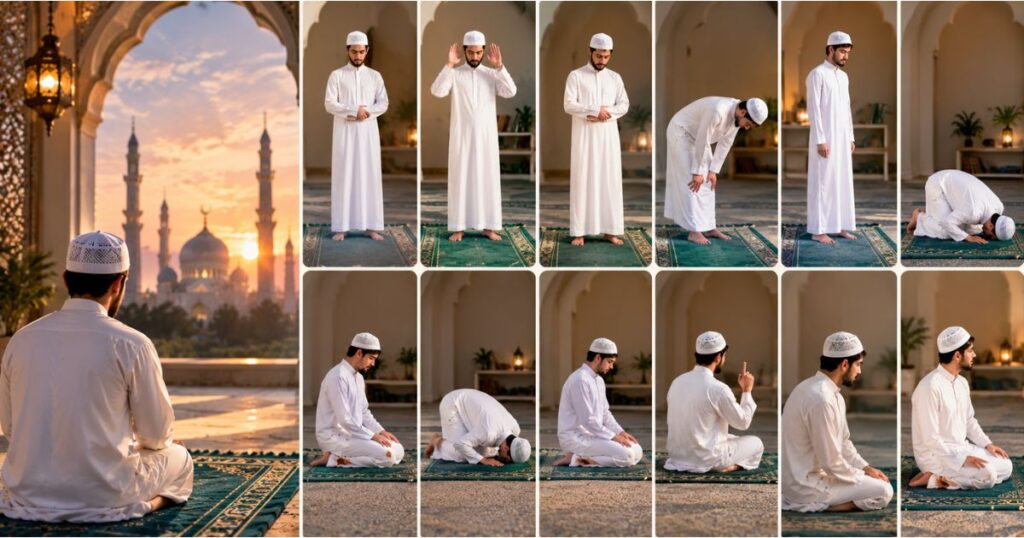
Each prayer follows the same pattern. Practice this one cycle (called a raka’ah), and you’ll understand the rhythm.
Step 1: Stand Facing the Qibla
Stand with your feet shoulder-width apart, facing Mecca. Your posture should feel natural and calm—not stiff, not slouchy.
What you’re doing: You’re positioning your body as a symbol of submission and presence.
Step 2: Make Your Intention
Silently think: “I intend to pray [name of prayer] for Allah’s sake.”
What you’re doing: You’re clarifying in your heart why you’re here not for show, but for connection with God.
Step 3: Raise Your Hands & Say the Opening
Raise both hands to ear level with palms facing forward. Then say clearly (even if just a whisper):
“Allahu Akbar” (Allah is Greatest)
This phrase marks the moment you leave the outside world behind and enter prayer.
Step 4: Place Your Hands on Your Chest
Lower your hands and cross them gently over your chest right hand over left. Rest them just below your collarbone or on your upper chest.
What you’re doing: You’re centering yourself, bringing all your attention inward.
Step 5: Recite Surah Al-Fatihah (The Opening Chapter of the Quran)
This is the one verse you absolutely must memorize. It’s recited in every single prayer, and it takes less than a minute to learn.
In Arabic:
Bismillaahir ar-Rahmani ar-Raheem
Al hamdu lillaahi rabbil ‘alameen
Ar-Rahmani ar-Raheem
Maaliki yawmid deen
Iyyaaka na’aboodu wa iyyaaka nasta’een
Ihdeenas siraatal mustaqeem
Siraatal ladheena an ‘amta ‘alayhim
Ghayril maghduubi ‘alayhim waladawleen
In English:
In the name of God, the Most Compassionate, the Most Merciful.
Praise be to God, Lord of all the worlds.
The Most Compassionate, the Most Merciful.
Master of the Day of Judgment.
You alone do we worship, and You alone do we ask for help.
Guide us along the straight path,
the path of those who have earned Your grace,
not those who have earned Your anger, nor those who are astray.
Say “Ameen” (Amen) after.
Tip for beginners: Use a prayer app with audio to hear the correct pronunciation while you learn. It takes 1–2 weeks to memorize if you practice daily.
Step 6: Bow (Ruku’)
Bend forward at the waist so your back is parallel to the ground. Place your hands on your knees, palms open. Your head should be level with your back—not looking down at the floor.
Say three times:
“Subhana Rabbee-al-Adheem”
(Glory be to my Lord, the Magnificent)
What you’re doing: Bowing is a gesture of humility, acknowledging that God is greater than any of life’s worries.
Step 7: Return to Standing
Slowly straighten up, bringing your hands back to your sides. As you rise, say:
“Samee Allahu liman hamidah”
(Allah hears those who praise Him)
Then, standing upright, say:
“Rabbana wa lakal hamd”
(Our Lord, to You is all praise)
What you’re doing: You’re acknowledging that God hears your sincere efforts and accepts your worship.
Step 8: Prostrate (Sujud)
This is the most powerful moment in prayer. Kneel down gently, then place your hands flat on the ground in front of you, then lower your forehead to touch the floor between your hands.
In sujud, your position symbolizes total submission nothing between you and God except your sincerity.
Say three times:
“Subhana Rabbee-al-Aalaa”
(Glory be to my Lord, the Most High)
What you’re doing: Prostration is the closest you come to God in prayer. The Prophet Muhammad said, “A person is nearest to their Lord while in prostration.”
Step 9: Sit Briefly
Lift your head and torso, sitting back on your heels. Your hands rest on your thighs. Pause for a moment—just 2–3 seconds. This is called the “between-two-sujuds” position.
If you wish, you can quietly say:
“Rabbighfir lee”
(My Lord, forgive me)
Step 10: Prostrate Again (Second Sujud)
Repeat Step 8 lower your forehead to the ground and say:
“Subhana Rabbee-al-Aalaa” (three times)
Congratulations: You’ve now completed one full cycle (raka’ah). Each prayer requires 2–4 of these cycles.
Step 11: Stand for the Next Cycle (If Needed)
If your prayer requires more cycles (most do), say “Allahu Akbar” quietly and stand up. Repeat Steps 4–10.
In the final cycle (after your last prostration), instead of standing again, you’ll move to Step 12.
Step 12: Sit & Recite the Testimony (Tashahud)
Sit on your knees, legs folded beneath you, hands resting on your thighs. Recite:
Attahiyyatu lillaahi was-salawatu wat-tayyibatu
Assalamu alayka ayyuhan-nabiyyu wa rahmatullahi wa barakaatuh
Assalamu alaina wa ala ibadillahi as-saliheen
Ashadu an la ilaha illallah wa ashadu anna Muhammadan abduhu wa rasuluh
“closing with the same testimony of faith at the heart of the Shahada: “I testify that there is no god but God, and I testify that Muhammad is His servant and messenger.”
In English:
All greetings, prayers, and good deeds belong to God.
Peace and God’s mercy and blessings be upon you, O Prophet.
Peace be upon us and upon God’s righteous servants.
I testify that there is no god but God, and I testify that Muhammad is His servant and messenger.
This is the testimony of faith the core of Islamic belief.
Step 13: End with Salam (The Greeting)
Turn your head to the right and say:
“Assalamu alaykum wa rahmatullahi wa barakatuhu”
(Peace and God’s mercy and blessings be upon you)
Then turn your head to the left and repeat the same greeting.
You’ve finished your prayer.
Arabic? Don’t Panic What You Actually Need to Know
One of the biggest barriers for new Muslims is thinking they must be fluent in Arabic before they can pray. This isn’t true.
You need to know three things to pray:
- Allahu Akbar (Allah is Greatest) This is 2 words.
- Surah Al-Fatihah (The Opening) This is 7 verses. It takes 1–2 weeks to memorize if you practice 5 minutes daily.
- The basic du’as (supplications) About 4–5 short phrases. Total: 2 weeks to memorize.
That’s it. Everything else can be learned gradually over months.
The 3-Month Learning Path
Month 1: Get the Movements Right
- Focus entirely on the physical steps
- Say “Subhana Rabbee-al-Adheem” and “Subhana Rabbee-al-Aalaa” (you’ll hear these in videos)
- Don’t worry about other recitations yet
- Practice daily for 5–10 minutes
Month 2: Add Surah Al-Fatihah
- Learn the opening chapter using an app like Quran.com or Athan
- Listen to the audio 2–3 times daily
- Recite along (even if imperfectly)
- Your brain will absorb it naturally
Month 3: Refine Everything Else
- Add the Tashahud (testimony) using audio guides
- You’re now completing full prayers with most key recitations
- Continue refining pronunciation for the rest of the year
Resources:
- Quran.com Free, has audio for every verse
- Athan or Muslim Pro app Prayer times + recitation guides
- YouTube channels Search “[prayer name] step by step” or “Surah Al-Fatihah”
- Local mosque Ask the imam if they offer beginner classes (most do)
For a structured version of this same ramp-up, our 7-Day Learning Plan covers the first week in more detail.
Most important: It’s completely OK to pray in English while learning Arabic. God understands all languages. Your sincere effort to learn is what matters.
Building Your Prayer Habit
Knowing how to pray and actually praying consistently are two different things. Here’s how to build the habit that sticks.
Why habit matters more than knowledge: Consistency is what transforms prayer from a ritual into a lived spiritual practice. Your brain needs about 21–66 days to form a new habit, so don’t expect perfection immediately.
The 30-Day Prayer Building Plan
Days 1–7: One Prayer, One Week
- Pick ONE prayer (Fajr or Dhuhr work well for beginners)
- Pray it daily for a full week
- Use your phone to remind you of the time
- Don’t add other prayers yet
Days 8–14: Add a Second Prayer
- Keep doing your first prayer
- Add a second prayer (maybe Maghrib, since it’s shorter at 3 cycles)
- Don’t stress about perfection focus on showing up
Days 15–21: Three Prayers
- You’re building momentum now
- Add a third prayer (Asr or Isha)
- By now, your brain is internalizing the steps
Days 22–30: All Five Prayers (Or Stay at Three)
- If you’re ready, add the remaining two prayers
- If three feels like enough for now, that’s OK consistency matters more than speed
- Most importantly: you’ve proven to yourself that prayer is doable
How to Actually Follow Through
- Set phone reminders for prayer times
- Find a prayer buddy someone learning alongside you (even via text) keeps you accountable
- Pray in the same spot at home your brain associates places with actions
- Don’t wait to feel motivated motivation follows action, not the other way around
- Celebrate small wins you prayed even when tired? That’s a victory
Joining a Mosque Community
After a week or two of practicing at home, consider visiting a local mosque. Congregational prayer deepens your connection and introduces you to the community.
What to expect: Most mosques welcome beginners warmly. Someone will show you where to pray, explain any differences, and answer questions. You’re not expected to know anything just show up with sincere intention.
How to find one:
- Search “[your city] mosque” on Google Maps
- Ask Muslim friends or coworkers for recommendations
- Check IslamicDirectory.org or your local Islamic center website
- Visit on a Friday (Jumu’ah prayer) or a weekday evening for a smaller, more intimate experience
Conclusion
Learning how to pray as a Muslim may feel challenging at first, but Salah becomes easier and more meaningful with regular practice. Start by learning the basic steps, prayer times, required rakats, recitations, and movements, while focusing on sincerity and understanding. If you make mistakes while learning, keep practicing and seek guidance from a trusted scholar or knowledgeable Muslim. With consistency, Salah can become a peaceful and essential part of your daily connection with Allah. For your next steps, check out our full Prayer Guide.
FAQs
1. What is salah?
Salah is the Islamic ritual prayer performed five times daily facing Mecca. It consists of standing, bowing, and prostrating while reciting Quranic verses and is one of the Five Pillars of Islam.
2. How many times per day do Muslims pray?
Muslims pray five times daily: Fajr (dawn), Dhuhr (noon), Asr (afternoon), Maghrib (sunset), and Isha (night).
3. How long does each prayer take?
Each prayer takes 5–15 minutes, depending on the number of cycles (raka’at) and individual pace. Total daily prayer time is approximately 45–60 minutes.
4. Can I pray without knowing Arabic?
You should memorize certain Quranic verses and supplications in Arabic, but you can learn these gradually while beginning prayer. The main verse (Surah Al-Fatihah) takes 1–2 weeks to memorize.
5. What do I need before praying?
You need ritual ablution (wudhu), clean clothes covering the appropriate areas, a clean space, knowledge of the qibla direction, and a sincere intention.
6. Can I pray at home?
Yes. Prayer is valid anywhere that’s clean, whether at home, work, outdoors, or in a mosque. Congregational prayer in a mosque offers additional spiritual benefit.
7. What breaks my prayer?
Major distractions like talking, eating, drinking, or large movements will invalidate prayer. Minor fidgeting, sneezing, or yawning does not.
8. Do women have to pray differently than men?
The core steps are the same, but there are slight differences in hand placement and body positioning. Women also don’t pray during menstruation but resume after.
9. How do I learn if I’m doing prayer correctly?
Ask a local imam, watch video tutorials from reputable Islamic teachers, or join a beginner class at your mosque.
10. What if I miss a prayer?
You can make it up (called “qada”) at any time afterward. Islamic law allows this flexibility.